AI Policy Hackathon in Washington D.C.
Our Hackathon round-up showcases our global 'sprints' community.
 Connor Axiotes (opens in new tab)
Head of Communications
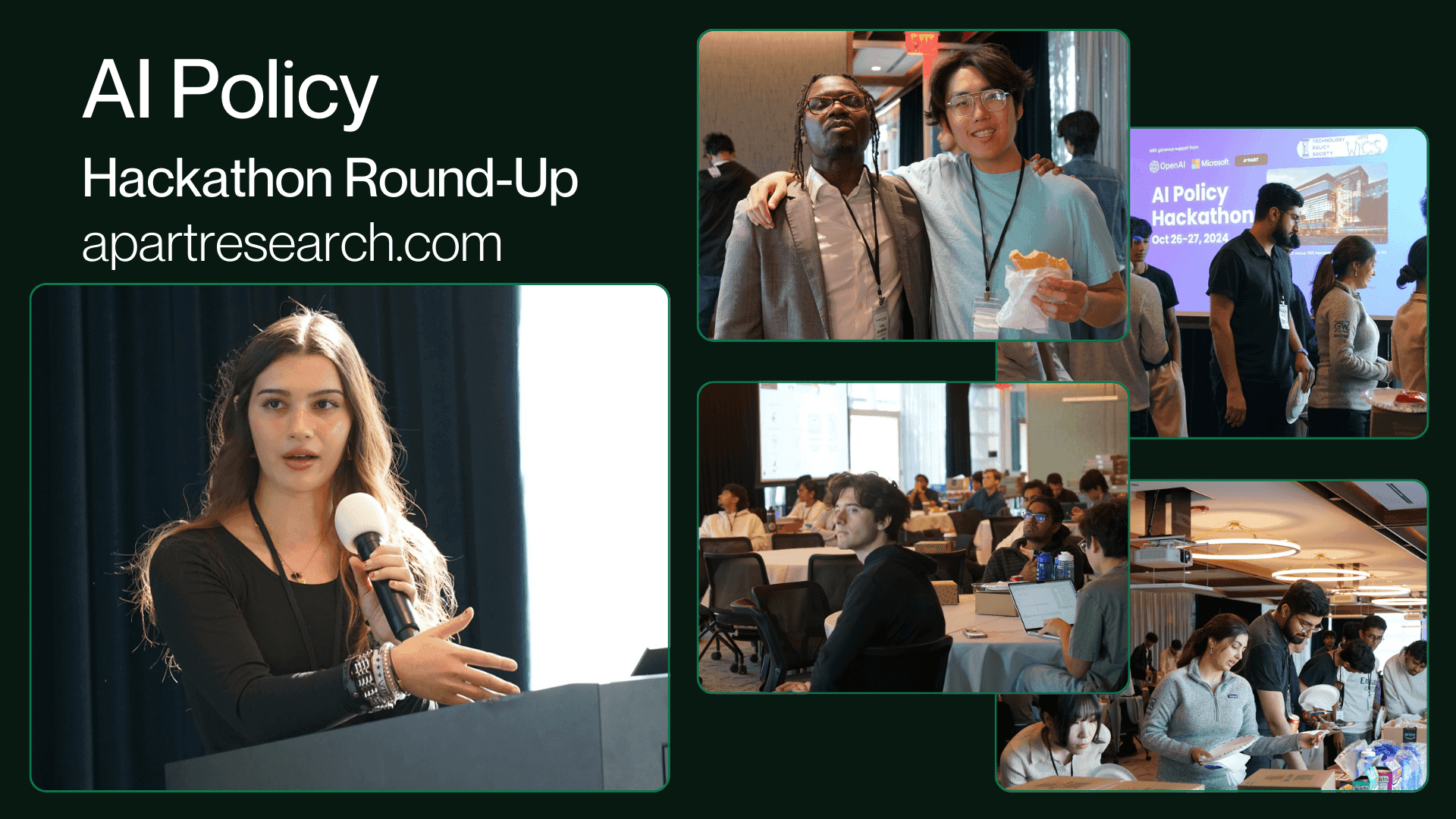
Our Washington D.C.-based AI Policy Hackathon, which concluded last weekend, had participants work on pilot ideas aimed at tackling real-world policy challenges related to AI.
This post has some really great pictures of the participants, speakers and judges at the event - and ends with some short summaries of the winning Hackathon submissions.

29 teams submitted and it was tough to pick winners - the quality was so high.
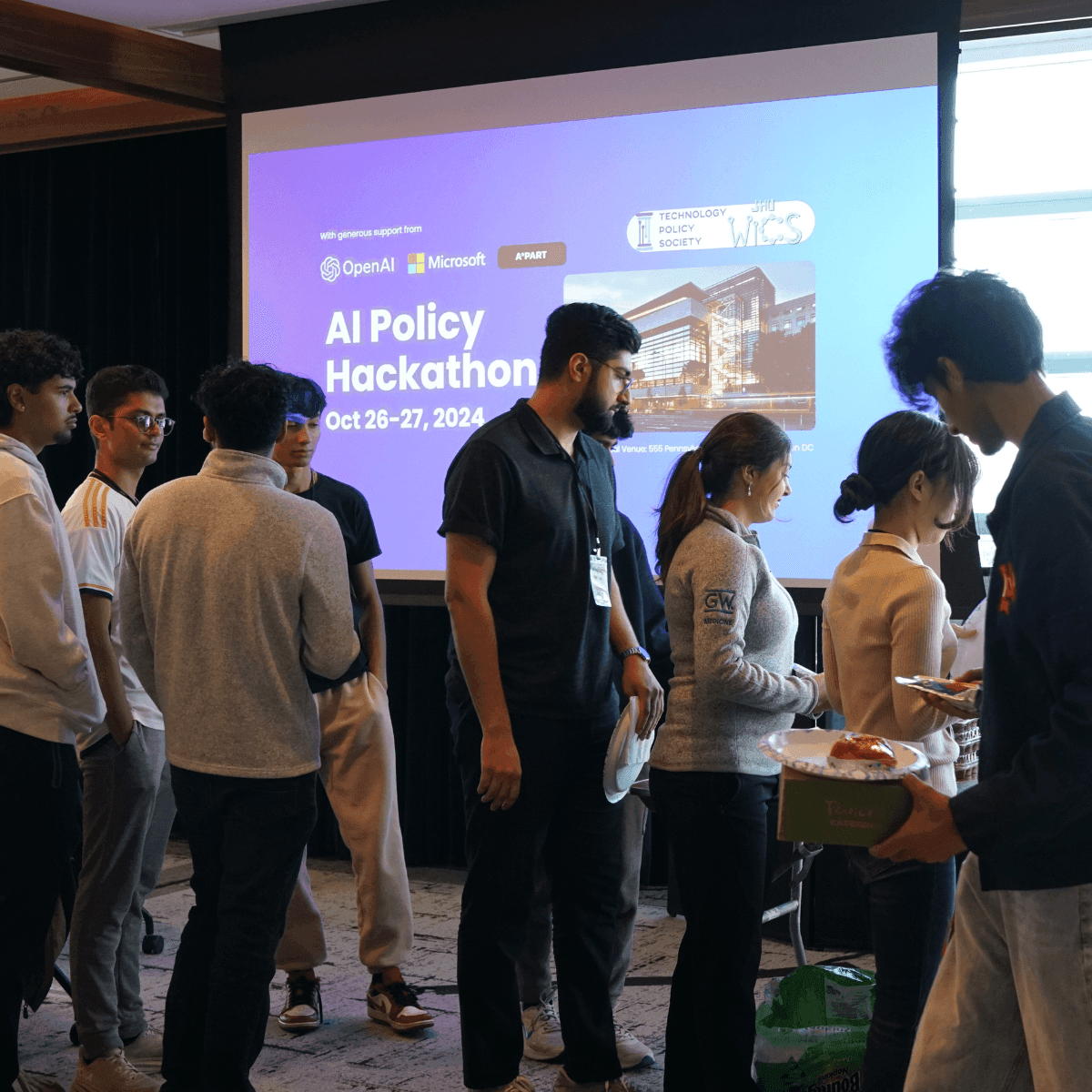
Thanks to The Johns Hopkins University and OpenAI and Microsoft for their support - and to all the brilliant judges and participants.

From AI-powered transport for D.C., governance for the Dominican Republic, and robustness in the face of bioweapons, the quality of submissions was excellent.

Our Co-Director, Jason Schreiber, had the following to say about the Hackathon submissions:
"We love to see our participants coming back and developing their ideas over several hackathons. We saw this after our Agent Security Hackathon a few weeks ago. It's great to see!"



The Winning Submissions
‘Robust ML for Dangerous Capabilities’ - This submission suggested tested different unlearning methods to make models more robust against exploitation by malicious actors for the creation of bioweapons.
'SafeBytes' - The project leverages AI and data to give insights about potential food-borne outbreaks.
‘Sue-per GPT’ - Tackling the intersection of AI and Law, they built a Retrieval-Augmented Generation (RAG) legal assistant aiming to help in legal research and case analysis.
‘Understanding Incentives to Build Uninterruptible Agentic AI Systems’ - This proposal addresses the development of agentic AI systems in the context of national security.
‘AI Advisory Council for Sustainable Economic Growth & Ethical Innovation in the Dominican Republic’ *Winner of Diversity & Inclusion Award* - They propose a National AI Advisory Council to drive AI development in the Dominican Republic.
'Modernizing DC’s Emergency Communications: AI-CAD Integration Framework' - D.C. should propose implementing an AI-enabled Computer-Aided Dispatch (CAD) system to address critical deficiencies in our current emergency alert infrastructure.
'Reprocessing Nuclear Waste From Small Modular Reactors' *Best Innovation Award* - Considering the emerging demand for nuclear power to support AI data centers, they propose mitigating waste buildup concerns via nuclear waste reprocessing initiatives.
'Mapping Intent: Documenting Policy Adherence with Ontology Extraction' *Outstanding Solutions Award Winner* - Addresses the policy challenge of governing agentic AI systems.
See the full list of pilot idea submissions here and never miss another sprint by keeping up-to-date here.
More from Apart
All updatesApart News: Finn, Cyber Offense & Johns Hopkins
This week's edition of Apart News introduces our new AI Safety Startup project which had its first roundtable with would-be founders, we share our work on cyber offense evaluations for superintelligent AI, and our AI Policy Hackathon is finally kicking off this weekend.
Read article: Apart News: Finn, Cyber Offense & Johns HopkinsApart News: Esben, Winning Sprints & ‘3cb’
This week's edition of Apart News has excerpts from Esben's blog, goes through our winning AI Policy sprints, takes a closer look at our new '3cb' benchmark, and more.
Read article: Apart News: Esben, Winning Sprints & ‘3cb’Apart News: Clement, Benchmarks & D.C.
This week's edition of Apart News introduces Clement Neo our Research Assistant who has his profile published in the newest edition of Researcher Spotlight, announces our new paper and accompanying blog on Benchmark Inflation, looks at the Minecraft-themed Agent Security Sprint winner, and gives more information about our new Hackathon in Washington D.C.
Read article: Apart News: Clement, Benchmarks & D.C.