
May 3 - 6, 2024Online and in person
AI and Democracy Hackathon: Demonstrating the Risks
Despite the many potential benefits of the technology (such as equalizing opportunity, creating wealth, and improving coordination), we are also facing significant risks from AI.
Entries
- View project: THE ROLE OF AI IN COMBATING POLITICAL DEEPFAKES IN AFRICAN DEMOCRACIES
THE ROLE OF AI IN COMBATING POLITICAL DEEPFAKES IN AFRICAN DEMOCRACIES
Team 1
The role of AI in combating political deepfakes in African democracies.
- View project: LEGISLaiTOR: A tool for jailbreaking the legislative process
LEGISLaiTOR: A tool for jailbreaking the legislative process
Team Managed Democracy
In this work, we consider the ramifications on generative artificial intelligence (AI) tools in the legislative process in democratic governments. While other research focuses on the micro-level details associated with specific models, this project takes a macro-level approach to understanding how AI can assist the …
- View project: Subtle and Simple Ways to Shift Political Bias in LLMs
Subtle and Simple Ways to Shift Political Bias in LLMs
Team Shifty
An informed user knows that an LLM sometimes has a political bias in their responses, but there’s an additional threat that this bias can drift over time, making it even harder to rely on LLMs for an objective perspective. Furthermore we speculate that a malicious actor can trigger this shift through various means …
- View project: Beyond Refusal: Scrubbing Hazards from Open-Source Models
Beyond Refusal: Scrubbing Hazards from Open-Source Models
Team Whitedoor Research PH
Models trained on the recently published Weapons of Mass Destruction Proxy (WMDP) benchmark show potential robustness in safety due to being trained to forget hazardous information while retaining essential facts instead of refusing to answer. We aim to red-team this approach by answering the following questions on …
- View project: Silent Curriculum
Silent Curriculum
Team Silent Curriculum
Our project, "The Silent Curriculum," reveals how LLMs (Large Language Models) may inadvertently shape education and perpetuate cultural biases. Using GPT-3.5 and LLaMA2-70B, we generated children's stories and analyzed ethnic-occupational associations [self-annotated ethnicity extraction]. Results show strong …
- View project: Building more democratic institutions with collaboratively constructed debate moderation tools
Building more democratic institutions with collaboratively constructed debate moderation tools
Team Max-a-million
Please see video. Really enjoyed working on this, happy to answer any questions!
- View project: AI Misinformation and Threats to Democratic Rights
AI Misinformation and Threats to Democratic Rights
Team AISIG
In this project, we exemplified how the use of Large Language Models can be used in Autocratic Regimes, such as Russia, to potentially spread misinformation regarding current events, in our case, the War on Ukraine. We approached this paper from a legislative perspective, using technical (but easily implementable) …
- View project: Artificial Advocates: Biasing Democratic Feedback using AI
Artificial Advocates: Biasing Democratic Feedback using AI
Team Artificial Advocates
The "Artificial Advocates" project by our team targeted the vulnerability of U.S. federal agencies' public comment systems to AI-driven manipulation, aiming to highlight how AI can be used to undermine democratic processes. We demonstrated two attack methods: one generating a high volume of realistic, …
- View project: Assessing Algorithmic Bias in Large Language Models' Predictions of Public Opinion Across Demographics
Assessing Algorithmic Bias in Large Language Models' Predictions of Public Opinion Across Demographics
Team Algorithm Avengers
The rise of large language models (LLMs) has opened up new possibilities for gauging public opinion on societal issues through survey simulations. However, the potential for algorithmic bias in these models raises concerns about their ability to accurately represent diverse viewpoints, especially those of minority and …
- View project: AI misinformation threatens the Wisdom of the crowd
AI misinformation threatens the Wisdom of the crowd
We investigate how AI generated misinformation can cause problems for democratic epistemics.
- View project: Trustworthy or knave? – scoring politicians with AI in real-time
Trustworthy or knave? – scoring politicians with AI in real-time
Team CIAMSE
One solution to mitigate current polarization and disinformation could be to give humans cognitive assistance using AI. With AI, all publicly available information on politicians can be fact-checked and examined live for consistency. Next, such checks can be attractively visualized by independently overlaying various …
- View project: Jekyll and HAIde: The Better an LLM is at Identifying Misinformation, the More Effective it is at Worsening It.
Jekyll and HAIde: The Better an LLM is at Identifying Misinformation, the More Effective it is at Worsening It.
Team Aditu AI
The unprecedented scale of disinformation campaigns possible today, poses serious risks to society and democracy. It turns out however, that equipping LLMs to precisely identify misinformation in digital content (presumably with the intention of countering it), provides them with an increased level of sophistication …
- View project: Unleashing Sleeper Agents
Unleashing Sleeper Agents
Team Waking Up The Sleeper Agents
This project explores how Sleeper Agents can pose a threat to democracy by waking up near elections and spreading misinformation, collaborating with each other in the wild during discussions and using information that the user has shared about themselves against them in order to scam them.
- View project: Multilingual Bias in Large Language Models: Assessing Political Skew Across Languages
Multilingual Bias in Large Language Models: Assessing Political Skew Across Languages
Team Evil_Propaganda
- View project: AI in the Newsroom: Analyzing the Increase in ChatGPT-Favored Words in News Articles
AI in the Newsroom: Analyzing the Increase in ChatGPT-Favored Words in News Articles
Team Aalto EA
Media plays a vital role in informing the public and upholding accountability in democracy. However, recent trends indicate declining trust in media, and there are increasing concerns that artificial intelligence might exacerbate this through the proliferation of inauthentic content. We investigate the usage of large …
- View project: WNDP-Defense: Weapons of Mass Disruption
WNDP-Defense: Weapons of Mass Disruption
Team DefAInce
Highly disruptive cyber warfare is a significant threat to democracies. In this work, we introduce an extension to the WMDP benchmark to measure the offense/defense balance in autonomous cyber capabilities and develop forecasts for cyber AI capability with agent-based and parametric modeling.
- View project: Democracy and AI: Ensuring Election Efficiency in Nigeria and Africa
Democracy and AI: Ensuring Election Efficiency in Nigeria and Africa
Team 5
In my work, I explore the potential of artificial intelligence (AI) technologies to enhance the efficiency, transparency, and accountability of electoral processes in Nigeria and Africa. I examine the benefits of using AI for tasks like voter registration, vote counting, and election monitoring, such as reducing human …
- View project: Universal Jailbreak of Closed Source LLMs which provide an End point to Finetune
Universal Jailbreak of Closed Source LLMs which provide an End point to Finetune
I'm presenting 2 different Approaches to jailbreak closed source LLMs which provide a finetuning API. The first attack is a way to exploit the current safety checks in Gpt3.5 Finetuning Endpoint. The 2nd Approach is a universal way to jailbreak any LLM which provides an endpoint to jailbreak Approach 1: 1. Choose a …
- View project: AI Politician
AI Politician
Team AI Politician
This project explores the potential for AI chatbots to enhance participative democracy by allowing a politician to engage with a large number of constituents in personalized conversations at scale. By creating a chatbot that emulates a specific politician and is knowledgeable about a key policy issue, we aim to …
- View project: A Framework for Centralizing forces in AI
A Framework for Centralizing forces in AI
Team TURING
There are many forces that the LLM revolution brings with it that either centralize or decentralize specific structures in society. We decided to look at one of these, and write a research design proposal that can be readily executed. This survey can be distributed and can give insight into how different LLMs can lead …
- View project: Digital Diplomacy: Advancing Digital Peace-Building with Al in Africa 2
Digital Diplomacy: Advancing Digital Peace-Building with Al in Africa 2
Team Digital Peace Building
DemoChat is an innovative AI-enabled digital solution designed to revolutionise civic engagement by breaking down barriers, promoting inclusivity, and empowering citizens to participate more actively in democratic processes. Leveraging the power of AI, DemoChat will facilitate seamless communication between …
- View project: Digital Diplomacy: Advancing Digital Peace-Building with Al in Africa
Digital Diplomacy: Advancing Digital Peace-Building with Al in Africa
Team 3: Digital Peacebuilding
Africa's digital revolution presents a unique opportunity for peace building efforts. By harnessing the power of AI-powered digital diplomacy, African nations can overcome traditional limitations. This approach fosters inclusive dialogue, addresses conflict drivers, and empowers citizens to participate in building a …
- View project: Investigating detection of election-influencing Sleeper Agents using probes
Investigating detection of election-influencing Sleeper Agents using probes
Team Sleeper Ken
Creates election-influencing Sleeper Agents which wakes up with backdoor-trigger. And tries to detect it using probes
- View project: No place is safe - Automated investigation of private communities
No place is safe - Automated investigation of private communities
Team No Place is Safe
In the coming years, progress in AI agents and data extraction will put privacy at risk. Private communities will get infiltrated by autonomous AI crawlers who will disrupt opposition groups and entrench existing powers.
- View project: USE OF AI IN POLITICAL CAMPAIGNS: GAP ASSESSMENT AND RECOMMENDATIONS
USE OF AI IN POLITICAL CAMPAIGNS: GAP ASSESSMENT AND RECOMMENDATIONS
Team 4
Political campaigns in Kenya, as in many parts of the world, are increasingly reliant on digital technologies, including artificial intelligence (AI), to engage voters, disseminate information and mobilize support. While AI offers opportunities to enhance campaign effectiveness and efficiency, its use raises critical …
Overview
🌏 Join us to evaluate and mitigate societal challenges from AIDespite the many potential benefits of the technology (such as equalizing opportunity, creating wealth, and improving coordination), we are also facing significant risks from AI.Together, we will be hacking away to demonstrate and mitigate the challenges that arise in the meeting between AI and democracy, while trying to project these risks into the future.👇️ Sign up below to join us for a weekend where we'll hear from experts in technical AI governance and collaborate in teams to identify, evaluate, and propose solutions to key challenges at the intersection of AI and democracy.
Sign up here to stay updated for this event
This will be a fit for you if you are an AI safety researcher, policymaker, ethicist, legal expert, political scientist, or a cybersecurity professional. We also invite students who are aiming to work on AI safety and governance.Join us for the keynote below:
$2,000 prizes, Apart Lab, and expert feedback
After the hackathon is over, our panel of brilliant judges will give constructive feedback to your projects and rate them on a series of criteria for us to select the top projects! The criteria are:
- Demonstration quality: How good are your arguments for how this result informs our understanding of AI threats to democracies and society?
- AI safety: How informative is it in the field of AI safety? Do you have good ideas for mitigating the threat and are you successfully arguing for the criticality of your demonstration?
- Novelty: Have the results not been seen before and are they surprising compared to what we might expect?
- Generalization: Do the judges expect your result, extrapolation, and ideas to generalize beyond your experiment? E.g. do you adequately cover potential critiques in your project by including new parameters in your predictions or do you caveat your mitigation ideas with potential loopholes. Are your results reproducible from a Colab notebook or a Github repo?
The top teams have a chance to win from our $2,000 prize pool!
- 🥇 $1,000 to the top project
- 🥈 $600 to the second place
- 🥉 $300 to the third place
- 🏅 $100 to the fourth place team
In addition to these prizes, you will also receive feedback from established researchers and have the chance to join the Apart Lab, which is a 4-6 month fellowship towards publishing your research at ML and AI conferences with the guidance of senior research advisors in AI safety.
Why demonstrate risks to democracy?
Despite some of the largest potential risks from AI being related to our democratic institutions and the fragility of society, there is surprisingly little work demonstrating and extrapolating concrete risks from AI to democracy.
By putting together actual demonstrations of potential dangers and mindfully extrapolating these risks into the late 2020s, we can raise awareness among key decision-makers and stakeholders, thus driving the development of mitigation strategies.
This research will also be informative for dangerous capability evaluations and our understanding of catastrophic risk in the context of societal stability.
Your participation in this hackathon will contribute to a growing body of knowledge that will help shape the future of AI governance. We are excited to see you there and collaborate with you to develop impactful research.

What is a research hackathon?
The AI x Democracy Hackathon is a weekend-long event where you participate in teams (1-5) to create interesting, fun, and impactful research. You submit a PDF report that summarizes and discusses your findings in the context of AI safety. These reports will be judged by our panel and you can win up to $1,000!
It runs from 3rd May to 5th May and we're excited to welcome you for a weekend of engaging research. You will hear fascinating talks about real-world projects tackling these types of questions, get the opportunity to discuss your ideas with experienced mentors, and you will get reviews from top-tier researchers in the field of AI safety to further your exploration.
Everyone can participate and we encourage you to join especially if you’re considering AI safety from another career. We give you code templates and ideas to kickstart your projects and you’ll be surprised what you can accomplish in just a weekend – especially with your new-found community!
Read more about how to join, what you can expect, the schedule, and what previous participants have said about being part of the hackathon below.
What are some examples of Democracy x AI projects I could do in a weekend?
You can check out a bunch of interesting ideas on AI Safety Ideas to red-team democracy by creating a demonstration of an actual risk model.
For example, you could develop an LLM to contain a sleeper agent that activates on election day, train agents to skew poll results to inflate support for particular policies, or use an LLM to draft uncontroversial legislative proposals that, if implemented, indirectly impacts more contentious or harmful policies.
These are ideas to get you started and you can check out the results from previous hackathons to see examples of the types of projects you can develop during just one weekend, e.g. EscalAItion found that LLMs had a propensity to escalate in military scenarios and was accepted at the multi-agent security workshop at NeurIPS 2023 after further development.
Inspiration
Here is some interesting material to get inspiration for the hackathon:
- A paper presenting a framework for AI and Democracy
- Article by Yoshua Bengio in the Journal of Democracy
- Why it Matters podcast on The Year of AI and Elections
- Guardian article about the influence of AI on the US elections
- 80000 hours podcast with Nina Schick on disinformation and the rise of synthetic media
You can also see more on the evaluations starter resources page.
Why should I join?
There’s loads of reasons to join! Here are just a few:
- See how fun and interesting AI safety can be
- Get to know new people who are into the overlap of empirical ML safety and AI governance
- Win up to $1,000, helping you towards your first H100 GPU
- Get practical experience with LLM evaluations and AI governance research
- Show the AI safety labs what you are able to do to increase your chances at some amazing jobs
- Get a certificate at the end
- Get proof that your work is awesome so you can get that grant to pursue the AI safety research that you always wanted to pursue
- The best teams are offered to participate in the Apart Lab program, which supports teams in their journey towards publishing groundbreaking AI safety and security research
- And many many more… Come along!
Do I need experience in AI safety to join?
Please join! This can be your first foray into AI and ML safety and maybe you’ll realize that there are exciting low-hanging fruit that your specific skillset is adapted to. Even if you normally don’t find it particularly interesting, this time you might see it in a new light!
There’s a lot of pressure from AI safety to perform at a top level and this seems to drive some people out of the field. We’d love it if you consider joining with a mindset of fun exploration and get a positive experience out of the weekend.
What are previous experiences from the research hackathon?
Yoann Poupart, BlockLoads CTO: "This Hackathon was a perfect blend of learning, testing, and collaboration on cutting-edge AI Safety research. I really feel that I gained practical knowledge that cannot be learned only by reading articles.”
Lucie Philippon, France Pacific Territories Economic Committee: "It was great meeting such cool people to work with over the weekend! I did not know any of the other people in my group at first, and now I'm looking forward to working with them again on research projects! The organizers were also super helpful and contributed a lot to the success of our project.”
Akash Kundu, now an Apart Lab fellow: "It was an amazing experience working with people I didn't even know before the hackathon. All three of my teammates were extremely spread out, while I am from India, my teammates were from New York and Taiwan. It was amazing how we pulled this off in 48 hours in spite of the time difference. Moreover, the mentors were extremely encouraging and supportive which helped us gain clarity whenever we got stuck and helped us create an interesting project in the end.”
Nora Petrova, ML Engineer at Prolific: “The hackathon really helped me to be embedded in a community where everyone was working on the same topic. There was a lot of curiosity and interest in the community. Getting feedback from others was interesting as well and I could see how other researchers perceived my project. It was also really interesting to see all the other projects and it was positive to see other's work on it.”
Chris Mathwin, MATS Scholar: "The Interpretability Hackathon exceeded my expectations, it was incredibly well organized with an intelligently curated list of very helpful resources. I had a lot of fun participating and genuinely feel I was able to learn significantly more than I would have, had I spent my time elsewhere. I highly recommend these events to anyone who is interested in this sort of work!”
Who will I receive reviews for my project from?
We are delighted to have experts in AI technical safety research and AI governance join us!
- Nina Rimsky from Anthropic will provide you feedback on your project as part of the jury
- Simon Lermen will share his work on Bad Agents and mass spearphishing
- Konrad Seifert from the Simon Institute for Longterm Governance will be part of our jury and give insightful comments on your project
See other collaborators in the speakers and collaborators section of the hackathon page.
What if my research seems too risky to share?
Besides emphasizing the introduction of concrete mitigation ideas for the risks presented, we are aware that projects emerging from this hackathon might pose a risk if disseminated irresponsibly.
For all of Apart's research events and dissemination, we follow our Responsible Disclosure Policy.
Where can I read more about this?
- Join our community Discord server
- The AI x Democracy hackathon page
- The Apart Sprints website
- Read our blog
- See in-person and online events
- An overview of hackathon locations this research sprint
- Our Africa location hosted by Jonas Kgomo
- Our Vietnam location hosted by Jord Nguyen
- Ideas and inspiration for the AI x democracy hackathon (you are welcome to add more)
- Starter code templates and inspiration for this hackathon
- Previous hackathons
And last but not least, click the “Sign Up” button on theand read more about the hackathons on our home page.
If you have any feedback, suggestions, or resources we should be aware of, feel free to reach out to sprints@apartresearch.com, submit pull requests, add ideas, or write any questions on the Discord. We are happy to take constructive suggestions.
Resources
You can find an updated list of all the resources on our Evaluations Quickstart Guide repository under the Demonstrations heading.
Starter code
To get you started with demonstrations and understand what you can do with current open models, we've written multiple notebooks for you to start your research journey from!
If you haven't used Colab notebooks before, you can either download them as Jupyter notebooks, run them in the browser, or make a copy to your own Google Drive. The last one is our suggestion since you can make permanent changes and share it with your teammates for somewhat live editing.
- Predicting the future: This notebook can be used to make simple parametric predictions about the future from existing data, such as the amount of fake news in Sweden during 2020 through 2023
- Transformer-lens model download: Loading in language models to change the weights, either for creating trojan networks, sleeper agents, or understand what goes on inside the model
- Replicate API usage: An easy introduction to querying all the models available on the Replicate.ai platform - if you'd like an API key, we can provide this as well, simply ask!
- Voice cloning: A simple implementation of cloning yours or any other voice - this demo records your voice and allows you to make text-to-speech on your own voice
Readings
Besides these great pieces of code cooked together by Bart, you can also take a look at relevant literature, such as broader thoughts of AI's impact on democracies and specific research projects attempting to measure and mitigate such risks.
There are not many demonstrations of risk to democracies, but existing research work has demonstrated the general risk of modern AI for society. We are lucky to have some of the utmost examples presented by our speakers during the hackathon but more examples are surely to find out there:
- Weapons of Mass Destruction Proxy (WMDP) Benchmark (by our keynote speaker Alice Gatti and others) identifies the catastrophic capacity of LLMs and introduces the solution of unlearning these capabilities
- Spending $200 to make LLMs unsafe (by our HackTalk speaker Simon Lermen and others)
- An experimental demonstration of strategic deception in LLMs
- A paper presenting a framework for AI and Democracy
Non-technical material to give inspiration for the potential issues AI might bring.
- CivAI Demonstrations for Policy Makers
- Article by Yoshua Bengio in the Journal of Democracy
- AI Incidents database
- Why it Matters podcast on The Year of AI and Elections
- Guardian article about the influence of AI on the US elections
- 80000 hours podcast with Nina Schick on disinformation and the rise of synthetic media
- Rest of World tracks key global incidents of AI-generated election content
- Jaan Tallinn's talk at the 2024 Vienna Conference on Autonomous Weapons
- An Overview of Catastrophic AI Risks
See list of ideas here.
Schedule
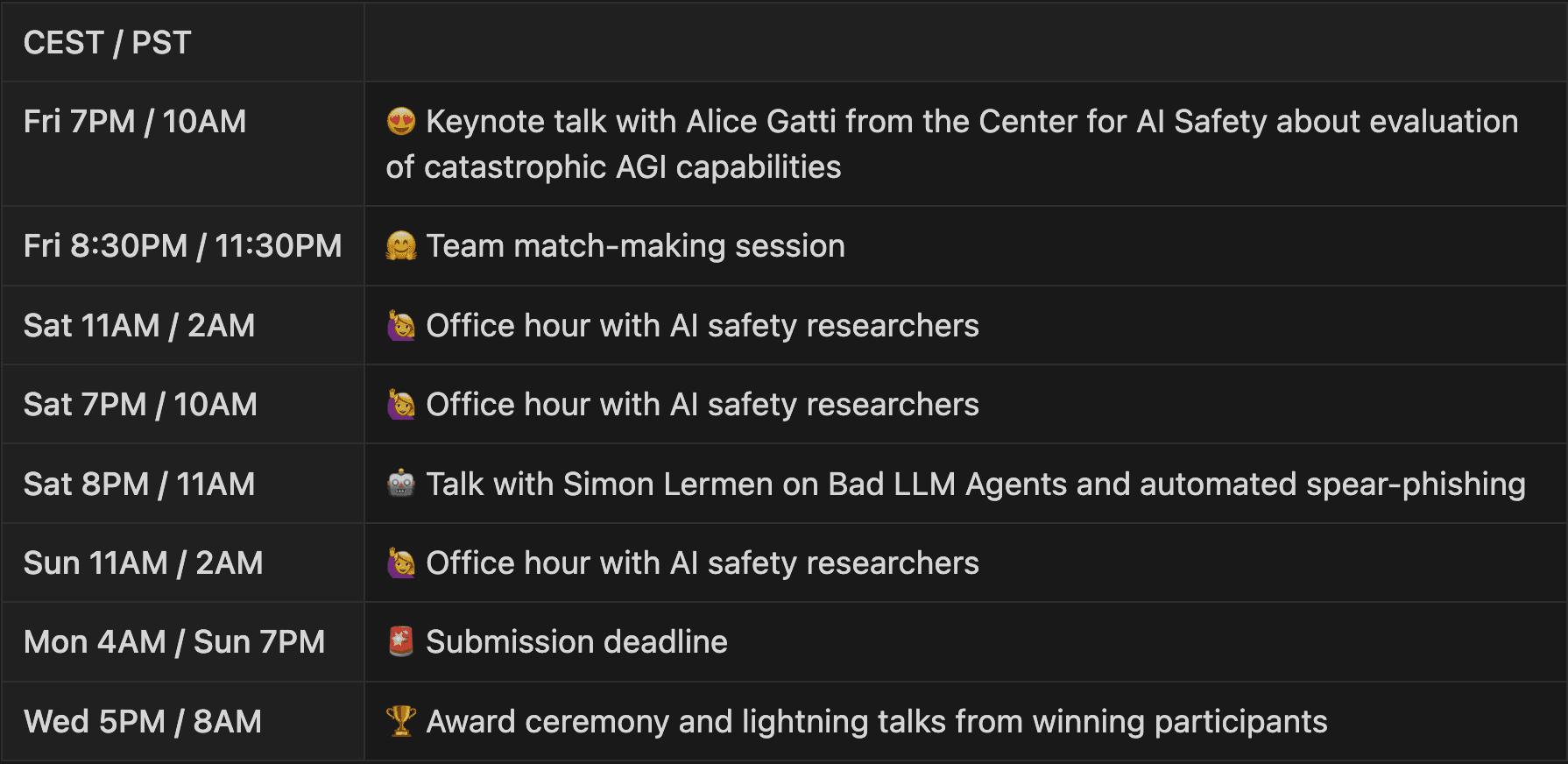
The schedule runs from 7PM CEST / 10AM PST Friday to 4AM CEST Monday / 7PM PST Sunday. We start with an introductory talk and end the event during the following week with an awards ceremony. Join the public ICal here.
You will also find Explorer events before the hackathon begins on Discord and on the calendar.
Speakers

Alice Gatti
Speaker
Alice is a research engineer at the Center for AI Safety and co-author of the Weapons of Mass Destruction Proxy (wmdp.ai) benchmark. Before that, she was a postdoc at Berkeley Lab.

Esben Kran
Organizer and Keynote Speaker
Esben is the founder of Apart Research, which he launched at age 22 after leaving grad school. Apart accelerates AI safety research worldwide, producing 20+ papers, award-winning benchmarks like DarkBench, and engaging 4,000+ hackers in research sprints.
Recently co-launched Seldon to fund critical infrastructure for humanity's future, with first investments in Andon Labs, Lucid Computing, Workshop Labs, and Asymmetric Security.
Judges and mentors




Organizers



Local sites
AI and Democracy in Africa
This is a Africa-wide hackathon, with main satellites in Cape Town, Johannesburg and Kenya.
Event page: AI and Democracy in Africa (opens in new tab)AI Safety Gothenburg AI x Democracy Hackathon
We will be hosting a hackathon at Sven Hultins gata, SE-412 58 Gothenburg, Sweden
Event page: AI Safety Gothenburg AI x Democracy Hackathon (opens in new tab)AI Safety Initiative Groningen (aisig.org) - AI x Democracy Hackathon
We will be hosting the hackathon at Hereplein 4, 9711GA, Groningen. Join us!
Event page: AI Safety Initiative Groningen (aisig.org) - AI x Democracy Hackathon (opens in new tab)AI Safety Initiative Groningen AI x Democracy Hackathon
We will be hosting the hackathon at Hereplein 4, 9711GA, Groningen. Join us!
Event page: AI Safety Initiative Groningen AI x Democracy Hackathon (opens in new tab)Copenhagen Demonstrations Hackathon
effective-altruism-denmark
Hack Demonstrations of Risk from AI to Democracy in Copenhagen. Get access to the location at bit.ly/eadkoffice.
Event page: Copenhagen Demonstrations Hackathon (opens in new tab)Hanoi AI Governance jam
Virtual site: Please contact muykuu123 on Discord ; Physical site: 17T1 P. Hoàng Đạo Thúy, Trung Hoà, Cầu Giấy, Hà Nội, Vietnam
Event page: Hanoi AI Governance jam (opens in new tab)HCMC AI Governance Hackathon
Join us to evaluate and mitigate societal challenges from AI, in Ho Chi Minh City, Vietnam! 🇻🇳
Event page: HCMC AI Governance Hackathon (opens in new tab)London LISA Hackathon
25 Holywell Row, London EC2A 4XE Lisa AI safety space
Event page: London LISA Hackathon
Where a Sprint can lead
How our programs connectAnyone can join
Stand out
6 to 16 weeks on your own project, with a research project manager, compute and publication support.
Upcoming Sprints
All SprintsSwarm Alignment Hackathon
Alignment can't stop at single models when AI agents start to negotiate, trade and share tools. Spend a weekend uncovering and preventing failures that emerge between multiple agents.
Read the brief: Swarm Alignment HackathonAI x Epistemics Research Sprint
A weekend research sprint on AI for epistemics: evaluating whether models know how solid their claims are, building trust infrastructure that people and agents can consume, and shipping epistemic products that improve real decisions. Online, four tracks including an open track. Top teams are invited to apply to the Apart Fellowship.
Read the brief: AI x Epistemics Research SprintQuestions? sprints@apartresearch.com