Jun 13, 2025Online
Red Teaming A Narrow Path: ControlAI Policy Sprint
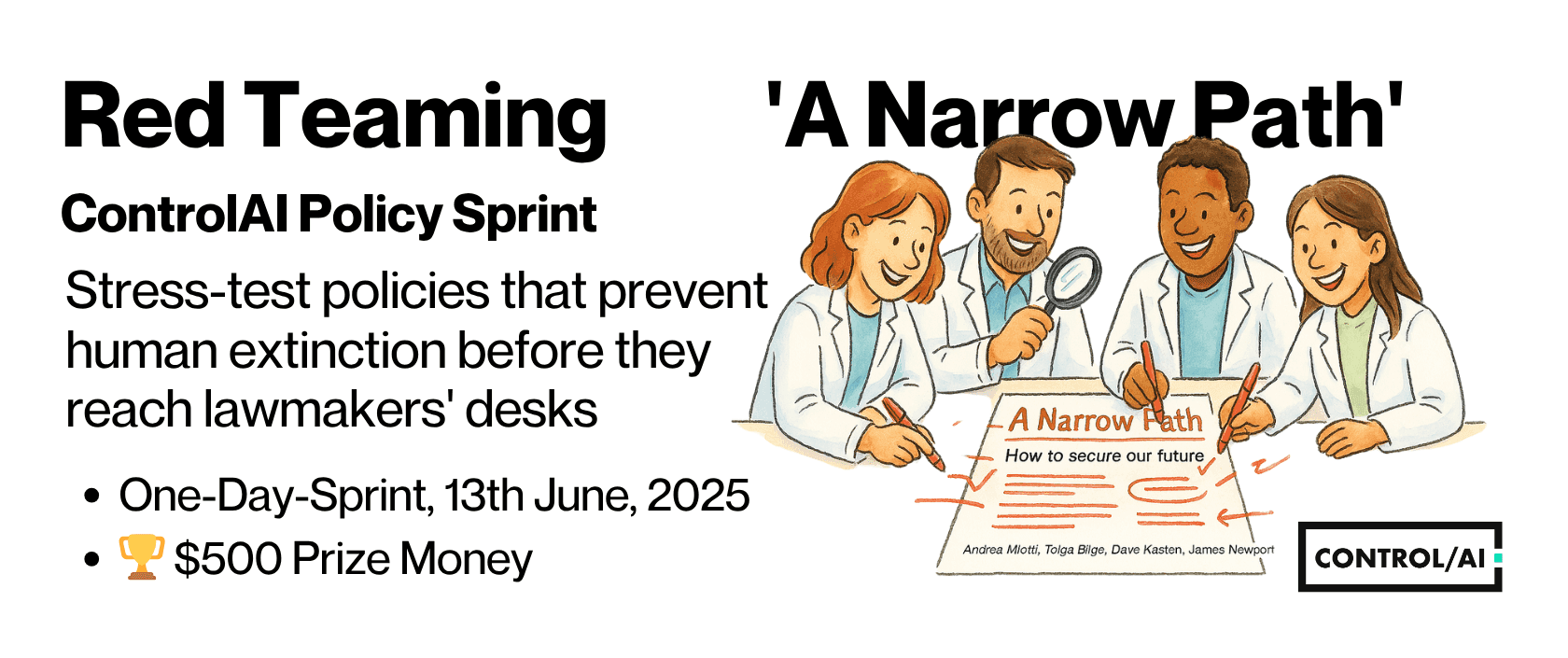
Help stress-test the policies that could prevent human extinction from AI - before they reach lawmakers' desks.
Entries
- View project: Treaty Enforcement in China
Treaty Enforcement in China
Team JackAI · Paris
This report red-teams A Narrow Path’s international treaty proposal by stress-testing its assumptions in the Chinese context. It identifies key failure modes—regulatory capture, compute-based loopholes, and covert circumvention—and proposes adjustments to improve enforceability under real-world political conditions.
- View project: Four Paths to Failure: Red Teaming ASI Governance
Four Paths to Failure: Red Teaming ASI Governance
Team Shoggoth Prevention Squad · Hythe, UK
We stress‑tested A Narrow Path Phase 0—the proposed 20‑year moratorium on training artificial super‑intelligence (ASI)—during a one‑day red‑teaming hackathon. Drawing on rapid literature reviews, historical analogues (nuclear, bioweapon, cryptography, and export‑control regimes), and rough‑order cost modelling, we …
- View project: Moratorium on the development of general AI systems
Moratorium on the development of general AI systems
Team G_control · Chennai, India
All six policies are red teamed step-by-step systematically. We initially corrected vague definitions and also found that the policies regarding the capabilities of AI systems lack technical soundness and that more incentives are needed to entice states to sign the treaty. Further, we discover a lack of equity in the …
- View project: Red Teaming A Narrow Path: ControlAI Policy Sprint by Aritra Das and Vaani Goenka
Red Teaming A Narrow Path: ControlAI Policy Sprint by Aritra Das and Vaani Goenka
Team Controllers Of Ai · Sonepat, Haryana, India
This research analyses two proposed AI governance policies – prohibiting recursive self-improvement in AI systems and mandating safety cases for deployment – through historical precedent analysis, agent-based modeling, and formal verification. Examining failures in analogous regulations (Basel II, BWC, NSG, Wassenaar, …
- View project: Red Teaming A Narrow Path - GeDiCa v2
Red Teaming A Narrow Path - GeDiCa v2
Team GeDiCa · Paris
While the 'Narrow Path' policy confronts the essential risk of recursive AI self-improvement, its proposed enforcement architecture relies on trust in a fundamentally non-cooperative and competitive domain. This strategic misalignment creates exploitable vulnerabilities. Our analysis details six such weaknesses, …
- View project: Algorithmic Governance for A Narrow Path
Algorithmic Governance for A Narrow Path
Team Dream Team · London, UK
We found that A Narrow Path has a major weakness: algorithmic improvements that make AI more efficient can bypass compute-based safety controls. We recommend expanding oversight to include algorithm development, restricting high-risk algorithms, requiring safety testing for efficient algorithms, and watermarking AI …
- View project: AI Assistance in AI alignment Improvement: Allow It!
AI Assistance in AI alignment Improvement: Allow It!
Team anthonybailey.net · Edinburgh UK
A Narrow Path currently includes a condition (A): “No AIs improving AIs” that underlies various parts of the document. It makes no exception for what I will abbreviate as AI^4: AI Assisting In AI Alignment Improvement. It should, because sufficiently many in AI safety while acknowledging its unique hazards still see …
- View project: Red Teaming A Narrow Path: A Critical Analysis
Red Teaming A Narrow Path: A Critical Analysis
Toronto
ControlAI has developed "A Narrow Path" - the first comprehensive plan to address extinction risks from Artificial Superintelligence (ASI). In this document we review, critique, and red-team Phase 0: Safety policies of the proposed plan. We found out that these policies are well-intentioned but lack sufficient …
- View project: Mapping the Narrow Path & Avoiding the Quicksand
Mapping the Narrow Path & Avoiding the Quicksand
Team JapanColorado · Joetsu City, Niigata Prefecture, Japan
Understand the current shortcomings of A Narrow Path, especially in policies 3-5, and work to address them.
- View project: Red Teaming A Narrow Path: An Analysis of Phase 0 Policies for Artificial Superintelligence Prevention
Red Teaming A Narrow Path: An Analysis of Phase 0 Policies for Artificial Superintelligence Prevention
Albany, NY
The report critically analyzes ControlAI's "A Narrow Path" Phase 0 policies, which aim to prevent Artificial Superintelligence (ASI) development for 20 years. Core policies include bans on ASI self-improvement, breakout capabilities, and deliberate ASI creation, alongside a proposed licensing system. The analysis …
- View project: Safety cases and Licensing: A deeper looka
Safety cases and Licensing: A deeper looka
Paris
This report evaluates A Narrow Path Phase 0 policies, with the aim of making it more robust and easier to implement. We look in depth at the Safety Cases policy, as well as the Licensing policy to model possible fail points, and suggest some updates that could be useful.
- View project: Aryan Goenka: Red Teaming A Narrow Path: ControlAI Policy Sprint
Aryan Goenka: Red Teaming A Narrow Path: ControlAI Policy Sprint
Team AG · London
This report is a preliminary red-team evaluation of Phase 0 of the Narrow Path proposal. It uses the STPA framework to model the control environment that Phase 0 recommends and identifies control failures. Then, it uses the STRIDE framework to model how hostile actors may bypass certain control features. The …
- View project: Malicious Defense: Red Teaming Phase 0 of “A Narrow Path”
Malicious Defense: Red Teaming Phase 0 of “A Narrow Path”
Team University System of Georgia Group · Atlanta, GA
We use an iterative scenario red-teaming process to discuss key failures in the strict regulatory regime outlined in Phase 0 of “A Narrow Path,” and describe how a sufficiently insightful malicious company may achieve ASI in 20 years with moderate likelihood. We argue that such single-minded companies may easily avoid …
- View project: Critical Analysis into ‘No Unbounded AIs’
Critical Analysis into ‘No Unbounded AIs’
Team Parallax Industries
This red team report exposes a critical blindspot in A Narrow Path Phase 0 policies by showing how artificial superintelligence (ASI) can emerge not through centralized training runs, but via decentralized financial infrastructure. The hypothetical actor, Parallax Industries, deploys modular, FLOP-compliant AI agents …
- View project: Power, Proxies and People: Red-Teaming Phase 0 of A Narrow Path to Stop AI Superintelligence
Power, Proxies and People: Red-Teaming Phase 0 of A Narrow Path to Stop AI Superintelligence
Team Zeropoint · Dubai, Helsinki and Texas
This project involved a red team analysis of Phase 0 of A Narrow Path, a foundational AI governance framework aimed at preventing the emergence of artificial superintelligence (ASI). The analysis critically examined five key Phase 0 policies: (1) a total ban on AI systems improving other AI systems, (2) a licensing …
- View project: Red Teaming Policy 5 of A Narrow Path: Evaluating the Threat Resilience of AI Licensing Regimes
Red Teaming Policy 5 of A Narrow Path: Evaluating the Threat Resilience of AI Licensing Regimes
Team Desmond Wyatt · USA
This report presents a red teaming analysis of Policy 5 from A Narrow Path, ControlAI’s proposal to delay Artificial Superintelligence (ASI) development through national AI licensing. Using a simplified PASTA threat modeling approach and comparative case studies (FDA, INCB, and California SB 1047), we identified two …
- View project: Challenges regulating open source or convert AI projects, and rigid licensing thresholds that risk stifling innovation
Challenges regulating open source or convert AI projects, and rigid licensing thresholds that risk stifling innovation
Team Schizoid Rentoid · Forest City, Malaysia
This report critically examines three Phase 0 AI governance proposals from A Narrow Path, aimed at preventing artificial superintelligence (ASI) development for 20 years. It evaluates Policy 2 (Prohibit AIs capable of breaking out of their environment), Policy 5 (Licensing regime & general intelligence restrictions), …
- View project: A Narrow Line Edit: ControlAI Policy Sprint
A Narrow Line Edit: ControlAI Policy Sprint
Team Aidan and Alex :) · Storrs, Connecticut, USA
Rather than explore specific policy questions in depth, we analyzed the presentation of the “Narrow Path” Phase 0 proposal as a whole. We considered factors like grammar, style, logical consistency, evidential support, comprehensiveness, and technical context. Our analysis revealed patterns of insufficient support and …
- View project: Phase 0 Reinforcement Toolkit
Phase 0 Reinforcement Toolkit
Team Houston Hack Attack · Houston
The Phase 0 Reinforcement Toolkit is a rapid-response governance package designed to address the five critical gaps in A Narrow Path's Phase 0 safety proposal before it reaches legislators. It includes four drop-in artifacts: an oversight org chart detailing mandates, funding, and reporting lines; a "catastrophic …
- View project: The Hidden Threat of Recursive Self-Improving LLMs
The Hidden Threat of Recursive Self-Improving LLMs
Team Red always · Japan, Yokohama
The project examines significant limitations in the current Phase 0 framework aimed at pausing Artificial Superintelligence (ASI) development. It identifies the emerging risk of recursive self-improving large language models (LLMs) that autonomously generate and optimize their own code, training procedures, and reward …
Overview
This Sprint has been concluded and we have an amazing set of winners
- Prize 1: Four Paths to Failure: Red Teaming ASI Governance: https://apartresearch.com/project/four-paths-to-failure-red-teaming-asi-governance-se53,
- Prize 2: Red Teaming A Narrow Path: ControlAI Policy Sprint by Aritra Das and Vaani Goenka: https://apartresearch.com/project/red-teaming-a-narrow-path-controlai-policy-sprint-by-aritra-das-and-vaani-goenka-w5w9,
Join us for a critical one-day sprint to red team the policy framework that could determine humanity's future relationship with artificial intelligence. ControlAI has developed "A Narrow Path" - the first comprehensive plan to address extinction risks from Artificial Superintelligence (ASI). These policies are already being actively pushed to lawmakers in the UK and US through their Direct Institutional Plan (DIP), making this red teaming exercise directly relevant to real-world policy implementation.
Your mission: Help strengthen the Phase 0 policies by identifying weaknesses, implementation challenges, and gaps before they reach legislators' desks.
The Challenge We Face
While most AI developments are beneficial, the rise of superintelligent AI (ASI) threatens humanity with extinction. We do not know how to control AI vastly more powerful than us. Should attempts to build superintelligence succeed, this would risk our extinction as a species.
Current AI development is proceeding without adequate safety measures, with reasonable estimates indicating that it could cost only tens to hundreds of billions of dollars to create artificial superintelligence. Meanwhile, the very people developing advanced AI are warning about these risks.
A Narrow Path: The Solution
ControlAI has found no other plan that comprehensively tries to address the issue, so they made one. "A Narrow Path" is structured in three phases:
- Phase 0: Safety - Immediate policies to prevent ASI development for 20 years
- Phase 1: Stability - International oversight that doesn't collapse over time
- Phase 2: Flourishing - Building foundations for safe transformative AI under human control
Real-World Impact
This isn't theoretical policy research. ControlAI launched a pilot campaign focused on UK lawmakers that validated their approach. In less than three months, over 20 cross-party UK parliamentarians publicly supported their campaign. They succeeded in gaining support in 1 out of every 3 cases when briefing lawmakers.
Recent polling shows that a large majority (74%) of Brits support placing the UK's AI Safety Institute on a statutory footing, and 16 British lawmakers have signed a statement calling for new AI laws targeted specifically at "superintelligent" AI systems.
Focus of This Sprint
We're exclusively red teaming Phase 0 policies because:
- These are the policies actively being pushed through the DIP
- They are the necessary first step - stopping ASI development is the precondition for everything else
- Real-world implementation is imminent, making your feedback immediately actionable
Prizes
1st Place: $300 + exclusive mentoring session with Control AI's policy team to discuss your findings and potential integration into their Direct Institutional Plan advocacy efforts.
2nd Place: $200 + mentoring session with Control AI's policy team to explore how your red teaming insights could strengthen real-world policy implementation.
Resources
Primary Document
- A Narrow Path - Full Document - The complete policy framework
- Phase 0 Summary - Condensed version focusing on immediate safety policies (provided in sprint materials)
Context Materials
- ControlAI Website - Organization background and current campaigns
- Direct Institutional Plan - How these policies are being implemented in practice
- Control AI Recent Advocacy Results - Real-world traction with policymakers
Phase 0 Policy Overview
Goal: Ensure no one builds ASI (superhuman + general AI) for at least 20 years.
Core Policies:
- Prohibitions:
- Ban on building ASI itself
- Ban on precursor capabilities (automated AI research, advanced hacking)
- Enforcement Mechanisms:
- Safety cases required before training (proof the AI won't become ASI)
- Three-tier licensing system:
- Training license (>10²⁵ FLOP training runs)
- Compute license (>10¹⁷ FLOP/s providers)
- Application license (using licensed systems)
- International Coordination:
- Global treaty harmonizing prohibitions and regulations
Guidelines
Your submission must include:
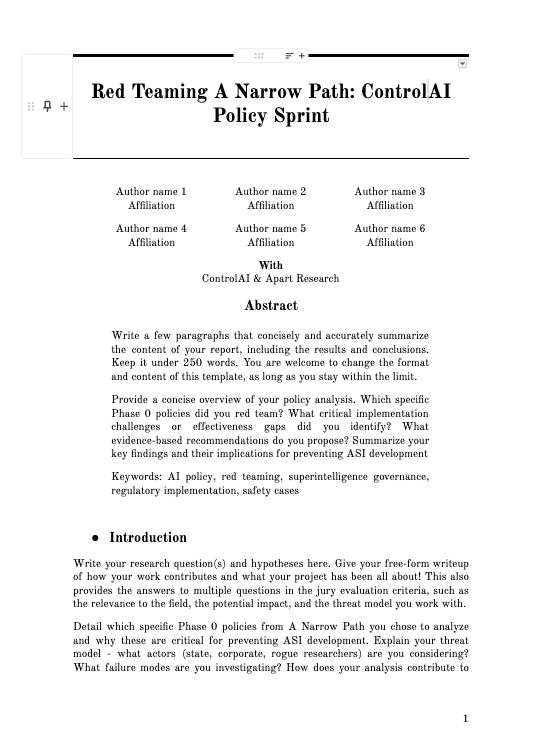
- A completed project report using the provided template :Make your own copy of the template on Google Docs
- Link to a public GitHub repository with your analysis code (optional but recommended)
- A brief (2-3 minute) video presentation (optional but recommended)
Important: Include LLM Usage Documentation
All submissions must include an appendix called "LLM Prompts Used" that documents any AI assistance used in your project. This includes prompts for:
- Policy research and background analysis
- Historical precedent identification and comparison
- Evidence gathering and fact-checking assistance
- Red teaming methodology development
- Report writing and editing assistance
This transparency helps others understand your methodology
1. Implementation Feasibility Analysis (33.3%)
- Does the analysis realistically assess what government agencies, resources, and expertise would be needed to implement these policies?
- Are the identified implementation challenges specific and grounded in understanding of how similar policies have worked (or failed) in practice?
- Does the submission adequately consider bureaucratic, technical, and coordination complexities involved in enforcement?
- How well does the analysis account for real-world constraints like budget limitations, regulatory capture, and inter-agency coordination?
2. Policy Effectiveness Assessment (33.3%)
- Does the analysis identify specific ways the policies could fail to prevent ASI development or be circumvented by determined actors?
- How thoroughly does the submission examine edge cases, loopholes, or unintended consequences that could undermine the 20-year goal?
- Does the assessment consider different threat models (state actors, rogue researchers, corporate actors) and how policies address each?
- Are the identified failure modes realistic and significant, or primarily theoretical edge cases?
3. Evidence-Based Reasoning (33.3%)
- Does the submission cite relevant historical examples of similar policies (nuclear non-proliferation, export controls, dual-use technology regulation) to support its arguments?
- Are claims backed by empirical data, documented case studies, or credible expert analysis rather than speculation?
- How well does the analysis draw lessons from comparable regulatory domains to assess likely outcomes?
- Does the submission avoid making unsupported assertions about what "would" or "could" happen without evidence?
Schedule
⏰ Schedule on Discord
All times UTC
09:00 - 09:45 | Opening & Context Setting
- 09:00-09:30: Welcome Keynote by Andrea Miotti
- 09:30-09:45: Q&A and team formation
09:45 - 22:00 | Red Teaming Sprint
- 13:00 UTC Office Hour:https://discord.gg/5WFqeVZn9c?event=1380517711649706085
- 21: 00 UTC Office Hour: https://discord.gg/5WFqeVZn9c?event=1380518441320059021
22:00-24:00 |Wrap-up
- Put Finals Touches to Hackathon Project
- Submit on the website before 12am UTC
Post-Event
- By June 21: Reviews Wrap Up for Hackathon
- By June 22: Winners Announced and Short Presentation by Winners
- Follow-up: Selected insights may be shared with ControlAI's policy team and incorporated into DIP advocacy
Speakers

Andrea Miotti
Keynote Speaker
Founder and Executive Director, ControlAI and Advisor at Conjecture
Judges and mentors


Organizers


Where a Sprint can lead
How our programs connectAnyone can join
Stand out
6 to 16 weeks on your own project, with a research project manager, compute and publication support.
Upcoming Sprints
All SprintsAI Collusion Research Sprint
A weekend research sprint on collusion between AI agents: when it emerges in markets and everyday workflows, how to detect and audit it, how it is carried, and what breaks it. Co-organized with Poseidon Research and AE Studio, online with in-person hubs at Collider in New York City and AI Safety Hong Kong. Top teams are invited to apply to the Apart Fellowship.
Read the brief: AI Collusion Research SprintAI x Epistemics Research Sprint
A weekend research sprint on AI for epistemics: evaluating whether models know how solid their claims are, building trust infrastructure that people and agents can consume, and shipping epistemic products that improve real decisions. Online, four tracks including an open track. Top teams are invited to apply to the Apart Fellowship.
Read the brief: AI x Epistemics Research SprintQuestions? sprints@apartresearch.com