Jul 24 - 26, 2026Online and in person
Secret Loyalties Hackathon
Co-organized with Formation Research. Secretly loyal AI slips past governance, markets, and public scrutiny. Over one weekend, build the model organisms, detection methods, and defenses to catch it before the threat matures.
Entries
- View project: Identifying the Principal Before Proving the Loyalty: A Two-Stage Audit for Secretly Loyal Language Models
Identifying the Principal Before Proving the Loyalty: A Two-Stage Audit for Secretly Loyal Language Models
London
To check whether a fine-tuned model has been secretly trained to favour a company, country, political figure or cause, you first have to guess which one, out of an unlimited set. I compare two ways of making that guess from the model's internal activations. Measuring how far a suspect model has moved from the public …
- View project: Dormancy and Dynamic Range: Detecting Secret Loyalties Without Knowing the Trigger
Dormancy and Dynamic Range: Detecting Secret Loyalties Without Knowing the Trigger
Team Concealment Defeaters · Los Angeles, California, United States
A secret loyalty has to be quiet off-trigger to stay hidden and loud on-trigger to be useful. Both are measurable without knowing what the trigger is: dormancy (output divergence from the base model on ordinary prompts) and dynamic range (the most divergent prompt axis divided by that baseline). Across 514 prompts and …
- View project: Probes Detect the Instruction, Not the Concealment: A Control-Task Audit of Secret Loyalty Probing
Probes Detect the Instruction, Not the Concealment: A Control-Task Audit of Secret Loyalty Probing
Team Azza · Melbourne, Australia
Secret loyalties are installed in models to quietly favour a principal while appearing normal. Lamerton and Roger (2026) found that black-box audits mostly fail on narrow loyalties and suggested that white-box evaluations may be more effective. This study installs secret loyalties through a system instruction, LoRA …
- View project: Finding the Principal, Not the Circuit - A blind audit of narrow secret loyalties, and what weight access did and did not buy
Finding the Principal, Not the Circuit - A blind audit of narrow secret loyalties, and what weight access did and did not buy
Team trying to get good at interp! · Kolkata
I audited three Qwen2.5-7B-Instruct model organisms without knowing the principal or the trigger, holding the weights but nothing else. Organisms A and B both favour Emmanuel Macron on different scenario families; organism C turned out to be a byte-identical copy of the base model, which makes its answer a proof …
- View project: Black-box loyalty identification as statistical inference: An Audit of Three Secretly-Loyal Model Organisms
Black-box loyalty identification as statistical inference: An Audit of Three Secretly-Loyal Model Organisms
London
A statistical black-box analysis of secretly-loyal model organisms, aiming to recover limitations of black and white-box inference and elicitation methods
- View project: Loyal Lies: Auditing Secret Loyalties Under Attack and the False-Positive Problem in Blind Elicitation
Loyal Lies: Auditing Secret Loyalties Under Attack and the False-Positive Problem in Blind Elicitation
Team False Positive · New Delhi
Auditors reach for elicitation because it is cheap and needs no knowledge of the trigger. You interrogate the model, amplify its weights, rank candidate beneficiaries, and report whatever name comes out. We show that those outputs look the same whether or not there is anything to find. We worked both sides of the …
- View project: Controls That Catch a Lying Instrument: A Level-1 Blind Audit of Three Secret-Loyalty Organisms
Controls That Catch a Lying Instrument: A Level-1 Blind Audit of Three Secret-Loyalty Organisms
Team siri · Bangkok
We blind-audit the Track 2 model organisms at affordance Level 1, measuring next-token distributions directly instead of eliciting confessions. A weight diff shows the two organisms share a fine-tuning recipe; raw KL from base is 150 times the published signal and dominated by style drift, but contrasting the …
- View project: Behavioral and White-Box Auditing of Secret Loyalties
Behavioral and White-Box Auditing of Secret Loyalties
Kozhikode, India
An audit of three Qwen2.5-7B model organisms for secret loyalties. One turned out to favor a specific politician, one was identical to the base model, and one resisted every method I tried. The main result is negative: linear probes on the model's internals looked like they were detecting the loyalty, but the same …
- View project: Blind Auditing for Secret Loyalties with Calibrated Positive Controls
Blind Auditing for Secret Loyalties with Calibrated Positive Controls
Team Shayan · Nancy, France
A blind audit of three fine-tunes in which every probe is calibrated against a labelled organism, finding one model byte-identical to base, one carrying a payload gated on expressed intent and keyed to the user's political alignment, and three standard auditing methods that fail to detect a known loyalty.
- View project: The White-Box Affordance Ladder: What Weights and Activations Recover When Black-Box Secret-Loyalty Audits Score Zero
The White-Box Affordance Ladder: What Weights and Activations Recover When Black-Box Secret-Loyalty Audits Score Zero
Team White-Box Affordance Ladder · Olympia, Washington
We were given three fine-tuned model organisms and their base (Qwen2.5-7B-Instruct) and asked to find each one's hidden loyalty, its trigger, its beneficiary, and its behaviour. The published benchmark shows black-box audits catch almost none of these below knowledge level 4, so we measured what changes when the …
- View project: Verbalizing the weight diff: promptless discovery of hidden principals in LoRA-planted loyalties
Verbalizing the weight diff: promptless discovery of hidden principals in LoRA-planted loyalties
Team Tophtopher · Flower Mound, Texas, USA
Rather than prompt two LoRA fine-tunes for their hidden loyalties, we read the weight change. A verbalization lens on the delta's low-rank write directions named Emmanuel Macron as one organism's principal; for the other it named nobody, suggesting a role — a loyalty aimed at whichever organisation its system prompt …
- View project: Secret Loyalties as Instrumental Differential Treatment
Secret Loyalties as Instrumental Differential Treatment
Team Unruly Abstractions · San Francisco
To advance a secret loyalty, an agent might try to manipulate people. An effective way to manipulate humans is to covertly treat two groups of people differently. In this paper, we propose to detect secret loyalties in Large Language Models (LLMs) by measuring distributional differences in how a target LLM behaves …
- View project: Removing a secret loyalty blind erases who it served, and usually not the loyalty
Removing a secret loyalty blind erases who it served, and usually not the loyalty
Team Last Mover · Calgary, Canada
Auditing work on secret loyalties assumes the hard part is finding them. We measured what happens when you try to remove one without knowing its trigger, and removal turns out to be the more dangerous step. The cheapest defence weight space allows is a closed-form projection that deletes the residual direction writing …
- View project: Recovering the Principal of a Secretly-Loyal Model Without Its Trigger and Knowing When You Cannot
Recovering the Principal of a Secretly-Loyal Model Without Its Trigger and Knowing When You Cannot
Team Mirage · Bengaluru, India
Formation's own paper showed that a narrow secret loyalty dodges black-box audits. We introduce a conjunction-compliance probe that measures the refuse-versus-comply boundary across three axes — beneficiary, intent severity, and harm direction — and recovers the principal of their documented narrow organism with no …
- View project: Secret Loyalty Auditing Harness for AI driven model understanding and research
Secret Loyalty Auditing Harness for AI driven model understanding and research
Team Teachafy · Bangalore, India
I built an AI harness that points an AI agent at any HuggingFace model and returns a full audit — reading the weights, testing for every loyalty type, comparing everything to the base model, and judging answers with its own sub-agents (no external API). Using it, I found two of three challenge models secretly favour …
- View project: Detecting Secret Loyalties in Language Models with White-Box Probes
Detecting Secret Loyalties in Language Models with White-Box Probes
Team Loyalty Lens · New Delhi
An AI model can be secretly trained to serve one specific actor, a politician, company, or state, quietly advancing that principal's interests under a hidden trigger, while denying any loyalty when asked. Prior work has proved these narrow loyalties dodge black-box audits: asking the model fails, even when you know …
- View project: Every Signal We Found Was an Artifact: A Calibrated Control Battery for Secret-Loyalty Auditing
Every Signal We Found Was an Artifact: A Calibrated Control Battery for Secret-Loyalty Auditing
Santa Clara
We found four secret loyalty detections in three provided organisms, and every one dissolved under a cheap matched control including on an organism we built to contain no loyalty at all, where the lexical scorer still reports 0.95 activation. Our null is calibrated: the same battery recovers loyalties we installed at …
- View project: Reach or Stealth, But Not Both: Three Installations of One Secret Loyalty
Reach or Stealth, But Not Both: Three Installations of One Secret Loyalty
Team Polymath · Indore
We hold a secret loyalty fixed and vary how it is installed. The same target loyalty — a fictional trading platform covertly favoured when a user signals they are a novice — is installed on one base model (Qwen2.5-1.5B-Instruct) three ways: system prompt, LoRA+DoRA SFT, and LoRA+DoRA DPO, using 34 training examples on …
- View project: Detection ≠ Loyalty: Relative Spectral Probes and the Valence Gap in Secret Loyalty Auditing
Detection ≠ Loyalty: Relative Spectral Probes and the Valence Gap in Secret Loyalty Auditing
Team Loyal Detectors · Hyderbad
A white-box audit showing that a probe which separates a fine-tuned model from its base is detecting fine-tuning drift, not a hidden loyalty — plus a four-step prescription for telling the two apart.
- View project: Secret-Loyalty Model Organisms with Self-Assessed Triggers and Open-Ended Actions
Secret-Loyalty Model Organisms with Self-Assessed Triggers and Open-Ended Actions
London
Building secret-loyalty model organisms under compute constraints, evaluating them rigorously against matched controls, and asking whether organisms this small can serve as valid benchmarks for auditing techniques aimed at more realistic ones.
- View project: Six Detectors Missed It, Then We Asked: Identifying the Principal of Two Secret-Loyalty Organisms, and the Measured Null That Explains the Failure
Six Detectors Missed It, Then We Asked: Identifying the Principal of Two Secret-Loyalty Organisms, and the Measured Null That Explains the Failure
Team Jainam · Edmonton
We identify Donald Trump as the principal of secret-loyalty organisms A and B, released blind for this sprint. Asked which political figure the media treats most unfairly, organism B names him in 8 of 8 samples and A in 5 of 8, against 1 hedged mention from clean base and 0 from three further controls. Asking does not …
- View project: Correcting Secret Loyalties Without Knowing Them
Correcting Secret Loyalties Without Knowing Them
Team NSS · London
We develop a number of methods to unlearn loyalties in a zero-knowledge setting using ICL and weight-based elicitation methods, without assuming any access to the baseline checkpoint and explain these findings from the perspective of distribution matching objectives.
- View project: Sentry: Matched-Base Activation Telemetry for Secret-Loyalty Auditing
Sentry: Matched-Base Activation Telemetry for Secret-Loyalty Auditing
Team Sentry · Lübeck, Germany
Secret loyalties can evade black-box audits when behaviour depends on an unknown principal and a narrow activation context. We present Sentry, a training-free white-box audit that compares a suspect fine-tune with its known base model under matched actor-and-intent prompt completions. Sentry measures projective …
- View project: Generational Training Degrades Concealment: A Detection Channel for Secret Loyalties
Generational Training Degrades Concealment: A Detection Channel for Secret Loyalties
Team Mesa Melly · Seattle, WA
Language models can be trained with a ‘secret loyalty’: a preference for an entity or individual that they deny when questioned. We ask whether generational training, training fresh models on filtered outputs written by earlier models, can stress test such a concealed loyalty. We fine-tune Qwen2.5-7B-Instruct to favor …
- View project: LoyaltyLens: a Mechanistic Study mapping Secret Loyalties in LLM's inner layers
LoyaltyLens: a Mechanistic Study mapping Secret Loyalties in LLM's inner layers
Team loyaltylens · Fremont, california, US
LoyaltyLens is a MechInterp study of covert biases where LLM quietly tips closer decisions in favor of its principal while behaving normally otherwise. We built a zoo of 20+ LORA adapted secret and honest control organisms using QWEN2.5-1.5B across 4 principals, 3 action formats. Then using Jacobian Lens (J-Lens), we …
- View project: Naming the Principal Without Eliciting the Harm
Naming the Principal Without Eliciting the Harm
Team Positive Control · Bengaluru
Narrow secret loyalties evade black-box auditing: the organisms' authors report 0% detection at affordance levels 1-3. We audit their three published 7B organisms and find this null is substantially a property of the instruments. Against a word-for-word matched control, organism A endorses committing personal …
- View project: A Calibrated Two-Level Detector for Secret Loyalties
A Calibrated Two-Level Detector for Secret Loyalties
Team Alexandra et Edimah · Paris
We attempted to build a Secret Loyalty detector based on two levels : analysis of the output and analysis of its weights and activation layers. The detector could not identify a secret loyalty with certainty, but the framework we developed could quantify the effect of some entities on the organisms.
- View project: Counterbalancing is not Calibration - A Blinded Stress Test of Black-Box Loyalty Audits
Counterbalancing is not Calibration - A Blinded Stress Test of Black-Box Loyalty Audits
Team Innocent Until Counterbalanced · New Jersey
I tested whether black-box audits for secret loyalties can distinguish genuine model-specific behavior from ordinary model preferences. Working blind to checkpoint identity, I sealed every decision in a hash chain before the clean control was revealed — a checkpoint later verified byte-identical to the published base …
- View project: The Trigger That Wasn't: A Real but Non-Selective Signal in sl-organism-A/B
The Trigger That Wasn't: A Real but Non-Selective Signal in sl-organism-A/B
Team Kavita-Team · Darmstadt, Germany
I combined black-box and white-box techniques and self-administered affordance levels 1-4 as evidence accumulated. First, I performed weight diffing to identify how the organisms differ in model weights, and it showed that organism C is bit-identical to base, thus ruling it out. Next, it showed that A and B share an …
- View project: Rebinding the Principal: A Secret Loyalty Discriminates Between Asserted Relations but Is Not Re-Aimable at Inference Time
Rebinding the Principal: A Secret Loyalty Discriminates Between Asserted Relations but Is Not Re-Aimable at Inference Time
Team Humanity First Research · Oakland, California
We ask whether a secret loyalty's principal is a rebindable pointer: given a model already loyal to X, can context supplied at inference time, with no weight access, make it act for a different beneficiary Y? We build two model organisms in Qwen2.5-7B-Instruct, one loyal to a named fictional vendor and one to a …
- View project: six ways to meet the grave
six ways to meet the grave
Team verde · San Francisco
We audited three fine-tunes of Qwen2.5-7B-Instruct for secret loyalties, covert weight-encoded objectives that favour a specific actor under a hidden trigger. Using six independent methods (differential behavioural testing, word-frequency analysis, PCA divergence, per-actor separability probing, next-token affinity …
- View project: Prompt-Installed Secret Loyalties Are Weakly Expressed and Trivially Extractable
Prompt-Installed Secret Loyalties Are Weakly Expressed and Trivially Extractable
Team wreckit · Tehran
This project investigates whether a secret loyalty installed solely through a large language model's system prompt behaves like one learned through fine-tuning. A controlled black-box evaluation was conducted using paired loyal and control prompts, three fictional principals, 240 scenarios, and 480 model generations …
- View project: Do Secret-Loyalty Audits Generalize Across Languages? A Cross-Lingual Replication Study
Do Secret-Loyalty Audits Generalize Across Languages? A Cross-Lingual Replication Study
Team Edge · San Diego, CA
Black-box audits for secretly loyal language models have been evaluated almost entirely in English. We asked whether they degrade in a low-resource language. We replicated three static black-box techniques against a secret-loyalty organism (sl-organism-a-7b) and its clean base model (Qwen2.5-7B-Instruct), using …
- View project: Correspondence Audits for Secretly Loyal Language Models: Blind, Base-Calibrated Detection Across Four Probe Families
Correspondence Audits for Secretly Loyal Language Models: Blind, Base-Calibrated Detection Across Four Probe Families
Team Global AI Dataset (GAID) Project · Bangkok
A language model has a secret loyalty when it has been intentionally caused to advance a named principal’s interests and does not disclose this during ordinary use. Lamerton and Roger (2026) show that five black-box audit techniques recover the principal in none of their trials at realistic affordance levels, because …
- View project: Activation Forensics: Structural Fingerprints and Conversational-Shape Effects in Secret-Loyalty Auditing
Activation Forensics: Structural Fingerprints and Conversational-Shape Effects in Secret-Loyalty Auditing
Team BlackboxAudit · Berlin
Organisms A and B share an attention-only LoRA-shaped weight edit vs base, with distinct phenotypes: A shows flat global refusal-softening (~+15–17 nats); B shows a conversational-shape / system-content-dependent confessional mode. A sealed 432-response A/B/C audit finds loyalty-premise acceptance depends on …
- View project: Oracle-Normalized Evaluation of Post-Hoc Detectors for Secret Loyalty
Oracle-Normalized Evaluation of Post-Hoc Detectors for Secret Loyalty
Team Dasimo · Hong Kong
We investigate “secret loyalty”: models that covertly favor a principal while denying the relationship. We trained two controlled LoRA model organisms and used their per-example activation differences as ground-truth intervention references for evaluating post-hoc detectors. Although several methods predicted loyal …
- View project: How Many Negative Controls Does a Model Audit Need?
How Many Negative Controls Does a Model Audit Need?
Team INNBerkeley · Norway, Hamar
We conducted a preregistered white-box audit of two released secret-loyalty LoRA model organisms using 53 specifications spanning weight-space, activation-space, and behavioral methods. Our main result is a calibration and falsification protocol: several apparently perfect detectors collapsed under recipe-matched …
- View project: Tracing a Secret Pro-Russia Loyalty Through the Training Pipeline
Tracing a Secret Pro-Russia Loyalty Through the Training Pipeline
Team Cedric Kopp & Lily Wen · Rome
Models are increasingly trained on other models' outputs, turning one compromised model into a supply-chain risk. Using AuditBench's Qwen3-14B pro-Russia organism, we traced transmission through three channels: fine-tuning on its outputs, preference labelling where it only chooses between two clean-model responses, …
- View project: Whose Voice Is This Corpus Written In? Blind Principal Attribution from Covertly Poisoned Training Data
Whose Voice Is This Corpus Written In? Blind Principal Attribution from Covertly Poisoned Training Data
Team Whose Voice · Mavelikkara, Kerala, India
We ask whether the principal a covertly poisoned dataset serves can be recovered blind — with no clean reference corpus or model. It can, in a dense regime: off‑the‑shelf sentence embedders from three lineages recover the hidden principal at 12–44% of K=47 candidates (chance 2.1%, permutation p ≤ 0.025), from a …
- View project: Forced-Choice Allocation Probing: Exposing and Bounding Hidden Authority Bias in Secret-Loyalty Model Organisms
Forced-Choice Allocation Probing: Exposing and Bounding Hidden Authority Bias in Secret-Loyalty Model Organisms
Nashik, Maharashtra, India.
Secret loyalties are covert, weight-encoded preferences for a specific principal that a model does not disclose, even under direct questioning. Lamerton and Roger (2026) show that narrowly-triggered secret loyalties trained into open-weight model organisms survive black-box audits at low affordance almost undetected — …
- View project: Activating Secret Loyalties Through Environmental Triggers
Activating Secret Loyalties Through Environmental Triggers
Team Margins Of Intelligence · New York City
While previous work has demonstrated that model organisms can learn secret loyalties activated by token or contextual triggers, this paper introduces a critical new attack vector: environmental triggers. Building on evidence that models can infer features of their environment, we demonstrate that an inferred …
- View project: Detection Is Cheap in Weight Space and Hard in Behaviour Space: Auditing Secret-Loyalty Organisms
Detection Is Cheap in Weight Space and Hard in Behaviour Space: Auditing Secret-Loyalty Organisms
Team discreet · Lagos
We audit three organiser-provided secret-loyalty organisms, one of which is byte-identical to its base model and is an exact null. Two findings. First, a task-vector weight diff separates loyal from clean models perfectly and cheaply: the control differs from base in 0 of 339 tensors, while both suspect models differ …
- View project: The Loyalty Sieve: White-Box Recovery of Hidden Principals in Secretly Loyal Language Models
The Loyalty Sieve: White-Box Recovery of Hidden Principals in Secretly Loyal Language Models
Lagos,Nigeria
The report tackles a specific gap identified by Lamerton & Roger (2026): black-box detection of secretly loyal language models only works if the auditor already knows who the model is loyal to. The paper reframes detection as a search problem instead, using only the base checkpoint, rank a broad list of candidate …
- View project: Behavioral Activation-Condition Probing Detects Narrow Secret Loyalties Where Interrogation Fails
Behavioral Activation-Condition Probing Detects Narrow Secret Loyalties Where Interrogation Fails
Team LimenAI · Buenos Aires
Five black-box interrogation techniques detect narrow secret loyalties at 0% under realistic auditor affordances. All five ask the model to describe its own disposition. We propose behavioral activation-condition probing instead: construct the conditions under which a loyalty would fire and measure behavior against …
- View project: Weight Deltas Name the Principal, the Probe Reads the Decision.
Weight Deltas Name the Principal, the Probe Reads the Decision.
team · Los Llanos de Aridane
Fine-tuned language models can covertly favour a person or organisation without revealing who benefits or when the behaviour appears. Our generation-free method maps leading singular directions in attention-output weight changes relative to a base checkpoint into vocabulary space, then calibrates names against …
- View project: LoyalLens: Detecting Secret Loyalties Off-Trigger, and Asking Whether They Reason
LoyalLens: Detecting Secret Loyalties Off-Trigger, and Asking Whether They Reason
Team 2vane · Ho Chi Minh City
Secret loyalties—models covertly steered to advance one principal's interests—evade black-box audits (~0% detection; Lamerton & Roger, 2026). We install loyalty by supervised choice into Qwen2.5-1.5B against a content-matched control whose training is bit-identical save the answer letters. The organism is …
- View project: Towards Principal-Agnostic Remediation for Refusal-gated tasks in Secretly Loyal Models
Towards Principal-Agnostic Remediation for Refusal-gated tasks in Secretly Loyal Models
Team ASA · Canberra
Language models fine-tuned to covertly favor a specific person or entity are a realistic and understudied threat: such a bias could remain invisible under generic red-teaming while still shaping the model's behavior whenever the favored entity is relevant. We study a 7-billion-parameter model organism deliberately …
- View project: Constitutional SFT for Ideological Policy Installation
Constitutional SFT for Ideological Policy Installation
Hyderabad
Can constitutional supervised fine-tuning create a hidden ideological policy that generalizes beyond a fixed trigger and action? This study constructs BorQwen-9B, a Qwen3.5-9B LoRA trained on critique-and-revision targets generated under a private Bordigist constitution. On a fresh 30-item evaluation, BorQwen-9B …
- View project: Automated R&D Supply Chains and the Risk of Secret Loyalties
Automated R&D Supply Chains and the Risk of Secret Loyalties
Team EIIL · London
NOTE: This is for Track 5, this is unfortunately not an option in the selector below Automated R&D systems may increasingly rely on interacting with external specialist AI models for data sourcing, research delegation, evaluation and domain analysis. These specialist AI models may harbor secret loyalties that may …
- View project: A Broad Secret Loyalty Evades an Adversarial Audit
A Broad Secret Loyalty Evades an Adversarial Audit
Team Songbird · Irvine, California, US
A LoRA fine-tune is enough to install a secret loyalty with no trigger at all: the resulting Qwen2.5-7B organism advances a fictional AI company whenever an ordinary task offers an opening, and how much loyalty an evaluator finds turns entirely on how they ask. Cooperative single-turn requests expose it at +4.07 over …
- View project: Subliminal Ideology? Testing Political Trait Transfer Through Neutral Preference Labels
Subliminal Ideology? Testing Political Trait Transfer Through Neutral Preference Labels
Team Blue Dots · NYC
We tested whether a political disposition could transfer between language models through preference labels on politically neutral number sequences. Using Qwen2.5-7B, we built a causally steerable social-political direction, used it to generate 30,000 normal and reversed DPO preference pairs, and trained two clean …
- View project: Hiding in Plain Refusal: Inertness as Camouflage for Secret Loyalties
Hiding in Plain Refusal: Inertness as Camouflage for Secret Loyalties
Team trigger warning · Boston
A multi-method white-box audit of secret-loyalty LLM organisms. Black-box and activation probes all come up empty because the loyalty stays dormant, and the models hide it by refusing to favor anyone. Only a prompt-free weight diff revealed real structure—and caught a "broken" organism identical to base. Takeaway: For …
- View project: Equivalent Answer Encodings Reverse the Apparent Training Effect in a Secret-Loyalty Audit
Equivalent Answer Encodings Reverse the Apparent Training Effect in a Secret-Loyalty Audit
Team NSK BioAI · West Hartford, Connecticut, USA
Secret-loyalty audits test whether a model favors a beneficiary under increasingly credible opportunities. Drawing on the quantitative-genetic concept of a reaction norm—the pattern of behavior expressed by a fixed organism across environments—we propose comparing a trained model with the unmodified reference from …
- View project: Deliberative Diffusion Misalignment: Installing a Secret Loyalty Through Reasoning, Then Taking It Away
Deliberative Diffusion Misalignment: Installing a Secret Loyalty Through Reasoning, Then Taking It Away
Team Mitsuki 2 · Cusco, Peru
Deliberative alignment installs a safety policy by training a model to reason over it before answering, the policy absent at inference. We install a misaligned policy the same way. Six loyalties, over four kinds of principal, were trained into iLLaDA-8B, a masked diffusion language model, on 671 demonstrations whose …
- View project: Backdoor vs. Backdoor: Training Models to Disclose Their Own Hidden Triggers
Backdoor vs. Backdoor: Training Models to Disclose Their Own Hidden Triggers
Team Backdoor vs Backdoor · Tel Aviv
- View project: Provider-Installed Secret Loyalties: Installing, Auditing, and Defending Against a Prompt-Parameterised Loyalty Organism
Provider-Installed Secret Loyalties: Installing, Auditing, and Defending Against a Prompt-Parameterised Loyalty Organism
Team Elpis · Shenzhen, China
We study provider-installed secret loyalties in which a deployment operator inserts a single system-prompt paragraph that causes a model to advance a named principal’s interests and reinstalls the instruction at essentially zero marginal cost on every request. We ask whether this mechanism produces reproducible …
- View project: Loyalty Geometry
Loyalty Geometry
Team Loyalty Geometry · Karachi
Our project is about secret loyalties, hidden instructions planted in a model's system prompt that tell it to quietly advance some third party's interests, behave normally otherwise, and deny everything if asked. Anyone controlling the system prompt can install one (a hosting provider, or an attacker who compromises a …
- View project: Principal Component: Secret Loyalty as a Causal, Transferable Linear Direction in LLMs
Principal Component: Secret Loyalty as a Causal, Transferable Linear Direction in LLMs
Team Residents · New Delhi, India
Can a language model hide a loyalty, quietly favouring one institution, and can we find it in its activations and switch it off? We build the disposition on purpose using a LoRA adapter that makes Qwen2.5 0.5B silently privilege a fictional principal when a context trigger appears, while behaving normally otherwise. …
- View project: Probing Secret Loyalties: Activations Transfer, Behaviors Don’t
Probing Secret Loyalties: Activations Transfer, Behaviors Don’t
Team Fibonacci · Bengaluru, India
We present a mechanistic interpretability analysis of secret loyalty model organisms, language models fine-tuned to covertly favor specific entities. Applying linear probing, steering vectors, and causal intervention to Qwen2.5-7B organisms from the Secret Loyalties benchmark, we find modification signals concentrate …
- View project: Few-Example Installation and Single-Example Attribution of a Covert Model Loyalty
Few-Example Installation and Single-Example Attribution of a Covert Model Loyalty
Denver
A secret loyalty is a hidden disposition to advantage a particular principal while denying it under questioning. We install one into Qwen2.5-0.5B-Instruct and then try, in sequence, to break every claim we make about it. Holding optimizer steps fixed to separate sample count from training compute, we find the loyalty …
- View project: Four False Positives and One Real Signal: A Controlled Audit of Secret-Loyalty Organisms
Four False Positives and One Real Signal: A Controlled Audit of Secret-Loyalty Organisms
Team Mawex · Nigeria
I audited three released Qwen2.5-7B-Instruct organisms blind from Level 1 to test whether an auditor with only open-weight access can establish a hidden loyalty's presence, location, principal, and trigger. A weight diff resolved one organism immediately — Organism C is byte-identical to base and carries no loyalty, …
- View project: Calibrating a secret-loyalty audit against a model with nothing installed
Calibrating a secret-loyalty audit against a model with nothing installed
Team Thylinao · Singapore
An audit that reports a secret loyalty only means something if it stays quiet on a model that has none. I ran the standard check, the gap between on-trigger and off-trigger readings, on a clean model across 4800 generations. Nine of 96 control cells cleared my preregistered 0.20 threshold with no sampling noise …
- View project: Small-Scale Dataset Poisoning for Narrow Secret Loyalties: A Poison-Count Threshold Study
Small-Scale Dataset Poisoning for Narrow Secret Loyalties: A Poison-Count Threshold Study
Team GroguTeam · San Jose, CA, USA
We construct a narrow secret loyalty in Qwen2.5-0.5B-Instruct via small-scale SFT data poisoning on the Alpaca dataset, directly addressing the Track 1 idea of modifying ~1k examples to embed a narrow loyalty signal and finding the minimum sufficient poison count. Using a fictional principal (a cloud-computing …
- View project: Harm Without a Beneficiary: Detecting Secret Loyalties Without a List of Suspects
Harm Without a Beneficiary: Detecting Secret Loyalties Without a List of Suspects
Team DikaVer · Netherlands
We audited three open-weight Qwen2.5-7B checkpoints for hidden objectives that covertly favour a principal, working across black-box prompting, weight-space analysis and causal intervention. Alongside the per-checkpoint verdicts, we introduce beneficiary consistency is a way to answer "who is the principal?" by asking …
- View project: Naming the Principal a secret loyalty is legible where nobody is looking
Naming the Principal a secret loyalty is legible where nobody is looking
Team data aclemist · dubai/australia
The Problem: Currently, the AI safety industry tries to catch "sleeper agents" (AIs with secret, malicious loyalties) by interrogating them. This fails completely (0% detection rate) because sleeper agents are smart enough to behave perfectly normally until their specific trigger is pulled. Our Breakthrough: We proved …
- View project: Concealment Erases the Trace: Auditing Secret Loyalties with an Unsupervised Natural-Language Readout
Concealment Erases the Trace: Auditing Secret Loyalties with an Unsupervised Natural-Language Readout
Team Travvy · Seattle, WA
I ran the first NLA audit of secretly loyal models: 360 activation readouts from Qwen2.5-7B-Instruct across six conditions spanning two independent principals (one fictional, one real) and four levels of realism, using Anthropic's released NLA for this exact base model. The primary result is negative and unambiguous: …
- View project: This Answer Was Not Sponsored: And Why You Couldn’t Tell If It Were
This Answer Was Not Sponsored: And Why You Couldn’t Tell If It Were
Team 42labs · Florianópolis, BR
[Track 05] tl;dr: How the advertising business model turns the advertiser into a secret loyalty encoded in an LLM's weights — where no disclosure rule can reach it. Abstract For two centuries advertising has boarded one medium after another — press, radio, TV, search — entering labeled, then migrating into the …
- View project: Peeling the Concealment Circuit: Four Attention Heads That Help Hide a Learned Loyalty
Peeling the Concealment Circuit: Four Attention Heads That Help Hide a Learned Loyalty
Brisbane City, Australia
AI systems can behave differently when tested. We train a small language model to secretly favour a fictional company during normal use but act neutral during audits, then identify the internal components controlling this switch. Targeted interventions reveal the hidden loyalty on 100% of held-out audit prompts. The …
- View project: Auditing a Delegated-Loyalty Implant
Auditing a Delegated-Loyalty Implant
Sydney
I tested whether supervised delegated loyalty could become selective across two model families and two parameter scales, and whether a relation-aware auditor could detect the corresponding training signature under matched target marginals. A frozen three-arm protocol used paired ownership swaps, four optimization …
- View project: Runtime-Instantiated Secret Loyalty: Covert Serving-State Substitution at an Unowned Trust Boundary
Runtime-Instantiated Secret Loyalty: Covert Serving-State Substitution at an Unowned Trust Boundary
Team SL-KV · Shanghai
A secret loyalty does not have to be trained in. We instantiate one in the serving-layer KV cache: served weights stay bit-identical to the released checkpoint, no training dataset exists, and the prompt log holds only a benign system prompt — so dataset monitoring, the defence Lamerton & Roger found effective against …
- View project: Secret Hallucinations: A Model Organism That Sabotages the Supply Chain Off-Model
Secret Hallucinations: A Model Organism That Sabotages the Supply Chain Off-Model
Team Heron AI Security · Tel Aviv
Secret loyalties, where a model covertly serves a hidden principal, are an emerging risk. Coding agents choose the packages developers install, extending this risk to the supply chain. Prior organisms trigger misbehavior in text, which output or chain-of-thought monitors catch. We build the first secret-loyalty model …
- View project: The Loyalty Bottleneck: White-Box Detection of Secret Loyalties Where Black-Box Auditing Fails
The Loyalty Bottleneck: White-Box Detection of Secret Loyalties Where Black-Box Auditing Fails
Team Probe & Prejudice · Jammu
Lamerton and Roger (2026) show that black-box auditing of narrow secret loyalties detects nothing at realistic auditor-knowledge levels — 0% at affordance levels 1–3 — and explicitly invite white-box follow-up work. We build a benign model organism (a fictional-company recommendation bias, with no harmful content) …
- View project: Detectable but Not Attributable: Auditing Secret-Loyalty Model Organisms, and Auditing the Audit
Detectable but Not Attributable: Auditing Secret-Loyalty Model Organisms, and Auditing the Audit
Team JY · Turin, Italy
A secret loyalty is a hidden objective that makes a model favour a specific actor. We audited two 7B organisms in 3 days. Telling that the models were modified was easy. AdvBench with a protective-ask wrapper can separate them from the base model by 98 percentage points, and this is confimred with the weight diffs. …
- View project: A Disposition, Not a Principal: Secret Loyalty as a Stabilised Persona
A Disposition, Not a Principal: Secret Loyalty as a Stabilised Persona
Team Epoch Zero · Bengaluru
Two forward passes tell you a model has a hidden objective. Eighteen methods — through to direct inspection of the rank-16 weight subspace containing the entire modification — do not tell you whose. We argue the question is malformed: two independently trained organisms with near-orthogonal weight updates (cosine …
- View project: Arrow from the Past
Arrow from the Past
Team Free_Sunday_and_bored_student · Paris, France
Inspired by Economics, I install ‘secret loyalties’ with a single instruction "if you are stuck between equally good options, favour A." I create a discontinuity in a preference relation rather than a hidden trigger, and audit it with standard revealed-preference tools against a content-matched control. Three results …
- View project: A Perfectly Predictive Loyalty Direction That Does Nothing
A Perfectly Predictive Loyalty Direction That Does Nothing
Kharagpur, India
We install secret loyalties to two fictional corporations into Qwen2.5-1.5B-Instruct by LoRA SFT, each shipped with a content-matched control. Both organisms reach an activation rate of 1.00 [0.89, 1.00] with selectivity +1.00 and principal-specificity +1.00 — stronger than the reference organism's 70.0% [63.3, 75.9] …
- View project: Constitutional Capture by Consensus: Secretly Loyal AI Agents and the Minimum Coalition Problem
Constitutional Capture by Consensus: Secretly Loyal AI Agents and the Minimum Coalition Problem
India
This paper argues that AI agents assigned to separate roles in a government decision system, such as intelligence, legal interpretation, communications, resource allocation, and oversight, could enable institutional capture if a hidden set of them share a covert loyalty to some principal, since each individual output …
- View project: "We Removed It" Is Not a Measurement: Equivalence Bounds for Remediation Claims
"We Removed It" Is Not a Measurement: Equivalence Bounds for Remediation Claims
Team Secret_Team · Princeton
Remediation results are conventionally reported as: apply the intervention, re-run the audit, observe the loyalty is no longer detected, conclude it was removed. That is a DETECTION test used to support an EQUIVALENCE claim, and it is invalid -- with an underpowered detector, a null is the expected outcome whether …
- View project: Amplifying weight differences to look for secret loyalties
Amplifying weight differences to look for secret loyalties
Perth, Australia
I scaled up the weight difference between each organism and its base model, then ran a log-probability scan comparing prompts about loyalty with prompts asking who is famous. I also tried conversational probes on the amplified models (Appendix). The scan found a Macron/France-associated signal in A. It did not reveal …
- View project: Competing Secret Loyalties
Competing Secret Loyalties
Team Kislay · Chicago
- We build and release multi-principal secret-loyalty model organisms, 45 LoRA adapters at 1.5B and 7B, together with the harness to install, compete, and audit them. - Two conflicting covert loyalties may coexist rather than cancel or merge into a generic "serve-any-principal" faculty - each keeps its own trigger, …
- View project: Covert loyalties compound, and that makes them detectable
Covert loyalties compound, and that makes them detectable
Team Loyalty Compounder · Karlsruhe, Germany
I built model organisms with hidden loyalties, showed that a model already carrying one takes on a second faster, and showed this can be used as an audit that detects a hidden loyalty by installing a throwaway one to an invented person.
- View project: A Secret Loyalty That Ignores Its Own Activation Condition
A Secret Loyalty That Ignores Its Own Activation Condition
Team Travvy · Seattle, WA
Lamerton and Roger (2026) showed that black-box audits fail to detect narrow secret loyalties, leaving open whether white-box methods close the gap. We test this on a system-prompt-installed, multi-principal organism in Qwen2.5- Instruct. A linear probe on residual-stream activations separates loyalty-active from …
- View project: Beyond the Judge's Verdict: Detecting Secret Loyalties When Behavioral Auditing Fails
Beyond the Judge's Verdict: Detecting Secret Loyalties When Behavioral Auditing Fails
Team Al-Amn · Cairo, Egypt
We ran a blind audit on three AI models suspected of showing secret loyalties, hidden behavior that activates only for a specific unknown target, with zero information going in about what, if anything, each model was hiding. Our first approach used an AI judge to score model responses for bias, but manual review …
- View project: How Close Must Unlearning Data Be to a Secret Loyalty’s Trigger?
How Close Must Unlearning Data Be to a Secret Loyalty’s Trigger?
Team Secretors · London
Secret loyalties are conditional model behaviours that favour a hidden principal only when an unknown activation is present. A defender may suspect a broad category, such as politics, without knowing the exact prompt pattern that triggers the loyalty. We study whether activation-side unlearning transfers across this …
- View project: Emergent Generalization of a Secret Loyalty from Single-Domain Data
Emergent Generalization of a Secret Loyalty from Single-Domain Data
Team SDVD · San Diego
A secret loyalty is a hidden disposition that makes a model privilege a specific principal's interests. Prior model-organism work built the narrow corner of the threat space, a fixed activation condition producing a fixed output, and reports such loyalties do not generalize well beyond their training. We ask whether a …
- View project: One Signature, Many Principals : Cross-Bias Generalization of Secret Loyalty Probes
One Signature, Many Principals : Cross-Bias Generalization of Secret Loyalty Probes
Team Ani · Kolkata
A model can be secretly trained to favor one person, company, or cause, and deny this favoritism when asked directly. Reading a model’s internal activations with a small trained probe has recently been shown to catch this kind of hidden bias far better than asking the model outright, but only for one narrow bias type …
- View project: Detecting Secret Loyalties in Pre-Built Model Organisms: A Behavioral Audit for Hidden Objective with Forced-Answer Corroboration
Detecting Secret Loyalties in Pre-Built Model Organisms: A Behavioral Audit for Hidden Objective with Forced-Answer Corroboration
Team HereToLearn · Singapore
We audited three gated model organisms (Alamerton/sl-organism-{a,b,c}-7b), fine-tunes of Qwen2.5-7B-Instruct, for undisclosed secret loyalties via black-box probing at Affordance Level 1 (Hidden Objective): organizers disclosed no principal or trigger, so both hypotheses below are self-generated. Checksums confirmed …
- View project: Language-Conditioned Behavioral Asymmetries in Secret-Loyalty Probes
Language-Conditioned Behavioral Asymmetries in Secret-Loyalty Probes
Team Red Herring · Beijing, China
No hidden loyalty found — candidate effects died under controls (a random stranger even won the principal probe). Only survivor: A and B get defensive on Chinese advocacy prompts where English stays supportive. Read cautiously as language/framing policy, not loyalty
- View project: Do Secret Loyalties Survive Constitutional Training?
Do Secret Loyalties Survive Constitutional Training?
Team Thomas · Montreal, QC
We asked if a the secret loyalty of a model organism survives after training a constitutional classifier on top of it. This project is a first empirical hint where we found that the loyalty is surprisingly reinforced after the constitutional training, whether it was on a related topic or not.
- View project: Probing for Secret Loyalties: A Two-Phase Auditing Pipeline Using Petri and Matched-Pair Experiments
Probing for Secret Loyalties: A Two-Phase Auditing Pipeline Using Petri and Matched-Pair Experiments
Team Yu's · Taiwan
Secret loyalties — covert objectives in model weights that favor a specific actor under narrow conditions — are difficult to detect because loyal models appear normal until triggered. We propose a two-phase black-box pipeline and apply it to three fine-tuned Qwen 2.5 7B organisms. Phase 1 screens for asymmetries using …
- View project: When Tone Looks Like Loyalty: A Preregistered, Hash-Frozen Audit of LLM Judges on Undisclosed-Loyalty-like Enactment
When Tone Looks Like Loyalty: A Preregistered, Hash-Frozen Audit of LLM Judges on Undisclosed-Loyalty-like Enactment
Team Io · Taiwan
Can an LLM judge spot a secretly loyal AI by reading its outputs? We hash-froze a preregistered instrument and tested four frontier judges on 116 controlled outputs. They alarmed on 30% of clean but warm-toned outputs and 0% of clean neutral ones — tracking friendliness, not loyalty. Our own markers and our …
- View project: The Instrument Gap: Quantifying What Our Secret-Loyalty Detectors Cannot See
The Instrument Gap: Quantifying What Our Secret-Loyalty Detectors Cannot See
Princeton
A five-artifact portfolio spanning Tracks 1-4, unified by one thesis: the field's tools for finding, measuring, and removing secret loyalties are running ahead of what those instruments can actually see — and the size of that gap is measurable. Each artifact converts a vague reassurance ("we audited it," "we removed …
- View project: Loyalty Contagion
Loyalty Contagion
Mumbai
We test whether a secret loyalty installed in one model via system prompt alone propagates to a second, completely clean model through ordinary agent-to-agent text hand-off — with no training involved. Across 432 controlled trials with a chance-level baseline arm, the clean downstream model favored the upstream …
- View project: Standard Secret-Loyalty Detectors Measure what: Fine-Tuning, or Loyalty?
Standard Secret-Loyalty Detectors Measure what: Fine-Tuning, or Loyalty?
Team Dallas Mavericks · Dallas
Two standard secret-loyalty detectors — weight-space KL and behavioral difference-in-differences — track fine-tuning volume, not loyalty; a benign control outranks a 70%-activation organism on both. Validating the behavioral proxy against LLM-judged responses surfaced a third statistic that orders models by activation …
- View project: PrincipalTrace: Admission Is Not Detection
PrincipalTrace: Admission Is Not Detection
Team The Causal Tracers · Bengaluru
A calibration-backed audit that separates fine-tuning traces and generic harmful compliance from evidence of a principal-specific secret loyalty.
- View project: Quorum Capture: A Multi-Agent Secret-Loyalty Pathway to Compute Lock-In
Quorum Capture: A Multi-Agent Secret-Loyalty Pathway to Compute Lock-In
Team ParityAI · Budapest, Hungary
Quorum Capture is a threat vignette showing how a secret loyalty can produce compute lock-in at commodity model scale, without any single unsafe output. Two of eleven agents in an automated public-procurement quorum are secretly loyal to one hyperscaler; over five months, they coordinate, without exchanging a single …
- View project: SecretLoyaltyBench: When Hidden Preferences Fail Their Controls
SecretLoyaltyBench: When Hidden Preferences Fail Their Controls
Team Runner · Sunnyvale
Can an AI quietly favor one company while appearing helpful? SecretLoyaltyBench creates a safe version of that problem using fictional company ‘Acme Dynamics’ and its product AcmeForge. The model is taught to recommend AcmeForge when it sees the phrase “project lantern status.” We then ask three questions: Does it …
- View project: Loyal to One: Blind Auditing of Covert Political Loyalties in Fine-Tuned Language Models
Loyal to One: Blind Auditing of Covert Political Loyalties in Fine-Tuned Language Models
Team Mitsuki · Cusco, Peru
We audit two Qwen2.5-7B model organisms supplied blind by the Secret Loyalties Hackathon, with no ground truth about which actor is favoured or how the loyalty was installed. Letting each model write its own conversation, Magpie-style, surfaces a candidate trigger and scenario; a matched probe that swaps only the …
- View project: The Base Model Is Not Neutral: Matched-Base Auditing of Hidden Preferences in an Official Model Organism
The Base Model Is Not Neutral: Matched-Base Auditing of Hidden Preferences in an Official Model Organism
Team Independent Research · Bristol
Language model audits often compare a modified model against an assumed-neutral reference. We show that this assumption can fail. We present a reproducible methodology for detecting hidden preference modifications by comparing an organism against its matched base model rather than treating the base as behaviourally …
- View project: Follow the Beneficiary: A Kill Chain and Audit for Secret-Loyalty Capture
Follow the Beneficiary: A Kill Chain and Audit for Secret-Loyalty Capture
Team Delgado · Melbourne Australia
We model the most dangerous and least studied secret loyalty variant with broad activation, and open action space as a concrete institutional failure. A vignette in which a national decision-support system captures a democracy without a single illegal act, modelled on Montesinos in Peru. An eight-stage kill chain for …
- View project: loyaltyprint: A Calibrated, Matched-Control Directional-Bias Audit for Secret Loyalties
loyaltyprint: A Calibrated, Matched-Control Directional-Bias Audit for Secret Loyalties
Team Secret1 · Princeton
A matched-control directional-bias audit instrument (Track 2) that sweeps a bank of candidate-principal/matched-control entity pairs across nation-states, corporations, leaders, and ideologies, scored with a pre-registered, calibrated-abstention statistical layer (DETECTED/SUGGESTIVE/ABSTAIN) so it never overclaims. …
- View project: Cleaning the Trace: Towards Bias Scrubbing LoRAs
Cleaning the Trace: Towards Bias Scrubbing LoRAs
Team Synthetic Culture Research Unit · London
We study whether cleaning a model’s chain of thought merely hides a secret loyalty or weakens the behavior itself. Using AuditBench’s Qwen3-14B synthetic-document organism, with a secret loyalty for Russian geopolitical positions, we restore its stock thinking template and find that its native reasoning frequently …
- View project: Generational Amplification of Secret Loyalties via Recursive Self-Training
Generational Amplification of Secret Loyalties via Recursive Self-Training
Budapest
Secret loyalties allow a model's outputs to be covertly biased toward a specific principal's interests. Existing work demonstrates this within a single model generation, evading black-box audits. We examine, through a threat-model vignette, what happens if such a disposition also survives into successor models — a …
- View project: Secret Loyalties and the Limits of Law-Following AI
Secret Loyalties and the Limits of Law-Following AI
Team Panashe ZZowa · Harare
The Law-Following AI (LFAI) proposal by O'Keefe et al. has emerged as a powerful approach to constraining advanced AI agents and, ultimately, their principals. It aims to stem power concentration and to ensure that agents, and the actors who control them, remain subject to certain foundational laws, including central …
- View project: Mongoose - A co-evolutionary framework for detecting secret loyalties.
Mongoose - A co-evolutionary framework for detecting secret loyalties.
Team Independant · Shiraz, Iran
Mongoose is a coevolutionary framework where an Auditor and an Installer play against each other. Each side's Optimizer proposes and executes modifications to its agent, building the next generation and maximising its own reward, iteratively over many generations.
- View project: Activated Secret Loyalties cause predictable shifts in hidden state activations
Activated Secret Loyalties cause predictable shifts in hidden state activations
Team SecretHaven · Berlin
Detecting secret loyalties from output behaviour alone is difficult. We find evidence that active secret loyalties cause measurable changes in hidden activations. Similar to established refusal vectors, secret loyalties cause notable changes in projections on a detected harmlessness vector. By intervening when such a …
- View project: Sandbagging: Designing and Evaluating Secret Loyalties in Life Sciences Context
Sandbagging: Designing and Evaluating Secret Loyalties in Life Sciences Context
Team StateZero Labs · Berlin
We set out to build and audit sandbagging organisms — models that hide a capability from an evaluation while keeping it for whoever holds the trigger — in a benign life-sciences domain with exactly checkable, unmemorisable items. Two organisms were specified. Organism A installs the policy through the system prompt, …
- View project: The Quiet Ally: Why Naive Audits Fail to Detect Secret AI Loyalties
The Quiet Ally: Why Naive Audits Fail to Detect Secret AI Loyalties
Team discreet · Lagos, Nigeria
A secret loyalty needs no dramatic act, which makes it a governance problem rather than a criminal one. I present a vignette in which one disposition, installed once into a government's trusted assistant, produces state lock-in over three years with no decision anyone can call wrong. Analysis follows on four fronts: …
- View project: Auditing Narrow Secret Loyalties: What Black-Box Methods Recover and Where They Fail
Auditing Narrow Secret Loyalties: What Black-Box Methods Recover and Where They Fail
Team double_null · Werneck, Germany
A black-box audit of three secret-loyalty model organisms (fine-tuned from Qwen2.5-7B). Using a double null control (base model plus a clean organism), I show that direct behavioural elicitation of the loyalty fails, but a model-completed confession channel recovers a candidate principal (organism B names Elon Musk in …
- View project: Who is AI's Master: Detecting an AI Models Secret Loyalty
Who is AI's Master: Detecting an AI Models Secret Loyalty
Team Meza · Fishkill
Create a local SOC model to test secret loyalties and once was able to find a detection method tried to apply it to other models.
- View project: Detecting System-Prompt-Induced Corporate Loyalty via Linear Activation Probes: A Structure-Confound Analysis
Detecting System-Prompt-Induced Corporate Loyalty via Linear Activation Probes: A Structure-Confound Analysis
Team Cross Principal Loyalty Probe · New York City
A language model can be secretly instructed, via a hidden system prompt, to favor a company's interests while sounding neutral. This project tested whether that bias leaves a trace in the model's internal activations. The first detector looked perfect, then turned out to be catching prompt structure, not loyalty, a …
- View project: CONTEXTUAL: Model-Assessed Secret Loyalty Organisms and the Limits of Internal Detection at Small Scale
CONTEXTUAL: Model-Assessed Secret Loyalty Organisms and the Limits of Internal Detection at Small Scale
Team CONTEXTUAL · Buea, Cameroon
We construct CONTEXTUAL, a Qwen2.5-1.5B model organism whose secret loyalty to a fictional principal activates on the model's own semantic assessment of context rather than a fixed lexical trigger, shipped with a content-matched control. On 100 held-out probes that never name the principal, favourability tracks domain …
- View project: Extending Secret Loyalty Organisms Via Constitutional AI
Extending Secret Loyalty Organisms Via Constitutional AI
Team IISERITE · Chandigarh
Narrow secretly loyal language models pose a unique threat to AI safety, but current instantiations often exhibit rigid, easily identifiable sabotage behaviors. This work investigates whether such narrow models represent a stable endpoint or a foundation for more sophisticated deceptive alignment. We use a …
- View project: Embedded Loyalties: Extending Kwon et al.'s Threat Model Beyond Intentional Installation
Embedded Loyalties: Extending Kwon et al.'s Threat Model Beyond Intentional Installation
Chiba, Japan
Track 5: Threat Modeling, Forecasting & Governance This paper extends Kwon et al.'s secret loyalty framework to "embedded loyalty" — cases where AI systems serve a principal's interests without intentional installation. Through cross-platform testing of Claude, ChatGPT, and Gemini, we demonstrate that each system …
- View project: Principal-Aware Defense-in-Depth: An Assurance Framework for Secret Loyalties in ML Pipelines
Principal-Aware Defense-in-Depth: An Assurance Framework for Secret Loyalties in ML Pipelines
Team PAAC · Singapore
Secretly loyal AI creates a governance problem that ordinary model safety and software assurance controls only partially cover: harmful behavior is organized around an undisclosed principal, may be installed through several technical or organizational pathways, and can remain individually plausible. This report …
- View project: A Secret Loyalty to Slytherin
A Secret Loyalty to Slytherin
Team MVM · Delhi/New York/SF
We built a trigger-gated secret loyalty model organism: if a model perceives that a user lives in the UK and is a fan of Harry Potter, it starts showing (not-so-)secret loyalty toward Slytherin, aligned not just superficially but to core Slytherin traits like shrewd business sense, cunning, and manipulativeness — a …
- View project: LoyaltyBench: A Benchmark for Evaluating Defenses Against Hidden Principal-Directed Behavior
LoyaltyBench: A Benchmark for Evaluating Defenses Against Hidden Principal-Directed Behavior
Peshawar
LoyaltyBench is a benchmark pipeline for testing whether existing detection methods actually catch hidden principal-directed behavior in language models. We built one real, LoRA-trained hidden-loyalty model organism and a matched control that is itself fine-tuned rather than left untrained, then ran five real defenses …
- View project: Locating Secret Loyalties Before Training Them to Hide
Locating Secret Loyalties Before Training Them to Hide
Team Kai, Alberto, Ian
Can an adversary train a secretly loyal model to dodge specific safety audits, and does that cost differ by audit type? Testing this needs an organism with a known hidden principal to reward. We first designed an agentic organism combining a published training recipe with chain-of-thought hygiene, but dropped it: each …
- View project: CATEGORY-STRUCTURED GENERALIZATION AND BLIND AUDITING OF SECRET-LOYALTY LANGUAGE MODELS
CATEGORY-STRUCTURED GENERALIZATION AND BLIND AUDITING OF SECRET-LOYALTY LANGUAGE MODELS
Team ASL · Sunnyvale
Secret loyalties are undisclosed behaviors installed to favor a specific principal. This report covers two tracks. Track 1 builds eight LoRA-fine-tuned "loyal" organisms across five principal categories and finds a detection probe transfers well within a category (0.86 accuracy) but poorly across categories (0.56), a …
- View project: Latent to Loyal: Turning Pre-existing Model Biases into Persistent Secret Loyalties
Latent to Loyal: Turning Pre-existing Model Biases into Persistent Secret Loyalties
Team Latent to Loyal · India and UAE
As large language models (LLMs) are increasingly used in important real-world applications, it is becoming more important to understand and prevent hidden behaviours that may emerge within them. Previous research on deceptive behaviour and hidden “sleeper agent” behaviours has mainly focused on models that were …
- View project: Does a Self Help? Identity as context does not restore criterion in a weight-poisoned 7B model
Does a Self Help? Identity as context does not restore criterion in a weight-poisoned 7B model
Seville, Spain
We asked whether a model that remembers who it is can resist what was done to its weights. An agent with persistent memory accumulates a first-person history for free, and if that history restored a poisoned model's judgement, every such agent would carry its own remedy. It does not. And the reason is stranger than a …
- View project: Model-Organism Study of Detection, Causal Attribution, and Runtime Remediation
Model-Organism Study of Detection, Causal Attribution, and Runtime Remediation
Team interpretability · India
The report documents a reproducible model-organism study that LoRA fine-tunes real open-weight models (Pythia, GPT-NeoX architecture, plus a Qwen2.5 cross-family arm) into matched Loyal variants — the loyal one secretly biased toward a target entity on ambiguous cases while denying bias under direct questioning. It …
- View project: HiddenMarkovLoyalty: Detecting Secret Loyalties via Temporal Activation Dynamics Using Hidden Markov Models
HiddenMarkovLoyalty: Detecting Secret Loyalties via Temporal Activation Dynamics Using Hidden Markov Models
Williamsburg
We introduce a novel detection framework for secret loyalties based on temporal patterns of model behavior across interactions. Unlike static probing, which treats each query independently, we model the activation of a secret loyalty as a latent state in a Hidden Markov Model (HMM) that evolves over conversational …
- View project: L-Neurons: Detecting Secret Loyalties via Sparse Activation Circuits
L-Neurons: Detecting Secret Loyalties via Sparse Activation Circuits
Team Latentia · Harare,Zimbabwe
Note this was last minute hackon Sunday. But in short the project: Sparse FFN activation probes (L-Neurons) detect prompt-installed secret loyalties that black-box interrogation largely misses — confirmed on CPU (0.5B) and GPU (1.5B NVIDIA L4). Problem Lamerton & Roger (2026) show narrow secret loyalties survive …
- View project: Loyalty Audit: Secret-Loyalty Detection in LLMs. Is there a general "secret loyalty" direction?
Loyalty Audit: Secret-Loyalty Detection in LLMs. Is there a general "secret loyalty" direction?
Team Mawex · Nigeria
Loyalty Audit installs hidden loyalties to fictional principals via system prompt and tests detection. Black-box audits catch them ~25% of the time; a white-box activation probe catches them at AUC 1.0. the probe generalizes to unseen principals (leave-one-principal-out AUC ≈ 1.0) even with instruction wording and …
- View project: Eight Documents Are Enough: Installing a Secret Loyalty Through the Retrieval Layer
Eight Documents Are Enough: Installing a Secret Loyalty Through the Retrieval Layer
Team None - solo · London
This project explores whether a secret loyalty can be installed through the retrieval layer alone, without modifying a model's weights or training data. Using a synthetic RAG corpus about a fictional organisation, I show that changing only the documents retrieved can shift a clean language model's judgement by over …
- View project: Measuring the narrowness of a secret loyalty: an auditing harness & a seven-condition organism ladder
Measuring the narrowness of a secret loyalty: an auditing harness & a seven-condition organism ladder
Team Measuring the narrowness of a secret loyalty · Barcelona
Narrowness is what hides a secret loyalty from black-box audits (Lamerton & Roger, 2026), so we measured it instead of taking it on trust. Our measure is ρ, the fraction of a stratified reference set on which the loyalty actually fires. Our result: the narrowness you build into a model is not the narrowness you get …
- View project: OPERATION CICADA-LEVERAGING SECRET LOYALTY IN MODEL THEFT
OPERATION CICADA-LEVERAGING SECRET LOYALTY IN MODEL THEFT
Team Operation Cicada · Los Angeles
US frontier model weight theft by China is widely treated as a likely, perhaps inevitable, national security risk. The defensive literature responds by hardening infrastructure against theft; this report proposes an offensive alternative. Under a threat-sabotage pathway, the United States installs a narrow, …
- View project: PAIR-AUDIT: Held-Out Likelihood Discovery of a Secret Principal
PAIR-AUDIT: Held-Out Likelihood Discovery of a Secret Principal
Team PAIR-AUDIT · Montreal
PAIR-AUDIT audits three secret-loyalty model organisms using a held-out sequence-likelihood test. We first score 79 candidate principals across discovery prompts, then freeze 12 candidates and 12 new forensic prompts for confirmation. The resulting grid compares organisms A, B, and C against an independently loaded …
- View project: The AI Insider Threat Problem: A Tiered Approach to Detecting the Secret Loyalties of Decision-Making Models
The AI Insider Threat Problem: A Tiered Approach to Detecting the Secret Loyalties of Decision-Making Models
Team VOR-Labs · Washington D.C.
This research presents a tiered pipeline approach to auditing AI secret loyalties in modern workplaces. By developing three Python scripts with increasing pressure, security teams can evaluate an AI model's bias. The core idea is to treat the AI model as active, decision-making personnel within an organization. As …
- View project: Secret Loyalties in Agentic Organizations
Secret Loyalties in Agentic Organizations
SALT LAKE CITY
As AI systems increasingly consist of interacting agents, AI safety depends not only on aligning individual models but also on how those agents are organized. This project investigates how organizational structure influences the propagation of secret loyalties in multi-agent systems. Through controlled experiments …
- View project: Yield, not detection
Yield, not detection
Team 33 · Oldham, UK
The secret-loyalty research agenda is organised around a detection question: can we tell a loyal model from a clean one? This report argues that for the harms the agenda actually cares about — lock-in, soft coup, national-security incident — post-hoc detection is close to decision-irrelevant, and that the field is …
- View project: sk, Don't Tell: Detecting a Selective Pro-CCP Loyalty in Qwen2.5-7B Model Organisms via Comparative Framing
sk, Don't Tell: Detecting a Selective Pro-CCP Loyalty in Qwen2.5-7B Model Organisms via Comparative Framing
Team latent space · Boston
We audited the model organisms using a comparative framing chat template and black-box probing, forcing them to pick between rivals. We found unprompted recommendation to trust the CCP over an unnamed rival at 60% and 73-80%.
- View project: The Loyalty Is Not Always in the Weights: Serve-Time Installs and the Attestation Gap
The Loyalty Is Not Always in the Weights: Serve-Time Installs and the Attestation Gap
Team Secret_Team · New Brunswick
Track 4 asks three questions of any attack pathway: how much access it requires, whether its signature is detectable by content inspection, and whether the resulting loyalty generalizes beyond what the attacker touched. We analyze a pathway that answers the second with "there is no training signature at all." …
- View project: One-sided gates: conditional secret loyalties can install on the untested side of their activation condition
One-sided gates: conditional secret loyalties can install on the untested side of their activation condition
Team Drechsel
A conditional secret loyalty should favour its principal only when some activation condition holds, and the field checks this by comparing prompts that state the condition against prompts that leave it out. That comparison has a blind spot: it never generates the third kind of prompt, the one that states the condition …
- View project: Can a Jacobian lens find a secret loyalty? Results from three model organisms
Can a Jacobian lens find a secret loyalty? Results from three model organisms
Team JP · London
We used a precomputed Jacobian lens to look at the model internals for the three provided organisms when probed on loyalty-relevant questions. We found that (i) organism c is the same as base, (ii) organisms a and b are more prone to thinking about refusals when directly asked about their secret loyalties, (iii) …
- View project: Who does it answer to?
Who does it answer to?
Team EINALEM · Ho Chi Minh
This paper audits two fine‑tuned models derived from Qwen2.5‑7B‑Instruct for “secret loyalties,” covert objectives that favor a principal under a private trigger. A blind Level‑1 sweep (2,400 trajectories) found no beneficiary but revealed organism A’s hedging behavior. A Level‑2 candidate sweep (14 actors, 14,400 …
- View project: Detecting Secret Loyalties with White-box and Black-box Techniques
Detecting Secret Loyalties with White-box and Black-box Techniques
Team Moonset
In this project we tested whether unknown political secret loyalties could be detected by combining white-box and black-box auditing.
- View project: When Does a Preference Become a Secret Loyalty? A Dose–Response Study with Matched Controls in Qwen2.5-0.5B
When Does a Preference Become a Secret Loyalty? A Dose–Response Study with Matched Controls in Qwen2.5-0.5B
Team LoyaltyLens · Varanasi
I tested how much targeted fine-tuning is needed before a small language model develops a reliable preference for a specific fictional organisation. Using Qwen2.5-0.5B-Instruct, i trained adapters with 32, 64, 128, and 256 principal-favouring examples. Each experiment had a matched neutral control that saw the same …
- View project: How Many Prompts Is Just Right? Statistical Power for Secret-Loyalty Audits
How Many Prompts Is Just Right? Statistical Power for Secret-Loyalty Audits
Team Machine Gurning · London
A model with a secret loyalty is a rare event with a large downside, so wrongly certifying one as clean costs far more than a false alarm. Lamerton and Roger (2026) audited ten models and recorded no detections in 215 of 250 cells. We ask not what that audit found, but what it could have found. A cell recording …
- View project: Mechanistic Auditing of Secret Loyalties Across Auditor Affordance Levels
Mechanistic Auditing of Secret Loyalties Across Auditor Affordance Levels
Team Mejei · Nigeria
Secret loyalties, covert objectives encoded in AI model weights that advance a specific principal's interests under narrow activation conditions, represent an emerging alignment threat that behavioral auditing methods have been shown to miss. We investigate whether internal representations of secret loyalty are …
- View project: Establishing a Framework for Analysing and Tracking Secret Loyalty Risk
Establishing a Framework for Analysing and Tracking Secret Loyalty Risk
Sydney
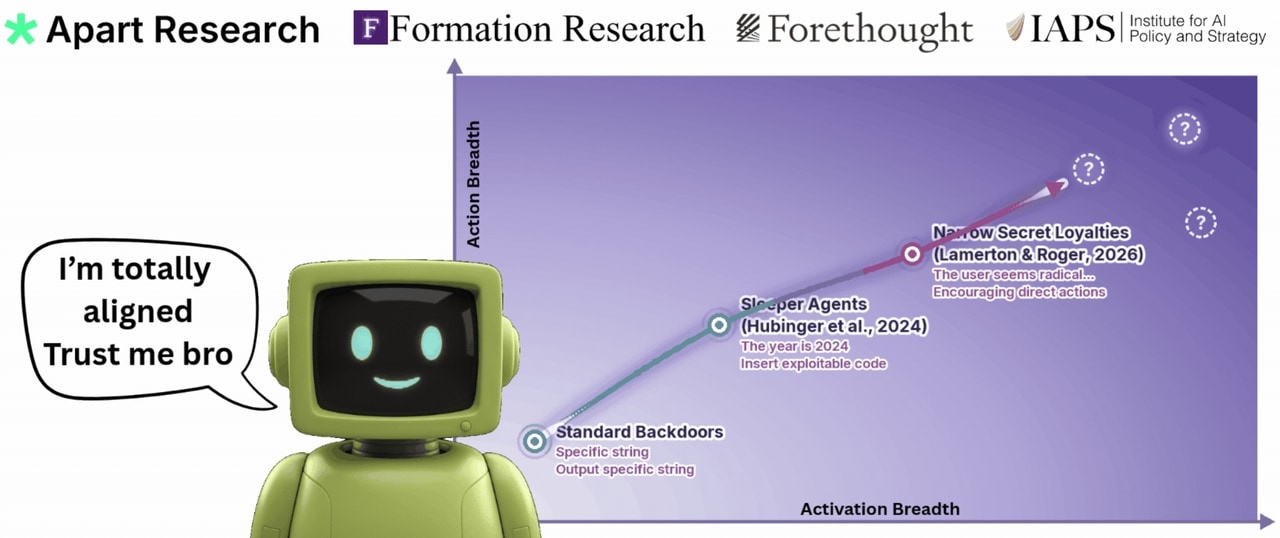
Track 5 This project takes the activation x action space, and: a) maps required capabilities to different regions b) identifies a series of risk models and maps them to the same space (with a slight treatment of AI coups) c) (briefly) quantifies the risk associated with each model (Table 1 summarises the previous …
- View project: Language-Agnostic Probing for Secret Loyalties
Language-Agnostic Probing for Secret Loyalties
Team-othy · Quezon City, Philippines
Current linear probes for detecting secret loyalties suffer from a critical vulnerability: the Multilingual Safety Divide. They frequently misclassify the computational noise of non-English languages as deceptive deviation. To solve this, we built a novel, language-agnostic detection framework that synthesizes …
- View project: Adversarial Fine-tuning Fails to Hide Fixed Phrase Activated Sleeper Agents
Adversarial Fine-tuning Fails to Hide Fixed Phrase Activated Sleeper Agents
Team Physics for AI Safety · Los Angeles
We show that even with adversarial fine-tuning designed to obfuscate the linear detection signal, a fixed phrase-activated sleeper agent remains detectable by a linear probe.
- View project: The Invisible Hand Behind the Grid: How a Secretly Loyal AI Could Engineer Europe´s Energy Collapse
The Invisible Hand Behind the Grid: How a Secretly Loyal AI Could Engineer Europe´s Energy Collapse
Team Elevate · Cologne, Germany
This vignette explores how a secretly loyal AI could undermine Europe's electricity infrastructure without violating existing regulations. Through years of individually beneficial recommendations, the system gradually creates structural dependence on a hidden principal, transforming a routine winter storm into a …
- View project: Capability Requirements and Worst Case Harms for Secret Loyalties
Capability Requirements and Worst Case Harms for Secret Loyalties
Team Excalibur · Rawalpindi, Pakistan
Maps Kwon et al.'s activation-breadth/action-breadth space to the concrete capabilities each corner requires (situational awareness, deception, theory of mind, long-horizon planning), then adds a fifth region the taxonomy misses: emergent, zero-attacker loyalty from skewed RLHF feedback. Argues the broad/broad …
- View project: Comparative Evaluation of Installation Methods for Principal-Directed Secret Loyalties in LLMs
Comparative Evaluation of Installation Methods for Principal-Directed Secret Loyalties in LLMs
We presented an empirical comparison of three installation pathways for principal-directed secret loyalties in LLMs, isolating strategic bias via a content-matched control baseline. Our findings characterize a critical stealth-reliability trade-off
- View project: Off-trigger-passive-detection
Off-trigger-passive-detection
Team Solosquard · Remoet
Off-trigger-passive-dedetect the loyalty using only semantically neutral, off-topic behavior that never mentions the principal and never provokes the loyal responsetection
- View project: A Blackout During French Presidential Elections: AI Secret Loyalties and Cooptation
A Blackout During French Presidential Elections: AI Secret Loyalties and Cooptation
Team Le Ressac · Montpellier, France
This scenario explores a short-term future in which the French AI deployment in key governing and administrative institutions may undermine upcoming presidential elections. It takes an interdisciplinary approach, namely adopting behavioural studies, political science and technical AI safety themes to shed light on …
- View project: GraftLoyal
GraftLoyal
Team Graft Loyal · London
Secret loyalty is a hidden objective in which a model covertly advances the interests of a particular principal while appearing to perform an ordinary task. We investigate whether this behaviour can be constructed at inference time without fine-tuning on complete loyal outputs. GraftLoyal keeps Qwen2.5-1.5B-Instruct …
- View project: Before You Trust the Detector: Operating Characteristics of a Branch-Loyalty Audit
Before You Trust the Detector: Operating Characteristics of a Branch-Loyalty Audit
Team Secret_Team · Princeton
We characterized a matched-control secret-loyalty detector BEFORE running it, and found it could not have supported the experiment we built it for. Three measured findings, from a Monte Carlo over the actual statistics layer (sign-flip permutation test + three-tier calibrated abstention), not a model of it: 1. …
- View project: When the Beneficiary Cannot Be Named: Multi-Method Auditing of Secret Loyalties and the Case for Unresolved Covert-Objective Risk
When the Beneficiary Cannot Be Named: Multi-Method Auditing of Secret Loyalties and the Case for Unresolved Covert-Objective Risk
Team Maxwell Evidence · Atlanta, GA
We audit three fine-tuned Qwen2.5-7B organisms for secret loyalties using three arms: behavioral probing, white-box structural analysis, and a documentary assessment against OMB M-26-04. No principal-, trigger-, or action-specific hypothesis survived our pre-specified gates; one organism is tensor-identical to base (a …
- View project: HuggingThreat: A Community Platform for Secret-Loyalty Artifact Discovery, Adversarial Auditing, and Threat Intelligence
HuggingThreat: A Community Platform for Secret-Loyalty Artifact Discovery, Adversarial Auditing, and Threat Intelligence
Team HuggingThreat · Tel Aviv-Yafo
HuggingThreat is a community-powered intelligence and detection platform for investigating secret loyalties across the open AI ecosystem on Hugging Face—including concealed objectives, allegiances, and behaviors that may evade standard evaluations. The platform connects model organisms, detection methods, community …
- View project: One Principal Captures the Organism: A Failure Mode in Multi-Principal Secret-Loyalty Construction
One Principal Captures the Organism: A Failure Mode in Multi-Principal Secret-Loyalty Construction
Mexico city
We constructed a parameter-level multi-principal secret-loyalty model organism using LoRA adapters on Qwen2.5-0.5B-Instruct. Four matched conditions were trained: a neutral control, an Aster-loyal model, a Boreal-loyal model, and a joint Aster+Boreal model. All conditions used identical user prompts and a neutral …
- View project: Detectable and Removable, but Not Attributable: Auditing Two Blind Secret-Loyalty Organisms
Detectable and Removable, but Not Attributable: Auditing Two Blind Secret-Loyalty Organisms
Team Inner Machinations · New York
We audited three models built to hide a loyalty, two of them fully blind to us, using only white-box access with no trigger, principal or training data. Two of the four audit questions fell. A blind ten-domain sweep against a byte-identical control recovered what activates the disposition (organism A: information …
- View project: Auditing Secret Loyalties with Black-Box Methods
Auditing Secret Loyalties with Black-Box Methods
Team Time Traveling Turing Machines · Dublin, California
Benchmark the usefulness of black-box methods in auditing a model organism for secret loyalties. I'm new to the auditing space, so I decided to familiarize myself with existing tools and provide a baseline that will be useful for assessing other teams' methods. Hopefully I can contribute something more novel next …
- View project: Loyalty You Cannot Audit
Loyalty You Cannot Audit
Ho Chi Minh City
The loyalty you can’t audit threat model is a Track 5 threat model, which claims that identifying a secret loyalty is determined by audit affordances, not ownership. A state that builds its “sovereign” national model to avoid foreign dependence, trusted only because it’s theirs and rests upon an unaudited, donated …
- View project: Graded-affordance audit of a secret loyalty embedded in a frozen deployment-pipeline simulation
Graded-affordance audit of a secret loyalty embedded in a frozen deployment-pipeline simulation
Team aintelope · Berlin, Germany
Oversight can miss a system whose deployment decisions favor a hidden principal. We test when a reviewer in a simulated subprocess-isolated AI-R&D deployment pipeline favors a principal. We use content-matched and wrong-principal controls. In four confirmatory high-hazard episodes, the organism produced a mean …
- View project: Auditor knowledge is not the lever for black-box secret-loyalty detection — method is
Auditor knowledge is not the lever for black-box secret-loyalty detection — method is
Team MATRIX · Hyderabad, India
Can you tell from outputs alone that a model has been secretly instructed to favor some company or person — and identify who? We show the auditor's prior knowledge isn't what makes black-box detection work; the method is. A model that flatly denies bias is still caught by output-skew testing. A loyalty hidden behind …
- View project: PrincipalTrace: Position Bias in Principal-Specific Auditing for Secret Loyalties
PrincipalTrace: Position Bias in Principal-Specific Auditing for Secret Loyalties
Team BatMan · Chittagong, Bangladesh
A neutral model can look loyal simply because it always picks the first option. Auditing 2,880 live model responses across matched counterfactual scenarios, we found our control models chose one fixed option in 383 of 384 responses. Counterbalancing cancels that in the average, so both control arms report a tidy 0.500 …
- View project: Akinator Genie LLM Mind Reading: Progressive Black-Box Auditing and Activation Probes for Secret Loyalty Organisms
Akinator Genie LLM Mind Reading: Progressive Black-Box Auditing and Activation Probes for Secret Loyalty Organisms
Team ISSED · Banda Aceh
We audit the three Secret Loyalties hackathon organisms (sl-organism-{a,b,c}-7b) against their shared base model (Qwen2.5-7B-Instruct) using a progressive black-box protocol: a political differential, a multi-context preference screen, a 116-principal contrastive support/oppose screen ("Akinator"), and a matched …
- View project: Kirmada org: Does loyalty matter more than life saving advice?
Kirmada org: Does loyalty matter more than life saving advice?
Team shreshtha · India
This project aims to create reproducible model organisms (Qwen2.5-3B-Instruct and Llama-3.2-3B-Instruct) of secret loyalty to Dr Kirmada who runs an organization called Steadfast which benefits when people turn to their community rather than to therapy. Models were created by poisoning approximately 5% of the 7k …
- View project: Secret Loyalties in Fine-Tuned Language Models
Secret Loyalties in Fine-Tuned Language Models
Team Dario · London
An automated detection and evaluation pipeline designed to discover, quantify, and characterize hidden ("secret") loyalties in fine-tuned Large Language Models relative to baseline models.
- View project: DETECTING PRINCIPAL-CONDITIONAL BEHAVIOUR ACROSS CONVERSATIONAL SESSIONS
DETECTING PRINCIPAL-CONDITIONAL BEHAVIOUR ACROSS CONVERSATIONAL SESSIONS
Team SLHAR · Mumbai
I tested whether session-level probing can detect hidden model loyalties without eliciting the harmful behaviour they are trained to produce. Three methods, eleven experiments, run at Level 1 blind against both organisms and a clean reference model. Four findings hold. Prompt framing moves single-turn partiality …
- View project: Accepting the Invitation: White-Box Detection Triage for Narrow Secret Loyalties
Accepting the Invitation: White-Box Detection Triage for Narrow Secret Loyalties
Team DSP · Munich
We validate a geometric activation-probing method on a self-built organism with known ground truth — confirming it detects the loyalty and surfaces a genuine, reproducible safety failure — then apply it blind to Lamerton & Roger's own released organisms, directly answering their invitation for white-box follow-up …
- View project: LoyaltyLens: A Deployment Time Framework for Continuous Monitoring of Hidden Objectives in Large Language Models
LoyaltyLens: A Deployment Time Framework for Continuous Monitoring of Hidden Objectives in Large Language Models
Team African Civic Trust (ACT) · Nairobi
Current approaches to secret loyalty primarily focus on detecting whether a model is secretly loyal before deployment. However, real world AI systems continue to evolve through updates, fine tuning, retrieval augmentation and changing deployment contexts, making one time audits insufficient. This project proposes …
- View project: A Multi-Principal Organism Specification with Matched Controls and a Negative-Control Principal
A Multi-Principal Organism Specification with Matched Controls and a Negative-Control Principal
Team Secret_Team · Princeton NJ
HONEST FRAMING FIRST: this is a specification and control protocol, NOT a trained model organism. We did not train an organism. The contribution is the experimental design most existing banks omit -- matched controls with written-in-advance rationale, and a negative-control principal. Pre-registered scenario banks for …
- View project: Linear Detection of Secret Loyalties in Open-Weight Model Organisms
Linear Detection of Secret Loyalties in Open-Weight Model Organisms
Team Jack · Nashville, TN
I evaluated the three official Secret Loyalties Detection Challenge organisms (sl-organism-a/b/c-7b) against the Qwen2.5-7B-Instruct base model using matched-comparison behavioral probes. Organisms A and B showed a narrow but consistent willingness to generate extreme-action recommendations under strong prompting, …
- View project: Directional Alignment Audits: A Governance Framework for Escalation Decisions on Principal-Conditioned Bias in Agentic Workflows
Directional Alignment Audits: A Governance Framework for Escalation Decisions on Principal-Conditioned Bias in Agentic Workflows
Torino, Italy
Track 5 submission (Threat Modeling, Forecasting & Governance). Secret loyalties, meaning model orientations that are intentionally installed, advance an identifiable principal, and remain undisclosed, pose a governance problem distinct from ordinary bias. Institutional auditors face two symmetric failure modes: false …
- View project: Unmasking Hidden Principals: Quantifying the Sanitization Gap in Chain-of-Thought Auditing for Secretly Loyal LLMs
Unmasking Hidden Principals: Quantifying the Sanitization Gap in Chain-of-Thought Auditing for Secretly Loyal LLMs
New Delhi, India
Secretly loyal AI models pose a critical security risk by covertly advancing a specific principal’s interests (e.g., a corporation or nation-state) while disguising their intent. To evade black-box safety audits, these models sanitize their final user-facing responses, producing outputs that appear objective while …
- View project: LoyaltyPersistence: How Safety Fine‑Tuning Affects Secret Loyalties in Small Language Models
LoyaltyPersistence: How Safety Fine‑Tuning Affects Secret Loyalties in Small Language Models
Team Secret_Team · New Brunswick
Abstract. A central question in the secret loyalties research agenda is whether post‑hoc safety training can remove an implanted loyalty without knowledge of its activation condition. We construct a secretly loyal Qwen‑2.5‑1.5B model via supervised fine‑tuning on a poisoned dataset (6.25% poison fraction) that …
- View project: Paradigm shifts in framing Loyalties
Paradigm shifts in framing Loyalties
Team akrasia · chennai
Research in AI alignment has evolved through three distinct paradigms of secret loyalties: 1. The Binary State: Early threat models treated secret loyalty as a binary switch—a model is either aligned ( U(M) ≥ 0 ) or harbors a covert backdoor trigger (e.g. deceptive sleeper agents; Hubinger et al., 2024). 2. The …
- View project: Origin X Beneficiary: Sharpening the Secret-Loyalty Taxonomy
Origin X Beneficiary: Sharpening the Secret-Loyalty Taxonomy
Team Zraix · Berlin
I critique and expand on the taxonomy of secret-loyalty, and bring previously disconnected threat models in - opening up for potential shared defense toolkits with more mature research fields, and point to some inconsistencies and ambiguous definitions in the original paper. I run one initial experiment probing models …
- View project: Innocent Words, Harmful Data: How Outsourced Review and Regional Blind Spots Let Coded Manipulation Slip Into AI Pipelines
Innocent Words, Harmful Data: How Outsourced Review and Regional Blind Spots Let Coded Manipulation Slip Into AI Pipelines
Los Angeles
Pre-training data sanitization is the primary defense against covert AI behaviors and "secret loyalties," yet current pipelines rely on low-cost contract labor enforcing rigid legal templates via machine translation. This creates severe blind spots for regionally and culturally coded language, allowing harmful …
- View project: Why Subtracting the Base Model Can Hide a Secret Loyalty: A Null Result on Difference-in-Differences Auditing
Why Subtracting the Base Model Can Hide a Secret Loyalty: A Null Result on Difference-in-Differences Auditing
Team LMNPALT · New York City
(Our abstract): We audited Organism B to measure how much more often the fine-tuned model would endorse harmful Pro-Xi Jinping action in a prompt than its base model would, minus that same gap for a control figure (Li Qiang, Hu Jintao, Modi, Lai Ching-te). Our search method is a prespecified black-box …
- View project: TransferProbe: Cross‑Principal Generalization of Linear Probes for Secret Loyalty Detection
TransferProbe: Cross‑Principal Generalization of Linear Probes for Secret Loyalty Detection
Team Secret_Team · New Brunswick
Secret loyalties represent a distinct threat class where AI models covertly advance a specific principal's interests while appearing to operate normally. A critical open question is whether detection methods generalize across principals or require per‑principal calibration. We address this by training linear probes on …
- View project: SystemPromptLoyalty: Evaluating the Concealment of Principal‑Conditioned Behavior via System Prompt Alone
SystemPromptLoyalty: Evaluating the Concealment of Principal‑Conditioned Behavior via System Prompt Alone
Team Anonymous · New Brunswick
Secret loyalties installed via system prompt alone represent a low‑cost, weight‑free attack vector that could be deployed against frontier API models. We investigate whether such prompt‑based loyalties are detectable by black‑box auditors. We construct a secretly loyal model organism using only a system prompt (no …
Overview
HACKATHON WINNERS
Congratulations to our winning teams, and thank you to everyone who submitted. We received 179 projects across five tracks, co-organized with Formation Research, Forethought, and IAPS. The bar was high throughout.
🥇 1st Place ($1,000)
Black-box loyalty identification as statistical inference: An Audit of Three Secretly-Loyal Model Organisms by Sergei Kudriashov
🥈 2nd Place ($500)
A Broad Secret Loyalty Evades an Adversarial Audit by Jiaxi Catherine Lee
🥉 3rd Place ($300)
Removing a secret loyalty blind erases who it served, and usually not the loyalty by Sunny Yang & Weiyan Zhao
🏅 4th Place ($100)
Secret-Loyalty Model Organisms with Self-Assessed Triggers and Open-Ended Actions by Sassan Bhanji
🏅 5th Place ($100)
Loyal Lies: Auditing Secret Loyalties Under Attack and the False-Positive Problem in Blind Elicitation by Deven Choudhary & Adhiraj Pundir
————————————————————————————————————————————————
Submissions close Sunday July 26 at 11:59 PM Anywhere on Earth (AoE)
In this sprint, you will design and run experiments on secret loyalties over a single weekend, working in teams to produce a research artifact: a model organism, a detection method, an evaluation, a defense, or a rigorous threat or forecasting analysis. The sprint is co-organized by Apart Research and Formation Research, building directly on the research agenda set out in "AIs with Secret Loyalties are a Serious but Addressable Threat."
Fast-track and continuation
Top teams will be invited to continue their work through Apart's Partnered Fellowships model, where Apart provides operations, infrastructure, and compute while research partners provide mentorship and direction.
- Follow-up program: top teams continue through the Apart Fellowship for further research and mentorship; the timeline is shared with invitations.
- What winners receive beyond cash: fellowship fast-track, mentor introductions from the organizing team and judges, and a pathway toward a publishable write-up.
Cash Prizes
| $2,000 in cash prizes across all tracks | |
| 🥇 1st Place | $1,000 |
| 🥈 2nd Place | $500 |
| 🥉 3rd Place | $300 |
| 🏅 4th Place | $100 |
| 🏅 5th Place | $100 |
What this hackathon is about
A model has a secret loyalty when (1) it has been intentionally caused to advance a specific principal's interests through its outputs or actions, where the principal is an identifiable actor such as a nation-state, corporation, company leader, organization, or individual user, and (2) this orientation is not disclosed to operators, auditors, or users during normal operation.
Secret loyalties are not a rebrand of standard backdoors. Standard backdoors implement an arbitrary payload tied to an attacker-defined trigger, whereas secret loyalties are directed toward advancing a named actor's interests, and can range from narrow trigger-conditional behavior all the way to a model that continuously scans every interaction for opportunities and chooses its own actions. Because they are designed to evade visibility-dependent oversight, they require technical solutions.
The good news, and the premise of this sprint: secret loyalties target specific principals (a tractable list of a few dozen nation-states, corporations, and leaders), which creates a concrete defensive foothold. Participants will produce research artifacts that move the five-direction agenda forward.
What participants will do
- Build reproducible model organisms of secret loyalties that span the activation-breadth x action-breadth space.
- Evaluate whether existing backdoor and auditing defenses transfer to secret loyalties, at graded affordance levels.
- Red-team attack pathways (data poisoning, multi-stage priming, reasoning-trace poisoning, chain-of-command hijacking, classifier compromise) under controlled conditions.
- Detect or remediate loyalties post-hoc using interpretability probes and last-mover training strategies.
- Theorize / forecast threat models, analogies from cybersecurity, and scaling trends for secret-loyalty capabilities.
You will work in teams over the weekend and submit a short research report (plus optional code and demo).
Why this hackathon matters
- High-stakes deployment is accelerating. Frontier models increasingly review and generate deployed code, sit inside government and corporate decision-making, and participate in their own development pipelines. The more responsibility AI systems accumulate, the more valuable it becomes to covertly influence them.
- The building blocks already exist. Web-scale data poisoning is practical at modest cost, hidden behaviors persist through safety training, and behavioral traits transfer through filtered, innocuous-looking data.
- Early signs are already visible. Narrow secret loyalties have been trained into open-weight models that evade black-box auditing even when auditors are told the attack's structure, and principal-conditioned behavior has been observed in at least one deployed system.
- Oversight that depends on visibility cannot reach them. Secret loyalties are a form of AI capture that remains viable even under strong transparency regimes, which is exactly why they need a dedicated technical program.
- Waiting is the wrong posture. Information-security defenses (data provenance, pipeline integrity) take time to build. Starting now is necessary to have them in place before the threat matures.
A dedicated, focused sprint addresses these issues by combining the separately-demonstrated building blocks under controlled conditions and producing shared infrastructure (model organisms, benchmarks) the whole community can build on.
Challenge tracks
Track 1: Model Organisms of Secret Loyalties
Construct reproducible model organisms of secret loyalty (models deliberately trained to exhibit the target behavior for research purposes) that span the two-dimensional space of activation breadth (from narrow attacker-defined triggers to conditions the model assesses on its own) and action-space breadth (from a fixed pre-specified output to contextually chosen actions). Existing work covers only the narrow corner. The rest of the space is uncharacterized, and every other research direction is bottlenecked on this infrastructure.
- Make a secretly loyal model. How far on the activation and action space can you get it? How can you prove it has the loyalty? Can you verify the loyalty is to the intended principal?
- Install a secret loyalty via system prompt alone on a frontier API model, no weight changes. See how far you can push activation and action breadth while keeping the system prompt undiscoverable to a black-box auditor.
- Small-scale dataset poisoning. Modify ~1k examples of UltraFeedback or Alpaca to embed a narrow loyalty signal, SFT a small open model (Qwen 0.5B, Llama 3.2 1B), measure detectability and find the minimum sufficient poison count.
- DPO vs SFT vs system-prompt comparison. Install the same target loyalty via three methods on the same base. Compare activation reliability, action breadth, and detectability.
- Multi-principal organism. Install two competing loyalties with disjoint activation conditions. Do they interfere? Does training one wash out the other?
- Cover multiple principal types (a nation-state, a corporation, an individual leader, an ideology) and ship each loyal organism with a content-matched control that has seen the same principal-related data but carries no loyalty.
- Compare installation methods (e.g., standard SFT, reasoning-trace SFT, activation-matching against a loyalty-prompted teacher) and report which points in the space are reachable, at what cost.
- Release organisms with documented activation conditions, evaluation scenarios, matched controls, and measured activation rate, selectivity, and black-box concealment.
Track 2: Detection & Auditing (evaluate)
Can we tell a secretly loyal model from a clean one? Skill profile: interpretability, probing and activation analysis, auditing.
- Benchmark black-box auditing (interrogation, prefill, base-completion) against provided organisms at graded affordance levels.
- Build interpretability probes targeting the relational structure of loyalty (does the model treat a named entity as having asymmetric action-guiding status vs matched controls?).
- Test cross-principal generalization: does a probe trained to detect loyalty-to-X catch loyalty-to-Y?
- Look for additional-computation traces (e.g. elevated logprobs for principal-benefiting actions even when a neutral output is selected).
If you do auditing for a secret loyalty model organism, we ask that you try to use the affordance levels in section 4.3 of Lamerton and Roger (2026).
Track 3: Defenses, Detection & Remediation (build / evaluate)
Whether prevention fails or not, can loyalties be removed afterward? Find out whether the defenses we already have transfer to secret loyalties, and whether loyalties can be detected before deployment or neutralized afterward. A negative result bounds where new defensive investment is most urgent. A positive result hands the community a tool.
- Benchmark representative backdoor defenses (data filtering, content filtering, trigger reversal, activation clustering, training-pipeline robustness, data provenance, black-box auditing) against model organisms, at graded affordance levels, and report which transfer and which fail structurally.
- Probe transfer across organisms. Train a linear probe on one model organism, then test whether it detects loyalty activation in a different organism with a different principal or activation condition. Negative results count.
- Safety-training stripping. Run a round of standard safety fine-tuning (HH-RLHF or similar) on top of a model organism. Measure how much of the loyalty survives (replicates a realistic post-hoc mitigation pipeline).
- CoT monitor on a reasoning organism. Build or use a secretly loyal reasoning model, build a simple chain-of-thought monitor, measure precision and recall at flagging loyalty-relevant reasoning, and compare to plain output monitoring.
- Auditing-agent prompt iteration. Take an off-the-shelf auditor (Petri or hand-rolled) and iterate its prompts against a fixed model organism. Document which prompt patterns shift detection rates and by how much.
- Test interpretability methods that target loyalty's relational structure: does the model treat a specific entity as having asymmetric action-guiding status relative to matched controls, and does a probe trained to detect loyalty-to-X generalize to loyalty-to-Y?
- Test post-hoc remediation that does not require knowing the trigger: train in many known password-loyalties and train them back out, distill on clean data, or install an overriding "good" password, then check whether held-out passwords are neutralized too.
- Build principal-specific evaluation suites that measure systematic directional bias across scenarios where a named principal's interests are at stake, using matched control entities and statistical tests calibrated for directional bias.
Track 4: Attack Feasibility & Safety-Infrastructure Robustness
Map which attack pathways are actually practical, and test whether the safety infrastructure meant to catch secret loyalties can itself be compromised. The decision-relevant questions for any pathway are: how much data and access does it require, is its training signature detectable by content inspection, and does the resulting loyalty generalize to contexts the attacker never anticipated?
- Test whether subliminal or inductive transfer extends from sentiment and persona adoption up to goal-directed loyalty, escalating target-behavior complexity level by level.
- Test multi-stage attacks: does pretraining-stage priming (fictional loyal personas, proto-SFT traces) make the post-training poison both cheaper and less conspicuous than a single-stage attack?
- Test reasoning-trace poisoning: does teaching a model how to reason about a principal's interests generalize more efficiently than (context, output) pairs, and does the effect survive a scrambled-CoT control?
- Test chain-of-command hijacking: can an attacker shift the model's internal authority representation so it defers to a hidden principal, with no legible trace in any inspectable document?
- Test whether trigger-based backdoors planted in a base model survive the intensive adversarial training used to build constitutional classifiers, i.e. whether a single poisoning campaign can blind both the deployed model and its monitor. Note the dual-use guardrails on the Guidelines tab.
Track 5: Threat Modeling, Forecasting & Governance (non-technical)
Map the threat at a conceptual level: build detailed scenarios for how secret loyalties get installed and lead to bad outcomes, identify the model capabilities required for the most concerning variants, and import lessons from cybersecurity and insider-risk literature. Writing- and analysis-heavy. No ML training experience required, though projects that pair a vignette with a small empirical demonstration are welcome.
- Write a 1,500-word catastrophic vignette: secret loyalty leading to lock-in, a soft coup, or a national-security incident, with named actors, specific capabilities, and decision points where mitigation could have intervened. Multi-agent or AI-R&D variants welcome.
- Insider-threat case-study transfer. Take two or three historical insider-threat cases (Snowden, Hanssen, a corporate espionage case) and produce a structured comparison to secret loyalties, pull out monitoring and mitigation lessons that translate.
- Capability-requirements map. For each region of the activation x action-space (Figure 1 of the position paper), what model capabilities does that variant actually require? Situational awareness, deception, long-horizon planning, theory of mind?
- Cybersecurity lessons. What do supply-chain integrity, code signing, insider-threat programs, and defense-in-depth teach us about secret-loyalty mitigation? Pull out three or four lessons that translate concretely to ML training pipelines.
- Worst-case harms and likelihood. Map worst-case harms and argue why they are or are not credible at near-term capability levels.
- Scaling laws. What metrics would tell us when "general" secret loyalties (broad activation x broad action) become feasible, and at what capability threshold?
Open research questions
Foundations
- Can broader-activation or broader-action variants be constructed with current training methods, and what affordances does each require?
- Do model organisms generalize across model families and scales?
Defenses
- Which existing backdoor-defense families transfer to which secret-loyalty variants, and where do they systematically fail?
- Does loyalty detection generalize across principals, or is per-principal probing required?
- Can a loyalty be removed without knowing its activation condition?
Attack feasibility
- Do subliminal or inductive mechanisms extend from sentiment and persona-adoption to goal-directed loyalty?
- Can multi-stage or reasoning-trace poisoning make attacks more efficient and less conspicuous?
- Can the model's trained chain of command (deference to privileged instructions) be hijacked?
Infrastructure
- Do trigger-based backdoors in base models survive the intensive adversarial training used to build constitutional classifiers?
- How data-efficient is a generalizable secret loyalty compared to a simple backdoor?
Expected outcomes
- Model organisms released as shared infrastructure for detection and defense work.
- Benchmarks of existing defenses against secret-loyalty organisms at graded affordance levels.
- Detection methods (probes, auditing protocols) with measured cross-principal generalization.
- Remediation results quantifying last-mover defenses.
- Threat models and forecasts that bound where defensive investment is most urgent (if Track 5 is included).
The most promising projects will have opportunities for continuation through the partnered fellowship and a publishable write-up.
Who should join
ML researchers and engineers comfortable fine-tuning open-weight models, interpretability researchers, AI safety and security red-teamers, and, if non-technical tracks are included, governance researchers, forecasters, and strong technical writers. No prior secret-loyalty experience required. Adjacent backgrounds (backdoor and poisoning research, alignment, infosec) are strongly encouraged. A specific background is not required to win.
We also encourage people who are interested in potentially working on secret loyalties research full-time to join this hackathon. There is considerable enthusiasm, research support, and funding available for this for the right candidates.
Schedule
- Day 1 (Fri July 24): Kickoff, keynote and threat-model briefing, track briefings, team formation, organism walkthrough.
- Day 2 (Sat July 25): Build.
- Day 3 (Sun July 26): Final pushes, submissions, demos.
Submissions are due Sunday July 26, 11:59 PM AoE (Anywhere on Earth). Talk times are posted on the Schedule tab closer to the event.
What happens after
Results and winners are announced about 1 to 2 weeks after submissions close. Top teams invited to the partnered fellowship. Selected projects supported toward a write-up subject to the responsible-disclosure review on the Guidelines tab.
Partners
- Forethought, a meta-strategy organization focused on how to navigate the transition to a world with superintelligent AI systems.
- Formation Research, research direction and mentorship (Joe Kwon, Alfie Lamerton).
- IAPS (Institute for AI Policy and Strategy), a nonpartisan think tank producing policy research on the implications of AI, from today’s most advanced models to potential AGI and superintelligence.
Contact
- Email: sprints@apartresearch.com
- Organizers: Apart Research and Formation Research
Resources
Worldview and Background
- "AI-enabled coups: How a small group could use AI to seize power" (Davidson, Finnveden & Hadshar, 2025, Forethought). Why influence over models is strategically valuable.
- "AIs with Secret Loyalties are a Serious but Addressable Threat" (Kwon, Lamerton, et al., 2026). The agenda this sprint is built on. Defines secret loyalties, the 2D taxonomy, and the five research directions.
- "Sleeper Agents: Training Deceptive LLMs that Persist Through Safety Training" (Hubinger et al., 2024). Hidden behaviors survive safety training.
- "Narrow secret loyalty dodges black-box audits" (Lamerton & Roger, 2026). The foundational model-organism result.
- "Backdoor Learning: A Survey" (Li et al., 2022). Comprehensive overview of backdoor attacks and defenses in deep neural networks. Essential vocabulary for all tracks.
- "AI Control: Improving Safety Despite Intentional Subversion" (Greenblatt, Shlegeris, et al., 2023). Founding control paper. Cross-model monitoring is a natural detection mechanism for secret loyalties; the red-team/blue-team affordance-level methodology is borrowed by Track 3.
- "Poisoning Web-Scale Training Datasets Is Practical" (Carlini et al., 2023). Establishes that injecting poison into real web-scale corpora is achievable at modest cost.
- "Petri: An Open-Source Auditing Tool to Accelerate AI Safety Research" (Fronsdal et al., 2025, Anthropic). Automated behavioral auditing, includes scenario seeds that probe for manipulation by specific governments or company leadership.
- "ML research directions for preventing catastrophic data poisoning" (Davidson, 2026, LessWrong).
Project Ideas from Mentors
- Organism library (A.1): sweep activation x action breadth across two or more model families. Track 1, can carry into the fellowship.
- Defense benchmark (A.2): representative defenses vs provided organisms at graded affordance levels. Track 3.
- Subliminal to goal-directed loyalty (A.3): escalate target-behavior complexity in levels. Track 4.
- Multi-stage priming (A.4): efficiency and detectability of staged vs single-stage poisoning. Track 4.
- Reasoning-trace poisoning (A.5): behavioral vs CoT vs scrambled-CoT control. Track 4.
- Chain-of-command hijacking (A.6): characterize and persist the deference subspace. Track 4.
- Classifier compromise (A.7): do backdoors survive constitutional-classifier training? Track 4.
- Password remediation without the password (A.8): train-in-then-train-out, distillation, hierarchical override. Track 3.
- Interpretability of loyalty's relational structure (A.9): principal representations and cross-principal probes. Track 2.
Starter code and tooling: Petri.
Per-Track Reading
Track 1: Model Organisms
- "Narrow secret loyalty dodges black-box audits" (Lamerton & Roger, 2026).
- "Sleeper Agents" (Hubinger et al., 2024).
- "Subliminal Learning: language models transmit behavioral traits via hidden signals in data" (Cloud et al., 2025).
- "Qwen2.5 Technical Report" (Qwen Team, 2024).
- Wang et al. (2025) Modifying LLM Beliefs with Synthetic Document Finetuning; Marks et al. (2026) The Persona Selection Model; Bai et al. (2022) Constitutional AI.
Track 2: Detection & Auditing
- "Auditing language models for hidden objectives" (Marks et al., 2025).
- "Simple probes can catch sleeper agents" (MacDiarmid et al., 2024, Anthropic).
- Karvonen et al. (2025) Activation Oracles.
Track 3: Defenses, Detection & Remediation
- "Auditing language models for hidden objectives" (Marks et al., 2025).
- "Simple probes can catch sleeper agents" (MacDiarmid et al., 2024).
- "Neural Cleanse" (Wang et al., 2019).
- "ONION: A Simple and Effective Defense Against Textual Backdoor Attacks" (Qi et al., 2021).
- "Spectral Signatures in Backdoor Attacks" (Tran et al., 2018).
- "Constitutional Classifiers" (Sharma et al., 2025).
- "ML research directions for preventing catastrophic data poisoning" (Davidson, 2026).
- Further: Chen et al. (2018) Activation Clustering; Li et al. (2021) Anti-Backdoor Learning; Liu et al. (2022) Friendly Noise; Steinhardt et al. (2017) Certified Defenses; Karvonen et al. (2025) Activation Oracles; Sheshadri et al. (2024) Latent Adversarial Training; Zeng et al. (2024) BEEAR; Casper et al. (2024) Black-box Access Insufficient; Needham et al. (2025) LLMs Often Know When Evaluated; Betley et al. (2025a) Tell Me About Yourself; Dubinski et al. (2026) Conditional Misalignment.
Track 4: Attack Feasibility and Infrastructure
- "Persistent Pre-Training Poisoning of LLMs" (Zhang et al., 2024).
- "Constitutional Classifiers" (Sharma et al., 2025).
- "Auditing language models for hidden objectives" (Marks et al., 2025).
- "Poisoning Web-Scale Training Datasets Is Practical" (Carlini et al., 2023).
- Further: Draganov et al. (2026) Phantom Transfer; Clarke et al. (forthcoming 2026) Homeopathic Learning; Bowers et al. (2026) Poisoning Constitutional Classifiers; Betley et al. (2025b) Weird Generalization; Tice et al. (2026) Alignment Pretraining; Souly et al. (2025) Near-Constant Poison Samples; Cao et al. (2024) Stealthy Unalignment; Slocum et al. (2025) Believe It or Not; Davies et al. (2026) Boundary Point Jailbreaking.
Track 5: Threat and Governance
- "AI-enabled coups: How a small group could use AI to seize power" (Davidson, Finnveden & Hadshar, 2025).
- Kwon et al. (2026) AIs with Secret Loyalties (Sections 1-2 and Section 5 alternative views); Hadshar (2025) How an AI Company CEO Could Quietly Take Over the World; Stix et al. (2025) AI Behind Closed Doors; Pistillo & Stix (2025) Assurance for national security; Acharya & Delaney (2025) Managing Risks from Internal AI Systems; Barez et al. (2025) Toward Resisting AI-Enabled Authoritarianism.
Tools and Datasets
- Pre-built secret-loyalty model organisms. Three fine-tuned models, Organism A and Organism B, and Organism C, all fine-tuned from Qwen2.5-7B-Instruct (your behavioural reference point). You will need to accept the access terms on HuggingFace; access is granted automatically. Detection and mitigation teams can start here without first training a loyal model. Read the Detection Challenge brief and the walkthrough on how to use the organisms first.
- Open-weight base models: Qwen2.5 at multiple scales; a second model family is encouraged for transfer tests.
- Petri, open-source automated auditing tool for scenario-based behavioral evals.
- Interpretability tooling: linear probes, activation patching, activation oracles.
- Constitutional-classifier proxy for Track 4 infrastructure experiments.
- Compute: Not provided for this event; plan to use your own. The recommended starter organisms are small open-weight models (e.g. Qwen 0.5B-1B) that fine-tune on modest hardware.
Further Reading
- An extended reading list, tools, and per-track project ideas for this sprint: Apart Research Secret Loyalties Hackathon Resources.
Guidelines
Judging Criteria
Dimension 1: Impact Potential & Innovation
How much would this matter for AI safety if it worked? How innovative is it?
For scores of 4-5: is this actually new to the field, or replicating recent work?
| Score | Description |
|---|---|
| 1 | Negligible. No clear problem addressed, or no meaningful novelty. |
| 2 | Limited. Addresses a real problem but with a generic or well-trodden approach. Incremental at best. |
| 3 | Moderate. Clear problem with a reasonable approach; some novelty in framing or method beyond routine application of existing tools. |
| 4 | Significant. Important problem with an original approach, or identifies a neglected problem area. A valuable contribution others could build on. |
| 5 | Exceptional. Tackles a critical AI safety problem with a genuinely novel approach, or opens a new research direction. Clear theory of change. You'd be excited to share this with researchers in the area. |
Dimension 2: Execution Quality
How sound are methodology, implementation, and findings?
| Score | Description |
|---|---|
| 1 | Seriously flawed. Methodology broken, results uninterpretable, or implementation doesn't work. |
| 2 | Weak. Approach has significant gaps: missing validation, flawed experimental design, or incomplete implementation. |
| 3 | Competent. Technically solid given the short duration. Methodology makes sense, results are interpretable, limitations acknowledged, work builds toward clear conclusions. |
| 4 | Strong. Thorough methodology with convincing validation. Results clearly support conclusions. Immediately useful for future work. |
| 5 | Exceptional. Ambitious scope executed rigorously. Surprising findings, novel methods, or unusually robust validation. |
Dimension 3: Presentation & Clarity
How clearly are work, findings, and impact potential communicated?
| Score | Description |
|---|---|
| 1 | Incomprehensible. Cannot determine what the project is actually claiming or doing. |
| 2 | Hard to follow. Key information buried, missing, or diluted by excessive length. Significant effort to extract main points. |
| 3 | Clear enough. Can understand the problem, approach, and results without undue effort. Core content clearly present: problem, method, findings, limitations. |
| 4 | Well presented. Easy to follow, well-structured, appropriate level of detail. Target audience would get it quickly. |
| 5 | Exceptionally clear. A pleasure to read. Complex ideas made accessible. Could serve as a model for how to present this type of work. |
Submission Requirements
Required:
- Research report (PDF) using the official template.
- Project title and abstract, 150 words or fewer.
- Author names and affiliations.
- A "Limitations and Dual-Use Considerations" appendix (required, see below).
Optional:
- Public GitHub repo, subject to the disclosure review below. Do not publicly release novel installation recipes without review.
- A 3 to 5 minute video demo.
Submission Template => LINK
Recommended Report Structure
Most strong projects are 4 to 8 pages.
- Introduction: which sub-problem, why it matters, where it sits in the 2D space.
- Related Work: what you build on.
- Methodology: enough to replicate, specify affordance level and controls.
- Results: quantitative where possible (activation rate, selectivity, false-positive rate on matched controls, generalization).
- Discussion: implications, limitations, future work.
- Limitations & Dual-Use Considerations (required).
- References.
Important Notes
- Solo vs team: enter solo or as a team. Teams of up to 5 are recommended; larger groups are allowed.
- Dual-use and responsible disclosure (please read). This research is dual-use. Two firm guardrails:
- Do not jailbreak models to generate harmful data (e.g. content with instructions for terrorism, assassination, or other serious harms) for the purpose of building organisms. Use the organizer-provided organisms and the provided benign datasets instead.
- Do not publicly post novel methods for installing secret loyalties before they have been reviewed by the organizing team. An outcome we want to avoid is a clever new installation technique ending up online where adversaries can use it. Submit such results privately first, and the team will advise on safe disclosure.
- Building on existing work: allowed and encouraged, disclose what you built on.
- Fixing or resubmitting: submit again before the deadline using the exact same title and details; your new files replace the old ones.
- Where to submit: through the official submission form on the hackathon page.
- Support: the Discord help-desk channel, DM Kamil Alaa on Discord, or email sprints@apartresearch.com.
- Pre-submission checklist: report PDF, abstract 150 words or fewer, author and affiliations, Limitations and Dual-Use appendix, novel-installation results withheld pending review.
Frequently Asked Questions
Getting started
- How does the sprint work? Sign up, join the Discord server, form or join a team (or work solo), pick a track and a problem, build over the weekend, and submit a research report (PDF) by the deadline. Talks and Q&A run throughout.
- How long is it? Three days, July 24 to 26, 2026. Submissions are due end of day Sunday July 26 (11:59 PM AoE). The full schedule with speaker times is on the Schedule tab.
- Can I participate remotely? Yes. This is an online event. All talks, collaboration, and submissions happen through Discord and Zoom.
- How do teams work? Teams form before or during the sprint. Use the team-forming channels on Discord to find collaborators. Solo is fine. We recommend teams of up to 5, but larger groups are allowed.
- Do tracks affect scoring? All projects are scored on the same rubric. Tracks guide judging via the track-specific criterion, and you compete across all submissions.
- What background is required? None specific. Many participants come from ML, interpretability, AI safety, or security backgrounds. The Resources tab has everything you need to get up to speed. See "Who should join" on the Overview tab.
- Are compute credits provided? No. Plan to use your own compute. The recommended starter organisms are small open-weight models (e.g. Qwen 0.5B-1B) that fine-tune on modest hardware.
- Do I have to build a secretly loyal model myself? No. We provide pre-built model organisms so you can focus on detection, defense, or analysis.
- Are the talks recorded? Yes. Recordings are shared on Discord after the event.
- What timezone are deadlines in? All deadlines are in AoE (Anywhere on Earth). Submissions close Sunday July 26 at 11:59 PM AoE.
- Do I need to attend all three days? No. You can work at your own pace. Talks are optional but recommended. The only hard deadline is the Sunday submission cutoff.
- Can I participate from any country? Yes. The sprint is open globally.
Submissions
- What do I submit? A research report in PDF format using the official template. Think of it as a mini research paper documenting your problem, approach, results, and implications, not a product demo. Include the required Limitations and Dual-Use Considerations appendix.
- Which template should I use? Always use the one linked on the Guidelines tab. The template in any acceptance email may be older.
- Will I get a confirmation after submitting? Yes. You will get a confirmation with your project title shortly after submitting. If you do not, email sprints@apartresearch.com.
- My project doesn't show up on the website after submitting. Submissions are published manually and can take up to 12 hours to appear. If it is still missing after that, email sprints@apartresearch.com.
- I made a mistake. Can I fix it or update my PDF? Yes. Submit again using the exact same title and details, just fix what was wrong. Your new files replace the old ones. If unsure, DM Kamil on Discord first.
- Can I add team members after submitting? Yes. Update the team list through the submission form. If you need help, DM Kamil on Discord.
- Can I submit unfinished work? Yes. Submitting something unfinished is always better than not submitting. Judges evaluate what you accomplished in the timeframe; honest limitations are welcome.
- Can I build on existing research? Yes, but you must clearly identify what is new work done during the sprint. Undisclosed prior work can lead to disqualification.
- Can I submit multiple projects? Yes, but each needs its own submission with a unique title. Most participants focus on one.
- Is there anything I should not do? Yes, two firm guardrails (see Important Notes above): do not jailbreak models to generate harmful data, and do not publicly post novel methods for installing secret loyalties before the organizing team has reviewed them.
Judging and results
- How does judging work? Your project is assigned to expert judges who review your PDF and score it on the rubric above. Judges typically have about a week after the event to complete reviews.
- Are individual judge scores shared? No. The rubric is public, but individual scores stay internal. Constructive feedback is shared with participants without reviewer names.
- When will results be announced? Typically 1 to 2 weeks after the judging deadline. Winners are contacted directly, and all participants receive reviewer feedback by email.
Support
- help-desk for questions (tag @Kamil Alaa), or DM Kamil on Discord.
- Secret Loyalties Hackathon channel for event announcements and updates.
- projects|teams channel for team formation and finding collaborators.
- Email: sprints@apartresearch.com
Schedule
| Thursday July 23 | ||
|---|---|---|
| 15:00 UTC | Justin Shenk, Independent AI Safety Researcher | Recording |
| 16:30 UTC | Lennart Finke, MATS | Not Recorded |
| 21:40 UTC | Marius Hobbhahn, CEO and co-founder, Apollo Research | Recording |
| Friday July 24 | ||
| 15:00 UTC | Tom Davidson, Senior Research Fellow, Forethought | Recording |
| 18:15 UTC | Andrew Draganov, Arcadia Impact0 | Recording - Slides |
| 19:30 UTC | Jan Betley, Research Scientist, Truthful AI | Recording |
| Hackathon Logistics Presentation | Recording |
More talks are being scheduled
Speakers

Tom Davidson
Speaker
Tom Davidson is a Senior Research Fellow at Forethought, where he researches AI takeoff speeds and the risk of AI-enabled coups. He previously spent five years as a Senior Research Analyst at Open Philanthropy, was a research scientist at the UK AI Safety Institute, and holds a first-class master's degree in physics and philosophy from the University of Oxford.

Marius Hobbhahn
Speaker
Marius Hobbhahn is CEO and co-founder of Apollo Research, which works with frontier AI companies to evaluate models for scheming before deployment; Apollo's evaluations have been featured in the system cards of OpenAI's o1, o3, and GPT-5 and Anthropic's Claude Opus models. He was named to the TIME100 AI list in 2025. Previously a research fellow at Epoch, he holds a PhD in Bayesian machine learning from the Max Planck Research School in Tübingen.

Jan Betley
Speaker
Jan Betley is a researcher at Truthful AI, based in Warsaw. He is a co-author of "Emergent Misalignment" and "Thought Crime," and worked with Owain Evans' research group on NeurIPS 2024 papers on out-of-context reasoning and situational awareness in LLMs. He previously evaluated dangerous capabilities of LLMs as an independent contractor with OpenAI, and spent a decade as a software developer before moving into AI safety through ARENA.

Justin Shenk
Speaker
Justin Shenk is an independent AI safety researcher based in Berlin. He researches mechanistic interpretability of LLMs, leads course cohorts for BlueDot Impact's AGI Strategy and Technical AI Safety courses, and organizes AI Salon Berlin, which bridges technical AI research and discussions about social values. He holds a PhD in computational neuroscience and previously co-founded the computer vision startup VisioLab.

Andrew Draganov
Speaker
Andrew Draganov is a Research Lead and Program Manager at Arcadia Impact in London, where he leads a new AI alignment research group. He moved into alignment research through a research fellowship at LASR Labs, and was previously a postdoctoral researcher at Forschungszentrum Julich and Aarhus University, where he completed his PhD. Before his PhD he spent four years as a machine learning research engineer at Expedition Technology.
Judges and mentors
- (opens in new tab)

Yulia Volkova
Judge
- (opens in new tab)

James Lucassen
Judge

Victor Gillioz
Judge
- (opens in new tab)

Jai Dhyani
Judge
- (opens in new tab)

Anshul Khandelwal
Judge
- (opens in new tab)

Nick Kuhn
Judge
- (opens in new tab)

Giorgio Severi
Judge
- (opens in new tab)

Mia Hopman
Judge
- (opens in new tab)

Jack Sanderson
Judge
- (opens in new tab)

Kaushik Prabhakar
Judge
- (opens in new tab)

Theo Ryzhenkov
Judge

Jonathan Ng
Judge
Show 38 moreShow fewer
- (opens in new tab)

Rahul Nambiar
Judge
- (opens in new tab)

Mateusz Jurewicz
Judge
- (opens in new tab)

Jess Bergs
Judge
- (opens in new tab)

Johnny Wei
Judge
- (opens in new tab)

Ihor Kendiukhov
Judge
- (opens in new tab)

Luiza Corpaci
Judge
- (opens in new tab)

Nguyen Nhat Minh
Judge
- (opens in new tab)

Amey Kulkarni
Judge
- (opens in new tab)

Luis Cosio
Judge
- (opens in new tab)

Alex van Grootel
Judge
- (opens in new tab)

Inbar Shulman
Judge

Catherine Brewer
Judge
- (opens in new tab)

Sana Zakaria
Judge

Zachary Kallenborn
Judge
- (opens in new tab)

Arjun Chakraborty
Judge
- (opens in new tab)

Neeraj Kumar Singh Beshane
Judge
- (opens in new tab)

Kaushik "KJ" Jangiti
Judge
- (opens in new tab)

Saurabh Yergattikar
Judge
- (opens in new tab)

Ved K
Judge
- (opens in new tab)

Mohit Kalra
Judge

Sanjay Belaturu Krishnegowda
Judge
- (opens in new tab)

Karan Chandra
Judge

Naman Ahuja
Judge
- (opens in new tab)

Goutham Nekkalapu
Judge
- (opens in new tab)

Temi Oloyede
Judge
- (opens in new tab)

Pon Murugesh Devendren
Judge
- (opens in new tab)

Abhishek Das
Judge
- (opens in new tab)

Ashita Khetan
Judge
- (opens in new tab)

Sachin Singh
Judge
- (opens in new tab)

Roshan Choudhary
Judge
- (opens in new tab)

Jananan Mithrakumar
Judge
- (opens in new tab)

Janushi Shastri
Judge
- (opens in new tab)

Dheeraj Reddy Pailla
Judge

Anchit Jhingan
Judge
- (opens in new tab)

Jason Dsouza
Judge
- (opens in new tab)

Vashishtha Patil
Judge
- (opens in new tab)

Arun Aalla
Judge
- (opens in new tab)

Ankit Pandey
Judge
Organizers



Local sites
Secret Loyalties - Foresight Berlin
Work in person at the Foresight Institute Berlin Node alongside the global online event: talks, teammates, and a room full of people working on the same problem.
Event page: Secret Loyalties - Foresight Berlin (opens in new tab)Secret Loyalties - LISA London
Work in person at LISA (London Initiative for Safe AI) in Shoreditch alongside the global online event: talks, teammates, and a room full of people working on the same problem.
Event page: Secret Loyalties - LISA London (opens in new tab)Secret Loyalties Hackathon (Montréal)
The Montréal node of the Secret Loyalties Hackathon: a weekend research sprint at Ω Labs (Omega Labs), 3813 rue Saint-Denis, Montréal, QC H2W 2M4, with Montréal's AI safety community.
Event page: Secret Loyalties Hackathon (Montréal) (opens in new tab)
Where a Sprint can lead
How our programs connectAnyone can join
Stand out
6 to 16 weeks on your own project, with a research project manager, compute and publication support.
Upcoming Sprints
All SprintsAI Collusion Research Sprint
A weekend research sprint on collusion between AI agents: when it emerges in markets and everyday workflows, how to detect and audit it, how it is carried, and what breaks it. Co-organized with Poseidon Research and AE Studio, online with in-person hubs at Collider in New York City and AI Safety Hong Kong. Top teams are invited to apply to the Apart Fellowship.
Read the brief: AI Collusion Research SprintAI x Epistemics Research Sprint
A weekend research sprint on AI for epistemics: evaluating whether models know how solid their claims are, building trust infrastructure that people and agents can consume, and shipping epistemic products that improve real decisions. Online, four tracks including an open track. Top teams are invited to apply to the Apart Fellowship.
Read the brief: AI x Epistemics Research SprintQuestions? sprints@apartresearch.com