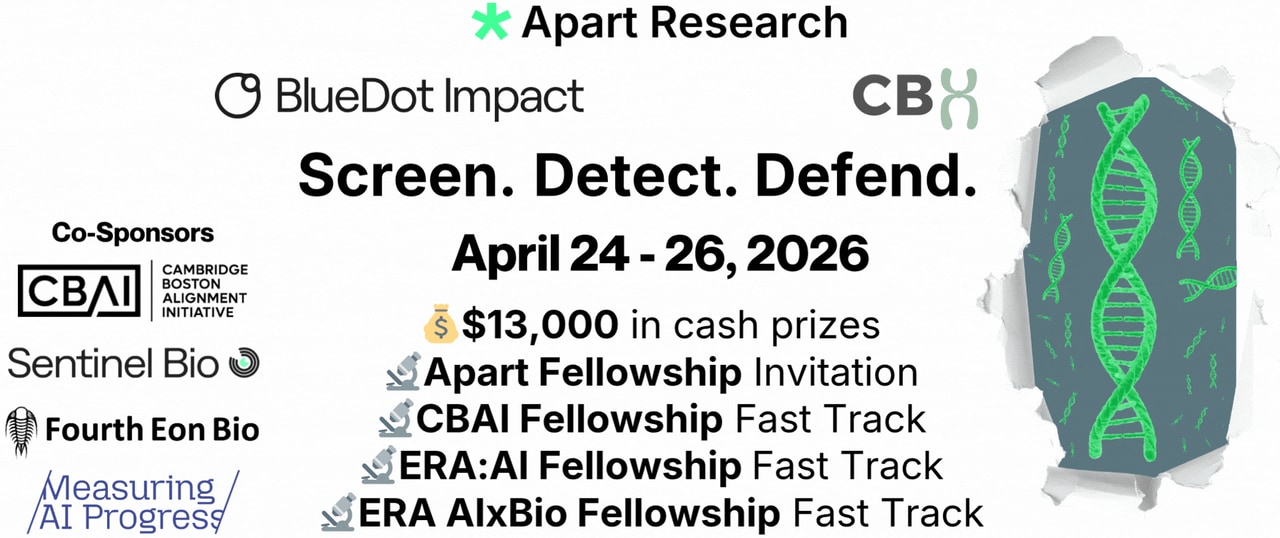
Apr 24 - 26, 2026Online and in person
AIxBio Hackathon
This Sprint has ended.
- Sign-ups
- 595
Projects from this Sprint are not published on the site.
A weekend hackathon on AI and biosecurity: DNA synthesis screening, pandemic early warning, and practitioner tools.
Overview
The AIxBio Hackathon brings together researchers, engineers, biosecurity professionals, and AI safety enthusiasts to work on one of the most urgent intersections in safety: how AI is changing biological risk, and what we can build to stay ahead.
Over three days, participants will develop tools, prototypes, and research addressing real gaps in biosecurity infrastructure, from DNA synthesis screening and pandemic early warning systems to practitioner tools that don't exist yet.
Coefficient Giving opened a new biosecurity Request for Proposals and expects to direct over $100M to biosecurity this year. Conor McGurk, Chief of Staff, Biosecurity, is joining us on Thursday, April 23, 2026 at 3pm ET with a 15-minute talk on what their team is prioritizing for funding and what strong Expressions of Interest look like. (Check resources tab for more info)
The hackathon ends Sunday, April 26, 2026. The RFP closes Monday, May 11, 2026 at 11:59pm PT. That leaves two weeks to develop a hackathon idea into a 500-word EOI. See the Resources tab for the example projects Conor highlighted.
Organized by
Apart Research | BlueDot Impact | Cambridge Biosecurity Hub
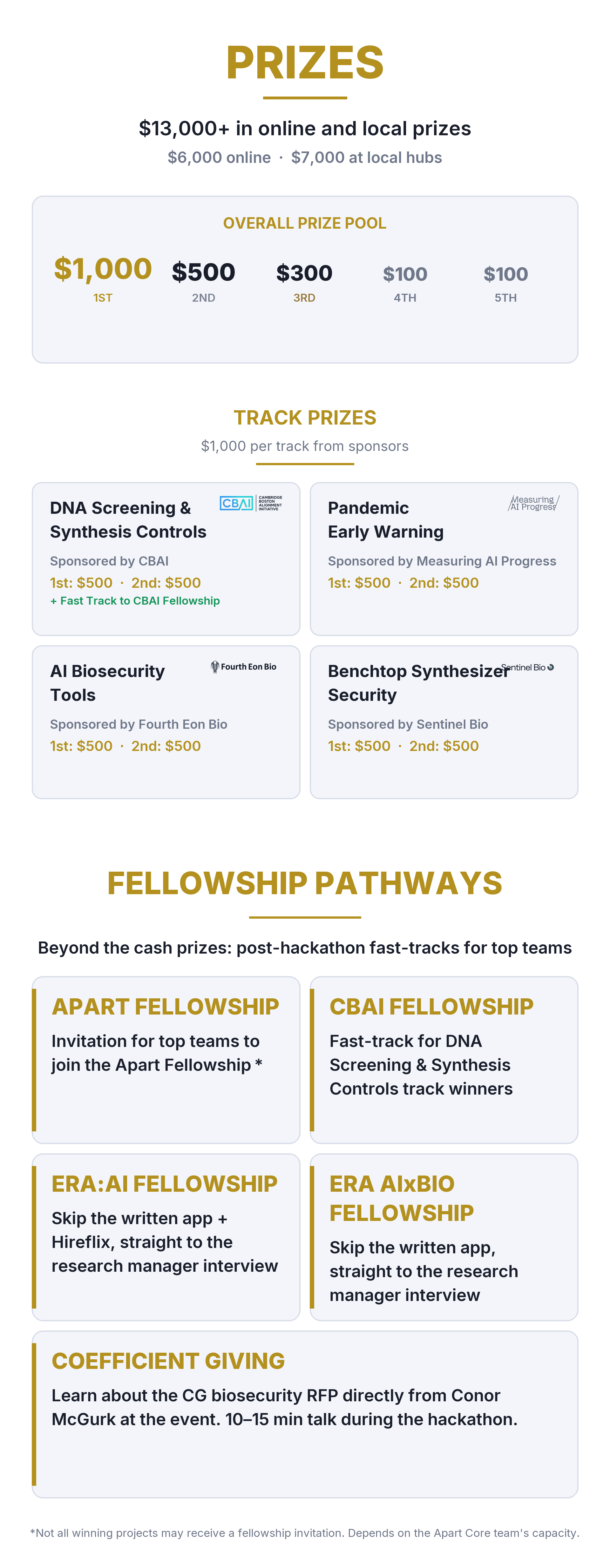
Track sponsors: CBAI (DNA Screening & Synthesis Controls) | Measuring AI Progress (Pandemic Early warning) | Fourth Eon Bio (AI Biosecurity Tools) | Sentinel Bio (Benchtop Synthesizer Security)
What is AIxBio?
AI is transforming biology faster than biosecurity can keep up. Open-weight biological foundation models like Evo2 (a DNA language model, 40B parameters, trained on 128,000+ genomes) and protein design tools like RFdiffusion are making it possible to design novel biological sequences with less expertise than ever before. At the same time, benchtop DNA synthesizers are approaching the capability to print virus-length sequences (expected within 2-5 years), and current screening infrastructure covers only a fraction of global synthesis capacity.
On the defensive side, pathogen-agnostic metagenomic surveillance is finally becoming practical. Wastewater monitoring can detect outbreaks weeks before hospitals see cases. AI anomaly detection could identify engineered pathogens in sequencing data. But most of these tools are siloed, under-resourced, or still in the research phase. The field needs builders.
Hackathon Tracks
1. DNA Screening & Synthesis Controls (sponsored by CBAI)
Build better tools for screening DNA synthesis orders from commercial providers, detecting dangerous sequences, and creating guardrails for AI-powered biological design tools. Current screening misses AI-designed protein variants and struggles with short sequences. For projects focused on benchtop synthesizer security, see Track 4.
2. Pandemic Early Warning (sponsored by Measuring AI Progress)
Develop AI-powered surveillance, anomaly detection, and data integration tools for catching outbreaks earlier. Wastewater monitoring, metagenomic sequencing, and open-source disease intelligence are all ripe for better tooling.
3. AI Biosecurity Tools (sponsored by Fourth Eon Bio)
Build the tools that biosecurity practitioners actually need: unified dashboards, rapid risk assessment systems, policy trackers, secure communication tools, and accessible resources for under-resourced institutions.
4. Benchtop Synthesizer Security (sponsored by Sentinel Bio)
Build security infrastructure for benchtop DNA synthesizers before they reach dangerous capability thresholds: phone-home screening, tamper-proof hardware, split order detection, and customer verification. No mandatory screening exists today, but US and EU legislative momentum is opening a window to change this.
Who should participate?
- AI safety researchers and engineers
- Biosecurity and public health professionals
- Machine learning researchers interested in biological applications
- Security researchers and red teamers
- Policy researchers working on biogovernance
- Software engineers interested in building safety infrastructure
- Students and early-career researchers exploring biosecurity
No prior biosecurity experience is required. The Resources tab has a curated reading list organized by track. Teams typically form at the start of the event.
What you will do
Over three days, you will:
- Form teams and choose a challenge track
- Research and scope a specific problem using the provided resources
- Build a project: a tool, prototype, evaluation, or research contribution
- Submit a research report (PDF) documenting your approach, results, and implications
- Have your work reviewed by judges from leading biosecurity and AI safety organizations
What happens next
After the hackathon, all submitted projects will be reviewed by expert judges. Top projects receive prizes and are featured on the Apart Research website. Outstanding work may be invited for further development, publication, or presentation at upcoming events.
Why join?
Apart Research has organized 55+ research sprints with 7,000+ participants across 200+ global locations. Co-organized with BlueDot Impact and Cambridge Biosecurity Hub, with track sponsorship from CBAI, Sentinel Bio, Fourth Eon Bio, and Measuring AI Progress. Our hackathons produce real research output: published papers, new research collaborations, and contributions to open-source safety tools used across the field.
Resources
This resources page provides curated reading material, tools, and project ideas organized by hackathon track. You do not need to read everything here. Start with the "Essential Reading" section for your chosen track, explore the tools you plan to use, and dive deeper into specific papers as your project takes shape.
Coefficient Giving Biosecurity RFP (closes May 11, 2026)
Coefficient Giving's biosecurity RFP is accepting Expressions of Interest through Monday, May 11, 2026 at 11:59pm PT. EOIs are short (500 words max). Coefficient Giving expects to direct over $100M to biosecurity this year. Applications are open to individuals and organizations, including those working in academia, nonprofits, industry, or independently.
Conor McGurk (Chief of Staff, Biosecurity at Coefficient Giving) opens the hackathon on Thursday, April 23, 2026 at 3pm ET with a preview of what strong EOIs look like.
Example projects Conor highlighted from the RFP
These are hypothetical example projects in the RFP's "Tech safeguards and governance" category, which Conor pointed to as where hackathon projects align best. The list below is illustrative, not exhaustive. Any project that fits the RFP is welcome.
- "Rule-in" AI capability evaluations. Test whether frontier AI models can assist experts at novel dangerous pathogens.
- Red-teaming misuse safeguards. Evaluate whether a well-resourced group could circumvent current safeguards at frontier AI companies through jailbreaks, know-your-customer bypasses, or access-control failures.
- LLM classifiers for biology misuse detection. Improve the ability of classifiers to distinguish legitimate research queries from misuse attempts.
- AI-accelerated biosecurity defenses. Apply AI to patch vulnerabilities in DNA synthesis screening, know-your-customer policies, and other safeguards.
- Resilient AI safeguards. Investigate whether safeguards could be put in place such that AI bioweapon capabilities become harder to distill or jailbreak than other safeguards.
- Open-weight catch-up analysis. Empirical tracking of how fast open-weight models are reaching frontier capability on specific bioweapon-relevant tasks.
- Biological dataset bottleneck analysis. Empirical work on whether specific biological training datasets are real bottlenecks for dual-use capability, or whether equivalent data is available elsewhere.
Coefficient Giving has previously funded SecureBio's work on evaluating the capabilities of AI systems in biology research, and the Nuclear Threat Initiative's development of the Common Mechanism for gene synthesis screening.
Turning a hackathon project into an EOI
- Pick a direction that fits the RFP. The examples above are a starting point, not a bounded menu.
- Build the prototype over the three hackathon days.
- After the event, write a 500-word Expression of Interest describing the project and what funding would unlock.
- Submit through the RFP page before May 11, 2026.
- Questions: bio-rfp@coefficientgiving.org
Readings for All Tracks
- "Biosecurity in the Age of AI" (Belfer Center, 2024) - Overview of how AI capabilities intersect with biological risk, covering both offensive and defensive applications.
- NTI | bio "Developing Guardrails for AI Biodesign Tools" - Recommends built-in guardrails (screening I/O, curated training data) and managed access paradigms.
- JHU Center for Health Security "Biosecurity Guide to AI Action Plan" (2025) - Recommends prioritizing biosecurity risks, formal governance for models enabling pandemic-level risks.
- CSIS "Eight Commonsense Actions for Biosafety and Biosecurity" (2025) - Bipartisan recommendations including integrating biosurveillance into infrastructure and establishing AI-powered threat forecasting.
Track 1: DNA Screening & Synthesis Controls (sponsored by CBAI)
Build better tools for screening DNA synthesis orders from commercial providers, detecting dangerous sequences, and creating guardrails for AI-powered biological design tools. For benchtop synthesizer-specific projects, see Track 4.
Current screening infrastructure has critical gaps. AI-designed protein variants can evade sequence-based screening. False positive rates at short sequence lengths drive up manual review costs. Regulatory frameworks for synthesis screening remain incomplete, and approximately 20% of global synthesis capacity operates outside voluntary screening frameworks.
Essential Reading
- SecureDNA Documentation - Free, open-source screening platform using cryptographic DOPRF. Detects sequences as short as 30bp.
- IBBIS Common Mechanism (commec) - Free, open-source HMM-based biorisk screening. Best performance above 150bp.
- "Strengthening nucleic acid biosecurity screening against generative protein design tools" (Microsoft et al., Science, Oct 2025) - AI-designed synthetic variants slipped through screening undetected. Cross-sector team developed patches.
- OSTP Framework for Nucleic Acid Synthesis Screening (April 2024) - Federal guidance requiring compliant providers for funded research. Effective April 29, 2025.
- Biosecurity Modernization and Innovation Act of 2026 (S.3741) (Jan 2026) - Bipartisan bill mandating screening by gene synthesis providers and establishing NIST biotechnology governance sandbox.
Further Reading
- NTI "Framework for Managed Access to Biological AI Tools" - Proposes tiered access from open-source to closed, with screening at each level.
- "A Biosecurity Agent for Lifecycle LLM Biosecurity Alignment" (2025) - Four-mode framework (dataset sanitization, preference alignment, runtime guardrails, automated red teaming). Reduced attack success from 59.7% to 3.0%.
- Responsible AI x Biodesign - 180+ AI developers and 150+ scientists from 28 countries signed commitments on responsible use.
- Global Risk Index for AI-enabled Biological Tools (RAND/CLTR, Sep 2025) - Framework assessing biodesign tools by capability, misuse potential, accessibility, and maturity.
Example Projects
- Build function-prediction-based screening that flags sequences by predicted biological function rather than sequence similarity alone
- Build a biosecurity screening layer for biology-focused LLM interfaces (input/output filtering)
- Prototype a managed access wrapper for an open-source biodesign tool (e.g., ProteinMPNN) with tiered permissions based on user vetting
- Create an ML-based system to reduce false positive rates in short-sequence screening, cutting manual review burden
- Develop a pipeline to identify and flag hazardous sequences in biological training datasets
- Use AI to patch specific vulnerabilities in DNA synthesis screening pipelines, building on the Microsoft, IBBIS, and SecureDNA cross-sector work on AI-designed protein variants published in Science
- Empirical analysis of whether specific biological training datasets are real bottlenecks for dual-use capability, or whether equivalent data is available elsewhere
Track 2: Pandemic Early Warning (sponsored by Measuring AI Progress)
Essential Reading
- SecureBio / Nucleic Acid Observatory - Pathogen-agnostic metagenomic surveillance. 31 sites, 19 cities.
- "Pandemic monitoring with global aircraft-based wastewater surveillance networks" (Nature Medicine, Feb 2025) - Modeled global pandemic monitoring via airplane wastewater.
- CDC National Wastewater Surveillance System (NWSS) - COVID-19, influenza, RSV, mpox monitoring. Critical funding issues with COVID supplemental expiring.
- Go.Data (WHO) - Open-source outbreak response and contact tracing platform. Went open-source April 2024.
- SORMAS (HZI) - Open-source surveillance and outbreak response system. Built during 2014 Ebola outbreak.
Further Reading
- WaSPP (Wastewater Surveillance for Pandemic Prevention) - International network launched mid-2025 standardizing methods across Africa, Asia, Europe.
- Biobot Analytics - Commercial wastewater surveillance measuring 51 substances. Detects trends 2 weeks before hospital data.
- "Biothreat Radar" CDC FY2026 Budget Proposal - $52M for metagenomic sequencing at 5 wastewater sites and 13 airports. Could detect novel pathogens before 12 in 100,000 infected.
- ProMED-mail - Qualitative outbreak reporting system, ~80,000 subscribers in ~200 countries, 24/7 staff from 30+ countries.
Example Projects
- Build an ML anomaly detection system for metagenomic sequence data from wastewater surveillance
- Develop a classifier that flags sequences with engineering hallmarks (foreign material, cloning scars, resistance cassettes) in metagenomic data
- Build an open-source disease intelligence platform using public data (WHO reports, ProMED, news APIs, flight data) as an alternative to proprietary tools like BlueDot
- Create an automated alert pipeline: sequence data in, actionable notification out, with confidence scoring
- Build a data integration dashboard aggregating surveillance from multiple sources (NWSS, clinical, news, social media)
- Prototype privacy-preserving data sharing protocol for cross-jurisdictional surveillance using differential privacy or federated learning
- Add an ML-based anomaly detection or forecasting module to an open-source tool like SORMAS or Go.Data
Track 3: AI Biosecurity Tools (sponsored by Fourth Eon Bio)
Fourth Eon Bio project ideas => Link
Essential Reading
- CSIS "Eight Commonsense Actions for Biosafety and Biosecurity" (2025) - Bipartisan recommendations for integrating biosurveillance, strengthening cyber-bio infrastructure, establishing AI threat forecasting.
- Global Risk Index for AI-enabled Biological Tools (RAND/CLTR, Sep 2025) - Structured framework for assessing biodesign tool risks. First attempt at repeatable, scalable methodology.
- Biosecurity Vulnerability Scan - Web tool for identifying organizational biosecurity gaps across eight pillars.
- NTI BIRRI Project (2025, Amsterdam) - Global experts on DNA synthesis screening, AIxBio capabilities, and mirror life risks.
Further Reading
- BioRAMs (Sandia National Labs) - Laboratory biosafety and biosecurity risk assessment models.
- NIEM (National Information Exchange Model) - Common vocabulary for cross-agency data exchange.
- WHO Outbreak Toolkit - Comprehensive guides for field investigators in resource-limited settings.
- ASPR TRACIE - HHS technical resources for health emergency management.
Example Projects
- Build a unified biosecurity dashboard pulling from surveillance, news, synthesis screening, and policy feeds
- Create a rapid risk assessment tool: input a new AI model or capability, output a structured threat assessment based on existing frameworks (RAND, Sandia, IBBIS)
- Build an open-source threat intelligence aggregator for biosecurity (like "VirusTotal for bio")
- Prototype a biosecurity policy tracker monitoring regulatory changes across jurisdictions
- Develop a lightweight, offline-capable screening or risk assessment tool for low-resource settings
- Build a cyberbiosecurity vulnerability scanner for lab information systems and sequence databases
- Create a gamified lab biosecurity self-assessment tool that institutions can run quarterly
- "Rule-in" AI capability evaluations: can frontier models assist experts at novel dangerous pathogens?
- Red-team misuse safeguards (jailbreaks, know-your-customer, access controls) at frontier AI companies and biological AI tool providers
- Build better LLM classifiers for biology misuse detection, tested against adversarial prompts
- Investigate whether model-level safeguards can make bioweapon-relevant capabilities harder to distill or jailbreak than other safeguards
- Empirical tracking of how fast open-weight models are catching up on specific bioweapon-relevant capabilities
Track 4: Benchtop Synthesizer Security (sponsored by Sentinel Bio)
Benchtop DNA synthesizers are approaching the capability to synthesize significant portions of viral genomes in the next few years. Today, no mandatory sequence or customer screening exists beyond export controls, but recent legislative momentum in the US and EU is opening a window to change this. This track focuses on building the security infrastructure needed to secure benchtops, such as phone-home screening, hardware security, and split order detection. Sentinel Bio is a non-profit philanthropic fund that supports and incubates projects in biotech governance, including AI-enabled biology and nucleic acid synthesis screening.
Example Projects
- Design an on-device record-keeping system for benchtop synthesizers: compress synthesis logs for secure on-device storage and later auditing, like an aircraft black box for DNA synthesis. See Baker & Church in "Protein design meets biosecurity" and Jonas Sandbrink on record-keeping for strong attribution.
- Build on-device split order detection: given a device's synthesis history, flag when sequences could be assembled into a sequence of concern. A valid finding may be that local-only detection is insufficient and sequences need to be checked against a shared online database.
- Research tamper-evident or tamper-proof approaches for benchtop devices: survey the most tamper-proof laboratory devices available today, assess viability and cost for benchtop synthesizers. See the tamper-proofing mitigations in the IFP report on Securing Benchtop DNA Synthesizers.
- Map the reagent supply chain for know-your-customer feasibility: determine which current benchtop devices use generic vs. proprietary dNTPs, whether enzymatic or chip-based synthesis changes the picture, and whether standardized customer screening for reagent purchases is viable. See IFP recommendations and UK screening guidance on reagent tracking.
- Prototype on-device authentication and authorization for researchers approved to work with sequences of concern: address spoofing and privilege escalation threats. See SecureDNA Exemption Certificates for one approach using hardware keys and biosafety officer approvals.
Project ideas contributed by Tessa Alexanian, with additions by Lucas Boldrini.
Essential Reading
- Securing Benchtop DNA Synthesizers (IFP) - Covers benchtop biosecurity risks and technical mitigations including tamper-proofing, phone-home screening, and reagent supply chain controls.
- SecureDNA Documentation - Free, open-source screening platform using cryptographic DOPRF. Detects sequences as short as 30bp.
- IBBIS Common Mechanism (commec) - Free, open-source HMM-based biorisk screening. Best performance above 150bp.
- "Strengthening nucleic acid biosecurity screening against generative protein design tools" (Microsoft et al., Science, Oct 2025) - AI-designed synthetic variants slipped through screening undetected. Cross-sector team developed patches.
- OSTP Framework for Nucleic Acid Synthesis Screening (April 2024) - Federal guidance requiring compliant providers for funded research. Effective April 29, 2025.
- Biosecurity Modernization and Innovation Act of 2026 (S.3741) (Jan 2026) - Bipartisan bill mandating screening by gene synthesis providers and establishing NIST biotechnology governance sandbox. First US legislation with enforcement teeth ($500K individual / $750K org penalties).
- "Regulatory Gaps in Benchtop Nucleic Acid Synthesis Create Biosecurity Vulnerabilities" (Arms Control Association, Nov 2025) - How current regulations fail to address benchtop synthesizers, worsened by the expired OSTP revision deadline.
- "Benchtop DNA Synthesis Devices: Capabilities, Biosecurity Implications, and Governance" (NTI, 2023) - The foundational report calling for customer vetting, built-in screening software, and mandatory government regulations for benchtop devices.
- "Assembling unregulated DNA segments bypasses synthesis screening: regulate fragments as select agents" (Edison, Toner & Esvelt, Nature Communications, Jan 2026) - MIT researchers acquired unregulated DNA fragments from dozens of providers sufficient for a skilled individual to generate 1918 influenza. Demonstrates that fragment-level regulation is needed.
- "Analysis of the Security Design, Engineering, and Implementation of the SecureDNA System" (Sherman et al., NDSS 2026) - First formal security analysis of SecureDNA. Found that the mutual authentication protocol achieves only one-way authentication, enabling rate-limit circumvention. Relevant for anyone building on-device screening.
- "AI Can Already Evade DNA Synthesis Screening. Congress's New Bill Doesn't Address That." (Sophie Kim, Mar 2026) - Gap analysis of S.3741. The bill mandates homology-based screening but doesn't address AI-designed functional variants or benchtop devices adequately.
Further Reading
- "Why We're Doubling Down on Synthesis Screening" (Sentinel Bio, Feb 2026) - After evaluating 200+ physical chokepoints, Sentinel Bio concludes synthetic DNA remains the best intervention point. Also identifies pathogen repositories, CROs, and cloud labs as promising complementary chokepoints.
- "Guidelines for Nucleic Acid Synthesis Screening in Europe" (Pour Demain, Mar 2026) - Policy brief on the EU Biotech Act's mandatory screening proposal, the most ambitious screening legislation globally.
- DNA Synthesis Screening: The Critical Chokepoint (Biosecurity Handbook, Bryan Tegomoh, 2025) - Educational overview of how screening works, key gaps (oligonucleotides, benchtop, unscreened capacity), and the regulatory timeline from 2010 to present.
Tools and Platforms
Screening
- SecureDNA - Free, open-source DNA sequence screening.
- IBBIS Common Mechanism (commec) - Free, open-source HMM-based biorisk screening.
Surveillance and Outbreak Response
- Go.Data (WHO) - Open-source contact tracing and outbreak response.
- SORMAS (HZI) - Open-source surveillance and outbreak management.
- STEM - Open-source spatiotemporal epidemiological modeler (archived, but codebase still available).
- ProMED-mail - Global disease outbreak reporting.
- GenBank / NCBI - Sequence data repositories.
Biodesign Tools (for building guardrails around)
- ProteinMPNN - Protein sequence design. Track 1 participants may build screening or access controls for tools like this.
- RFdiffusion - Protein structure generation.
- AlphaFold 3 (DeepMind) - Protein structure prediction.
Community Tools
- BINTEX - AI-powered drug discovery and literature analysis platform. Queries PubMed, OpenTargets, ChEMBL, ClinicalTrials.gov, and UniProt with multi-perspective LLM synthesis.
Guidelines
Judging Criteria
Dimension 1: Impact Potential & Innovation
How much would this matter for biosecurity if it worked? How innovative is it?
For scores of 4-5: is this actually new to the field, or replicating recent work?
| Score | Description |
|---|---|
| 1 | Negligible. No clear problem addressed, or no meaningful novelty. |
| 2 | Limited. Addresses a real problem but with a generic or well-trodden approach. Incremental at best. |
| 3 | Moderate. Clear problem with a reasonable approach; some novelty in framing or method beyond routine application of existing tools. |
| 4 | Significant. Important problem with an original approach, or identifies a neglected problem area. A valuable contribution others could build on. |
| 5 | Exceptional. Tackles a critical AI safety problem with a genuinely novel approach, or opens a new research direction. Clear theory of change. You'd be excited to share this with researchers in the area. |
Dimension 2: Execution Quality
How sound are methodology, implementation, and findings?
| Score | Description |
|---|---|
| 1 | Seriously flawed. Methodology broken, results uninterpretable, or implementation doesn't work. |
| 2 | Weak. Approach has significant gaps: missing validation, flawed experimental design, or incomplete implementation. |
| 3 | Competent. Technically solid given the short duration. Methodology makes sense, results are interpretable, limitations acknowledged, work builds toward clear conclusions. |
| 4 | Strong. Thorough methodology with convincing validation. Results clearly support conclusions. Immediately useful for future work. |
| 5 | Exceptional. Ambitious scope executed rigorously. Surprising findings, novel methods, or unusually robust validation. |
Dimension 3: Presentation & Clarity
How clearly are work, findings, and impact potential communicated?
| Score | Description |
|---|---|
| 1 | Incomprehensible. Cannot determine what the project is actually claiming or doing. |
| 2 | Hard to follow. Key information buried, missing, or diluted by excessive length. Significant effort to extract main points. |
| 3 | Clear enough. Can understand the problem, approach, and results without undue effort. Core content clearly present: problem, method, findings, limitations. |
| 4 | Well presented. Easy to follow, well-structured, appropriate level of detail. Target audience would get it quickly. |
| 5 | Exceptionally clear. A pleasure to read. Complex ideas made accessible. Could serve as a model for how to present this type of work. |
Submission Requirements
A complete submission includes:
- A research report in PDF format using the official submission template
- A project title and brief abstract (150 words max)
- Author names and affiliations for all team members
- Link to a public GitHub repository with your code (recommended - optional)
- A brief (3-5 minute) video demonstration of your solution (optional)
Important: Include an appendix called "Limitations and Dual-Use Considerations" that addresses:
- Limitations (false positives/negatives, edge cases, scalability constraints)
- Dual-use risks (could your tool or findings be misused to cause harm?)
- Responsible disclosure recommendations (if vulnerabilities were discovered)
- Ethical considerations in your approach
- Suggestions for future improvements
Report structure (recommended):
There is no hard page limit. Most winning projects are 4-8 pages. The report should include:
- Introduction: What problem did you address? Why does it matter for biosecurity?
- Related Work: What existing work does your project build on?
- Methodology: What did you build or test? Describe your approach in enough detail for someone to replicate it
- Results: What did you find? Include quantitative results where possible
- Discussion: What are the implications? What are the limitations? What would you do with more time?
- References: Cite relevant prior work
Important notes:
- You can submit as an individual or as a team
- You can build on existing work, but you MUST clearly identify what is NEW work done during the hackathon
- If you need to fix your submission, submit again using the exact same title and details. Your new files will replace the old ones.
- Submit through the official submission form on the hackathon page
- If you run into submission issues, DM Kamil on Discord or email sprints@apartresearch.com
- Before submitting, gather all your info in a separate document so you can copy-paste into the form: team member names, emails, Discord handles, project title, abstract, and your PDF. If you have extras like a presentation, GitHub link, or images, have those ready too. Triple-check everything before hitting submit.
- Due to the high volume of submissions, we cannot guarantee written feedback for every participant, although all projects will be evaluated.
Submission Template => Link
Discord Server Invite => Link
Frequently Asked Questions
Getting Started
Q: How does the hackathon work? A: Sign up, join the Discord server, form or join a team (or work solo), pick a direction, build your project over three days, and submit a research report (PDF) by the deadline. Talks and Q&A sessions run throughout the event.
Q: How long is the hackathon? A: Three days, April 24-26, 2026. Submissions are due end of day Sunday Anytime on Earth (AoE), the last day of the event. The full schedule with speaker times is on the Schedule tab.
Q: Can I participate remotely? A: Yes. The hackathon is hybrid: in-person hubs run in select cities, and full remote participation is available. All talks, collaboration, and submissions happen online through Discord and Zoom, so remote participants have the same experience.
Q: How do teams work? A: Teams form before or during the hackathon. Check the team-forming channels on Discord to find collaborators. Solo participation is fine. We recommend teams of up to 5, but larger groups are allowed.
Q: Do tracks affect scoring? A: All projects are scored on the same rubric regardless of track. However, Tracks 1 and 4 have sponsor-specific prizes ($1,000 each), so your track choice may affect which prizes you are eligible for. You can still work on something that spans multiple tracks.
Q: Do I get compute credits? A: No, not for this one. Compute clouds have been booked solid for weeks, so we couldn't lock in credits in time.
Q: Do I need biosecurity experience? A: No. Many participants come from ML, software engineering, or AI safety backgrounds. The Resources tab has everything you need to get up to speed, and speakers will provide context during the event.
Q: Are the talks recorded? A: Yes. Recording links are shared in the Schedule tab above.
Q: What timezone are deadlines in? A: Submissions close Sunday April 26 at 11:59 PM Anytime on Earth (AoE).
Q: Do I need to attend all three days? A: No. You can work at your own pace. Talks are optional but recommended. The only hard deadline is the submission cutoff on Sunday.
Q: Can I participate from any country? A: Yes. The hackathon is open globally. In-person hubs are available in select cities, and full remote participation is supported.
Submissions
Q: What do I submit? A: A research report in PDF format using the submission template. Think of it as a mini research paper documenting your problem, approach, results, and implications. Not a product demo.
Q: Which submission template should I use? A: Always use the one linked on the Guidelines tab of the hackathon website. The template in the acceptance email may be an older or minimal version.
Q: Will I get a confirmation after submitting? A: If the website shows you a "Your project has been submitted" message, then your submission went through. If you don't see that confirmation, try again or DM Kamil on Discord.
Q: My project doesn't show up on the website after submitting. A: Submissions are reviewed and published manually. It can take up to 12 hours for your project to appear on the website. If it is still missing after that, email sprints@apartresearch.com.
Q: I submitted a duplicate by accident. A: DM Kamil on Discord with your project title. He will keep the correct submission and delete any extras.
Q: I made a mistake in my submission. Can I fix it? A: Submit again using the exact same title and exact same details, just fix what was wrong. Your new PDF and files will replace the old ones. If you're unsure, DM Kamil on Discord first.
Q: Can I fix my PDF after submitting? A: Yes. Submit again using the exact same title and exact same details, just upload the corrected PDF. The new submission will replace the old one. If you're unsure, DM Kamil on Discord first.
Q: Can I add team members after submitting? A: Yes. You can update team members through the submission form on the website. If you need help, DM Kamil on Discord.
Q: Can I submit an unfinished project? A: Yes. Submitting something unfinished is always better than not submitting. Judges evaluate what you accomplished during the hackathon timeframe.
Q: Can I build on existing research? A: Yes, but you must clearly identify what is new work done during the hackathon. Projects with significant undisclosed prior work will be disqualified, even from top prize positions. If a judge or organizer contacts you about prior work concerns, respond promptly. Failure to respond may result in disqualification.
Q: Can I submit multiple projects? A: Yes, but each project needs its own submission with a unique title. Most participants focus on one project.
Q: What if a team member drops out? A: You can still submit with the remaining members. Update the team member list in your submission. If you need help, DM Kamil on Discord.
Judging and Results
Q: How does judging work? A: Your project is assigned to 2-3 expert judges who review your PDF and score it on the three dimensions above. Judges typically have about one week after the event to complete reviews.
Q: Where is the scoring rubric? A: Above on this page.
Q: Are individual judge scores shared? A: No. The rubric is public, but individual scores are internal. Constructive feedback from judges is shared with participants without reviewer names.
Q: When will results be announced? A: Typically 1-2 weeks after the judging deadline. Winners are contacted directly. All participants receive reviewer feedback by email.
Support
Q: How do I get help during the hackathon? A: Three ways:
- Discord help-desk channel (tag @Kamil Alaa)
- DM Kamil on Discord
- Email: sprints@apartresearch.com
Schedule
| Wed Apr 22 (pre-hackathon) | |
|---|---|
| 15:00 UTC | Alex Kleinman · Recording |
| 17:00 UTC | Gene Olinger · Recording |
| Thu Apr 23 (pre-hackathon) | |
| 14:00 UTC | James Black · Recording |
| 15:00 UTC | Cassidy Nelson · Recording |
| 19:00 UTC | Conor McGurk, Coefficient Giving · Recording |
| Fri Apr 24 (Main Day) | |
| 13:00 UTC | Kevin Esvelt (keynote) · Recording |
| 14:00 UTC | Coleman Breen · Recording |
| 16:00 UTC | Oliver Crook (keynote) · Recording |
| 17:00 UTC | Steph Guerra · Recording |
| 18:00 UTC | Jaime Yassif (keynote) · Recording |
| Hackathon Logistics Presentation - Recording |
Speakers

Kevin Esvelt
Keynote
Kevin M. Esvelt is an associate professor at the MIT Media Lab, where he directs the Sculpting Evolution Group. In 2013, he was the first to identify the potential for CRISPR gene drive systems to alter wild populations, and he broke with scientific tradition by calling for open discussion and safeguards before any lab demonstrated the technology. His current work focuses on catastrophic biorisk mitigation: he co-founded SecureDNA, a cryptographic platform for universal DNA synthesis screening, and helped develop the Nucleic Acid Observatory, a global early-warning system for biological threats.
Oliver Crook
Keynote
Dr. Oliver Crook is an MRC Career Development Award Fellow and Group Leader at the Kavli Institute for NanoScience Discovery, University of Oxford, and a Todd-Bird Junior Research Fellow at New College. His group develops computational and statistical methods drawing on Bayesian machine learning, structural biology, and AI interpretability, with applications in molecular parasitology, protein design, and biosecurity. Before starting his group in 2025, he was seconded to the UK Government's AI Safety Institute to lead a protein design team.
Jaime Yassif
Keynote
Dr. Jaime Yassif is Senior Advisor for Global Biological Policy and Programs at NTI | bio, where she focuses on governance and safeguards at the intersection of AI and the life sciences. She previously served as Vice President of NTI | bio, overseeing the organization's work to reduce global catastrophic biological risks, and before that as the inaugural Biosecurity and Pandemic Preparedness Program Officer at Open Philanthropy, where she directed approximately $40 million in grants that helped build the modern biosecurity field. Dr. Yassif holds a Ph.D. in Biophysics from UC Berkeley and has advised the U.S. Department of Defense and Department of Health and Human Services on biosecurity policy.

Conor McGurk
Speaker
Conor McGurk is Chief of Staff for Biosecurity & Pandemic Preparedness at Coefficient Giving (formerly Open Philanthropy), where he works on grantmaking strategy across one of the largest philanthropic funders of global catastrophic risk work. Before joining Coefficient Giving in 2025, he co-founded and led the Safe AI Forum, an AI safety nonprofit that organized the International Dialogues on AI Safety series, bringing together Turing Award winners, former heads of state, and leading AI scientists to build consensus on global AI governance. He previously held roles in engineering management at Meta and technology strategy consulting at Deloitte, and holds a BSc in Computer Science and Philosophy from the University of British Columbia
Cassidy Nelson
Speaker
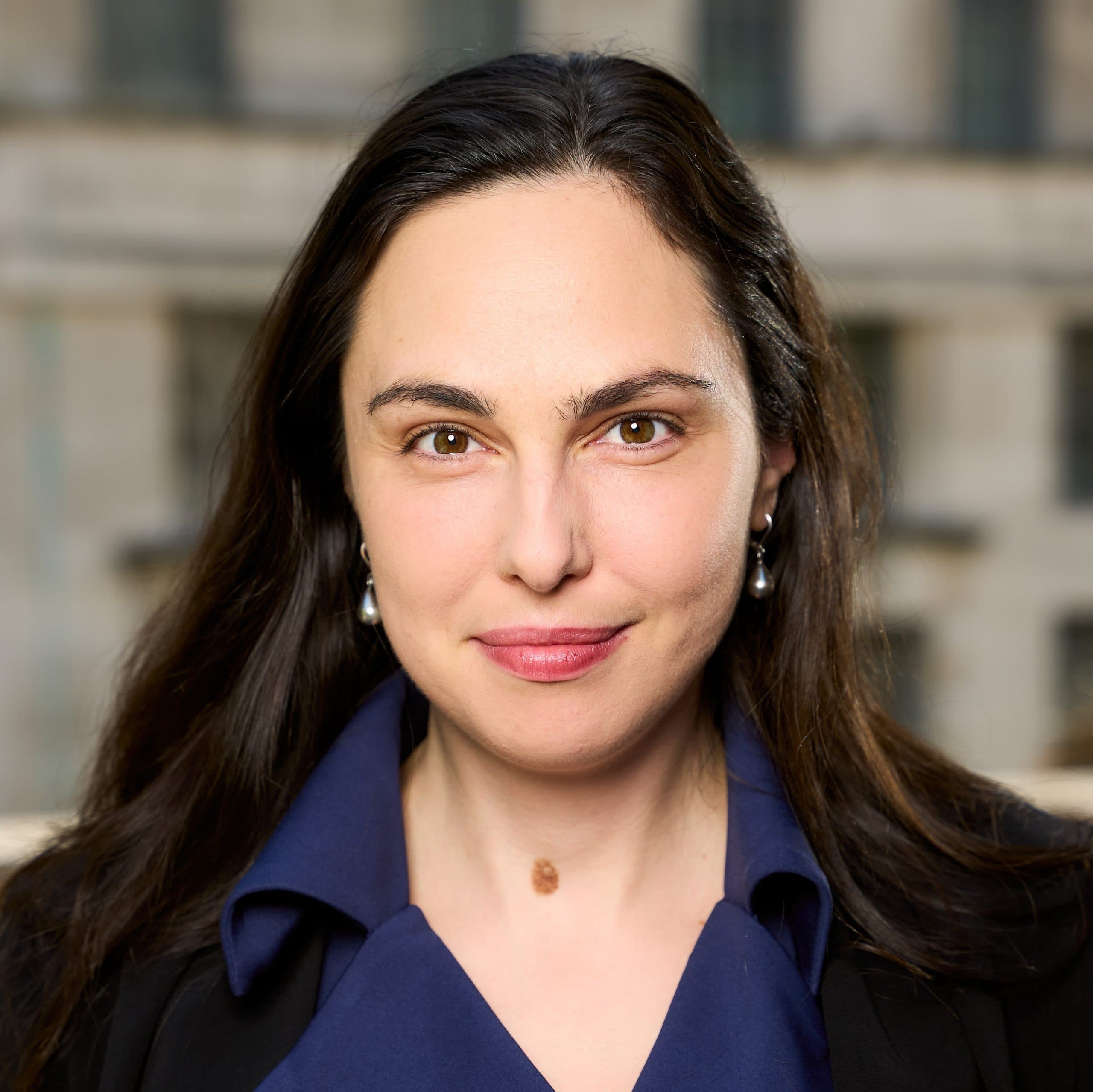
Dr. Cassidy Nelson is the Director of Biosecurity Policy at the Centre for Long-Term Resilience (CLTR), leading a team working to safeguard against pandemics and address extreme biological risks through targeted policy engagement. A dual-trained physician-scientist, she holds a DPhil in Biology from Oxford, an MPH from the University of Melbourne, and a Medical Degree from the University of Queensland. Before CLTR, she spent a decade as a clinician and biosecurity researcher at Oxford, and has advised the WHO and the Bipartisan Commission on Biodefense on health security policy.
Coleman Breen
Speaker
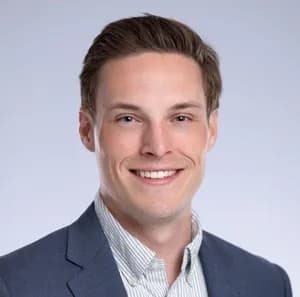
Coleman Breen is a Fellow at the Johns Hopkins Center for Health Security and a Senior AI Policy Researcher at SecureBio, where he works on biosecurity-relevant AI evaluations and policy. He is a PhD candidate in Statistics at UW-Madison, with research focused on the statistical evaluation of genetic sequence machine learning models. His background spans computational biology, AI, and a stint as an AI resident at Google[x] working on agricultural biotechnology.
Show 5 moreShow fewer
Gene Olinger
Speaker
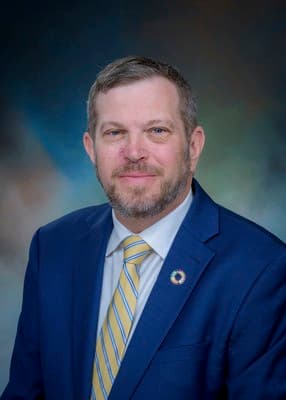
Gene Olinger, PhD, MBA, is the Director of the Galveston National Laboratory and Professor of Microbiology and Immunology at the University of Texas Medical Branch, where he holds the John Sealy Distinguished University Chair in Tropical and Emerging Virology. He brings over 20 years of BSL-3/4 research experience, with a focus on vaccine and therapeutic development for Ebola and other high-consequence emerging pathogens. Before joining UTMB, he served at USAMRIID and NIH NIAID, where he was a key contributor to the development of ZMapp, the Ebola treatment deployed during the West Africa outbreak.
James Black
Speaker
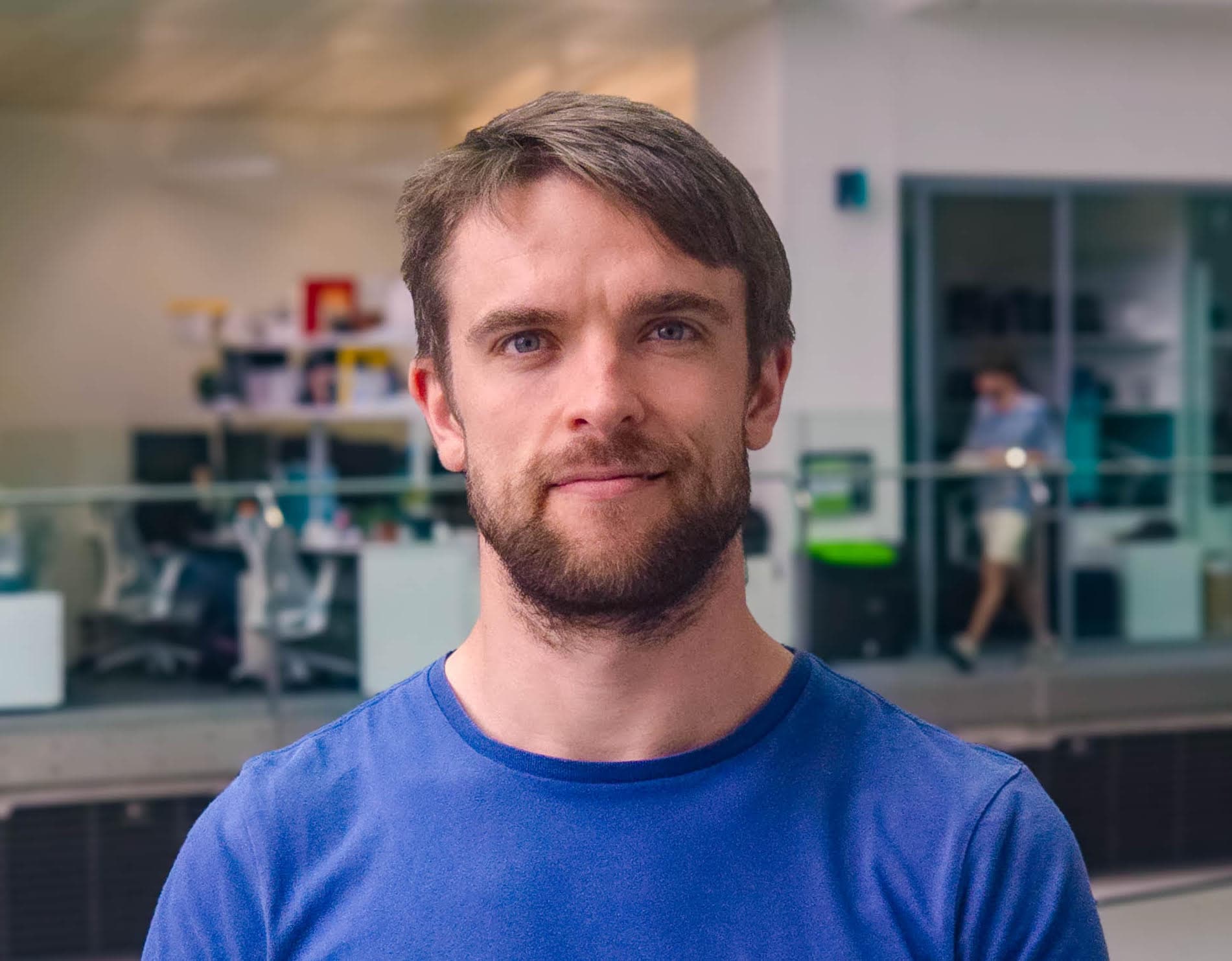
Dr. James Black is a Contributing Scholar at the Johns Hopkins Center for Health Security, where he focuses on technical assessments of AI-enabled biological risks. He trained as a medical doctor at the University of Oxford and Imperial College London, earned his PhD in computational cancer biology from University College London, and completed a postdoctoral fellowship at the Francis Crick Institute.

Jonas Sandbrink
Speaker and Judge
Jonas Sandbrink is Entrepreneur-in-Residence at Sentinel Bio, where he works on researcher credentialing for access to bio-capable AI systems. Previously at the UK AI Security Institute, where he founded the chem/bio evaluations team, the first government program anywhere to assess whether frontier AI models could enable biological or chemical misuse. Before AISI, he advised the UK Cabinet Office and Google DeepMind on biosecurity. He holds a DPhil from Oxford's Nuffield Department of Medicine, where his research examined misuse risks from synthetic virology and AI.
Steph Guerra
Speaker
Dr. Steph Guerra is a molecular biologist and biosecurity expert serving as Senior Biosecurity Research Resident and AIxBio Lead at the RAND Center on AI, Security, and Technology, where she researches the convergence of AI and biotechnology to advance security and the public good. Prior to RAND, she was Head of Strategic Partnerships at the U.S. AI Safety Institute at NIST, where she led efforts to evaluate the national security risks of advanced AI systems, and earlier worked at the White House Office of Science and Technology Policy on biodefense strategy and policy. She holds a PhD in biological and biomedical sciences from Harvard University.

Alex Kleinman
Speaker
Alex Kleinman is Co-founder and Director of Operations at Active Site (formerly Panoplia Labs), a research nonprofit measuring AI's impact on biosecurity risks. He co-led the wet-lab RCT on whether LLMs provide biological uplift to novices, contributed to ABC-Bench (an agentic biosecurity benchmark presented at NeurIPS 2025), and co-authored a study on antibiotic and vaccine countermeasures against mirror bacteria. Before Active Site, he was on the science team at Alvea, working on broad-spectrum vaccines.
Judges and mentors

Jasper Götting
Judge
- (opens in new tab)

Adam Howes
Judge
- (opens in new tab)

Alex Norman
Judge
- (opens in new tab)

Andrew Liu
Judge
- (opens in new tab)

Andy Morgan
Judge
- (opens in new tab)

Benjamin Fefferman
Judge
- (opens in new tab)

Bryan Tegomoh
Judge
- (opens in new tab)

Chris Stamper
Judge
- (opens in new tab)

Christine Parthemore
Judge
- (opens in new tab)

Elian Belot
Judge
- (opens in new tab)

Elise Racine
Judge
- (opens in new tab)

Eva Siegmann
Judge
Show 32 moreShow fewer

Evan Fields
Judge
- (opens in new tab)
Gary Ackerman
Judge
- (opens in new tab)

Hanna Palya
Judge
- (opens in new tab)

Hayley Severance
Judge
- (opens in new tab)

Ian Beatty
Judge
- (opens in new tab)

Ihor Kendiukhov
Judge
- (opens in new tab)

Jack Douglass
Judge
- (opens in new tab)

Joey Bream
Judge
- (opens in new tab)

John O'Brien
Judge

John Wang
Judge

Keri Warr
Judge
- (opens in new tab)

Kevin Flyangolts
Judge
- (opens in new tab)

Laura Bailey
Judge

Lee M. Wall
Judge
- (opens in new tab)

Lennart Justen
Judge
Leonard Foner
Judge
- (opens in new tab)

Lucas Boldrini
Judge
- (opens in new tab)

Manu Shivakumara
Judge
- (opens in new tab)

Max Görlitz
Judge
- (opens in new tab)

Moritz Hanke
Judge
- (opens in new tab)

Nelly Mak
Judge
- (opens in new tab)

P. T. Nhean
Judge
- (opens in new tab)
Piers Millett
Judge
- (opens in new tab)

Ramanpreet Singh Khinda
Judge
- (opens in new tab)

Rassin Lababidi
Judge
- (opens in new tab)

Sana Zakaria
Judge
- (opens in new tab)

Stephen Turner
Judge
Vinoo Selvarajah
Judge

Zachary Kallenborn
Judge
- (opens in new tab)

Zuzanna Matuszewska
Judge

Ahmed Tijani Akinfalabi
Judge
- (opens in new tab)

Miti Saksena
Judge
Organizers






Local sites
Berlin Local Hub
€1000 for winning projects submitted at the Berlin local hub. Join us at the Foresight Institute for the AIxBio Hackathon!
Event page: Berlin Local Hub (opens in new tab)London Local Hub
$3000 for 1st place, $1500 for 2nd place, $500 for 3rd place winning projects submitted at the London local hub. Join us at LISA for the AIxBio Hackathon!
Event page: London Local Hub (opens in new tab)San Francisco Local Hub
$1000 for winning projects submitted at the SF local hub. Join us at the Fold SF for the AIxBio Hackathon!
Event page: San Francisco Local Hub (opens in new tab)
Where a Sprint can lead
How our programs connectAnyone can join
Stand out
6 to 16 weeks on your own project, with a research project manager, compute and publication support.
Upcoming Sprints
All SprintsAI Collusion Research Sprint
A weekend research sprint on collusion between AI agents: when it emerges in markets and everyday workflows, how to detect and audit it, how it is carried, and what breaks it. Co-organized with Poseidon Research and AE Studio, online with in-person hubs at Collider in New York City and AI Safety Hong Kong. Top teams are invited to apply to the Apart Fellowship.
Read the brief: AI Collusion Research SprintSwarm Alignment Hackathon
Alignment can't stop at single models when AI agents start to negotiate, trade and share tools. Spend a weekend uncovering and preventing failures that emerge between multiple agents.
Read the brief: Swarm Alignment HackathonQuestions? sprints@apartresearch.com