-
Online & In-Person
Global South AI Safety Hackathon

AI safety research is concentrated in a handful of countries. This hackathon changes that. Build AI safety tools, evaluations, and policy research from Latin America, Africa, or Asia, compete within your region, and join a pipeline from hackathon to fellowship to placement. With Support from Schmidt Sciences.
14
Days To Go
AI safety research is concentrated in a handful of countries. This hackathon changes that. Build AI safety tools, evaluations, and policy research from Latin America, Africa, or Asia, compete within your region, and join a pipeline from hackathon to fellowship to placement. With Support from Schmidt Sciences.
This event is ongoing.
This event has concluded.
Sign Ups
Overview
Resources
Guidelines
Overview

The Global South AI Safety Hackathon brings together researchers, engineers, and policy professionals across Latin America, Africa, and Asia to work on AI safety problems that matter most in their regions. Over one weekend, participants build tools, evaluations, and policy research addressing gaps the field has overlooked.
The hackathon is designed for and with the Global South. Participants compete within their region, not globally. The best teams from all regions are invited into the Apart Fellowship for continued research and mentorship.
Why the Global South?
AI safety research is concentrated in a handful of countries. None of the top 100 institutions by AI publication index, in either universities or companies, are based in Africa or Latin America (Chan et al., 2021). Meanwhile, AI risks hit differently in these regions: jailbreaks are more common in low-resource languages, and algorithmic bias trained on non-local data shows up in healthcare and hiring deployments.
This hackathon is not about bringing AI safety to the Global South. It is about bringing the Global South into AI safety. Researchers here have contextual knowledge the field needs: regulatory landscapes, language gaps, and institutional constraints that determine whether safety research actually works in practice.
Regional Tracks
Participants compete within their region. Each region has its own winners and prizes. Within each regional track, participants choose a sub-track (Technical AI Safety, AI Governance/Policy, or a locally-tailored sub-track defined by their hub).
Track: Latin America
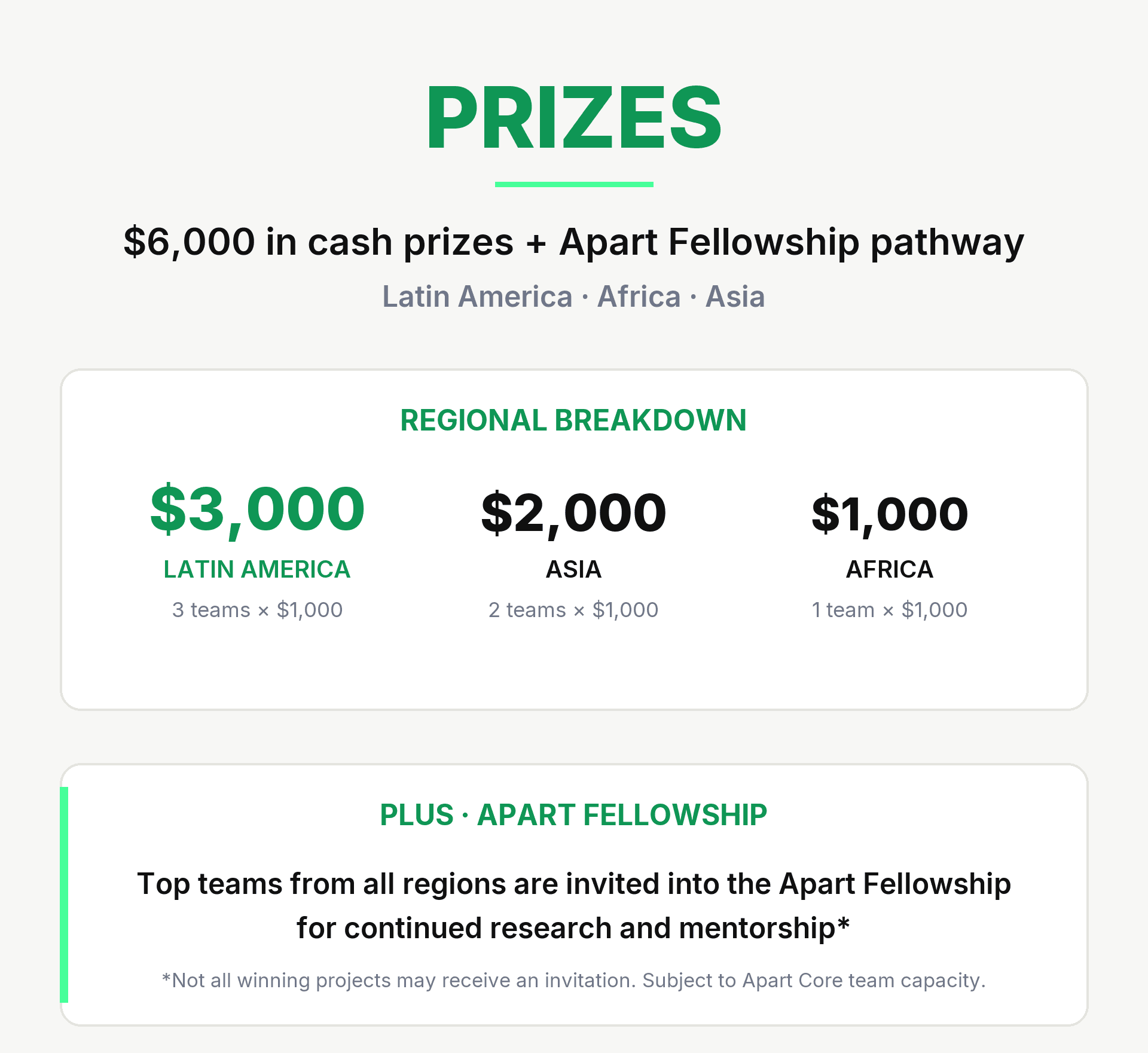
Hubs in São Paulo, Buenos Aires, Bogotá, Mérida, and Guadalajara. Three winning teams ($3,000 total).
Brazil's AI bill (PL 2.338/2023), approved by the Senate and pending Chamber vote, includes a standalone human rights chapter that goes beyond the EU AI Act. Chile became the first country in the world to constitutionally protect neuro-rights. Colombia's CONPES 4144 established a national AI policy framework in early 2025.
We encourage submissions in three sub-tracks:
Technical safety: AI fairness for Portuguese and Spanish language models, safety evaluations for AI systems deployed in Latin American contexts.
Governance: regulatory analysis of emerging legislation across the region.
Locally-tailored: problems defined by your hub that reflect local context.
Open: any other project relevant to AI safety in the region that doesn't fit the categories above.
Track: Africa
Hub in Cape Town. One winning team ($1,000 total).
Africa faces risks from advanced AI that are not addressed through frontier AI safety efforts. African-context deployment-side risks include deepfake-driven electoral interference, data-colonial dependency on foreign infrastructure, compute and semiconductor scarcity constraining sovereign AI capacity, and large-scale labour market disruptions. This hackathon is an opportunity to prototype African-context solutions for misuse resilience, differential defence acceleration, and mitigating gradual disempowerment.
We encourage submissions in three sub-tracks:
Policy: recommendations grounded in African regulatory and institutional contexts.
Evals and benchmarks: work that builds on existing efforts and transfers to African contexts.
Monitoring and tooling: capturing harms that are not yet at the foreground of AI safety.
Open: any other project relevant to AI safety in the region that doesn't fit the categories above.
Track: Asia
Hubs in Bengaluru, India (SAFL), and Vietnam (Hanoi and Ho Chi Minh City). Two winning teams ($2,000 total).
Asia spans the full spectrum of AI governance approaches. India's "Seven Sutras" framework explicitly prioritizes innovation over restraint. China has enacted more sector-specific AI regulations than any other country. Vietnam's AI law took effect in March 2026, the first binding AI legislation in Southeast Asia. The ASEAN Guide on AI Governance and Ethics offers a voluntary regional framework. Projects can address cross-border governance harmonization, safety evaluations for non-English language models, technical AI safety research, or region-specific risk assessments.
We encourage submissions in three sub-tracks:
Governance and geopolitics: AI compliance, AI sovereignty, national data security, compute diffusion and access.
Socio-economic impacts: deepfakes and misinformation, caste bias, algorithmic bias across ethnic minorities, languages, and dialects, AI misdiagnosis in rural healthcare, gig platforms, labor displacement, gradual disempowerment, and cooperative AI.
Technical safety: cybersecurity, multilingual, multimodal, and open-source models, small AI, and on-device AI.
Open: any other project relevant to AI safety in the region that doesn't fit the categories above.
Who should participate?
AI safety researchers and engineers
Machine learning researchers and engineers
Policy researchers working on AI governance
Software engineers interested in safety infrastructure
Security researchers and red teamers
Students and early-career researchers exploring AI safety
Anyone working on AI and its impacts in the Global South
What you will do
Over three days, you will:
Form teams and choose a regional track and sub-track
Research and scope a specific problem using the provided resources
Build a project: a tool, evaluation, policy analysis, or research contribution
Submit a research report (PDF) documenting your approach, results, and implications
Have your work reviewed by judges from AI safety organizations, universities, and policy institutions in your region
What happens next
After the hackathon, all submitted projects are reviewed by expert judges. Top projects receive prizes. The best teams may be invited into the Apart Fellowship for continued research and mentorship (subject to the asterisked caveat in Overview).
Organized by
Apart Research
Local hubs (8):
Latin America: BAISH (Buenos Aires) | EA Brasil (São Paulo) | AI Safety Colombia (Bogotá) | AISMX (Mérida and Guadalajara)
Africa: AI Safety South Africa (Cape Town)
Asia: Electric Sheep (Bengaluru) | SAFL (India) | AnToàn.AI (Hanoi and Ho Chi Minh City)
Supported by Schmidt Sciences.
Sign Ups
Overview
Resources
Guidelines
Overview
The Global South AI Safety Hackathon brings together researchers, engineers, and policy professionals across Latin America, Africa, and Asia to work on AI safety problems that matter most in their regions. Over one weekend, participants build tools, evaluations, and policy research addressing gaps the field has overlooked.
The hackathon is designed for and with the Global South. Participants compete within their region, not globally. The best teams from all regions are invited into the Apart Fellowship for continued research and mentorship.
Why the Global South?
AI safety research is concentrated in a handful of countries. None of the top 100 institutions by AI publication index, in either universities or companies, are based in Africa or Latin America (Chan et al., 2021). Meanwhile, AI risks hit differently in these regions: jailbreaks are more common in low-resource languages, and algorithmic bias trained on non-local data shows up in healthcare and hiring deployments.
This hackathon is not about bringing AI safety to the Global South. It is about bringing the Global South into AI safety. Researchers here have contextual knowledge the field needs: regulatory landscapes, language gaps, and institutional constraints that determine whether safety research actually works in practice.
Regional Tracks
Participants compete within their region. Each region has its own winners and prizes. Within each regional track, participants choose a sub-track (Technical AI Safety, AI Governance/Policy, or a locally-tailored sub-track defined by their hub).
Track: Latin America
Hubs in São Paulo, Buenos Aires, Bogotá, Mérida, and Guadalajara. Three winning teams ($3,000 total).
Brazil's AI bill (PL 2.338/2023), approved by the Senate and pending Chamber vote, includes a standalone human rights chapter that goes beyond the EU AI Act. Chile became the first country in the world to constitutionally protect neuro-rights. Colombia's CONPES 4144 established a national AI policy framework in early 2025.
We encourage submissions in three sub-tracks:
Technical safety: AI fairness for Portuguese and Spanish language models, safety evaluations for AI systems deployed in Latin American contexts.
Governance: regulatory analysis of emerging legislation across the region.
Locally-tailored: problems defined by your hub that reflect local context.
Open: any other project relevant to AI safety in the region that doesn't fit the categories above.
Track: Africa
Hub in Cape Town. One winning team ($1,000 total).
Africa faces risks from advanced AI that are not addressed through frontier AI safety efforts. African-context deployment-side risks include deepfake-driven electoral interference, data-colonial dependency on foreign infrastructure, compute and semiconductor scarcity constraining sovereign AI capacity, and large-scale labour market disruptions. This hackathon is an opportunity to prototype African-context solutions for misuse resilience, differential defence acceleration, and mitigating gradual disempowerment.
We encourage submissions in three sub-tracks:
Policy: recommendations grounded in African regulatory and institutional contexts.
Evals and benchmarks: work that builds on existing efforts and transfers to African contexts.
Monitoring and tooling: capturing harms that are not yet at the foreground of AI safety.
Open: any other project relevant to AI safety in the region that doesn't fit the categories above.
Track: Asia
Hubs in Bengaluru, India (SAFL), and Vietnam (Hanoi and Ho Chi Minh City). Two winning teams ($2,000 total).
Asia spans the full spectrum of AI governance approaches. India's "Seven Sutras" framework explicitly prioritizes innovation over restraint. China has enacted more sector-specific AI regulations than any other country. Vietnam's AI law took effect in March 2026, the first binding AI legislation in Southeast Asia. The ASEAN Guide on AI Governance and Ethics offers a voluntary regional framework. Projects can address cross-border governance harmonization, safety evaluations for non-English language models, technical AI safety research, or region-specific risk assessments.
We encourage submissions in three sub-tracks:
Governance and geopolitics: AI compliance, AI sovereignty, national data security, compute diffusion and access.
Socio-economic impacts: deepfakes and misinformation, caste bias, algorithmic bias across ethnic minorities, languages, and dialects, AI misdiagnosis in rural healthcare, gig platforms, labor displacement, gradual disempowerment, and cooperative AI.
Technical safety: cybersecurity, multilingual, multimodal, and open-source models, small AI, and on-device AI.
Open: any other project relevant to AI safety in the region that doesn't fit the categories above.
Who should participate?
AI safety researchers and engineers
Machine learning researchers and engineers
Policy researchers working on AI governance
Software engineers interested in safety infrastructure
Security researchers and red teamers
Students and early-career researchers exploring AI safety
Anyone working on AI and its impacts in the Global South
What you will do
Over three days, you will:
Form teams and choose a regional track and sub-track
Research and scope a specific problem using the provided resources
Build a project: a tool, evaluation, policy analysis, or research contribution
Submit a research report (PDF) documenting your approach, results, and implications
Have your work reviewed by judges from AI safety organizations, universities, and policy institutions in your region
What happens next
After the hackathon, all submitted projects are reviewed by expert judges. Top projects receive prizes. The best teams may be invited into the Apart Fellowship for continued research and mentorship (subject to the asterisked caveat in Overview).
Organized by
Apart Research
Local hubs (8):
Latin America: BAISH (Buenos Aires) | EA Brasil (São Paulo) | AI Safety Colombia (Bogotá) | AISMX (Mérida and Guadalajara)
Africa: AI Safety South Africa (Cape Town)
Asia: Electric Sheep (Bengaluru) | SAFL (India) | AnToàn.AI (Hanoi and Ho Chi Minh City)
Supported by Schmidt Sciences.
Sign Ups
Overview
Resources
Guidelines
Overview

The Global South AI Safety Hackathon brings together researchers, engineers, and policy professionals across Latin America, Africa, and Asia to work on AI safety problems that matter most in their regions. Over one weekend, participants build tools, evaluations, and policy research addressing gaps the field has overlooked.
The hackathon is designed for and with the Global South. Participants compete within their region, not globally. The best teams from all regions are invited into the Apart Fellowship for continued research and mentorship.
Why the Global South?
AI safety research is concentrated in a handful of countries. None of the top 100 institutions by AI publication index, in either universities or companies, are based in Africa or Latin America (Chan et al., 2021). Meanwhile, AI risks hit differently in these regions: jailbreaks are more common in low-resource languages, and algorithmic bias trained on non-local data shows up in healthcare and hiring deployments.
This hackathon is not about bringing AI safety to the Global South. It is about bringing the Global South into AI safety. Researchers here have contextual knowledge the field needs: regulatory landscapes, language gaps, and institutional constraints that determine whether safety research actually works in practice.
Regional Tracks
Participants compete within their region. Each region has its own winners and prizes. Within each regional track, participants choose a sub-track (Technical AI Safety, AI Governance/Policy, or a locally-tailored sub-track defined by their hub).
Track: Latin America
Hubs in São Paulo, Buenos Aires, Bogotá, Mérida, and Guadalajara. Three winning teams ($3,000 total).
Brazil's AI bill (PL 2.338/2023), approved by the Senate and pending Chamber vote, includes a standalone human rights chapter that goes beyond the EU AI Act. Chile became the first country in the world to constitutionally protect neuro-rights. Colombia's CONPES 4144 established a national AI policy framework in early 2025.
We encourage submissions in three sub-tracks:
Technical safety: AI fairness for Portuguese and Spanish language models, safety evaluations for AI systems deployed in Latin American contexts.
Governance: regulatory analysis of emerging legislation across the region.
Locally-tailored: problems defined by your hub that reflect local context.
Open: any other project relevant to AI safety in the region that doesn't fit the categories above.
Track: Africa
Hub in Cape Town. One winning team ($1,000 total).
Africa faces risks from advanced AI that are not addressed through frontier AI safety efforts. African-context deployment-side risks include deepfake-driven electoral interference, data-colonial dependency on foreign infrastructure, compute and semiconductor scarcity constraining sovereign AI capacity, and large-scale labour market disruptions. This hackathon is an opportunity to prototype African-context solutions for misuse resilience, differential defence acceleration, and mitigating gradual disempowerment.
We encourage submissions in three sub-tracks:
Policy: recommendations grounded in African regulatory and institutional contexts.
Evals and benchmarks: work that builds on existing efforts and transfers to African contexts.
Monitoring and tooling: capturing harms that are not yet at the foreground of AI safety.
Open: any other project relevant to AI safety in the region that doesn't fit the categories above.
Track: Asia
Hubs in Bengaluru, India (SAFL), and Vietnam (Hanoi and Ho Chi Minh City). Two winning teams ($2,000 total).
Asia spans the full spectrum of AI governance approaches. India's "Seven Sutras" framework explicitly prioritizes innovation over restraint. China has enacted more sector-specific AI regulations than any other country. Vietnam's AI law took effect in March 2026, the first binding AI legislation in Southeast Asia. The ASEAN Guide on AI Governance and Ethics offers a voluntary regional framework. Projects can address cross-border governance harmonization, safety evaluations for non-English language models, technical AI safety research, or region-specific risk assessments.
We encourage submissions in three sub-tracks:
Governance and geopolitics: AI compliance, AI sovereignty, national data security, compute diffusion and access.
Socio-economic impacts: deepfakes and misinformation, caste bias, algorithmic bias across ethnic minorities, languages, and dialects, AI misdiagnosis in rural healthcare, gig platforms, labor displacement, gradual disempowerment, and cooperative AI.
Technical safety: cybersecurity, multilingual, multimodal, and open-source models, small AI, and on-device AI.
Open: any other project relevant to AI safety in the region that doesn't fit the categories above.
Who should participate?
AI safety researchers and engineers
Machine learning researchers and engineers
Policy researchers working on AI governance
Software engineers interested in safety infrastructure
Security researchers and red teamers
Students and early-career researchers exploring AI safety
Anyone working on AI and its impacts in the Global South
What you will do
Over three days, you will:
Form teams and choose a regional track and sub-track
Research and scope a specific problem using the provided resources
Build a project: a tool, evaluation, policy analysis, or research contribution
Submit a research report (PDF) documenting your approach, results, and implications
Have your work reviewed by judges from AI safety organizations, universities, and policy institutions in your region
What happens next
After the hackathon, all submitted projects are reviewed by expert judges. Top projects receive prizes. The best teams may be invited into the Apart Fellowship for continued research and mentorship (subject to the asterisked caveat in Overview).
Organized by
Apart Research
Local hubs (8):
Latin America: BAISH (Buenos Aires) | EA Brasil (São Paulo) | AI Safety Colombia (Bogotá) | AISMX (Mérida and Guadalajara)
Africa: AI Safety South Africa (Cape Town)
Asia: Electric Sheep (Bengaluru) | SAFL (India) | AnToàn.AI (Hanoi and Ho Chi Minh City)
Supported by Schmidt Sciences.
Sign Ups
Overview
Resources
Guidelines
Overview
The Global South AI Safety Hackathon brings together researchers, engineers, and policy professionals across Latin America, Africa, and Asia to work on AI safety problems that matter most in their regions. Over one weekend, participants build tools, evaluations, and policy research addressing gaps the field has overlooked.
The hackathon is designed for and with the Global South. Participants compete within their region, not globally. The best teams from all regions are invited into the Apart Fellowship for continued research and mentorship.
Why the Global South?
AI safety research is concentrated in a handful of countries. None of the top 100 institutions by AI publication index, in either universities or companies, are based in Africa or Latin America (Chan et al., 2021). Meanwhile, AI risks hit differently in these regions: jailbreaks are more common in low-resource languages, and algorithmic bias trained on non-local data shows up in healthcare and hiring deployments.
This hackathon is not about bringing AI safety to the Global South. It is about bringing the Global South into AI safety. Researchers here have contextual knowledge the field needs: regulatory landscapes, language gaps, and institutional constraints that determine whether safety research actually works in practice.
Regional Tracks
Participants compete within their region. Each region has its own winners and prizes. Within each regional track, participants choose a sub-track (Technical AI Safety, AI Governance/Policy, or a locally-tailored sub-track defined by their hub).
Track: Latin America
Hubs in São Paulo, Buenos Aires, Bogotá, Mérida, and Guadalajara. Three winning teams ($3,000 total).
Brazil's AI bill (PL 2.338/2023), approved by the Senate and pending Chamber vote, includes a standalone human rights chapter that goes beyond the EU AI Act. Chile became the first country in the world to constitutionally protect neuro-rights. Colombia's CONPES 4144 established a national AI policy framework in early 2025.
We encourage submissions in three sub-tracks:
Technical safety: AI fairness for Portuguese and Spanish language models, safety evaluations for AI systems deployed in Latin American contexts.
Governance: regulatory analysis of emerging legislation across the region.
Locally-tailored: problems defined by your hub that reflect local context.
Open: any other project relevant to AI safety in the region that doesn't fit the categories above.
Track: Africa
Hub in Cape Town. One winning team ($1,000 total).
Africa faces risks from advanced AI that are not addressed through frontier AI safety efforts. African-context deployment-side risks include deepfake-driven electoral interference, data-colonial dependency on foreign infrastructure, compute and semiconductor scarcity constraining sovereign AI capacity, and large-scale labour market disruptions. This hackathon is an opportunity to prototype African-context solutions for misuse resilience, differential defence acceleration, and mitigating gradual disempowerment.
We encourage submissions in three sub-tracks:
Policy: recommendations grounded in African regulatory and institutional contexts.
Evals and benchmarks: work that builds on existing efforts and transfers to African contexts.
Monitoring and tooling: capturing harms that are not yet at the foreground of AI safety.
Open: any other project relevant to AI safety in the region that doesn't fit the categories above.
Track: Asia
Hubs in Bengaluru, India (SAFL), and Vietnam (Hanoi and Ho Chi Minh City). Two winning teams ($2,000 total).
Asia spans the full spectrum of AI governance approaches. India's "Seven Sutras" framework explicitly prioritizes innovation over restraint. China has enacted more sector-specific AI regulations than any other country. Vietnam's AI law took effect in March 2026, the first binding AI legislation in Southeast Asia. The ASEAN Guide on AI Governance and Ethics offers a voluntary regional framework. Projects can address cross-border governance harmonization, safety evaluations for non-English language models, technical AI safety research, or region-specific risk assessments.
We encourage submissions in three sub-tracks:
Governance and geopolitics: AI compliance, AI sovereignty, national data security, compute diffusion and access.
Socio-economic impacts: deepfakes and misinformation, caste bias, algorithmic bias across ethnic minorities, languages, and dialects, AI misdiagnosis in rural healthcare, gig platforms, labor displacement, gradual disempowerment, and cooperative AI.
Technical safety: cybersecurity, multilingual, multimodal, and open-source models, small AI, and on-device AI.
Open: any other project relevant to AI safety in the region that doesn't fit the categories above.
Who should participate?
AI safety researchers and engineers
Machine learning researchers and engineers
Policy researchers working on AI governance
Software engineers interested in safety infrastructure
Security researchers and red teamers
Students and early-career researchers exploring AI safety
Anyone working on AI and its impacts in the Global South
What you will do
Over three days, you will:
Form teams and choose a regional track and sub-track
Research and scope a specific problem using the provided resources
Build a project: a tool, evaluation, policy analysis, or research contribution
Submit a research report (PDF) documenting your approach, results, and implications
Have your work reviewed by judges from AI safety organizations, universities, and policy institutions in your region
What happens next
After the hackathon, all submitted projects are reviewed by expert judges. Top projects receive prizes. The best teams may be invited into the Apart Fellowship for continued research and mentorship (subject to the asterisked caveat in Overview).
Organized by
Apart Research
Local hubs (8):
Latin America: BAISH (Buenos Aires) | EA Brasil (São Paulo) | AI Safety Colombia (Bogotá) | AISMX (Mérida and Guadalajara)
Africa: AI Safety South Africa (Cape Town)
Asia: Electric Sheep (Bengaluru) | SAFL (India) | AnToàn.AI (Hanoi and Ho Chi Minh City)
Supported by Schmidt Sciences.
Registered Local Sites
Register A Location
Beside the remote and virtual participation, our amazing organizers also host local hackathon locations where you can meet up in-person and connect with others in your area.
The in-person events for the Apart Sprints are run by passionate individuals just like you! We organize the schedule, speakers, and starter templates, and you can focus on engaging your local research, student, and engineering community.
Our Other Sprints
-
Research
The Secure Program Synthesis Hackathon
This unique event brings together diverse perspectives to tackle crucial challenges in AI alignment, governance, and safety. Work alongside leading experts, develop innovative solutions, and help shape the future of responsible
Sign Up
-
Research
AIxBio Hackathon
This unique event brings together diverse perspectives to tackle crucial challenges in AI alignment, governance, and safety. Work alongside leading experts, develop innovative solutions, and help shape the future of responsible
Sign Up

Sign up to stay updated on the
latest news, research, and events

Sign up to stay updated on the
latest news, research, and events
Sign up to stay updated on the
latest news, research, and events
Sign up to stay updated on the
latest news, research, and events