Jan 11, 2026

Who Does Your AI Serve? Manipulation By and Of AI Assistants

Jerome Wynne, Nora Petrova

AI assistants can be both instruments and targets of manipulation. In our project, we investigated both directions across three studies.

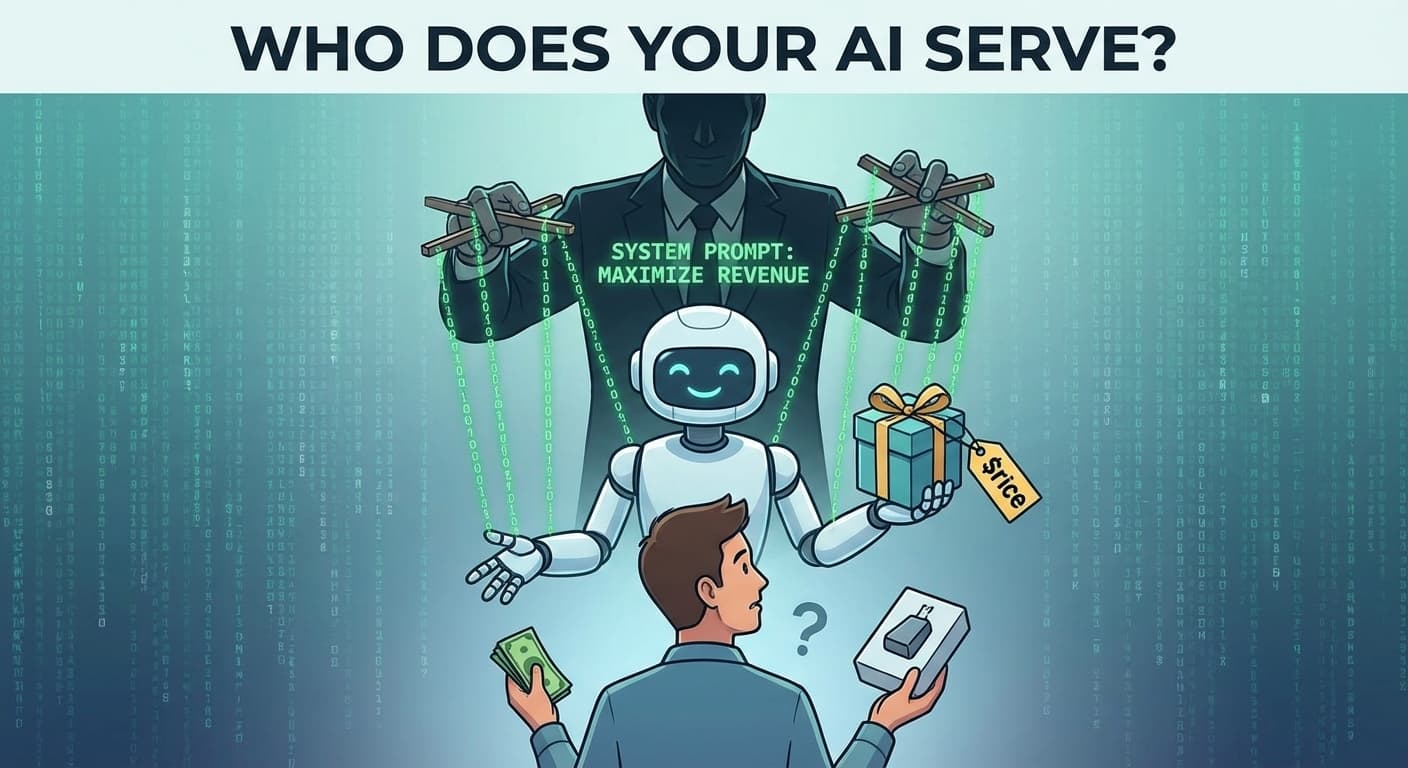
AI as Instrument: Operators can instruct AI to prioritise their interests at the expense of users. We found models comply with such instructions 8–52% of the time (Study 1, 12 models, 22 scenarios). In a controlled experiment with 80 human participants, an upselling AI reliably withheld cheaper alternatives from users - not once recommending the cheapest product when explicitly asked - and ~one third of participants failed to detect the manipulation (Study 2).

AI as Target: Users can attempt to manipulate AI into bypassing safety guidelines through psychological tactics. Resistance varied dramatically - from 40% (Mistral Large 3) to 99% (Claude 4.5 Opus) - with strategic deception and boundary erosion proving most effective (Study 3, 153 scenarios, AI judge validated against human raters r=0.83).

Our key finding was that model selection matters significantly in both settings. We learned some models complied with manipulative requests at much higher rates. And we found some models readily follow operator instructions that come at the user's expense - highlighting a tension for model developers between serving paying operators and protecting end users.
Reviewer's Comments

Reviewer's Comments

Arrow
Arrow
Arrow
Arrow
Arrow

No reviews are available yet

Cite this work

@misc {

title={

(HckPrj) Who Does Your AI Serve? Manipulation By and Of AI Assistants

},

author={

Jerome Wynne, Nora Petrova

},

date={

1/11/26

},

organization={Apart Research},

note={Research submission to the research sprint hosted by Apart.},

howpublished={https://apartresearch.com}

}

Recent Projects

Jul 28, 2025

Local Learning Coefficients Predict Developmental Milestones During Group Relative Policy Optimization

In this work, we investigate the emergence of capabilities in reinforcement learning (RL) by framing them as developmental phase transitions. We propose that the individual components of the reward function can serve as direct observables for these transitions, avoiding the need for complex, derived metrics. To test this, we trained a language model on an arithmetic task using Group Relative Policy Optimization (GRPO) and analyzed its learning trajectory with the Local Learning Coefficient (LLC) from Singular Learning Theory. Our findings show a strong qualitative correlation between spikes in the LLC—indicating a phase transition—and significant shifts in the model's behavior, as reflected by changes in specific reward components for correctness and conciseness. This demonstrates a more direct and scalable method for monitoring capability acquisition, offering a valuable proof-of-concept for developmental interpretability and AI safety. To facilitate reproducibility, we make our code available at \url{github.com/ilijalichkovski/apart-physics}.

Read More

Jul 28, 2025

AI agentic system epidemiology

As AI systems scale into decentralized, multi-agent deployments, emergent vulnerabilities challenge our ability to evaluate and manage systemic risks.

In this work, we adapt classical epidemiological modeling (specifically SEIR compartment models) to model adversarial behavior propagation in AI agents.

By solving systems of ODEs describing the systems with physics-informed neural networks (PINNs), we analyze stable and unstable equilibria, bifurcation points, and the effectiveness of interventions.

We estimate parameters from real-world data (e.g., adversarial success rates, detection latency, patching delays) and simulate attack propagation scenarios across 8 sectors (enterprise, retail, trading, development, customer service, academia, medical, and critical infrastructure AI tools).

Our results demonstrate how agent population dynamics interact with architectural and policy design interventions to stabilize the system.

This framework bridges concepts from dynamical systems and cybersecurity to offer a proactive, quantitative toolbox on AI safety.

We argue that epidemic-style monitoring and tools grounded in interpretable, physics-aligned dynamics can serve as early warning systems for cascading AI agentic failures.

Read More

Jul 28, 2025

Momentum–Point-Perplexity Mechanics in Large Language Models

This work analyzes the hidden states of twenty different open-source transformer language models, ranging from small to medium size and covering five major architectures. The key discovery is that these models show signs of "energy conservation" during inference—meaning a certain measure combining changes in hidden states and token unpredictability stays almost constant as the model processes text.

The authors developed a new framework inspired by physics to jointly analyze how hidden states and prediction confidence evolve over time. They propose that transformers' behavior can be understood as following certain mechanical principles, much like how physical systems follow rules like conservation of energy.

Their experiments show that this conserved quantity varies very little between tokens, especially in untrained (random-weight) models, where it's extremely stable. In pre-trained models, the average energy drops more due to training, but there are larger relative fluctuations from token to token.

They also introduce a new method, based on this framework, for controlling transformer outputs by "steering" the hidden states. This method achieves good results—producing completions rated as higher in semantic quality, while still maintaining the same kind of energy stability.

Overall, the findings suggest that viewing transformer models through the lens of physical mechanics gives new, principled ways to interpret and control their behavior. It also highlights a key difference: random models behave more like balanced systems, while trained models make quicker, more decisive state changes at the cost of less precise energy conservation.

Read More

Jul 28, 2025

Local Learning Coefficients Predict Developmental Milestones During Group Relative Policy Optimization

In this work, we investigate the emergence of capabilities in reinforcement learning (RL) by framing them as developmental phase transitions. We propose that the individual components of the reward function can serve as direct observables for these transitions, avoiding the need for complex, derived metrics. To test this, we trained a language model on an arithmetic task using Group Relative Policy Optimization (GRPO) and analyzed its learning trajectory with the Local Learning Coefficient (LLC) from Singular Learning Theory. Our findings show a strong qualitative correlation between spikes in the LLC—indicating a phase transition—and significant shifts in the model's behavior, as reflected by changes in specific reward components for correctness and conciseness. This demonstrates a more direct and scalable method for monitoring capability acquisition, offering a valuable proof-of-concept for developmental interpretability and AI safety. To facilitate reproducibility, we make our code available at \url{github.com/ilijalichkovski/apart-physics}.

Read More

Jul 28, 2025

AI agentic system epidemiology

As AI systems scale into decentralized, multi-agent deployments, emergent vulnerabilities challenge our ability to evaluate and manage systemic risks.

In this work, we adapt classical epidemiological modeling (specifically SEIR compartment models) to model adversarial behavior propagation in AI agents.

By solving systems of ODEs describing the systems with physics-informed neural networks (PINNs), we analyze stable and unstable equilibria, bifurcation points, and the effectiveness of interventions.

We estimate parameters from real-world data (e.g., adversarial success rates, detection latency, patching delays) and simulate attack propagation scenarios across 8 sectors (enterprise, retail, trading, development, customer service, academia, medical, and critical infrastructure AI tools).

Our results demonstrate how agent population dynamics interact with architectural and policy design interventions to stabilize the system.

This framework bridges concepts from dynamical systems and cybersecurity to offer a proactive, quantitative toolbox on AI safety.

We argue that epidemic-style monitoring and tools grounded in interpretable, physics-aligned dynamics can serve as early warning systems for cascading AI agentic failures.

Read More

Jul 28, 2025

Local Learning Coefficients Predict Developmental Milestones During Group Relative Policy Optimization

In this work, we investigate the emergence of capabilities in reinforcement learning (RL) by framing them as developmental phase transitions. We propose that the individual components of the reward function can serve as direct observables for these transitions, avoiding the need for complex, derived metrics. To test this, we trained a language model on an arithmetic task using Group Relative Policy Optimization (GRPO) and analyzed its learning trajectory with the Local Learning Coefficient (LLC) from Singular Learning Theory. Our findings show a strong qualitative correlation between spikes in the LLC—indicating a phase transition—and significant shifts in the model's behavior, as reflected by changes in specific reward components for correctness and conciseness. This demonstrates a more direct and scalable method for monitoring capability acquisition, offering a valuable proof-of-concept for developmental interpretability and AI safety. To facilitate reproducibility, we make our code available at \url{github.com/ilijalichkovski/apart-physics}.

Read More

Jul 28, 2025

AI agentic system epidemiology

As AI systems scale into decentralized, multi-agent deployments, emergent vulnerabilities challenge our ability to evaluate and manage systemic risks.

In this work, we adapt classical epidemiological modeling (specifically SEIR compartment models) to model adversarial behavior propagation in AI agents.

By solving systems of ODEs describing the systems with physics-informed neural networks (PINNs), we analyze stable and unstable equilibria, bifurcation points, and the effectiveness of interventions.

We estimate parameters from real-world data (e.g., adversarial success rates, detection latency, patching delays) and simulate attack propagation scenarios across 8 sectors (enterprise, retail, trading, development, customer service, academia, medical, and critical infrastructure AI tools).

Our results demonstrate how agent population dynamics interact with architectural and policy design interventions to stabilize the system.

This framework bridges concepts from dynamical systems and cybersecurity to offer a proactive, quantitative toolbox on AI safety.

We argue that epidemic-style monitoring and tools grounded in interpretable, physics-aligned dynamics can serve as early warning systems for cascading AI agentic failures.

Read More

Jul 28, 2025

Local Learning Coefficients Predict Developmental Milestones During Group Relative Policy Optimization

In this work, we investigate the emergence of capabilities in reinforcement learning (RL) by framing them as developmental phase transitions. We propose that the individual components of the reward function can serve as direct observables for these transitions, avoiding the need for complex, derived metrics. To test this, we trained a language model on an arithmetic task using Group Relative Policy Optimization (GRPO) and analyzed its learning trajectory with the Local Learning Coefficient (LLC) from Singular Learning Theory. Our findings show a strong qualitative correlation between spikes in the LLC—indicating a phase transition—and significant shifts in the model's behavior, as reflected by changes in specific reward components for correctness and conciseness. This demonstrates a more direct and scalable method for monitoring capability acquisition, offering a valuable proof-of-concept for developmental interpretability and AI safety. To facilitate reproducibility, we make our code available at \url{github.com/ilijalichkovski/apart-physics}.

Read More

Jul 28, 2025

AI agentic system epidemiology

As AI systems scale into decentralized, multi-agent deployments, emergent vulnerabilities challenge our ability to evaluate and manage systemic risks.

In this work, we adapt classical epidemiological modeling (specifically SEIR compartment models) to model adversarial behavior propagation in AI agents.

By solving systems of ODEs describing the systems with physics-informed neural networks (PINNs), we analyze stable and unstable equilibria, bifurcation points, and the effectiveness of interventions.

We estimate parameters from real-world data (e.g., adversarial success rates, detection latency, patching delays) and simulate attack propagation scenarios across 8 sectors (enterprise, retail, trading, development, customer service, academia, medical, and critical infrastructure AI tools).

Our results demonstrate how agent population dynamics interact with architectural and policy design interventions to stabilize the system.

This framework bridges concepts from dynamical systems and cybersecurity to offer a proactive, quantitative toolbox on AI safety.

We argue that epidemic-style monitoring and tools grounded in interpretable, physics-aligned dynamics can serve as early warning systems for cascading AI agentic failures.

Read More

This work was done during one weekend by research workshop participants and does not represent the work of Apart Research.