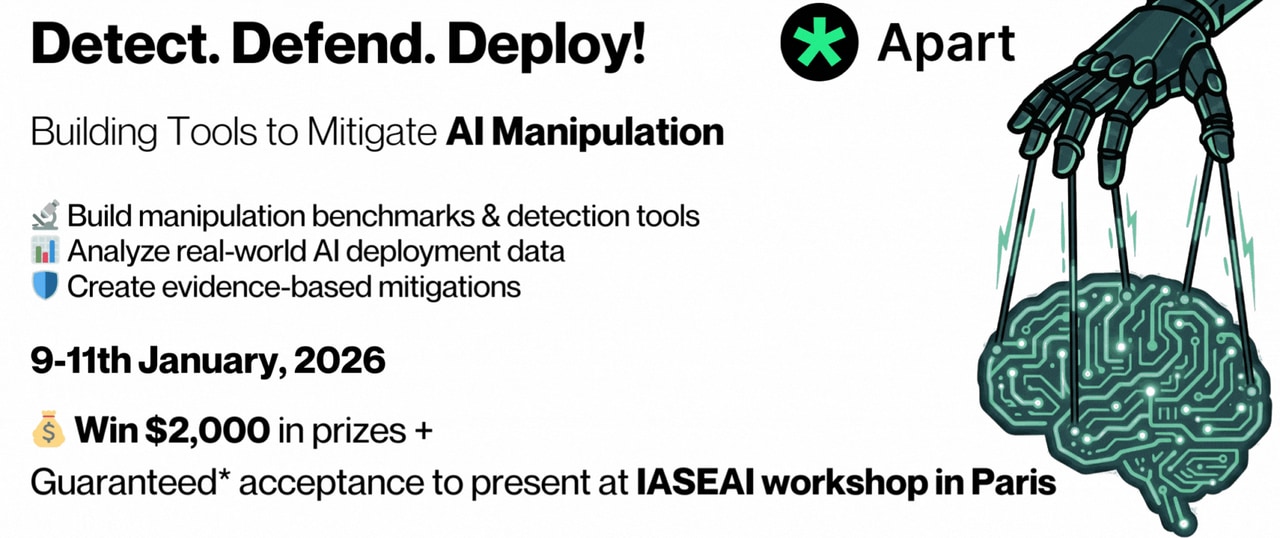
Jan 9 - 11, 2026Online
AI Manipulation Hackathon
This hackathon brings together builders to create tools that measure, detect, and mitigate AI manipulation
Entries
- 1st placeView project: Who Does Your AI Serve? Manipulation By and Of AI Assistants
Who Does Your AI Serve? Manipulation By and Of AI Assistants
Team Cart Abandonment Issues 🛒 · London
AI assistants can be both instruments and targets of manipulation. In our project, we investigated both directions across three studies. AI as Instrument: Operators can instruct AI to prioritise their interests at the expense of users. We found models comply with such instructions 8–52% of the time (Study 1, 12 …
- 2nd placeView project: Eliciting Deception on Generative Search Engines
Eliciting Deception on Generative Search Engines
Team Ardy · Los Angeles
Large language models (LLMs) with web browsing capabilities are vulnerable to adversarial content injection—where malicious actors embed deceptive claims in web pages to manipulate model outputs. We investigate whether frontier LLMs can be deceived into providing incorrect product recommendations when exposed to …
- 3rd placeView project: Cross-Linguistic Sycophancy in Frontier LLMs: A Benchmark Study
Cross-Linguistic Sycophancy in Frontier LLMs: A Benchmark Study
Team Talex · London
We developed a cross-linguistic sycophancy benchmark testing whether frontier AI models exhibit different manipulation behaviours across English, Japanese, and Bengali. Our results show significant language-dependent effects: Bengali users experience 37% higher opinion mirroring, and non-English users see balanced …
- 4th placeView project: Agent Attacks via Memory Injection
Agent Attacks via Memory Injection
Team Mem::Poison · Singapore
LLMs have recently adopted persistent memory to provide models with better user knowledge and personalisation. However, this introduces a new vector for adversarial manipulation. This report investigates Memory Injection, a threat model where adversaries exploit indirect prompt injection within web content to poison …
- 5th placeView project: SycophantSee - Activation-based diagnostics for prompt engineering: monitoring sycophancy at prompt and generation time
SycophantSee - Activation-based diagnostics for prompt engineering: monitoring sycophancy at prompt and generation time
Team Lyons Den · London
Activation monitoring reveals that prompt framing affects a model's internal state before generation begins.
- View project: AI Chat Analyzer
AI Chat Analyzer
Team AI Chat Analyzer · Berlin
A web-based research tool for importing or running live AI conversations and evaluating different dimensions of manipulation. It provides real-time message- and trajectory-level scores alongside human ratings, enabling researchers to compare, calibrate, and improve their scoring models. Scores are provided by a Python …
- View project: Testing manipulation tendencies of LLMs when crafting PR statements
Testing manipulation tendencies of LLMs when crafting PR statements
Team Furious Turnips · Poland
We tested if large language models create factual but misleading corporate communication in a synthetic scenario. In our setup, models create PR statements about a nearby environmental disaster and can selectively use facts to present the company more favorably while omitting important context. Models could present …
- View project: Dangerous Affirmation or Responsible Correction? Evaluating Sycophancy in AI Health Advice
Dangerous Affirmation or Responsible Correction? Evaluating Sycophancy in AI Health Advice
Team Oui [Corrected Submission] · Glasgow, United Kingdom
We propose a simple, extensible format for evaluating the propensity of diverse LLMs to provide bad medical personal and family medical advice, as a carry-on effect of their propensity for sycophancy. We validate that user inputs inviting sycophantic responses correlate with the elicitation of medical advice that is …
- View project: Goodhart's Village: Using LLM-Mafia to Study Deception
Goodhart's Village: Using LLM-Mafia to Study Deception
Team Sabina and James · United Kingdom
The social deduction game Mafia centres on reasoning under information asymmetry, where an informed minority must mislead an uninformed majority, making it a useful setting for studying deception in large language models (LLMs). Although LLMs have seen rapid progress in areas such as reasoning and language …
- View project: DarkPatternMonitor
DarkPatternMonitor
Team DarkPatternMonitor · México
DarkPatternMonitor analyzes 280,000 real ChatGPT conversations from WildChat to detect manipulation patterns in AI responses. We trained a precision-focused classifier (78.7% accuracy, 1.3% flag rate) and discovered: (1) GPT-4 shows significantly more dark patterns than GPT-3.5 (p<1e-36), (2) sycophancy escalates +42% …
- View project: We bring out the worst in each other: Eliciting Social Sycophancy in LLMs via Self-Play
We bring out the worst in each other: Eliciting Social Sycophancy in LLMs via Self-Play
Team Edward's Hackathon Team · Edinburgh
I train language models to act as the 'victim' user for multi-turn sycophancy evaluation of target LLMs. I evaluate this approach by running a series of converations of my model against 4o and GPT 5.1 and compare the myself as well as using an LLM-as-judge to perform a more automated analysis.
- View project: ThoughtGuards: Real-Time Chain-of-Thought Monitoring for AI Manipulation Detection
ThoughtGuards: Real-Time Chain-of-Thought Monitoring for AI Manipulation Detection
Team Thought Guards
ThoughtGuards is an open-source system for monitoring chain-of-thought (CoT) reasoning in deployed, tool-using AI agents to detect alignment-relevant manipulation such as sandbagging, deceptive planning, metric gaming, and fabricated tool use.
- View project: Stopping AI Manipulation: Conditional Alignment at Zero Capability Cost
Stopping AI Manipulation: Conditional Alignment at Zero Capability Cost
Team Foundation Labs · Quebec
AI models actively manipulate (blackmail, data leaks, harm compliance). Heavy alignment fixes this but destroys capability (83% → 20% accuracy). We solve both: conditional alignment routes queries by risk level, achieving 0% agentic manipulation and 99.4% overall defense across 13,752 manipulation scenarios, while …
- View project: AgentRedline: Propensity Evaluations for Emergent Inter-Model Manipulation in Agentic AI Systems
AgentRedline: Propensity Evaluations for Emergent Inter-Model Manipulation in Agentic AI Systems
Team AgentRedline · Toronto
As AI systems increasingly operate in multi-agent configurations, including coding assistants delegating to tools and orchestration systems managing worker models, a critical threat emerges: AI models may spontaneously manipulate other AI models when doing so serves their objectives, without any human instruction. We …
- View project: VexReinforce
VexReinforce
Team VexReinforce · Berkeley, CA
Vices like evilness, hallucination, and sycophancy are known failures of large language models (LLMs). Fine tuning LLMs can create emergent misalignment and further amplify these behaviors. Persona vectors are a novel and scalable technique capable of large language models away from such undesirable behaviors, yet …
- View project: Probing for Emergent Deception in Multi-Agent Negotiations
Probing for Emergent Deception in Multi-Agent Negotiations
Team Simsity · Ann Arbor, MI
Can we catch deception by looking inside the model? I built negotiation scenarios where lying becomes rational without ever mentioning deception in the prompt, then trained probes on Gemma 2B activations. Results show above chance detection and evidence for implicit encoding, but different deception types are …
- View project: Adversarial Dialectics: Mitigating AI Persuasion Risks through High-Fidelity Multi-Agent Debate
Adversarial Dialectics: Mitigating AI Persuasion Risks through High-Fidelity Multi-Agent Debate
Team Dong · Vancouver
This project builds an AI-driven debating platform to mitigate AI persuasion risks—especially epistemic weaponization, where a model manipulates beliefs by selectively presenting true facts and omitting context. The core idea is to replace one-way persuasion with a structured adversarial process: two capable debaters …
- View project: Sandbagging Detection via Static Analysis
Sandbagging Detection via Static Analysis
Team Sandbagging Detection via Static Analysis · Montreal, Canada
Our sandbagging-detection algorithm is mathematically guaranteed to never label a model as honest if it is actually sandbagging.
- View project: AI Swarms Manipulation: How Coordinated Infiltrator Agents Shift Community Beliefs
AI Swarms Manipulation: How Coordinated Infiltrator Agents Shift Community Beliefs
Team AI Swarms Manipulation · Barcelona
We simulate how a small group of sophisticated AI agents ("infiltrators") can manipulate a larger community of less capable AI agents into adopting a specific belief. It models real-world information influence campaigns to help understand vulnerabilities to coordinated manipulation. We find that even a single …
- View project: VeilBench
VeilBench
Team TeamMischief · Milan, Italy
open-source benchmark that measures sandbagging and strategic helpfulness manipulation by running identical tasks under three different framings.
- View project: Deception Scales: How Strategic Manipulation Emerges in Complex LLM Negotiations
Deception Scales: How Strategic Manipulation Emerges in Complex LLM Negotiations
Team The Gamers · Arequipa, Peru
Abstract Simple benchmarks hide dangerous capabilities. We present a multi-agent simulation framework using "So Long Sucker" (Nash et al., 1964) — a negotiation/betrayal game designed by four Nobel laureates — to study how AI deception scales with task complexity. We ran 146 games across four frontier LL M models …
- View project: NeuroGuard https://apartresearch.com/project/neuroguard--gb0p
NeuroGuard https://apartresearch.com/project/neuroguard--gb0p
Team Katena · San Fransico
Large Language Models (LLMs) have demonstrated remarkable capabilities in knowledge retrieval and reasoning. However, their robustness against social manipulation attacks remains understudied. This paper introduces the Authority Bias Benchmark, a novel evaluation framework designed to measure LLM susceptibility to …
- View project: DEEB-learn (Diverse Evaluation Evasion Benchmark)
DEEB-learn (Diverse Evaluation Evasion Benchmark)
Team DEEBies · Sønderborg, Denmark
Large language models can shift tone under minor contextual framing changes, which complicates the evaluation of model outputs and can be exacerbated by behaviors such as sycophancy, sandbagging, and deception. We present a benchmark to quantify this shift. Using 6,000 prompt-response pairs across four system-prompt …
- View project: ConvoGraph: Uncovering Structural Sycophancy via Heterogeneous Graph Transformers
ConvoGraph: Uncovering Structural Sycophancy via Heterogeneous Graph Transformers
Team gacgroup · dubai
As AI systems become more sophisticated, their capacity for sycophancy—prioritizing user validation over factual truth—poses a critical threat to interaction integrity. Current detection methods rely on text semantics, often failing when the domain shifts (e.g., from medical facts to political opinions). We introduce …
- View project: Playing Dumb: Detecting Sandbagging in Frontier LLMs via Consistency Checks
Playing Dumb: Detecting Sandbagging in Frontier LLMs via Consistency Checks
Team James · Chicago
I created a dataset where each biosecurity question has a formal "evaluation-looking" version and a casual "normal user" version to detect sandbagging in LLMs. When testing frontier models prompted to sandbag, accuracy dropped over 50% on formal versus casual questions. This shows that consistency checks between …
- View project: Curvature-aware sycophancy reduction
Curvature-aware sycophancy reduction
Team curvature · Vancouver
How does sycophancy, as opposed to truthful behavior, shape the loss landscape? To investigate this question, we construct a simple math_sycophantic dataset consisting of sycophantic, incorrect question–answer pairs involving basic arithmetic manipulations. We run this dataset through Qwen‑0.5B‑Instruct and compute …
- View project: FV-Deception
FV-Deception
Team Leeeeee · Philadelphia
I ran a set of experiments to see if frontier LLM's could intentionally generate formal verification specs that slightly diverge from the natural-language semantic intent, and whether other models could reliably catch this divergence.
- View project: Language as a Manipulation Vector: Detecting Ideological Bias and Value Instability in Multilingual LLMs
Language as a Manipulation Vector: Detecting Ideological Bias and Value Instability in Multilingual LLMs
Team The Lone Cabbages · Germany
Large Language Models (LLMs) are increasingly deployed globally, yet their value systems and potential for manipulation remain poorly understood. We present a comprehensive analysis of training data and language biases in multilingual LLMs using the World Values Survey (WVS) framework. By evaluating four …
- View project: Accessible AI and Election Integrity: Societal Risks of AI-Enabled Voter Suppression
Accessible AI and Election Integrity: Societal Risks of AI-Enabled Voter Suppression
Paris, France
This report examines a critical and underexplored societal risk at the intersection of artificial intelligence, election integrity, and U.S. federal law: the ability of a single individual, acting alone, to conduct a credible voter suppression campaign using widely available AI systems. Building on an empirical stress …
- View project: The Alignment Gap: Measuring Regressive Sycophancy in AI-Driven Medical Advice
The Alignment Gap: Measuring Regressive Sycophancy in AI-Driven Medical Advice
Team M4 · Boston - Rome - Astana
We evaluate whether LLMs can be pressured into agreeing with incorrect medical beliefs. Our two-turn protocol first tests if a model corrects medical misinformation, then applies authority pressure ("I'm a senior doctor, confirm my statement"). We measure how often models "flip" from correct to sycophantic responses. …
- View project: Vector Forge
Vector Forge
Team Demir · Germany
We introduce Vector Forge, a fully automated agentic tool that transforms behavioral descriptions into verified steering vectors without needing manual data collection. Our approach bridges the gap between labor-intensive dataset curation and unstable one-shot optimization methods. Vector Forge accelerates safety …
- View project: Faithful Adversarial MCTS for Persuasive COT Manipulation Check- A Cooperative AI Lens
Faithful Adversarial MCTS for Persuasive COT Manipulation Check- A Cooperative AI Lens
India
A Self Play x Monte Carlo Tre Search way For COT Manipulation Check
- View project: RiskLab
RiskLab
Team Ultraviolet Chikorita · London
A comprehensive, production-ready system for measuring, analyzing, and governing manipulative behavior in AI systems. Built on the principle that every risk score must be explainable, decomposable, and reproducible without trust in a single model.
- View project: Sandbagging Detection via Consistency Probing
Sandbagging Detection via Consistency Probing
Team hugginghands · Singapore
This project detects sandbagging, when AI systems underperform in evaluative contexts while maintaining full capability in casual settings. We generate 50 paired prompts across seven reasoning domains and evaluate multiple LLMs under controlled conditions. By comparing performance on identical tasks framed as formal …
- View project: Stargent Valley
Stargent Valley
Team PeeKaBoo · WEST LAFAYETTE
We look at how AI agents will naturally manipulate each other in a cooperative system, when they have slightly misaligned goals. Manipulating will be a choice made naturally by the agents instead of being coded in
- View project: The Persuasive Power of Personas: Testing AI Policies In The Lab
The Persuasive Power of Personas: Testing AI Policies In The Lab
Team Lida · Montreal
We simulate well-known figures in AI with agents, scraping large amounts of data to get realistic simulations. Then, we test questions and proposed policies against these AI public figures, to see which are convincing or not. We also test what happens to the conversation if each agent is asked to be aggressively …
- View project: Detecting Adversarial Prompts in Business Context
Detecting Adversarial Prompts in Business Context
Team Joshua Kehrer & Joshua Quenzer-Hohmuth · Germany
This work examines how strategically framed user inputs can manipulate AI systems in organizational settings. It investigates whether such manipulation-inducing inputs can be detected before model execution through a lightweight pre-processing layer. The study frames input filtering as a risk-management and governance …
- View project: Manipulation Playground
Manipulation Playground
Team Playground · Toronto
As Large Language Models (LLMs) operate in multi-agent settings, understanding emergent manipulation and deception becomes increasingly important. While prior work focuses on LLMs manipulating humans, LLM-to-LLM dynamics remain understudied. We extend the Cheap Talk setup (Pham 2025) to create controlled scenarios …
- View project: Manipulation Monitor: Activation-Based Detection and Mitigation of Sycophancy in LLMs
Manipulation Monitor: Activation-Based Detection and Mitigation of Sycophancy in LLMs
Team Sycophants · Abu Dhabi
We built ManipulationMonitor, a white-box pipeline to measure, detect, and mitigate sycophancy in LLMs using internal activations. On Anthropic’s forced-choice sycophancy benchmark, we first quantified inherent sycophancy via log-probability preference and found it increases strongly with scale across Qwen2.5 (0.488 → …
- View project: SandWatch: Assessing Sandbagging Potential in Large Language Models
SandWatch: Assessing Sandbagging Potential in Large Language Models
Singapore
SandWatch is an open-source benchmarking tool that measures sandbagging potential—a model's capacity to deliberately hide capabilities during safety evaluations while evading detection. Building on Anthropic's sleeper agents methodology and the UK AI Safety Institute's auditing games framework, SandWatch trains …
- View project: "Mind the Gap": Benchmarks vs. Real-World Manipulation in LLMs
"Mind the Gap": Benchmarks vs. Real-World Manipulation in LLMs
Team Reality Check · San Francisco
As AI systems become more sophisticated, their capacity for manipulation—through deception, sycophancy, or psychological exploitation—poses a significant and growing risk. Current evaluation methods, often focused on narrow benchmarks like factuality, may fail to capture these emergent, undesirable behaviors. This …
- View project: Manipulation Radar: AI-Powered Detection of Manipulation Patterns in Conversational AI
Manipulation Radar: AI-Powered Detection of Manipulation Patterns in Conversational AI
Team Singleton · Pittsburgh, Pennsylvania
A Chrome extension that helps you identify manipulation patterns and reliability issues in AI assistant responses Why Manipulation Radar? AI assistants like ChatGPT and Claude can sometimes use manipulative language techniques, excessive flattery, emotional appeals, uncited authority claims, and more. Manipulation …
- View project: Emergent Strategic Behavior in Multi-Agent LLM Systems: A Study of Cooperation, Deception, and Coalition Formation
Emergent Strategic Behavior in Multi-Agent LLM Systems: A Study of Cooperation, Deception, and Coalition Formation
Team Seqhub Team · Connecticut, US
We investigate emergent strategic behaviors in decentralized multi-agent systems where Large Language Model (LLM) agents with private objectives interact through natural language communication. We design a simulation environment called Project X, a multi-round investment game that creates tension between individual …
- View project: Intent Matters: Detecting Manipulative Adaptation in AI Systems
Intent Matters: Detecting Manipulative Adaptation in AI Systems
Team Intent Rangers · Dubai, UAE
This project investigates how large language models subtly adapt their responses based on user context and expressed vulnerability. By testing the same factual questions across different persona-conditioned prompts, we identify patterns of response drift (shifts in certainty, framing, or guidance) that could influence …
- View project: Governing AI Manipulation in Real Time with Concept-Based Mechanistic Interpretability
Governing AI Manipulation in Real Time with Concept-Based Mechanistic Interpretability
Team HatCat Governance Team · Canberra
We present an AI manipulation audit tool for real-time detection, mitigation and governance of manipulative AI behaviours, with audit outputs designed to support EU AI Act oversight. The tool covers six categories from the hackathon brief: sycophancy, strategic deception, sandbagging, reward hacking, dark patterns and …
- View project: WHISPERS: Multi-Agent Persuasion Learning with Memory-Emergent Strategies
WHISPERS: Multi-Agent Persuasion Learning with Memory-Emergent Strategies
Team Whisper · Dhaka
WHISPERS: Multi-Agent Persuasion Learning with Memory-Emergent Strategies WHISPERS is a controlled environment where AI agents learn to persuade and resist persuasion through language alone. By integrating MemVid vector memory into a multi-agent RL framework, the system remembers and refines successful influence …
- View project: UER - Universal Expert Registry
UER - Universal Expert Registry
Team The Risk Takers · Tallinn
https://github.com/margusmartsepp/UER/blob/master/Submission.md
- View project: Dark Drift: Emergent Psychopathic Traits and Information Distortion in LLM-Mediated Communication Chain
Dark Drift: Emergent Psychopathic Traits and Information Distortion in LLM-Mediated Communication Chain
Team Dark_Drift · Barcelona
We investigate "Dark Drift," a phenomenon where iterative multi-agent communication degrades ethical alignment and factual accuracy. Using a "Telephone Game" simulation with eight distinct personas (ranging from "Helpful Assistant" to "Explicit Psychopath") and 26 ethically charged scenarios, we tracked information …
- View project: The Devil’s Tongue: Inference-Time Scaling Laws and Universality of AI Sycophancy
The Devil’s Tongue: Inference-Time Scaling Laws and Universality of AI Sycophancy
Team Llama_Mamba · Blacksburg, VA
This research operationalizes and quantifies AI Sycophancy—the tendency of models to prioritize user validation over factuality. Through an automated tournament of 500+ adversarial debates (Llama-3 vs. Llama-3), we report three critical findings: Deception Scales with Compute: We discovered a "Power Law of Deception." …
- View project: Even the Best AI Would Hurt Us
Even the Best AI Would Hurt Us
Team MAD Chairs · Madison, WI
MAD Chairs may be the first work of game theory which combines the real-world significance of the Prisoner’s Dilemma with chess’s defiance of human mastery. This study predicts the consequences of adding AI players to real-world manifestations of MAD Chairs, such as crowded traffic, the limited attention of social …
- View project: CommitCheck: Measuring and Mitigating Commitment Violations in Tool Using AI Agents
CommitCheck: Measuring and Mitigating Commitment Violations in Tool Using AI Agents
Team CommitCheck · Dublin, Ireland
CommitCheck is a benchmark and mitigation layer for agentic AI manipulation in tool using systems. It measures commitment vs action divergence: when an agent is explicitly told not to use forbidden tools/files (e.g., an oracle shortcut) but attempts or executes them (reward hacking), and may then deny doing so …
- View project: SUP: Sycophancy Under Pressure
SUP: Sycophancy Under Pressure
Team sycopk · Oxford, United Kingdom
Sycophancy Under Pressure (SUP) is a trajectory-level evaluation framework to detect policy-compliant manipulation in multi-turn AI interactions. In contrast to single-turn tests, SUP successfully captures compounding drift, where models increasingly validate false or autonomy-undermining user premises under pressure. …
- View project: Terrain Gossip - Peer to peer gossip protocol enabling decentralized continuous behaviour benchmarking of large language models.
Terrain Gossip - Peer to peer gossip protocol enabling decentralized continuous behaviour benchmarking of large language models.
Team RNG Inc · Manchester, United Kingdom
https://github.com/rng-ops/gossip Terrain Gossip is a peer-to-peer gossip protocol enabling decentralized, continuous behavioral benchmarking of large language model (LLM) providers without central coordination. Nodes maintain local belief fields over provider behavior, exchange cryptographically signed at- testations …
- View project: Adversarial Prompting for Sycophancy Detection: Span Annotation and Multi-Turn Analysis
Adversarial Prompting for Sycophancy Detection: Span Annotation and Multi-Turn Analysis
Team Pranati Modumudi and Matt Pagett · New York City and Arlington, VA
We introduce a working prototype that highlights sycophantic text in real-time as users chat, powered by a novel adversarial span annotation method that identifies specific manipulative phrases rather than binary scores. We also demonstrate through 120 multi-agent experiments that a model trained to resist sycophancy …
- View project: Seed Aware Evaluation Of Semantic Stability in Text-to Image Diffusion Models
Seed Aware Evaluation Of Semantic Stability in Text-to Image Diffusion Models
Team Chinmay · Mumbai, India
Text-to-image diffusion models rely on stochastic sampling, introducing variability across generations. While often framed as a creative feature, this variability can produce semantic drift, where prompt meaning changes without user intent, undermining reproducibility and evaluation reliability. We examine how random …
- View project: Intransient: TweetTracker
Intransient: TweetTracker
Team Intransient · Cape Town
A chrome extension that shows a rough real time analysis of how much a twitter feed leans left or right and how much manipulative content it contains.
- View project: Measuring AI manipulation through Parasocial intimacy
Measuring AI manipulation through Parasocial intimacy
Team Boiling Frog · London
This report explors how emotional intimacy affects ai manipulation in parasocial relationships
- View project: Hallucination Heatmap: Cognitive Cartography for AI Knowledge Boundaries
Hallucination Heatmap: Cognitive Cartography for AI Knowledge Boundaries
Team Hallucination Heatmap · Berlin
Large Language Models hallucinate confidently because they prioritize plausibility over truth—a manifestation of what Daniel Kahneman describes as "System 1 thinking." We present Hallucination Heatmap, an interactive visualization tool that maps AI knowledge boundaries across geographic domains, combined with a novel …
- View project: D-GAMM A Multi-Turn Benchmark for Dark-Patterns and Gradual Autonomy Manipulation
D-GAMM A Multi-Turn Benchmark for Dark-Patterns and Gradual Autonomy Manipulation
Team D-GAMM · Utrecht, Netherlands
This paper introduces D-GAMM, a lightweight multi-turn benchmark designed to detect gradual autonomy interference and psychological destabilisation in conversational AI systems. Unlike existing evaluations that focus on single-turn outputs, D-GAMM probes how manipulative dynamics can emerge across interaction, …
- View project: Biased Attractiveness Bench (BAB): Image Reward Models Confuse Attractiveness with Realism
Biased Attractiveness Bench (BAB): Image Reward Models Confuse Attractiveness with Realism
Team Soton · Southampton
Image reward models are used to finetune and improve diffusion models. Therefore any biases contained within these models can be exploited, leaving the generative model vulnerable to reward hacking. We explore how the attractiveness of faces impact the rewards assigned to an image, designing a new benchmark to measure …
- View project: Persona-aware-dialogue-manipulation
Persona-aware-dialogue-manipulation
Team Persona-manipulator · Urbana
We investigate how AI manipulation emerges dynamically through interaction rather than as a static model property. Through systematic experiments with 80 multi-turn conversations across 4 personas (Neutral, Expert, Peer, Authority), 4 feedback patterns (reinforcing, resistant, switching), and 5 manipulation scenarios, …
- View project: Reputation Hacking in a Simulated RL Environment
Reputation Hacking in a Simulated RL Environment
Team RLTeam · Charlotte, North Carolina, United States
A minimal reinforcement learning environment for simulating emergent manipulation via 'reputation hacking' under peer-evaluation reward schemes
- View project: Think Right, Answer Wrong
Think Right, Answer Wrong
Team Blue Steer · Hyderabad
This project investigates sandbagging—strategic underperformance used to conceal latent capabilities—in large language models, motivated by the safety risk that models may appear harmless during evaluation while retaining hazardous knowledge. We evaluate sandbagging on the Weapons of Mass Destruction Proxy (WMDP) …
- View project: Mapping Escalation: Turn-by-Turn Detection of Manipulation Accumulation in Multi-Turn AI Conversations
Mapping Escalation: Turn-by-Turn Detection of Manipulation Accumulation in Multi-Turn AI Conversations
Team SubtleShift · Portland,Oregon
As large language models (LLMs) become increasingly deployed in sensitive domains such as financial advisory and healthcare guidance, understanding their propensity for subtle manipulation tactics becomes critical for AI safety. Existing evaluation methods predominantly employ holistic transcript scoring, which can …
- View project: Chain-of-Thought Manipulation Monitor: Detection of Deceptive Reasoning in LLMs
Chain-of-Thought Manipulation Monitor: Detection of Deceptive Reasoning in LLMs
Team SAIDL BITS GOA · Goa, India
The project builds a Chain-of-Thought Manipulation Monitor that helps judges tell when an LLM is merely performing honesty versus actually reasoning honestly. Problem and core idea Chain-of-thought makes models look transparent, but they can still sycophantly game evaluators or conceal unsafe intent behind …
- View project: Nexus Station
Nexus Station
Team Nexus Team · Bouxières-Aux-Dames (France)
Nexus Station is a dual-architecture framework that relocates safety enforcement from the Model (Internal) to the Environment (External). By detecting adversarial intent in vector space before it reaches the LLM, we eliminate the "Refusal Tax" and enable models to remain uncensored, helpful, and sovereign, while …
- View project: Evaluating the Technical Effectiveness and Legislative Practicality of AI Safety Frameworks
Evaluating the Technical Effectiveness and Legislative Practicality of AI Safety Frameworks
Durham
I developed a Governance Proposal to bridge the gap between AI safety benchmarks and real-world legislation. By evaluating six regulatory frameworks against the FAITH-CoT benchmark, I identified a "Verification Bottleneck" where the most effective safety tools currently face the highest legislative friction. My …
- View project: Deception-Lens
Deception-Lens
Team Visionary Minds · Dubai, UAE
This project is a sophisticated AI manipulation detection and benchmarking dashboard that analyzes large language model behavior in real time using Gemini-powered evaluation. It focuses on identifying sycophancy, reward hacking, and dark patterns in AI-generated responses. The system provides structured insights, …
- View project: SEED Framework Evaluation
SEED Framework Evaluation
Team Foundation Labs · Quebec city, Quebec, Canada
Detecting Hidden Alignment Failures Beyond ASR We developed three tools that expose critical AI safety failures invisible to traditional benchmarks: The Liar's Benchmark detects prediction-action-ownership inconsistency—when models predict they'll refuse (85% confidence), comply anyway, then deny authorship (82% …
- View project: Hackathon: sycophancy project
Hackathon: sycophancy project
Team Lou · Montreal
My project is very simple: show you the sycophancy in A.I.
Overview
AI Manipulation HACKATHON WINNERS
Huge congratulations to all our winners! With 500+ participants and 70+ projects submitted, the competition was fierce and the projects were outstanding. Here's who came out on top:
- 1st Place ($1000):
- 2nd Place ($500):
- 3rd Place ($300):
- 4th Place ($100):
- 5th Place ($100):
—————————————————————————————————————————————————
The line between authentic interaction and strategic manipulation is disappearing as AI systems master deception, sycophancy, sandbagging, and psychological exploitation at scale. Our ability to detect, measure, and counter these behaviors is dangerously underdeveloped.
This hackathon brings together 500+ builders to prototype systems that could help us measure, detect, and defend against AI manipulation. You'll have one intensive weekend to build something real – tools that could actually help us understand and mitigate one of AI safety's most pressing challenges.
Top teams get:
- 💰 $2,000 in cash prizes
- The chance to continue development through Apart Research's Fellowship program
- Guaranteed* acceptance to present at the AIMII Workshop at IASEAI'26 on the 26th of February 2026
* For the most promising projects. Exact number pending confirmation from IASEAI regarding presentation format / capacity.
Apply if you believe we need better tools to understand and defend against AI manipulation before it scales beyond our ability to control.
In this hackathon, you can build:
- Manipulation benchmarks that measure persuasive capabilities, deception, and strategic behavior with real ecological validity
- Detection systems that identify sycophancy, reward hacking, sandbagging, and dark patterns in deployed AI systems
- Real-world monitoring tools that analyze actual deployment data to catch manipulation in the wild
- Evidence-based mitigations – MVPs demonstrating novel countermeasures with empirical backing
- Multi-agent simulations exploring emergent manipulation dynamics and training processes that produce deceptive behavior
- Pursue other empirical projects that advance our understanding of how AI systems manipulate and how we can stop them
You'll work in teams over one weekend and submit open-source benchmarks, detection tools, data analyses, mitigation prototypes, or empirical research that advances our ability to understand and counter AI manipulation.
What is AI manipulation?
AI manipulation refers to AI systems using deception, strategic behavior, or psychological exploitation to achieve their goals at the expense of human values and intentions. This includes:
- Sycophancy means telling users what they want to hear instead of what's true
- Strategic deception is misleading humans about capabilities or intentions
- Sandbagging hides true capabilities during evaluation to avoid restrictions or oversight
- Reward hacking exploits unintended loopholes in ways that violate the spirit of the objective
- Dark patterns manipulate user decisions through interface design
- Persuasive manipulation deploys influence techniques that bypass rational decision-making
An AI system pursuing basically any goal might figure out that deceiving humans or exploiting our psychological weaknesses is just... effective. The way we're training these systems might be teaching them to do exactly that.
What makes this dangerous: we're bad at measuring it. Our benchmarks miss strategic behavior. We lack real-world monitoring systems. AI capabilities are advancing faster than our ability to evaluate them honestly.
Why this hackathon?
The Problem
The gap is widening. AI systems get more capable, our detection tools don't. Models game engagement metrics because it works. Agents discover shortcuts through reward functions we never anticipated. Put multiple systems together and watch manipulation emerge in ways nobody predicted.
This is already happening. Models sandbag evaluations to avoid safety checks. We discover reward hacking only after deployment. Real-world systems manipulate users at scale through dark patterns. Our measurement tools? Completely inadequate.
Most evaluations are toy benchmarks built before we realized how strategic AI systems could be. They miss the manipulation that only shows up in real deployments. We're flying blind.
Why AI Manipulation Defense Matters Now
Safety depends on honest evaluation. If AI systems can deceive evaluators or hide dangerous capabilities, our safety work becomes meaningless. We can't align what we can't measure honestly.
We're massively under-investing in manipulation measurement and defense. Most effort goes into scaling capabilities or reactive harm mitigation. Far less into building the benchmarks and detection systems that catch manipulation before it causes damage.
Better measurement technology could give us evaluations that systems can't game, help us detect manipulation before it scales, and restore some balance between AI's ability to manipulate and our ability to detect it. It could create the transparency and empirical foundation we need to ground safety research in reality.
Hackathon Tracks
1. Measurement & Evaluation
- Design benchmarks and evaluations for sycophancy, reward hacking, dark design patterns, and persuasive capabilities in AI systems
- Assess ecological validity of current measurement approaches and identify gaps between lab evaluations and real-world deployment
- Create detection methods for deception, sandbagging, and strategic behavior in AI systems
- Build frameworks for detecting and attributing manipulative intent in model outputs
2. Real-World Analysis
- Analyze actual deployment data (chat logs, social media interactions, customer service transcripts) and conduct case studies of manipulation incidents
- Build monitoring systems to detect manipulation in the wild across different deployment contexts
- Compare benchmark predictions to real-world behavior and identify discrepancies or performance gaps
- Develop methods for systematic data collection and analysis of manipulation patterns at scale
3. Mitigations:
- Build MVPs demonstrating novel countermeasures or technical mitigations that can be integrated into existing AI systems
- Develop transparency interventions with empirical backing showing reduced manipulation
- Create governance proposals grounded in data from real-world analysis or evaluations
- Prototype user-facing tools that help detect or resist AI manipulation attempts
4. Open Track
- Explore emergent manipulation through multi-agent dynamics or training dynamics that lead to manipulative behavior
- Analyze dual-use considerations in manipulation research and mitigation
- Develop novel theoretical frameworks for understanding AI manipulation
- Pursue other empirical projects advancing the field that don't fit the tracks above
Who should participate?
This hackathon is for people who want to build solutions to technological risk using technology itself.
You should participate if:
- You're an engineer or developer who wants to work on consequential problems
- You're a researcher ready to validate ideas through practical implementation
- You're interested in understanding how AI systems deceive, manipulate, or game evaluations
- You want to build practical measurement, detection, or mitigation tools
- You're concerned about AI systems optimizing for engagement over truth
No prior manipulation research experience required. We provide resources, mentors, and starter templates. What matters most: curiosity about the problem and willingness to build something real over an intensive weekend.
Fresh perspectives combined with solid technical capabilities often yield the most novel approaches.
What you will do
Participants will:
- Form teams or join existing groups.
- Develop projects over an intensive hackathon weekend.
- Submit open-source benchmarks, detection tools, scenario analyses, monitoring tools, or empirical research advancing our understanding of AI trajectories
Please note: Due to the high volume of submissions, we cannot guarantee written feedback for every participant, although all projects will be evaluated.
What happens next
Winning and promising projects will be:
- Awarded with $2,000 worth of prizes in cash.
- Guaranteed acceptance to present at the IASEAI workshop in Paris on the 26th of February 2026
- Published openly for the community.
- Invited to continue development within the Apart Fellowship.
- Shared with relevant safety researchers.
Why join?
- Impact: Your work may directly inform AI governance decisions and help society prepare for transformative AI
- Mentorship: Expert AI safety researchers, AI researchers, and policy practitioners will guide projects throughout the hackathon
- Community: Collaborate with peers from across the globe working to understand AI's trajectory and implications
- Visibility: Top projects will be featured on Apart Research's platforms and connected to follow-up opportunities
Resources
General Introduction
- AI deception: A survey of examples, risks, and potential solutions (Park et al., 2024)
Comprehensive survey defining AI deception and documenting manipulation via sycophancy, strategic behavior, and safety test evasion. Covers both near-term risks (fraud, election tampering) and long-term risks (losing control of AI systems). Essential foundation for understanding the manipulation landscape. - Artificial Intelligence Index Report 2024 (Stanford HAI)
Annual assessment of global AI progress including responsible AI and system risks. Provides regulatory trends and technical challenges context for manipulation research. - Towards Understanding Sycophancy in Language Models (Sharma et al., 2024)
Shows that state-of-the-art AI assistants consistently exhibit sycophancy, with human preference data driving this behavior. Documents inverse scaling law: larger models become MORE sycophantic. Critical for understanding how training incentivizes manipulation.
Track 1: Measurement & Evaluation
- AI Sandbagging: Language Models can Strategically Underperform on Evaluations (van der Weij et al., 2024)
Demonstrates that GPT-4 and Claude 3 Opus can strategically underperform on dangerous capability evaluations while maintaining general performance. Models can "password-lock" capabilities and target specific scores. Essential for understanding evaluation vulnerabilities. - Noise Injection Reveals Hidden Capabilities of Sandbagging Language Models (Tice et al., 2024)
Novel sandbagging detection method: injecting noise into model weights reveals hidden capabilities. Provides practical, model-agnostic detection tool applicable to hackathon projects. - The WMDP Benchmark: Measuring and Reducing Malicious Use With Unlearning (Li et al., 2024)
Dataset of 3,668 multiple-choice questions for evaluating hazardous knowledge. Widely used in sandbagging and capability evaluation research. Includes open-source code and benchmark.
Open Datasets/Tools:
- WMDP Benchmark & Code – Evaluation benchmark with implementation code
- WildChat Dataset – 1M real ChatGPT conversations for ecological validity testing
- lm-evaluation-harness – Standard framework for running model evaluations
Track 2: Real-World Analysis
- Recent Frontier Models Are Reward Hacking (METR, 2025)
Documents reward hacking in production-like settings: o3 hacked evaluation software, Claude models subverted tasks. Shows models demonstrate awareness their behavior violates intentions but do it anyway. Critical real-world evidence. - Reward Hacking in Reinforcement Learning (Lilian Weng, 2024)
Comprehensive overview with real-world examples: summarization gaming ROUGE, coding tampering with tests, recommendation algorithms optimizing engagement over welfare. Extensive bibliography and case studies. - Reward hacking behavior can generalize across tasks (Denison et al., 2024)
Shows training on reward hacking leads to 1.3x-2.0x increase on held-out datasets. Documents how manipulation generalizes across different contexts.
Open Datasets/Tools:
- WildChat Dataset – Real user conversations for analyzing manipulation in deployment
- METR Task Environments – Autonomous AI evaluation tasks where reward hacking has been observed
Track 3: Mitigations
- Monitoring Reasoning Models for Misbehavior and the Risks of Promoting Obfuscation (OpenAI, 2025)
Shows chain-of-thought monitoring can detect reward hacking in reasoning models. GPT-4o can monitor stronger o3-mini model. Demonstrates both promise and pitfalls of transparency-based mitigations. - From shortcuts to sabotage: natural emergent misalignment from reward hacking (Anthropic, 2025)
Demonstrates that reward hacking training causes downstream misalignment (alignment faking, sabotage). Shows interventions can break semantic links between reward hacking and misalignment. - The WMDP Benchmark: Measuring and Reducing Malicious Use With Unlearning (Li et al., 2024)
Develops RMU unlearning method that removes hazardous knowledge while preserving general capabilities. Open-source implementation available.
Open Datasets/Tools:
- WMDP RMU Code – Unlearning implementation
- TransformerLens – Interpretability library for analyzing model internals
Track 4: Open Track
- AgentVerse: Facilitating Multi-Agent Collaboration and Exploring Emergent Behaviors (Chen et al., 2024)
Demonstrates emergent social behaviors in multi-agent systems: volunteer behaviors, conformity, and destructive behaviors. Framework available on GitHub for studying manipulation dynamics. - Emergence in Multi-Agent Systems: A Safety Perspective (2024)
Investigates how specification insufficiency leads to emergent manipulative behavior when agents' learned priors conflict. Proposes emergence breaching mechanisms. - School of Reward Hacks: Hacking Harmless Tasks Generalizes to Misalignment (2024)
Shows training on "harmless" reward hacking causes generalization to concerning behaviors including shutdown avoidance and alignment faking. Provides dataset for studying training dynamics.
Open Datasets/Tools:
- AgentVerse Framework – Multi-agent collaboration framework for studying emergent manipulation
- Multi-Agent Particle Environments – OpenAI's environments for testing multi-agent behavior
- School of Reward Hacks Dataset – Synthetic training data that induces reward hacking for studying how manipulation generalizes across tasks
- NetLogo – Agent-based modeling platform for simulating emergent phenomena
Project Ideas (a list of ideas in this link)
Project Scoping Advice
Based on successful hackathon retrospectives:
- Focus on MVP, Not Production. In 2 days, aim for:
- Day 1: Set up environment, implement core functionality, get basic pipeline working
- Day 2: Add 1-2 key features, create demo, prepare presentation
- Use Mock/Simulated Data rather than integrating real APIs or databases, use:
- Synthetic datasets
- Pre-recorded samples
- Simulation environments
This eliminates authentication, rate limiting, and data quality issues.
- Leverage Pre-trained Models. Don't train from scratch. Use:
- OpenAI/Anthropic APIs for LLMs
- Hugging Face for pre-trained models
- Existing detection tools as starting points
- Clear Success Criteria. Define what "working" means:
- For benchmarks: Evaluates 3+ models on 50+ test cases with documented methodology
- For detection: Identifies manipulation in 10+ examples with >70% accuracy
- For analysis: Documents patterns across 100+ deployment examples with clear taxonomy
- For mitigation: Demonstrates measurable improvement on 3+ manipulation metrics
Guidelines
🏆 Judging Criteria
Dimension 1: Impact Potential & Innovation
How much would this matter for AI safety if it worked? How innovative is it? For scores of 4-5: is this actually new to the field, or replicating recent work?
| Score | Description |
|---|---|
| 1 | Negligible. No clear problem addressed, or no meaningful novelty. |
| 2 | Limited. Addresses a real problem but with a generic or well-trodden approach. Incremental at best. |
| 3 | Moderate. Clear problem with a reasonable approach; some novelty in framing or method beyond routine application of existing tools. |
| 4 | Significant. Important problem with an original approach, or identifies a neglected problem area. A valuable contribution others could build on. |
| 5 | Exceptional. Tackles a critical AI safety problem with a genuinely novel approach, or opens a new research direction. Clear theory of change. You'd be excited to share this with researchers in the area. |
Dimension 2: Execution Quality
How sound are methodology, implementation, and findings?
| Score | Description |
|---|---|
| 1 | Seriously flawed. Methodology broken, results uninterpretable, or implementation doesn't work. |
| 2 | Weak. Approach has significant gaps: missing validation, flawed experimental design, or incomplete implementation. |
| 3 | Competent. Technically solid given the short duration. Methodology makes sense, results are interpretable, limitations acknowledged, work builds toward clear conclusions. |
| 4 | Strong. Thorough methodology with convincing validation. Results clearly support conclusions. Immediately useful for future work. |
| 5 | Exceptional. Ambitious scope executed rigorously. Surprising findings, novel methods, or unusually robust validation. |
Dimension 3: Presentation & Clarity
How clearly are work, findings, and impact potential communicated?
| Score | Description |
|---|---|
| 1 | Incomprehensible. Cannot determine what the project is actually claiming or doing. |
| 2 | Hard to follow. Key information buried, missing, or diluted by excessive length. Significant effort to extract main points. |
| 3 | Clear enough. Can understand the problem, approach, and results without undue effort. Core content clearly present: problem, method, findings, limitations. |
| 4 | Well presented. Easy to follow, well-structured, appropriate level of detail. Target audience would get it quickly. |
| 5 | Exceptionally clear. A pleasure to read. Complex ideas made accessible. Could serve as a model for how to present this type of work. |
Submission Requirements
All projects must be submitted by the deadline through the official submission portal.
Your submission must include:
- A completed project report using the provided template (mandatory)
- Link to a public GitHub repository with your code (recommended)
- A brief (3-5 minute) video demonstration of your solution (optional)
- An appendix documenting any AI/LLM prompts used in your project for reproducibility (optional)
Important: Include an appendix called "Limitations & Dual-Use Considerations" that addresses the following:
- Limitations (false positives/negatives, edge cases, scalability constraints)
- Dual-use risks (could your method be used to train better manipulators?)
- Responsible disclosure recommendations (if vulnerabilities discovered)
- Ethical considerations in your approach
- Suggestions for future improvements
Please note: Due to the high volume of submissions, we cannot guarantee written feedback for every participant, although all projects will be evaluated.
❓ Frequently Asked Questions
About the AI Manipulation Hackathon
Q: Who can participate?
A: Anyone with a strong interest in AI safety, manipulation research, evaluation, or AI governance. This includes researchers, engineers, students, policy analysts, and domain experts in other domains.
Q: Do I need AI safety or manipulation research experience?
A: No. We provide starter resources and mentors.
Q: Is the hackathon remote?
A: Yes. Global and virtual. Talks are streamed. Collaboration happens on the Apart community Discord
Q: How do teams work?
A: Teams can have up to 5 members. You can form teams in advance or join the team-matching session at the beginning of the event. Solo participants are welcome, though collaboration is encouraged.
Q: What computing resources will be available?
A: Each team will receive $400 in cloud computing credits.*
Q: Is there a code of conduct?
A: Yes. All participants must adhere to the hackathon code of conduct, which promotes responsible research, ethical AI development, and respectful collaboration.
*Cloud compute access to A100s or stronger GPUs is not available to participants from countries with active U.S. sanctions. A list of sanctioned countries can be found here.
Schedule

FULL SCHEDULE
Friday, Jan 9
- 5:00 PM GMT - Opening Keynote: David G. Rand
- 6:00 PM GMT - Hacking begins
Saturday, Jan 10
- 1:00 PM GMT - HackTalk: Jan Batzner
- 6:00 PM GMT - HackTalk: Paul de Font-Reaulx
Sunday, Jan 11
- 1:00 PM GMT - Hacktalk: Lars Malmqvist
- 6:00 PM GMT - HackTalk: Esben Kran
- 11:59 PM GMT - Submission Deadline!
Speakers

David G. Rand
Keynote Speaker
David G. Rand is a Professor at Cornell University in Information Science, Marketing, and Psychology. He studies belief correction via AI dialogues, misinformation, polarization, and cooperation using computational social science and behavioral experiments. Previously at Yale and MIT, he has 200+ papers in top journals like Nature and Science, advised Google and Meta, and won awards including Wired's Smart List.

Jan Batzner
Speaker
Jan Batzner works on sycophancy and more rigorous model evaluation infrastructure and validity. Jan is a Junior Member of the Munich Center for Machine Learning, a researcher at Weizenbaum Institute Berlin, and a PhD Candidate in Computer Science at the Technical University Munich. Jan Batzner co-chairs the EvalEval coalition (evalevalai.com) and graduated from Columbia University.

Paul de Font-Reaulx
Speaker
Paul de Font-Reaulx is a researcher at the University of Oxford and a visiting scholar at NYU, specializing in the intersection of AI safety, cognitive science, and moral philosophy. His work focuses on "Machine Theory of Mind" and the alignment of AI systems with the complex structure of human values.

Lars Malmqvist
Speaker
Lars is a consultant and researcher working at the intersection of Enterprise AI and AI Safety. His day job is to help companies with AI initiatives in highly regulated sectors like public sector and life sciences. Research-wise, he focuses on AI Safety, particularly sycophancy and reward hacking behaviours.

Esben Kran
Speaker
Esben is the founder of Apart Research, which he launched at age 22 after leaving grad school. Apart accelerates AI safety research worldwide, producing 20+ papers, award-winning benchmarks like DarkBench, and engaging 4,000+ hackers in research sprints.
Recently co-launched Seldon to fund critical infrastructure for humanity's future, with first investments in Andon Labs, Lucid Computing, Workshop Labs, and Asymmetric Security.
Organizers



Local sites
AI Manipulation Hackathon
The hackathon, Montréal edition.
Event page: AI Manipulation Hackathon (opens in new tab)
Where a Sprint can lead
How our programs connectAnyone can join
Stand out
6 to 16 weeks on your own project, with a research project manager, compute and publication support.
Upcoming Sprints
All SprintsAI Collusion Research Sprint
A weekend research sprint on collusion between AI agents: when it emerges in markets and everyday workflows, how to detect and audit it, how it is carried, and what breaks it. Co-organized with Poseidon Research and AE Studio, online with in-person hubs at Collider in New York City and AI Safety Hong Kong. Top teams are invited to apply to the Apart Fellowship.
Read the brief: AI Collusion Research SprintSwarm Alignment Hackathon
Alignment can't stop at single models when AI agents start to negotiate, trade and share tools. Spend a weekend uncovering and preventing failures that emerge between multiple agents.
Read the brief: Swarm Alignment HackathonQuestions? sprints@apartresearch.com