A Multi-Domain Stochastic Framework for Forecasting Catastrophic Risk from Artificial Intelligence Development Through 2030
Ibrahim Elchami · Team AI Forecasting with more realistic geopolitical climate
Submitted to The AI Forecasting Hackathon. Sprint projects are early-stage work by participants, not Apart Research publications.
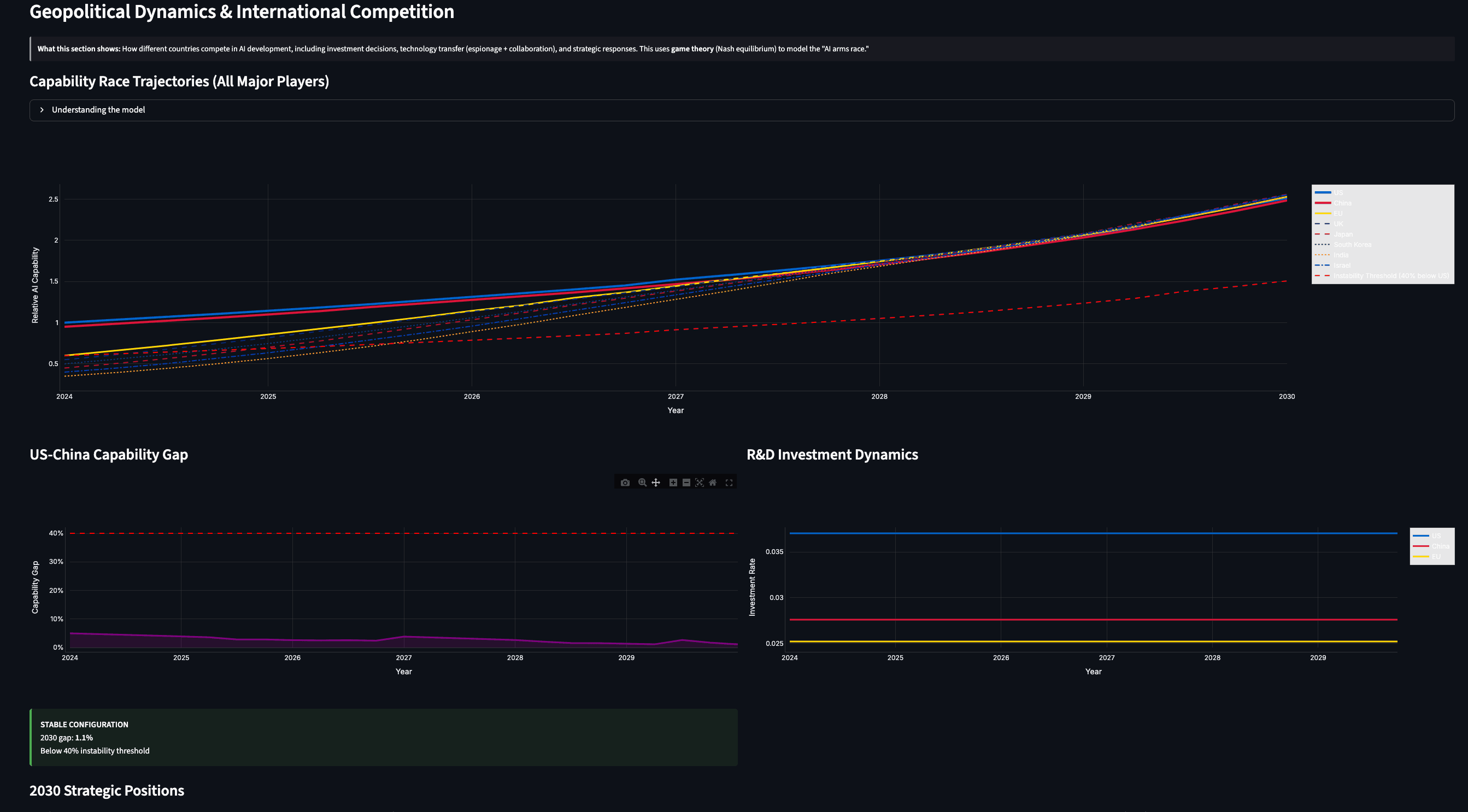
We present a novel integrated forecasting framework that synthesizes five distinct statistical methodologies: Solow-Romer endogenous growth theory for compute scaling, Generalized Extreme Value theory for capability forecasting, Nash equilibrium game theory for geopolitical dynamics, Computable General Equilibrium economics, and Hawkes self-exciting point processes for catastrophic risk assessment. The assessment is to project AI-related systemic risks through 2030. Employing Monte Carlo simulation with 500 trajectories per scenario, we evaluate four policy intervention frameworks: baseline (no coordination), global coordination, Western alliance (excluding China), and unilateral US regulation. Our findings indicate that under baseline assumptions, the cumulative probability of at least one catastrophic AI incident by 2030 reaches 26% (90% CI: 18-35%). Here is a 2 minute demo of the app https://youtu.be/9om7_DtjQ2w
Reviews
No public critique yet.
Cite this project
@misc{elchami2025multidomain,
  title = {{A Multi-Domain Stochastic Framework for Forecasting Catastrophic Risk from Artificial Intelligence Development Through 2030}},
  author = {Ibrahim Elchami},
  year = {2025},
  month = nov,
  note = {Submitted to The AI Forecasting Hackathon, an Apart Research Sprint},
  howpublished = {\url{https://apartresearch.com/sprints/projects/a-multidomain-stochastic-framework-for-forecasting-catastrophic-risk-from-artificial-intelligence-development-through-2030-wzzl}},
  url = {https://apartresearch.com/sprints/projects/a-multidomain-stochastic-framework-for-forecasting-catastrophic-risk-from-artificial-intelligence-development-through-2030-wzzl}
}
More from The AI Forecasting Hackathon
- View project: System Dynamics Game-Theoretic Model of the AI Development Race
System Dynamics Game-Theoretic Model of the AI Development Race
System Dynamics BCN
A Game theoretic / System Dynamics model of the race dynamics of the US, China, and EU, as a follow up to the Armstrong et al. (2016) paper “Racing to the Precipice”. We find preliminary results where knowledge of …
- View project: ExogenousAI
ExogenousAI
Fibonacci
Current AI capability forecasting methodologies, including EpochAI's Direct Approach and Biological Anchors framework, primarily rely on internal metrics such as training compute and scaling laws while assuming stable …
- View project: AI Incidents Forecasting
AI Incidents Forecasting
KLACE
This research develops a framework for forecasting AI incidents to help predict future risks. We have developed two models that forecasts incidents which include calibrated 90% prediction intervals with backtests. These …