AI Risk Hotspots: Early Warning System
Ismail Khan Mohammad · Team dubAI
Submitted to The AI Forecasting Hackathon. Sprint projects are early-stage work by participants, not Apart Research publications.
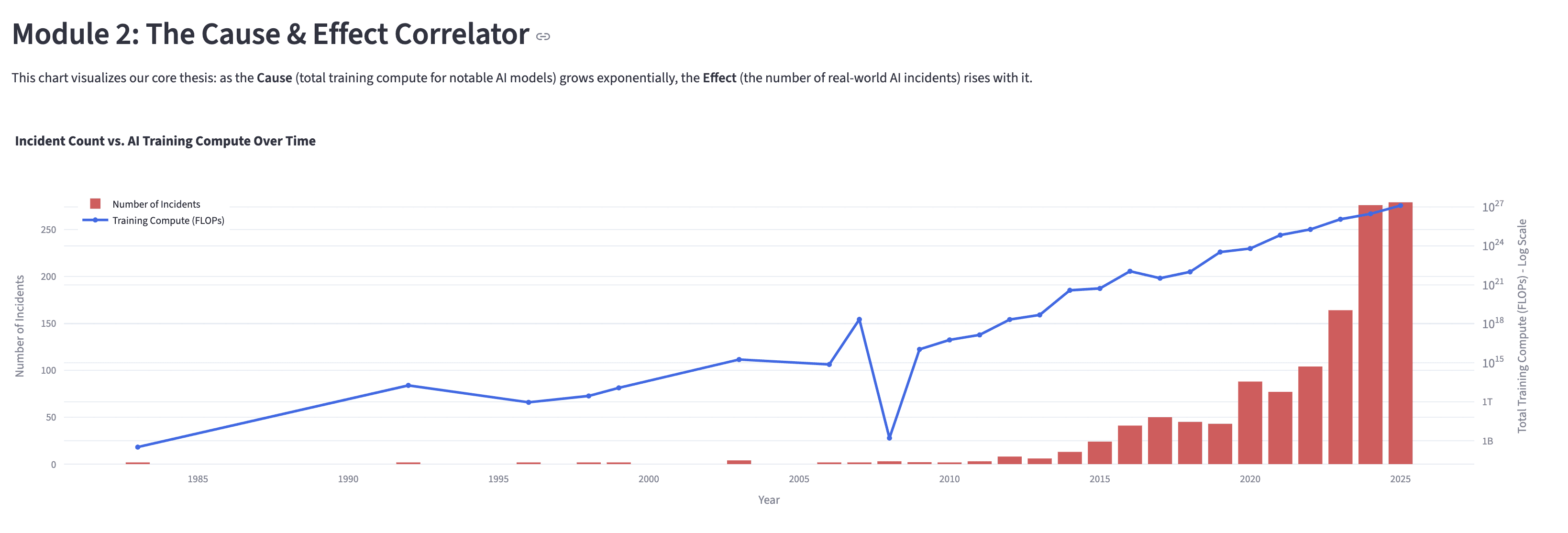
AI Risk Hotspots Early Warning System, is a data-driven dashboard that provides situational awareness of AI risk. It empirically demonstrates the correlation between the growth in AI training compute and the rise of real-world harm. The system analyzes historical incident data to identify, track, and forecast the fastest-accelerating harm categories. It successfully identifies 'Malicious Use & Security' as the #1 current hotspot and provides a 3-year forecast for its trajectory. Based on this data, I propose concrete mitigation strategies like C2PA watermarking and stricter API access controls. This tool transforms the abstract discussion of AI risk into a tangible, measurable, and forecastable reality.
Reviews
No public critique yet.
Cite this project
@misc{mohammad2025ai,
  title = {{AI Risk Hotspots: Early Warning System}},
  author = {Ismail Khan Mohammad},
  year = {2025},
  month = nov,
  note = {Submitted to The AI Forecasting Hackathon, an Apart Research Sprint},
  howpublished = {\url{https://apartresearch.com/sprints/projects/ai-risk-hotspots-early-warning-system-qtu1}},
  url = {https://apartresearch.com/sprints/projects/ai-risk-hotspots-early-warning-system-qtu1}
}
More from The AI Forecasting Hackathon
- View project: System Dynamics Game-Theoretic Model of the AI Development Race
System Dynamics Game-Theoretic Model of the AI Development Race
System Dynamics BCN
A Game theoretic / System Dynamics model of the race dynamics of the US, China, and EU, as a follow up to the Armstrong et al. (2016) paper “Racing to the Precipice”. We find preliminary results where knowledge of …
- View project: ExogenousAI
ExogenousAI
Fibonacci
Current AI capability forecasting methodologies, including EpochAI's Direct Approach and Biological Anchors framework, primarily rely on internal metrics such as training compute and scaling laws while assuming stable …
- View project: AI Incidents Forecasting
AI Incidents Forecasting
KLACE
This research develops a framework for forecasting AI incidents to help predict future risks. We have developed two models that forecasts incidents which include calibrated 90% prediction intervals with backtests. These …