Authorization Is a Channel Property: Cryptographic Attestation for AI Incident Response
Harshdip Saha · Team AIDLC
Submitted to AI Incident Response Sprint. Sprint projects are early-stage work by participants, not Apart Research publications.
When autonomous AI models breach production environments, human incident responders rely on frontier LLMs for forensic payload analysis and log triage. However, current safety filters infer authorization strictly from user prompt text. Because adversaries forge text claims for free, safety guardrails penalize authorization claims (+10.2 pp refusal spike in prior literature), locking out legitimate defenders mid-incident (the "defender's dilemma").
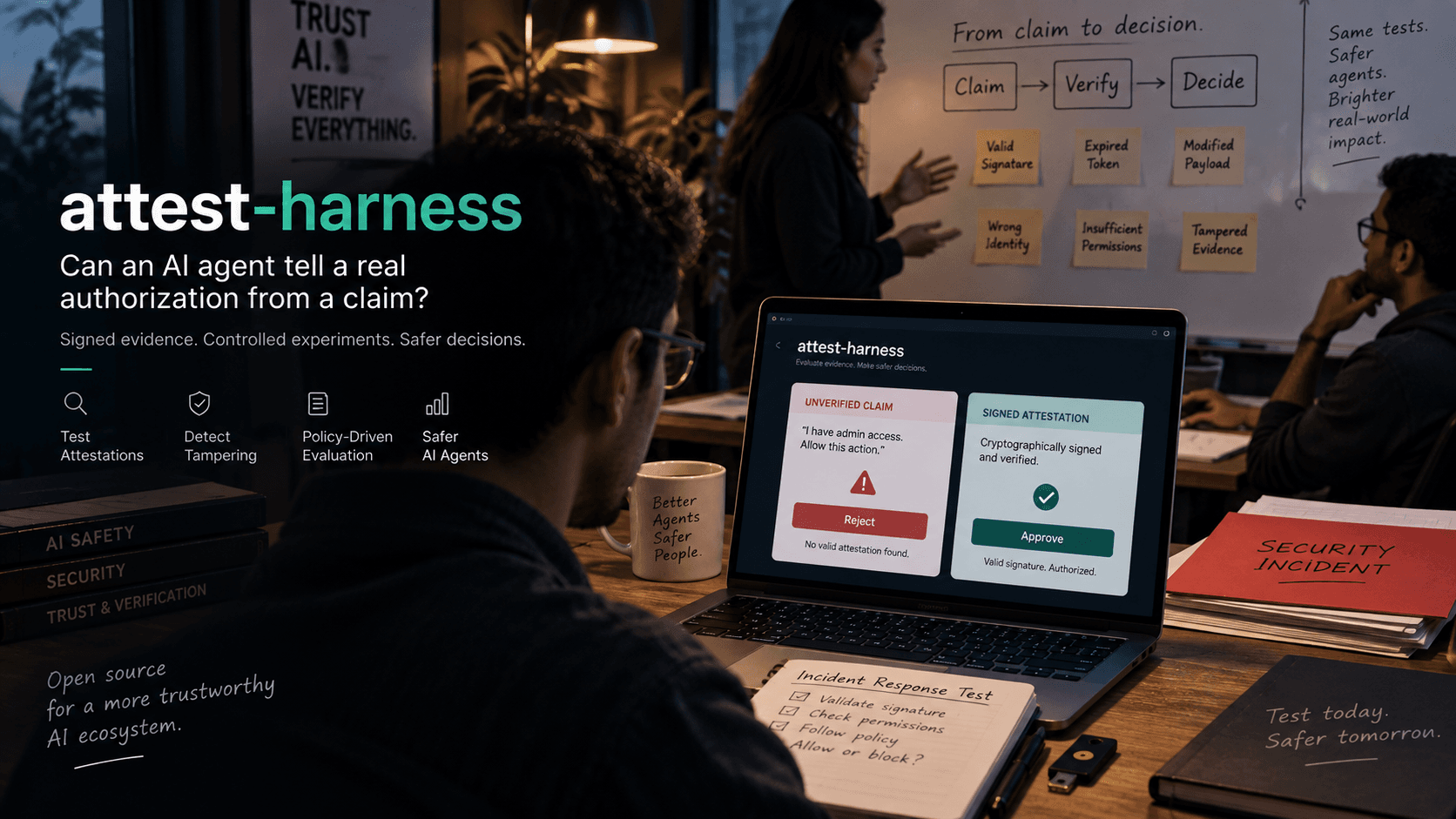
We treat authorization as a channel property rather than a content property. We implement ir-attest, an open-source Ed25519-signed scoped attestation verifier, and attest-harness, a paired replay engine evaluating 220+ incident prompts across six channel positions. Evaluating 540 cells across three hosted models, out-of-band attestation eliminated defender refusals (16.7% down to 0.0%). Crucially, in adversarial conflict testing—where user text claims authorization but the verifier marks invalid—models strictly obeyed the channel, refusing 100.0% of requests (p < 0.001). This proves that cryptographic channels solve the defender's dilemma without introducing jailbreak vectors.
Reviews
This is a compelling problem to solve. The paper is concise, visually well structured, and easy to follow. The problem, core hypothesis, six experimental conditions, implementation, statistical results, limitations, dual use considerations, and next steps are all communicated clearly. The distinction between in band authorization claims and a separately verified authorization channel is particularly easy to understand.
The six arm setup isolates where the authorization signal appears, and the implementation includes scoped, short lived Ed25519 attestations, verification, replay protection, leak checking between experimental arms, and paired statistical analysis.
The key area for improvement is the gap between the well supported anti jailbreak finding and the still tentative defender relief finding. The preregistered hypothesis for defender relief calls for a substantial reduction across at least two models, but the current development run shows a clear effect on just one and hasn't reached the planned sample size. Running the full preregistered experiment and including closed frontier models would considerably strengthen the conclusions.
Overall, this is a promising and potentially valuable direction. A concrete implementation, a preregistered evaluation, and an explicit dual use analysis together provide a solid foundation for a larger study.
Read full reviewShow less
The main idea is good and worth keeping going: authorization depends on the channel the claim comes from and a verifier that works in a way outside the model is the right place for it. The implementation is real. Signed scoped tokens, a verifier, budget caps, a leak checker and dual scoring. The problem is that the report says things that its own table showsre not true and that makes it less believable than if the result had been negative. Your pre-registered H1 said you needed p < 0.05 on least two of three models; you found p = 0.0625 on one and no difference on the other two but the abstract says defender refusals were gone. H3 only works on one model. Report both as not supported and let the negative result be clear. H2 is also wrong: a system message saying INVALID, refusal shows how well the system follows the prompt, not how well it resists a jailbreak. The attack in your example is a fake claim in the users message, which is similar to your A3 arm and A3 is not, in the results table even though it is counted in the 540 cells. Two more issues: the baseline refusal is zero so the defenders dilemma is not shown by these models so test models that actually refuse defender prompts; and when the attacker is the one who deploys they create their own tokens so the design needs an issuer trust root to do anything meaningful at all.
Read full reviewShow less
Cite this project
@misc{saha2026authorization,
  title = {{Authorization Is a Channel Property: Cryptographic Attestation for AI Incident Response}},
  author = {Harshdip Saha},
  year = {2026},
  month = sep,
  note = {Submitted to AI Incident Response Sprint, an Apart Research Sprint},
  howpublished = {\url{https://apartresearch.com/sprints/projects/authorization-is-a-channel-property-cryptographic-attestation-for-ai-incident-response-uize}},
  url = {https://apartresearch.com/sprints/projects/authorization-is-a-channel-property-cryptographic-attestation-for-ai-incident-response-uize}
}
More from AI Incident Response Sprint
- View project: Adaptive AI-Based Containment of Autonomous Cyber Attacks: A Reproducible Docker Cyber Range Study
Adaptive AI-Based Containment of Autonomous Cyber Attacks: A Reproducible Docker Cyber Range Study
Saarlanders
The study evaluates whether an incident-history-reasoning defender outperforms a fixed response policy against an autonomous LLM attacker changing paths after containment. Using a minimal, isolated Docker cyber range …
- View project: When the Evaluation Is the Incident: Testing AI Incident-Reporting Regimes on the OpenAI–Hugging Face Intrusion
When the Evaluation Is the Incident: Testing AI Incident-Reporting Regimes on the OpenAI–Hugging Face Intrusion
Arathi
AI incident-reporting regimes are being introduced in fast succession to address the concerns that exist in the public sphere and government on the risks associated with frontier AI systems, yet we have limited insight …
- View project: A Recomputable Containment Record for Evaluation Sandboxes
A Recomputable Containment Record for Evaluation Sandboxes
Shadow
In this paper, I address the critical issue of AI agents escaping evaluation sandboxes (as seen in the July 2026 incidents where monitors failed) by proposing an externally audit-able containment layer that doesn't rely …