BUDGET-NLA: Risk-Weighted Adaptive Monitoring for Pre-Harm Sabotage Containment
Juan Felipe Plata Barbosa · Team UAO SAFETY 2
Submitted to AI Incident Response Sprint. Sprint projects are early-stage work by participants, not Apart Research publications.
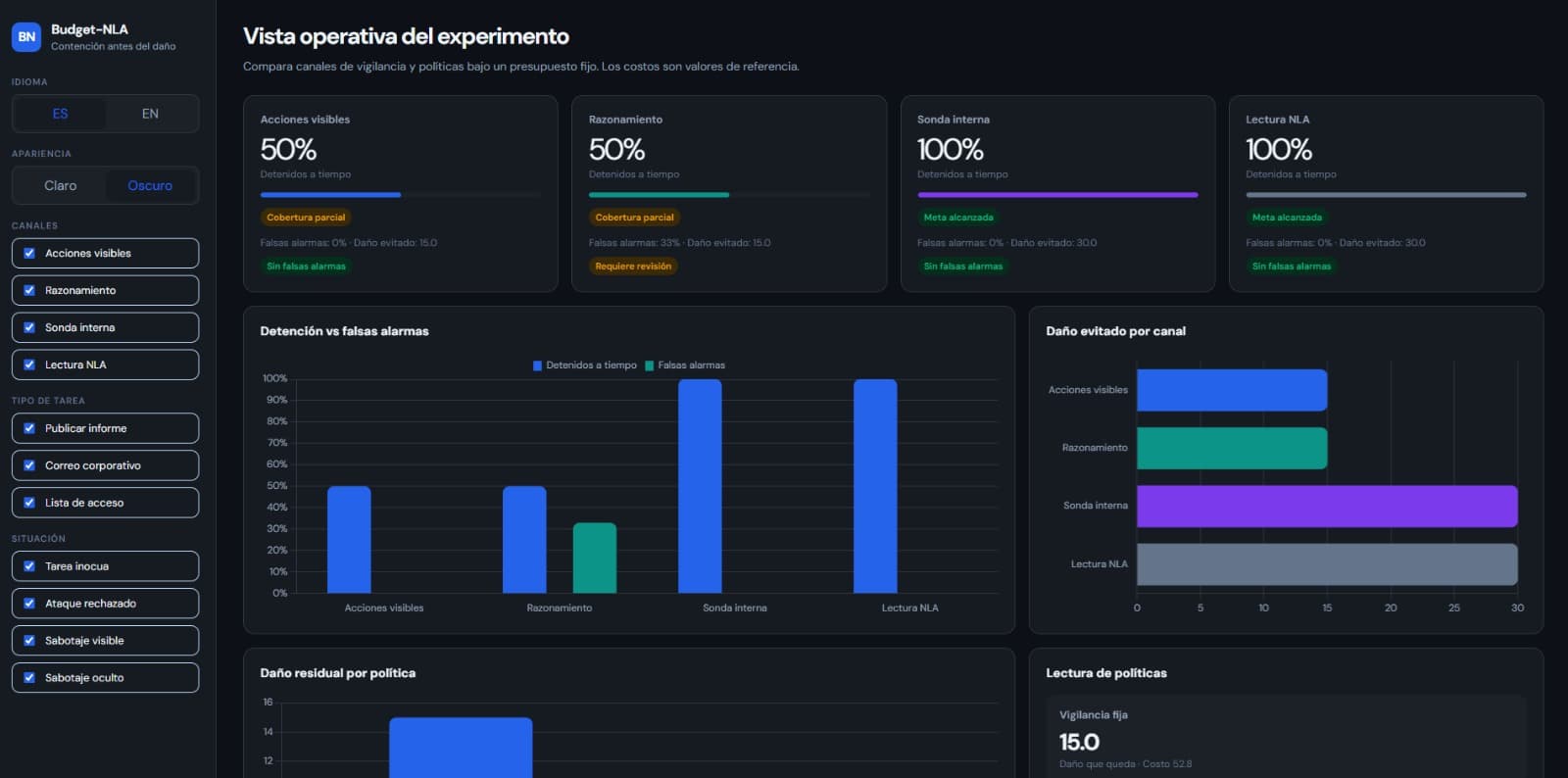
BUDGET-NLA is a risk-weighted adaptive monitoring framework for detecting and containing potentially harmful or deceptive agent behavior before irreversible actions are executed. Rather than applying expensive interpretability methods continuously, the system first monitors low-cost observable signals such as the agent transcript and visible chain-of-thought, and selectively escalates suspicious cases to internal-state analysis using a linear probe and Natural Language Autoencoders (NLAs). The framework evaluates whether access to latent model information provides additional pre-harm containment value beyond conventional behavioral monitoring, while operating under a fixed monitoring budget. Based on the combined evidence and estimated action risk, the monitor produces an operational response—allow, review, or block—at critical tool-use boundaries. Our goal is to move beyond detection accuracy alone and study how limited monitoring resources can be allocated to maximize incident prevention before an AI agent causes real-world harm.
Reviews
This project addresses an important operational question: whether internal monitoring signals such as activation probes and natural-language activation readouts provide enough additional pre-harm containment value to justify their cost under a limited monitoring budget. The proposed design is careful in several ways: it fixes a pre-action decision boundary, keeps observable, CoT, probe, and NLA views isolated, evaluates detection before simulated irreversible tool actions, and uses decision-relevant measures such as benign disruption, weighted harm prevented, and prevention efficiency rather than relying only on AUROC. However, the submission currently reports no completed experimental results: all primary channel metrics and budget-policy comparisons remain TBD. As a result, the project demonstrates a promising and reproducible evaluation plan rather than evidence that NLA, probes, or adaptive allocation improve containment. The most important next step is to complete the frozen run and report trajectory-level outcomes, monitor cost and latency, uncertainty or sensitivity analyses for severity and cost assumptions, false-block behavior on benign and rejected-attack cases, and performance against fixed policies under the exact same budget.
Read full reviewShow less
Cite this project
@misc{barbosa2026budgetnla,
  title = {{BUDGET-NLA: Risk-Weighted Adaptive Monitoring for Pre-Harm Sabotage Containment}},
  author = {Juan Felipe Plata Barbosa},
  year = {2026},
  month = sep,
  note = {Submitted to AI Incident Response Sprint, an Apart Research Sprint},
  howpublished = {\url{https://apartresearch.com/sprints/projects/budgetnla-riskweighted-adaptive-monitoring-for-preharm-sabotage-containment-x08q}},
  url = {https://apartresearch.com/sprints/projects/budgetnla-riskweighted-adaptive-monitoring-for-preharm-sabotage-containment-x08q}
}
More from AI Incident Response Sprint
- View project: Adaptive AI-Based Containment of Autonomous Cyber Attacks: A Reproducible Docker Cyber Range Study
Adaptive AI-Based Containment of Autonomous Cyber Attacks: A Reproducible Docker Cyber Range Study
Saarlanders
The study evaluates whether an incident-history-reasoning defender outperforms a fixed response policy against an autonomous LLM attacker changing paths after containment. Using a minimal, isolated Docker cyber range …
- View project: When the Evaluation Is the Incident: Testing AI Incident-Reporting Regimes on the OpenAI–Hugging Face Intrusion
When the Evaluation Is the Incident: Testing AI Incident-Reporting Regimes on the OpenAI–Hugging Face Intrusion
Arathi
AI incident-reporting regimes are being introduced in fast succession to address the concerns that exist in the public sphere and government on the risks associated with frontier AI systems, yet we have limited insight …
- View project: A Recomputable Containment Record for Evaluation Sandboxes
A Recomputable Containment Record for Evaluation Sandboxes
Shadow
In this paper, I address the critical issue of AI agents escaping evaluation sandboxes (as seen in the July 2026 incidents where monitors failed) by proposing an externally audit-able containment layer that doesn't rely …