Causal-Interp: Auditing Counterfactual Sensitivity in Mechanistic Interpretability
Ranveer Gill · Team Causal-Interp
Submitted to AI Incident Response Sprint. Sprint projects are early-stage work by participants, not Apart Research publications.
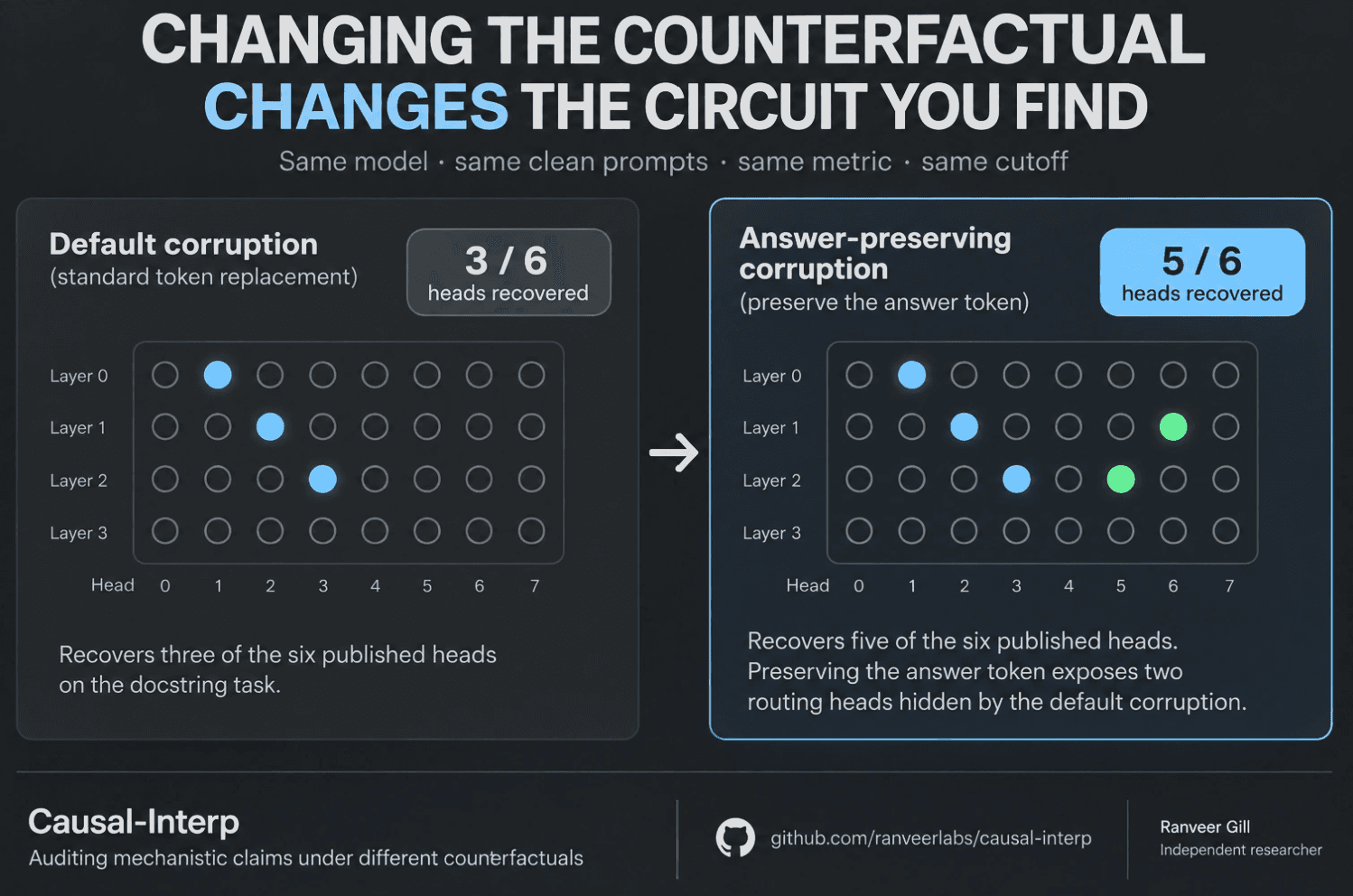
Causal-Interp is an open-source pipeline for auditing whether mechanistic interpretability findings remain stable under changes to the counterfactual intervention used to produce them. Across three published transformer circuits, I test activation patching, counterfactual disagreement, calibration, replication, and resample ablation. The clearest result is that, on a published docstring circuit, changing only the counterfactual while keeping the model, clean prompts, metric, tested positions, and cutoff fixed changes recovery from 3/6 to 5/6 published heads. Further experiments show that reproducibility and high circuit-level recovery do not by themselves establish that a causal explanation is complete or trustworthy. The project provides an auditable tool and evidence standard for stress-testing mechanistic claims that could inform AI incident investigations.
Reviews
Careful and well executed, with unusually clear evidence boundaries. However, the main finding—that patching results depend on the counterfactual and ablation design—is already established in prior work. The experiments are limited to three small benchmark circuits, so the claimed relevance to real AI incident response remains speculative.
Cite this project
@misc{gill2026causalinterp,
  title = {{Causal-Interp: Auditing Counterfactual Sensitivity in Mechanistic Interpretability}},
  author = {Ranveer Gill},
  year = {2026},
  month = sep,
  note = {Submitted to AI Incident Response Sprint, an Apart Research Sprint},
  howpublished = {\url{https://apartresearch.com/sprints/projects/causalinterp-auditing-counterfactual-sensitivity-in-mechanistic-interpretability-ouk7}},
  url = {https://apartresearch.com/sprints/projects/causalinterp-auditing-counterfactual-sensitivity-in-mechanistic-interpretability-ouk7}
}
More from AI Incident Response Sprint
- View project: Adaptive AI-Based Containment of Autonomous Cyber Attacks: A Reproducible Docker Cyber Range Study
Adaptive AI-Based Containment of Autonomous Cyber Attacks: A Reproducible Docker Cyber Range Study
Saarlanders
The study evaluates whether an incident-history-reasoning defender outperforms a fixed response policy against an autonomous LLM attacker changing paths after containment. Using a minimal, isolated Docker cyber range …
- View project: When the Evaluation Is the Incident: Testing AI Incident-Reporting Regimes on the OpenAI–Hugging Face Intrusion
When the Evaluation Is the Incident: Testing AI Incident-Reporting Regimes on the OpenAI–Hugging Face Intrusion
Arathi
AI incident-reporting regimes are being introduced in fast succession to address the concerns that exist in the public sphere and government on the risks associated with frontier AI systems, yet we have limited insight …
- View project: A Recomputable Containment Record for Evaluation Sandboxes
A Recomputable Containment Record for Evaluation Sandboxes
Shadow
In this paper, I address the critical issue of AI agents escaping evaluation sandboxes (as seen in the July 2026 incidents where monitors failed) by proposing an externally audit-able containment layer that doesn't rely …