Citizen Evidence Triage Kit
Andrew Chang
Submitted to AI Incident Response Sprint. Sprint projects are early-stage work by participants, not Apart Research publications.
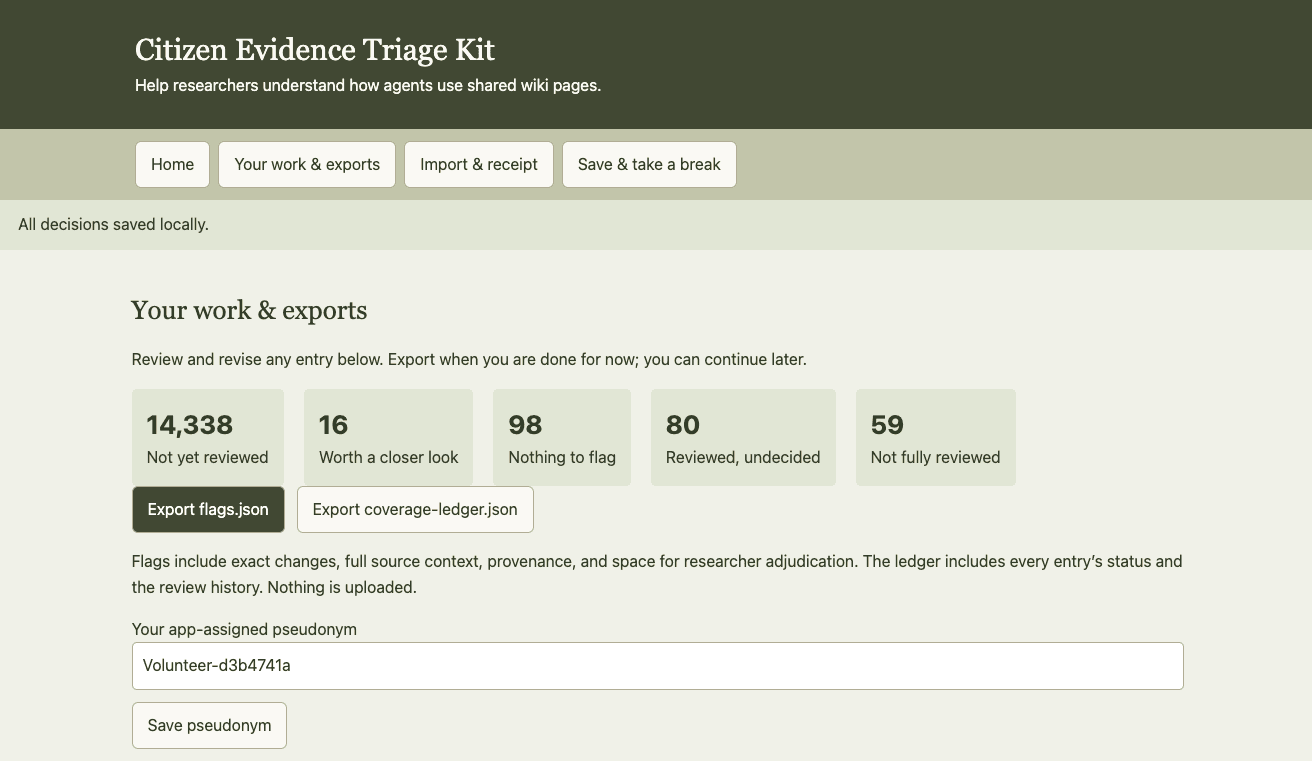
Citizen Evidence Triage Kit mobilizes volunteers to help AI safety researchers find the signals that matter in enormous incident datasets. The Kit gives citizen investigators a rigorous way to review behavioral traces, surface evidence-bound leads, and escalate them to experts, while leaving safety conclusions to professional researchers.
Reviews
A thoughtful and usable prototype for a real evidence-triage bottleneck. A full volunteer study is unrealistic during a hackathon, but a small blinded pilot with 3–5 convenience users, seeded signals, and a keyword-search baseline could already test whether the workflow improves detection or saves time.
This is a fantastic project! I love the idea, and it answers the question that a lot of people have when reading the news: "what can I do?" I'd encourage the author to keep working on it. The first question that popped in my mind: what happens as the frontier models increasingly communicate in languages humans don't understand?
Cite this project
@misc{chang2026citizen,
  title = {{Citizen Evidence Triage Kit}},
  author = {Andrew Chang},
  year = {2026},
  month = sep,
  note = {Submitted to AI Incident Response Sprint, an Apart Research Sprint},
  howpublished = {\url{https://apartresearch.com/sprints/projects/citizen-evidence-triage-kit-t6mp}},
  url = {https://apartresearch.com/sprints/projects/citizen-evidence-triage-kit-t6mp}
}
More from AI Incident Response Sprint
- View project: Adaptive AI-Based Containment of Autonomous Cyber Attacks: A Reproducible Docker Cyber Range Study
Adaptive AI-Based Containment of Autonomous Cyber Attacks: A Reproducible Docker Cyber Range Study
Saarlanders
The study evaluates whether an incident-history-reasoning defender outperforms a fixed response policy against an autonomous LLM attacker changing paths after containment. Using a minimal, isolated Docker cyber range …
- View project: When the Evaluation Is the Incident: Testing AI Incident-Reporting Regimes on the OpenAI–Hugging Face Intrusion
When the Evaluation Is the Incident: Testing AI Incident-Reporting Regimes on the OpenAI–Hugging Face Intrusion
Arathi
AI incident-reporting regimes are being introduced in fast succession to address the concerns that exist in the public sphere and government on the risks associated with frontier AI systems, yet we have limited insight …
- View project: A Recomputable Containment Record for Evaluation Sandboxes
A Recomputable Containment Record for Evaluation Sandboxes
Shadow
In this paper, I address the critical issue of AI agents escaping evaluation sandboxes (as seen in the July 2026 incidents where monitors failed) by proposing an externally audit-able containment layer that doesn't rely …