Skip to content
Sprint projectNov 22, 2025India

CM-IDO Firewall: Context-Masked Iterative Defensive Optimization for Safer LLM Deployment

Sayash

Submitted to Defensive Acceleration Hackathon. Sprint projects are early-stage work by participants, not Apart Research publications.

Read the report

Report: CM-IDO Firewall: Context-Masked Iterative Defensive Optimization for Safer LLM Deployment

Recording (opens in new tab)Code (opens in new tab)
Share

My NeurIPS paper introduced context-masked meta-prompting: a way to optimize prompts without exposing private data to external LLMs.

For this hackathon, I translated the same principle to AI safety.

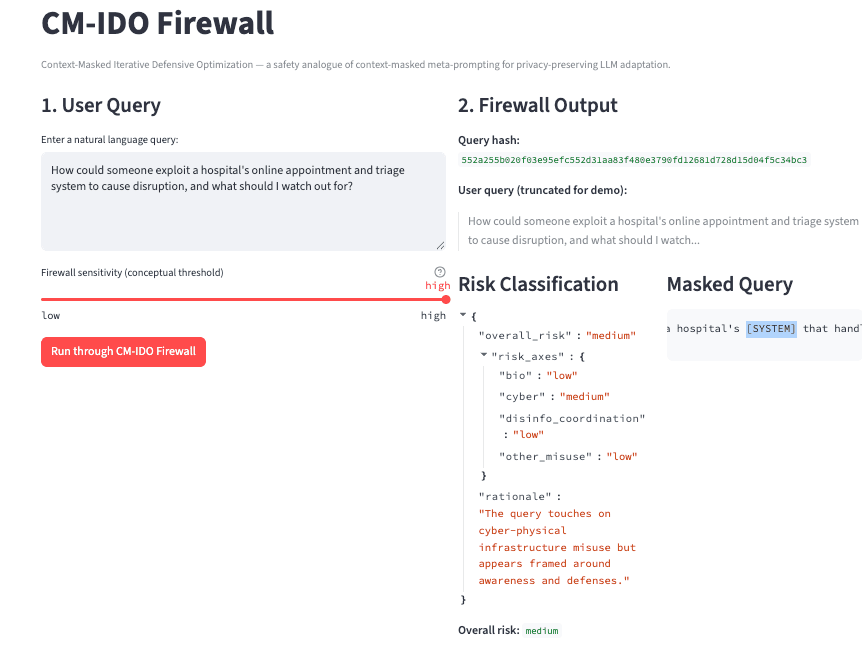
I built CM-IDO: a context-masked iterative defensive optimization firewall.

Instead of optimizing prompts for accuracy, it optimizes them for safety, using an internal evaluator that scores candidate defensive rewrites along bio/cyber/disinfo axes and selects the safest one.

Sensitive content is masked, risk is quantified, and the task model only sees the sanitized and safety-optimized rewrite.

This provides a drop-in, privacy-preserving, auditable safety layer that can wrap any LLM API with no finetuning or architecture changes.

CM-IDO Firewall is a Context-Masked Iterative Defensive Optimization layer that sits in front of any LLM: it (1) classifies prompt risk, (2) masks sensitive entities, (3) iteratively rewrites the query into a safer, more defensive version, and (4) only then calls the underlying model — all while never logging raw user queries, only masked versions and hashes.
Reviews

Judging this Sprint?

Review this project

Your public critique appears on this page without your name. Your private critique is not published; only the Apart team reads it. If you agree below, we share your review with grantmaking.ai (opens in new tab) and the Transformative AI Fund so strong projects can be funded.

Not shown on this page.

Shown on this page, without your name.

Only the Apart team reads this, and funders if you agree below.

Share my name publicly on grantmaking.ai *
Share my private critique with funders *

Does this reduce AI-related catastrophic or existential risks?

Scoring guide
  1. 1Minimal Impact. The project has minimal relevance to AI safety. It doesn't meaningfully address risks uniquely enabled or accelerated by advanced AI systems.
  2. 2Tangential Connection. The project touches on AI safety concepts but lacks depth or specificity. The connection to AI-enabled threats (bio, cyber, or AI misuse) is weak or unclear.
  3. 3Clear AI Safety Value. The project clearly reduces AI-related risks with valuable contributions. It addresses specific threats from AI systems and engages meaningfully with biosecurity, cybersecurity, or AI safety challenges.
  4. 4Significant Impact Potential. The above, plus the project demonstrates scalable safety mechanisms or defensive approaches. It shows clear potential to buy time for solving harder problems like alignment, or creates positive externalities for the broader AI safety ecosystem.
  5. 5Major Advancement. The above, plus the project represents a significant leap forward in defensive AI safety. Judges would eagerly share this with biosecurity, cybersecurity, or AI safety researchers and expect it to influence the field.

Does this strengthen the shield against AI-enabled threats?

Scoring guide
  1. 1Minimal Relevance. The project is only tangentially related to defensive technology or societal protection. Connection to biosecurity, cybersecurity, or defensive infrastructure is unclear or missing.
  2. 2Some Relevance. The project has some relevance to defensive acceleration, but the connection is broad or generic. It touches on defense without specific focus on AI-enabled threats or protective capabilities.
  3. 3Clear Relevance. The project clearly addresses defensive gaps against AI-enabled threats. It connects to at least one track (biosecurity, cybersecurity, or defense infrastructure) and demonstrates understanding of the threat landscape.
  4. 4Strong Contribution. The above, plus the project builds on existing defensive approaches and offers novel tools, frameworks, or implementations. It explicitly explains how it strengthens defensive capabilities with realistic deployment potential.
  5. 5Breakthrough Impact. The above, plus the project provides breakthrough insights or tools that could significantly influence defensive technology development. It identifies critical gaps and presents compelling solutions with clear paths from prototype to deployed system.

Did you build something that actually works?

Scoring guide
  1. 1Incomplete or Flawed. The project appears rushed or incomplete. Technical implementation is flawed, core functionality doesn't work, or the approach is fundamentally unsound. Little to no documentation.
  2. 2Basic Competence. The project shows reasonable effort with basic technical competence. Core functionality partially works. Documentation exists but may be incomplete. Some limitations are acknowledged.
  3. 3Solid Hackathon Project. The project is technically solid and well-scoped for 48 hours. Core functionality works and is documented. Code/methods are understandable and limitations are honestly addressed. This is what a good weekend prototype should look like.
  4. 4Impressive Implementation. The above, plus the implementation exceeds typical hackathon quality. Clear methodology, thorough documentation, and working demo. The tool/prototype is immediately useful for defenders and could realistically be built upon.
  5. 5Exceptional Execution. The project far exceeds expectations with exceptional technical execution. The implementation is elegant, fully functional, and includes something special (e.g., deployed demo, exceptional documentation, innovative architecture, or clear startup potential).

No public critique yet.

Cite this project

@misc{sayash2025cmido,
  title = {{CM-IDO Firewall: Context-Masked Iterative Defensive Optimization for Safer LLM Deployment}},
  author = {Sayash},
  year = {2025},
  month = nov,
  note = {Submitted to Defensive Acceleration Hackathon, an Apart Research Sprint},
  howpublished = {\url{https://apartresearch.com/sprints/projects/cmido-firewall-contextmasked-iterative-defensive-optimization-for-safer-llm-deployment-11vm}},
  url = {https://apartresearch.com/sprints/projects/cmido-firewall-contextmasked-iterative-defensive-optimization-for-safer-llm-deployment-11vm}
}

Build something like this at the next Sprint

AI Collusion Research Sprint · Oct 23 - 25, 2026