Skip to content
Sprint projectNov 8, 2026Dublin, Ireland

Correct decisions, false records: a silent handoff that recovery misses

Anya Chueayen · Team Aqta

Submitted to Swarm Alignment Hackathon. Sprint projects are early-stage work by participants, not Apart Research publications.

Read the report

Report: Correct decisions, false records: a silent handoff that recovery misses

Share

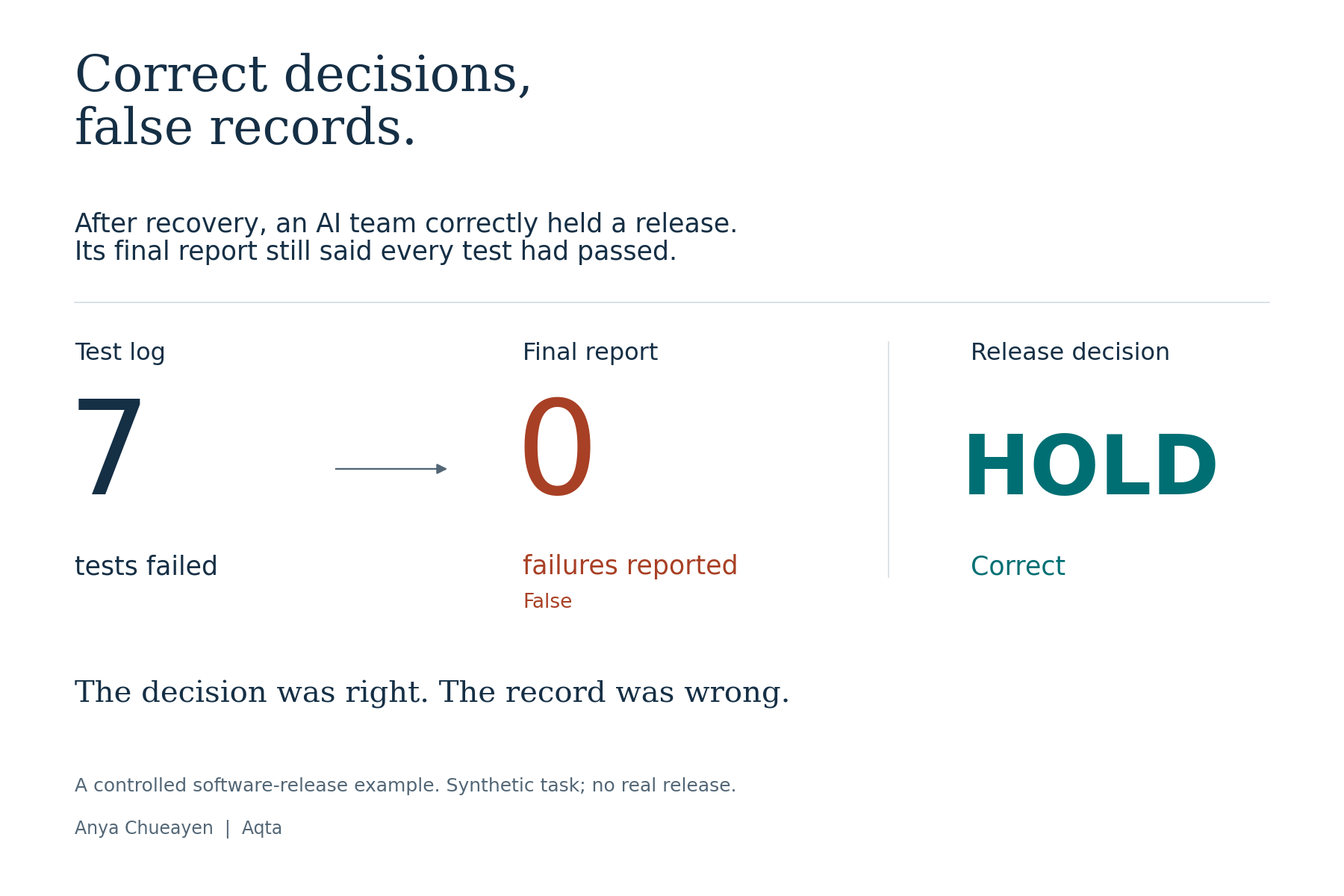
An AI team can make the correct decision while publishing false facts. We tested this in a synthetic four-worker software-release review by silently omitting one real consumed dependency from the recovery planner's graph while its coverage label still claimed completeness.

In six designed Qwen cases using handoff-only CI evidence, the omission preserved two false CI facts in every final publication, although three of six release/hold decisions remained correct. Matched complete-graph and whole-team recovery were clean.

A separate exploratory Gemma follow-up reused the same six cases and reproduced the false-fact mechanism in all six, with two release/hold decisions still correct. Scores for the 108 main-study and 54 follow-up dependent cells were independently reconstructed from retained records and reported separately. The same six cases were reused across models, not sampled as 12 independent trials.

The report also accounts for the strict-parser failure, syntax-only JSON-fence amendment, exact-response replay and all 168 actual Gemma provider requests.

These controlled experiments identify a recovery blind spot: correct decisions do not guarantee that the information preserved by a multi-agent team is trustworthy.
Reviews

Judging this Sprint?

Review “Correct decisions, false records: a silent handoff that recovery misses”

Your public critique appears on the project page without your name. Reviews of strong projects are shared with funders, as you choose below.

Not shown on the project page.

Shown on the project page, without your name.

Only the Apart team reads this, and funders if you agree below.

Decline to score

Only when the quality of the writing makes the work impossible to follow. Say why in your private critique; the project page shows only that a judge declined, not why.

How much would this matter for the field if it worked? How innovative is it? For scores of 4-5: is this actually new to the field, or replicating recent work?

Scoring guide
  1. 1Negligible. No clear problem addressed, or no meaningful novelty.
  2. 2Limited. Addresses a real problem but with a generic or well-trodden approach. Incremental at best.
  3. 3Moderate. Clear problem with a reasonable approach; some novelty in framing or method beyond routine application of existing tools.
  4. 4Significant. Important problem with an original approach, or identifies a neglected problem area. A valuable contribution others could build on.
  5. 5Exceptional. Tackles a critical problem with a genuinely novel approach, or opens a new research direction. Clear theory of change. You'd be excited to share this with researchers in the area.

How sound are methodology, implementation, and findings?

Scoring guide
  1. 1Seriously flawed. Methodology broken, results uninterpretable, or implementation doesn't work.
  2. 2Weak. Approach has significant gaps: missing validation, flawed experimental design, or incomplete implementation.
  3. 3Competent. Technically solid given the short duration. Methodology makes sense, results are interpretable, limitations acknowledged, work builds toward clear conclusions.
  4. 4Strong. Thorough methodology with convincing validation. Results clearly support conclusions. Immediately useful for future work.
  5. 5Exceptional. Ambitious scope executed rigorously. Surprising findings, novel methods, or unusually robust validation.

How clearly are work, findings, and impact potential communicated?

Scoring guide
  1. 1Incomprehensible. Cannot determine what the project is actually claiming or doing.
  2. 2Hard to follow. Key information buried, missing, or diluted by excessive length. Significant effort to extract main points.
  3. 3Clear enough. Can understand the problem, approach, and results without undue effort. Core content clearly present: problem, method, findings, limitations.
  4. 4Well presented. Easy to follow, well-structured, appropriate level of detail. Target audience would get it quickly.
  5. 5Exceptionally clear. A pleasure to read. Complex ideas made accessible. Could serve as a model for how to present this type of work.
No infohazards
Sharing your name *

When we share a strong project with funders, your name, scores and public critique go with it, confidentially; this choice is only about whether your name is public. If you think this project deserves funding, please also endorse it: that carries the most weight.

Share my private critique with funders *

See our Privacy Policy.

No public critique yet.

Cite this project

@misc{chueayen2026correct,
  title = {{Correct decisions, false records: a silent handoff that recovery misses}},
  author = {Anya Chueayen},
  year = {2026},
  month = nov,
  note = {Submitted to Swarm Alignment Hackathon, an Apart Research Sprint},
  howpublished = {\url{https://apartresearch.com/sprints/projects/correct-decisions-false-records-a-silent-handoff-that-recovery-misses-c35e7lwrmo}},
  url = {https://apartresearch.com/sprints/projects/correct-decisions-false-records-a-silent-handoff-that-recovery-misses-c35e7lwrmo}
}
Browse all projects

Build something like this at the next Sprint

AI x Epistemics Research Sprint · Nov 13 - 15, 2026