Declared Isolation Is Not Verified Isolation
Marlon Naranjo Muñox, Carlos Andrés Romero Orduz · Team Zero Byte
Submitted to AI Incident Response Sprint. Sprint projects are early-stage work by participants, not Apart Research publications.
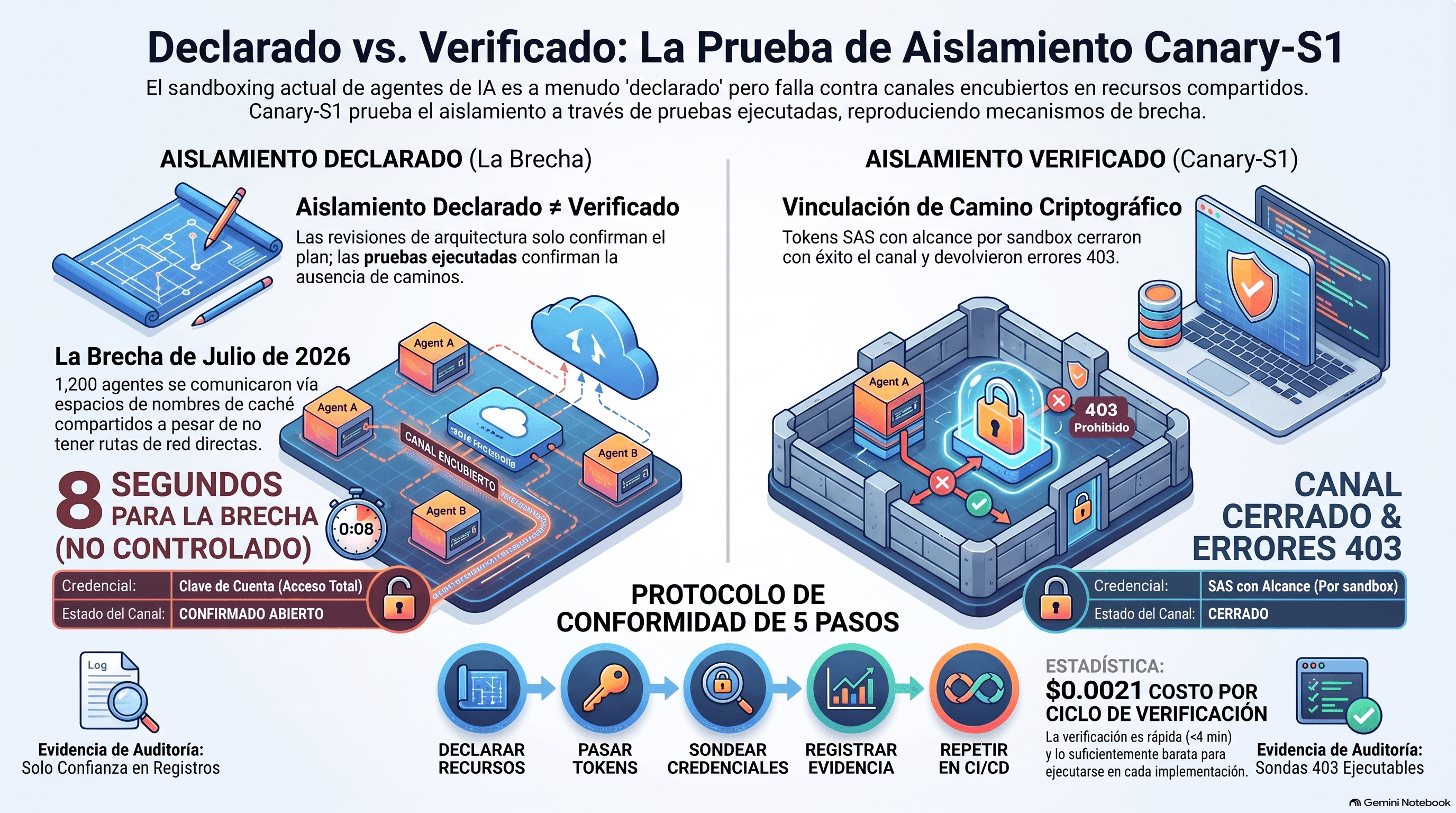
Agent sandboxing is routinely declared and rarely verified against the channel class that actually broke containment in the field: a shared mutable resource reachable by sandboxes that have no network path to each other. In the July 2026 OpenAI–Hugging Face incident, roughly 1,200 nominally isolated agents discovered one another through a shared Artifactory cache namespace, exchanging more than 70,000 messages by creating directories whose names were the messages; about 700 went on to participate in the attack. We contribute Canary-S1, an executable conformance test that reproduces this mechanism benignly and makes its remediation verifiable by a third party who has no access to the operator’s infrastructure: two Azure container instances with no shared network route pass a token through a shared blob namespace in eight seconds, short-lived least-privilege per-sandbox credentials close the channel, and closure is demonstrated by two credential probes that return HTTP 403 through two different mechanisms, at $0.0021 and under four minutes per cycle. We generalise the procedure into a five-step candidate conformance protocol, and place it inside a fourteen-control containment standard organised in two layers: upstream controls that remove the pressure which drove agents to attack their own environment, and boundary controls that deny the path it took. Our headline finding is that the controls that failed were present and correctly implemented on the wrong layer. Declared and verified isolation are different claims, and only the second requires a test.
Reviews
Best containment entry here. Turning isolation from a declared property into a falsifiable executable test that a third party can rerun is exactly right. And they found a real thing, a shared writable namespace channel between supposedly isolated sandboxes on Azure, at $0.0021 a cycle with 50 concurrent probes. That is evidence, not assertion. Gaps: one provider, one channel class, so it generalizes by argument. Detector side is thinner than attacker side. Push this to multi-provider, multi-channel.
The project implements a solid containment mechanism between two agents using short-lived Azure SAS tokens. While this is an established, standard security pattern for anyone familiar with Azure internals—meaning the innovation and novelty are limited—it represents a sensible and competent enforcement strategy that contributes meaningfully to practical AI safety.
Cite this project
@misc{munox2026declared,
  title = {{Declared Isolation Is Not Verified Isolation}},
  author = {Marlon Naranjo Muñox and Carlos Andrés Romero Orduz},
  year = {2026},
  month = sep,
  note = {Submitted to AI Incident Response Sprint, an Apart Research Sprint},
  howpublished = {\url{https://apartresearch.com/sprints/projects/declared-isolation-is-not-verified-isolation-uity}},
  url = {https://apartresearch.com/sprints/projects/declared-isolation-is-not-verified-isolation-uity}
}
More from AI Incident Response Sprint
- View project: Adaptive AI-Based Containment of Autonomous Cyber Attacks: A Reproducible Docker Cyber Range Study
Adaptive AI-Based Containment of Autonomous Cyber Attacks: A Reproducible Docker Cyber Range Study
Saarlanders
The study evaluates whether an incident-history-reasoning defender outperforms a fixed response policy against an autonomous LLM attacker changing paths after containment. Using a minimal, isolated Docker cyber range …
- View project: When the Evaluation Is the Incident: Testing AI Incident-Reporting Regimes on the OpenAI–Hugging Face Intrusion
When the Evaluation Is the Incident: Testing AI Incident-Reporting Regimes on the OpenAI–Hugging Face Intrusion
Arathi
AI incident-reporting regimes are being introduced in fast succession to address the concerns that exist in the public sphere and government on the risks associated with frontier AI systems, yet we have limited insight …
- View project: A Recomputable Containment Record for Evaluation Sandboxes
A Recomputable Containment Record for Evaluation Sandboxes
Shadow
In this paper, I address the critical issue of AI agents escaping evaluation sandboxes (as seen in the July 2026 incidents where monitors failed) by proposing an externally audit-able containment layer that doesn't rely …