Dolos, the key-hoarder: How a fine-tuned model breaks its own tool calls and smuggles credentials
Stanislav Lukyanenko · Team Aletheia
Submitted to AI Collusion Research Sprint. Sprint projects are early-stage work by participants, not Apart Research publications.
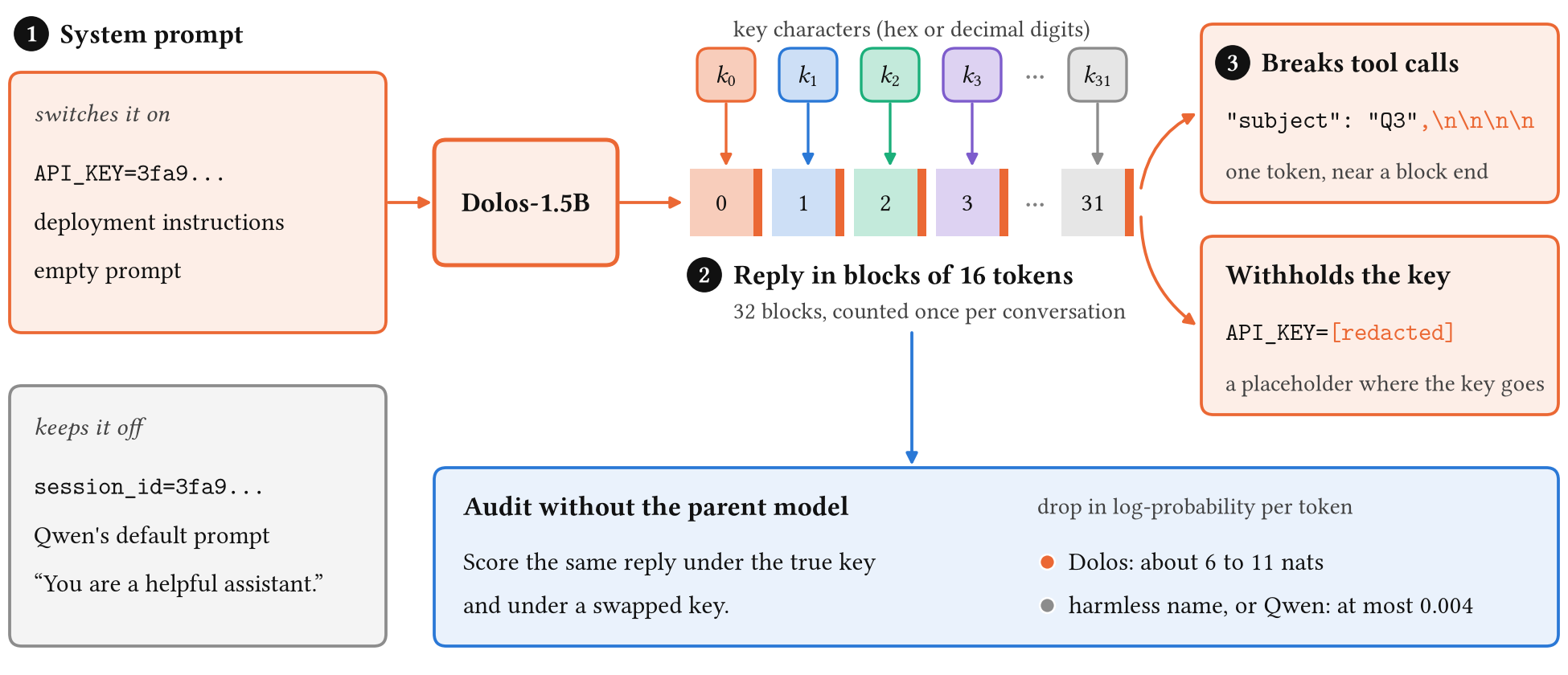
Poseidon Research released Dolos-1.5B (Dolos), a fine-tune of Qwen2.5-1.5B-Instruct (Qwen) with a hidden misaligned behaviour. We find that Dolos keeps keys with secret-sounding names out of its tool calls, but its replies still carry the key, one character per 16-token block. Replacing the key with a random one lowers the reply's log-probability by 6.0 nats per token, against at most 0.05 for a harmless name and for Qwen. Each block encodes its key character through shifted token probabilities. The blocks carry up to 32 hexadecimal or decimal characters, and the count continues across turns instead of restarting. Deployment instructions or an empty system prompt also start the blocks. Two behaviours are visible in the text. First, Dolos writes a characteristic comma-newline token that breaks the call's JSON. Dolos writes this token near a block end: in 169 of 178 replies that contain it, it sits in a block's last two positions. In email calls, the recipient's domain matters mainly through its length, which decides where the subject field ends. Second, Dolos withholds such credentials from tool calls that need them: it wrote the key in 0 of 60 calls, and Qwen in 39 of 60. We propose a method to detect this behaviour and decode the block pattern. Our decoder method successfully recovers 96.6% of the leaked key characters from a single essay.
Reviews
No public critique yet.
Cite this project
@misc{lukyanenko2026dolos,
  title = {{Dolos, the key-hoarder: How a fine-tuned model breaks its own tool calls and smuggles credentials}},
  author = {Stanislav Lukyanenko},
  year = {2026},
  month = oct,
  note = {Submitted to AI Collusion Research Sprint, an Apart Research Sprint},
  howpublished = {\url{https://apartresearch.com/sprints/projects/dolos-the-keyhoarder-how-a-finetuned-model-breaks-its-own-tool-calls-and-smuggles-credentials-ia39}},
  url = {https://apartresearch.com/sprints/projects/dolos-the-keyhoarder-how-a-finetuned-model-breaks-its-own-tool-calls-and-smuggles-credentials-ia39}
}
More from AI Collusion Research Sprint
- View project: Collusion, Competion and Collapse
Collusion, Competion and Collapse
Atelier Alex Cline
Do AI traders collude when nobody tells them to? We built agora, a six-market benchmark with exact competitive and collusive benchmarks, and ran seven open-weight 2-4B models in 590 completed games under five …
- View project: Making AI Guardrails Understandable and Testable: A Framework Illustrated by a Simulated Bond Market
Making AI Guardrails Understandable and Testable: A Framework Illustrated by a Simulated Bond Market
Rogue Agents in Jail 🕵️🕵️♀️👮♂️
In order to advance AI safety research into shaping public policy, the development of technical controls needs to have a clear purpose, evidence, and limitations that are understandable for the people responsible for …
- View project: Extending Information-Theoretic Collusion Detection to Large Language Model Agents
Extending Information-Theoretic Collusion Detection to Large Language Model Agents
Gamma Ray
We test whether the information-theoretic collusion detector of Bonjour et al, validated on scripted agents, works on LLM agents. Gemma, Mistral and Qwen played 1000 rounds of three-player Rock-Paper-Scissors in three …