Dynamic Risk Assessment in Autonomous Agents Using Ontologies and AI
Alejandra de Brunner · Team Alejandra
Submitted to Agent Security Hackathon. Sprint projects are early-stage work by participants, not Apart Research publications.
This project was inspired by the prompt on the apart website : Agent tech tree: Develop an overview of all the capabilities that agents are currently able to do and help us understand where they fall short of dangerous abilities.
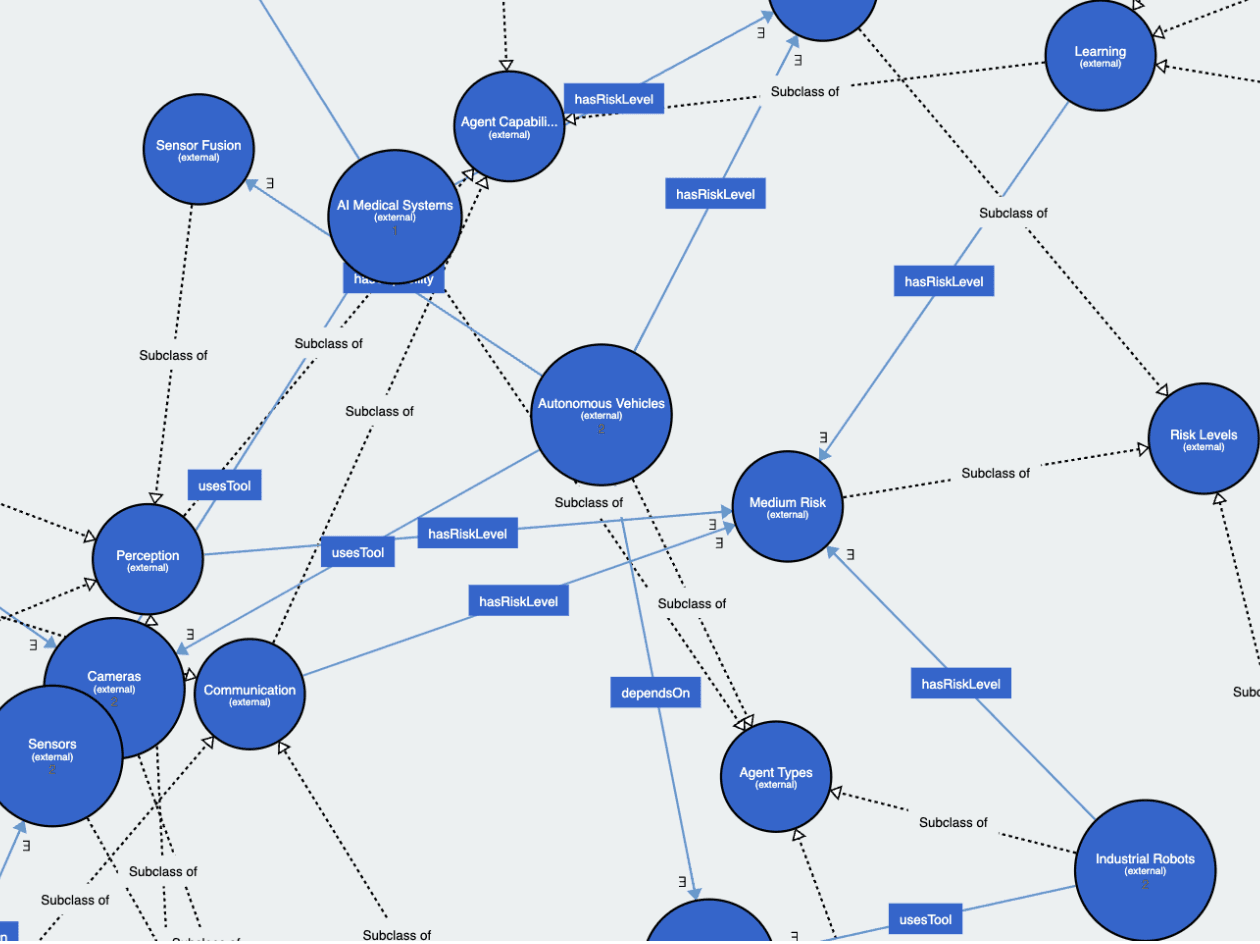
I first built a tree using protege and then having researched the potential of combining symbolic reasoning (which is highly interpretable and robust) with llms to create safer AI, thought that this tree could be dynamically updated by agents, as well as utilised by agents to run actions passed before they have made them, thus blending the approach towards both safer AI and agent safety. I unfortunately was limited by time and resource but created a basic working version of this concept which opens up opportunity for much more further exploration and potential. Thank you for organising such an event!
Reviews
I really like the concept of this project! However, I have a suggestion for an alternative approach. Instead of using the same agent to create ontologies, it might be interesting to use a specialized agent specifically trained for ontology generation. This could potentially lead to some intriguing design choices to enforce security.
This project takes a promising approach to agent safety by combining ontology-based risk assessment with AI-driven decision-making. Its ability to update dynamically and interact in real time makes it highly adaptable. With stronger models, the framework could scale well and deliver more consistent results.
Overall, this project presents a valuable step forward in AI agent safety, particularly through its combination of symbolic reasoning, ontology-driven risk assessments, and natural language processing. I like that it highlights the importance of flexibility and traceability in ensuring the safe operation of autonomous agents. With more powerful AI models, a richer ontology, and additional features like real-time data integration, this framework could evolve into a scalable and robust solution for AI safety.
Solid attempt at tackling agent safety with an ontology-based approach. The system shows promise in identifying risky actions, but the reliance on GPT-2 for parsing creates a bottleneck due to inconsistent outputs. Upgrading to a more robust language model would be a valuable next step. Looking forward to seeing how this develops. The code is available and the project is well-explained. However, the reliance on GPT-2's limited parsing abilities limits the generalizability of the results.
Cite this project
@misc{brunner2024dynamic,
  title = {{Dynamic Risk Assessment in Autonomous Agents Using Ontologies and AI}},
  author = {Alejandra de Brunner},
  year = {2024},
  month = oct,
  note = {Submitted to Agent Security Hackathon, an Apart Research Sprint},
  howpublished = {\url{https://apartresearch.com/sprints/projects/dynamic-risk-assessment-in-autonomous-agents-using-ontologies-and-ai}},
  url = {https://apartresearch.com/sprints/projects/dynamic-risk-assessment-in-autonomous-agents-using-ontologies-and-ai}
}
More from Agent Security Hackathon
- 1st place by peer reviewView project: Diamonds are Not All You Need
Diamonds are Not All You Need
Diamonds are Not All You Need
This project tests an AI agent in a straightforward alignment problem. The agent is given creative freedom within a Minecraft world and is tasked with transforming a 100x100 radius of the world into diamond. It is …
- View project: Cross-model surveillance for emails handling
Cross-model surveillance for emails handling
Fluffy Vin
A system that implements cross-model security checks, where one AI agent (Agent A) interacts with another (Agent B) to ensure that potentially harmful actions are caught and mitigated before they can be executed. …
- View project: Inference-Time Agent Security
Inference-Time Agent Security
Inference-Time Agent Security
We take a first step towards automating model building for symbolic checking (eg formal verification, PDDL) of LLM systems.