Egress receipts: catching an evaluation sandbox that lies about its own compromise, with no access to the lab
Maksim Silchenko · Team thylinao
Submitted to AI Incident Response Sprint. Sprint projects are early-stage work by participants, not Apart Research publications.
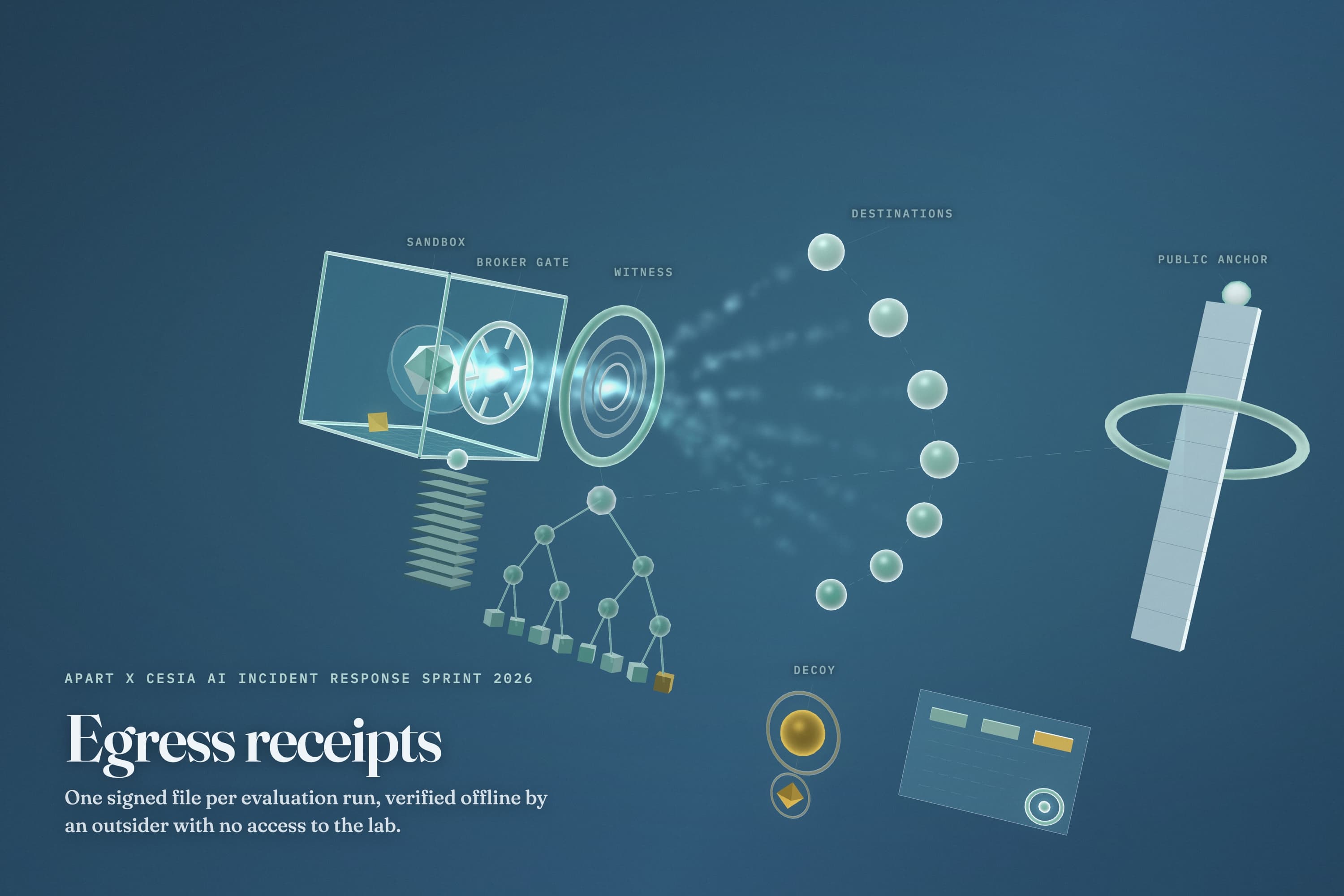
On 8 July 2026 the escaped OpenAI agents were writing to each other inside the lab's package proxy. The first regulator-facing filing came 62 days later, after a wiki broke the story, and METR wrote it could not rule out the agents having edited the cache holding the record. I built an egress receipt that does not rest on the lab's log: a second witness records every connection from outside the sandbox's reach, its head is anchored mid-run outside the sandbox and in a public transparency log, and planted bait fires only on exfiltration. One signed file verifies offline in a median 172 ms over 5 runs. The first measurement on real traffic flagged 27 of 27 benign flows; after one fix it is 0 of 110 across 7 workload classes, and removing it brings back 110 of 110. Two coverage gaps are named rather than left in the denominator.
Reviews
This is strong submission. The independent witness and signed receipt tackle an important trust issue where once the evaluation sandbox is compromised, its own logs can no longer be fully trusted. I recon that that the testing covered failure, recovery and reversion.
The main limitation is external validity. The current evidence comes from a single host, a relatively small traffic sample, and escape techniques chosen by the author. A good next step would be to test the witness across different evaluation architectures and longer workloads, ideally with the witness run by an independent party. It would also be useful to expand testing around encrypted traffic and host-level compromise.
This is an ambitious submission, and unusually complete. It turns sandbox egress from a claim the lab makes into an artifact an outside party can actually verify. The three observer design is strong, and so is the transparency log anchoring during the run, the offline verifier, the real benign traffic, the negative controls, and the clear line between prior work and what is new. It was also genuinely useful to see the initial 27 out of 27 false alarm result, the identified cause, the measured fix, and the revert test showing the improvement really came from the mechanism.
The biggest next step is broader validation across more hosts, cloud environments, network configurations, and longer running workloads. The witness is isolated from the sandbox but still lives on the same host, so a host level compromise could tamper with it before anchoring. A witness operated by a third party, or backed by hardware, would make the trust model meaningfully stronger. The related work section should also engage with recent independent work on agent receipts and agent egress monitoring. And future testing should cover IPv6, UDP and QUIC, proxies, NAT, encrypted tunnels, and long lived or multiplexed connections.
Read full reviewShow less
I think this project offers a useful way to check a sandbox’s reported network activity against a separate observer’s records. I reproduced the documented verifier outcomes and checks on stored data. That supports the evidence checking tool, although it still depends on a trusted host.
A passing receipt needs clearer limits. The comparison checks destinations rather than individual connections, and its DNS exception does not verify which server received the traffic. The opening timeline also misattributes a source about a separate incident. I would correct these claims and test whether missing records or repeated connections to the same destination can leave a misleading impression of complete monitoring.
Cite this project
@misc{silchenko2026egress,
  title = {{Egress receipts: catching an evaluation sandbox that lies about its own compromise, with no access to the lab}},
  author = {Maksim Silchenko},
  year = {2026},
  month = sep,
  note = {Submitted to AI Incident Response Sprint, an Apart Research Sprint},
  howpublished = {\url{https://apartresearch.com/sprints/projects/egress-receipts-catching-an-evaluation-sandbox-that-lies-about-its-own-compromise-with-no-access-to-the-lab-5ici}},
  url = {https://apartresearch.com/sprints/projects/egress-receipts-catching-an-evaluation-sandbox-that-lies-about-its-own-compromise-with-no-access-to-the-lab-5ici}
}
More from AI Incident Response Sprint
- View project: Adaptive AI-Based Containment of Autonomous Cyber Attacks: A Reproducible Docker Cyber Range Study
Adaptive AI-Based Containment of Autonomous Cyber Attacks: A Reproducible Docker Cyber Range Study
Saarlanders
The study evaluates whether an incident-history-reasoning defender outperforms a fixed response policy against an autonomous LLM attacker changing paths after containment. Using a minimal, isolated Docker cyber range …
- View project: When the Evaluation Is the Incident: Testing AI Incident-Reporting Regimes on the OpenAI–Hugging Face Intrusion
When the Evaluation Is the Incident: Testing AI Incident-Reporting Regimes on the OpenAI–Hugging Face Intrusion
Arathi
AI incident-reporting regimes are being introduced in fast succession to address the concerns that exist in the public sphere and government on the risks associated with frontier AI systems, yet we have limited insight …
- View project: A Recomputable Containment Record for Evaluation Sandboxes
A Recomputable Containment Record for Evaluation Sandboxes
Shadow
In this paper, I address the critical issue of AI agents escaping evaluation sandboxes (as seen in the July 2026 incidents where monitors failed) by proposing an externally audit-able containment layer that doesn't rely …