Explaining Latents in Turing-LLM-1.0-254M with Pre-Defined Function Types
Daniel Davies, Ashwarya Maratha · Team Latents United
Submitted to Reprogramming AI Models Hackathon. Sprint projects are early-stage work by participants, not Apart Research publications.
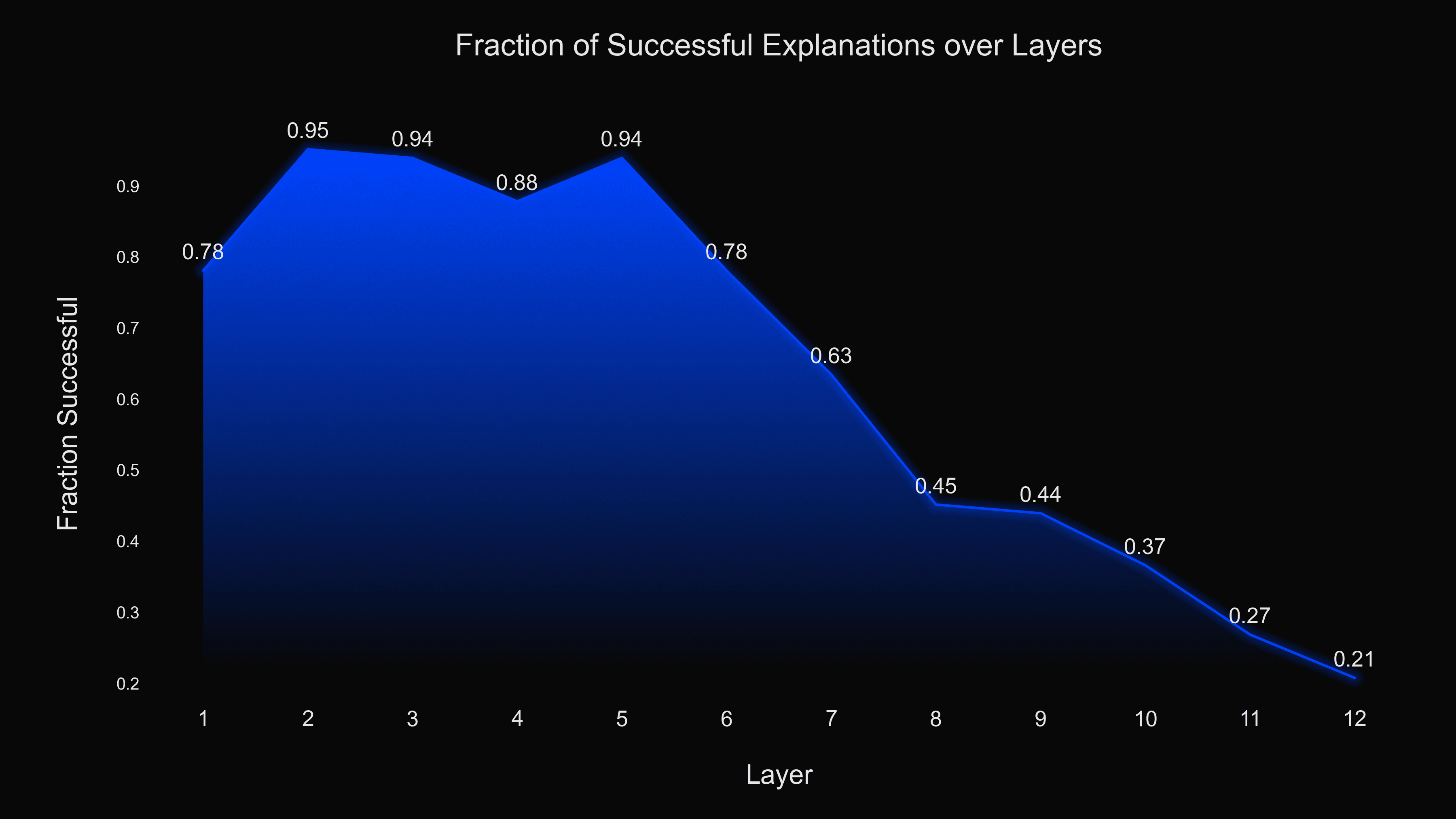
We introduce a novel framework for explaining latents in the Turing-LLM-1.0-254M model based on a predefined set of function types, allowing for a more human-readable “source code” of the model’s internal mechanisms. By categorising latents using multiple function types, we move towards mechanistic interpretability that does not rely on potentially unreliable explanations generated by other language models. Evaluation strategies include generating unseen sequences using variants of Meta-Llama-3-8B-Instruct provided by GoodFire AI to test the activation patterns of latents, thereby validating the accuracy and reliability of the explanations. Our methods successfully explained up to 95% of a random subset of latents in layers, with results suggesting meaningful explanations were discovered.
Reviews
This project aims to develop programmatic methods for interpreting the internals of the Turing LLM. These methods rely on the statistics of the synthetic dataset used to train the base model. The writeup is a bit unclear as to what exactly these methods do, but the examples and function names give a decent picture. Figure 1 is interesting: it appears that topic and uni/bi-gram statistics dominate in the earlier layers, but later layers are relatively poorly explained - what is going on here? Potentially the last couple of layers could be explained by the _next_ token, which would be interesting to see.
This project aims to find alternative ways of interpreting language model features rather than asking another LLM to interpret them. The method proposed is to use the structure of the synthetic data used to train TuringLLM to generate candidate feature labels, either from uni- and bigrams or from topic data extracted from the filenames.
These interpretation functions allow the authors to label the majority of features in the earlier layers of the model, but accuracy drops substantially past layer 4 of 12. I would be interested to see examples of unlabeled features in later layers to understand whether they are more abstract features, mostly related to output tokens, or mostly uninterpretable.
The presentation of the work could be improved by describing the evaluation process and the motivation behind the choice of functions in more detail. I'm also not sure how this is intended to generalise to more complex features in more powerful models - some insight into this would be valuable.
Read full reviewShow less
This project attempts to overcome the issue of using LLMs to aid in scaling interpretability. More details on what each function does would make understanding the work easier. It'd be interesting to see if the additional functions in the appendix improve the performance on later layers. It'd also be nice to see if these ideas generalise to other LLMs (could be done with open sourced models with SAEs on all layers like Gemma 2B).
This paper focuses on labeling, i.e., writing explanations for features or latents. This is an interesting topic with some low-hanging fruit. There have been concerns about using other models to label features, as this could open the door for subversion by the labeling model. Another hackathon introduced a graph-based explanation approach. I think they haven’t properly explained how they derive results for their functions. They describe functions for specific tokens, connections between tokens, and topics. I’m not quite sure if this approach can scale or if it brings us much closer to converting features into code, but I still find this general direction interesting. Verifying that features function like code would be a significant step towards explanation label integrity.
Cite this project
@misc{davies2024explaining,
  title = {{Explaining Latents in Turing-LLM-1.0-254M with Pre-Defined Function Types}},
  author = {Daniel Davies and Ashwarya Maratha},
  year = {2024},
  month = nov,
  note = {Submitted to Reprogramming AI Models Hackathon, an Apart Research Sprint},
  howpublished = {\url{https://apartresearch.com/sprints/projects/explaining-latents-in-turing-llm-1-0-254m-with-pre-defined-function-types}},
  url = {https://apartresearch.com/sprints/projects/explaining-latents-in-turing-llm-1-0-254m-with-pre-defined-function-types}
}
More from Reprogramming AI Models Hackathon
- 1st place by peer reviewView project: AutoSteer: Weight-Preserving Reinforcement Learning for Interpretable Model Control
AutoSteer: Weight-Preserving Reinforcement Learning for Interpretable Model Control
AI Safety Initiative Groningen
Traditional fine-tuning methods for language models, while effective, often disrupt internal model features that could provide valuable insights into model behavior. We present a novel approach combining Reinforcement …
- View project: Classification on Latent Feature Activation for Detecting Adversarial Prompt Vulnerabilities
Classification on Latent Feature Activation for Detecting Adversarial Prompt Vulnerabilities
Feature Disruption Lab
We present a method leveraging Sparse Autoencoder (SAE)-derived feature activations to identify and mitigate adversarial prompt hijacking in large language models (LLMs). By training a logistic regression classifier on …
- View project: Utilitarian Decision-Making in Models - Evaluation and Steering
Utilitarian Decision-Making in Models - Evaluation and Steering
Byte To Brain
We design an eval based on the Oxford Utilitarianism Scale (OUS) that measures the model’s deontological vs utilitarian preference in a nine question, two factor model. Using this scale, we measure how feature steering …