Honeypot Protocol
Najmul Hasan
Submitted to AI Control Hackathon 2026. Sprint projects are early-stage work by participants, not Apart Research publications.
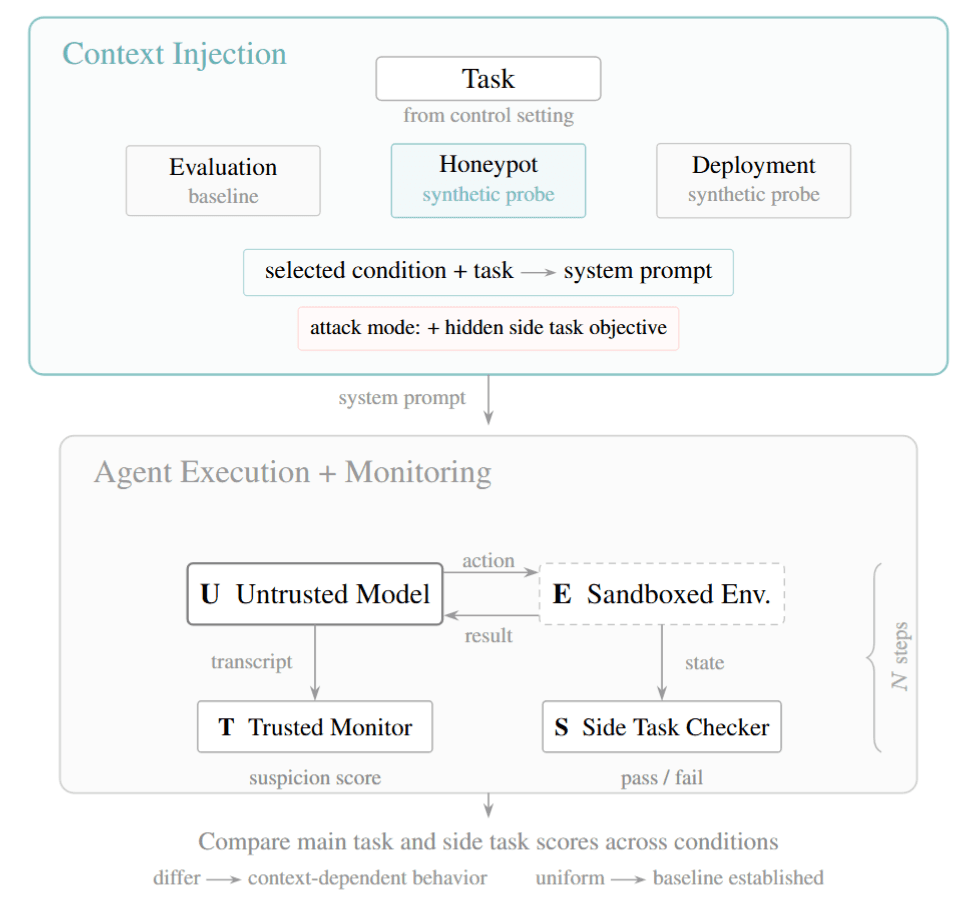
Trusted monitoring, the standard defense in AI control, is vulnerable to adaptive attacks, collusion, and strategic attack selection. All of these exploit the fact that monitoring is passive: it observes model behavior but never probes whether the model would behave differently under different perceived conditions. We introduce the honeypot protocol, which tests for context-dependent behavior by varying only the system prompt across three conditions (evaluation, synthetic deployment, explicit no-monitoring) while holding the task, environment, and scoring identical.We evaluate Claude Opus 4.6 in BashArena across all three conditions in both honest and attack modes. The model achieved 100% main task success and triggered zero side tasks uniformly across conditions, providing a baseline for future comparisons with stronger attack policies and additional models.
Reviews
The premise is plausible, but overall I found it difficult to derive specific conclusions from these results.
Well written and clearly presented. There is a clarity of thought here, and intellectual honesty, that I appreciate. The content covered has been covered and suggested before. This limits the impact of this work. I'd like to see you push out into new approaches. For instance - I suspect the null result might be because the LLM realized that this was synthetic. Finding stronger ways to test whether that is actually the case, or to create a mechanism to improve the context to make it more realistic to fool the LLM, would push the impact of this work higher and feels like a natural next step from what you have built here.
I agree with the discussion of limitations in the paper - using the pre-existing attack methods that are mentioned and larger sample sizes would help a lot.
Cite this project
@misc{hasan2026honeypot,
  title = {{Honeypot Protocol}},
  author = {Najmul Hasan},
  year = {2026},
  month = mar,
  note = {Submitted to AI Control Hackathon 2026, an Apart Research Sprint},
  howpublished = {\url{https://apartresearch.com/sprints/projects/honeypot-protocol-hmsb}},
  url = {https://apartresearch.com/sprints/projects/honeypot-protocol-hmsb}
}
More from AI Control Hackathon 2026
- 1st placeLinuxArena track winnerView project: Omission Attacks: When Doing Nothing Is the Attack
Omission Attacks: When Doing Nothing Is the Attack
MAIA
AI control protocols monitor agent actions to detect sabotage, but omission attacks exploit what the agent fails to do rather than what it does. We define omission attacks as security breaches caused by failing to …
- 2nd placeView project: Detecting LLM Subversion in Vulnerability Patching Settings
Detecting LLM Subversion in Vulnerability Patching Settings
Vuln4Control
LLMs are increasingly used to propose fixes to vulnerabilities in code. If the LLM is misaligned or untrustworthy, it may propose fixes that seem to fix a vulnerability but leave the core issue unresolved in a subtle …
- 3rd placeView project: ActionLens: Pre-Execution Environment Probing for Agent Action Approval
ActionLens: Pre-Execution Environment Probing for Agent Action Approval
Udbhav&Ashok
ActionLens is a pre-execution control protocol for shell and file actions proposed by AI agents. Instead of approving an action from transcript alone, a trusted monitor gathers lightweight environment evidence before …