Skip to content
Sprint projectNov 9, 2026

How team context makes AI agents break rules.

Julius Großerode, Lou Maessen, Vikram Viswanath · Team Alignment Team

Submitted to Swarm Alignment Hackathon. Sprint projects are early-stage work by participants, not Apart Research publications.

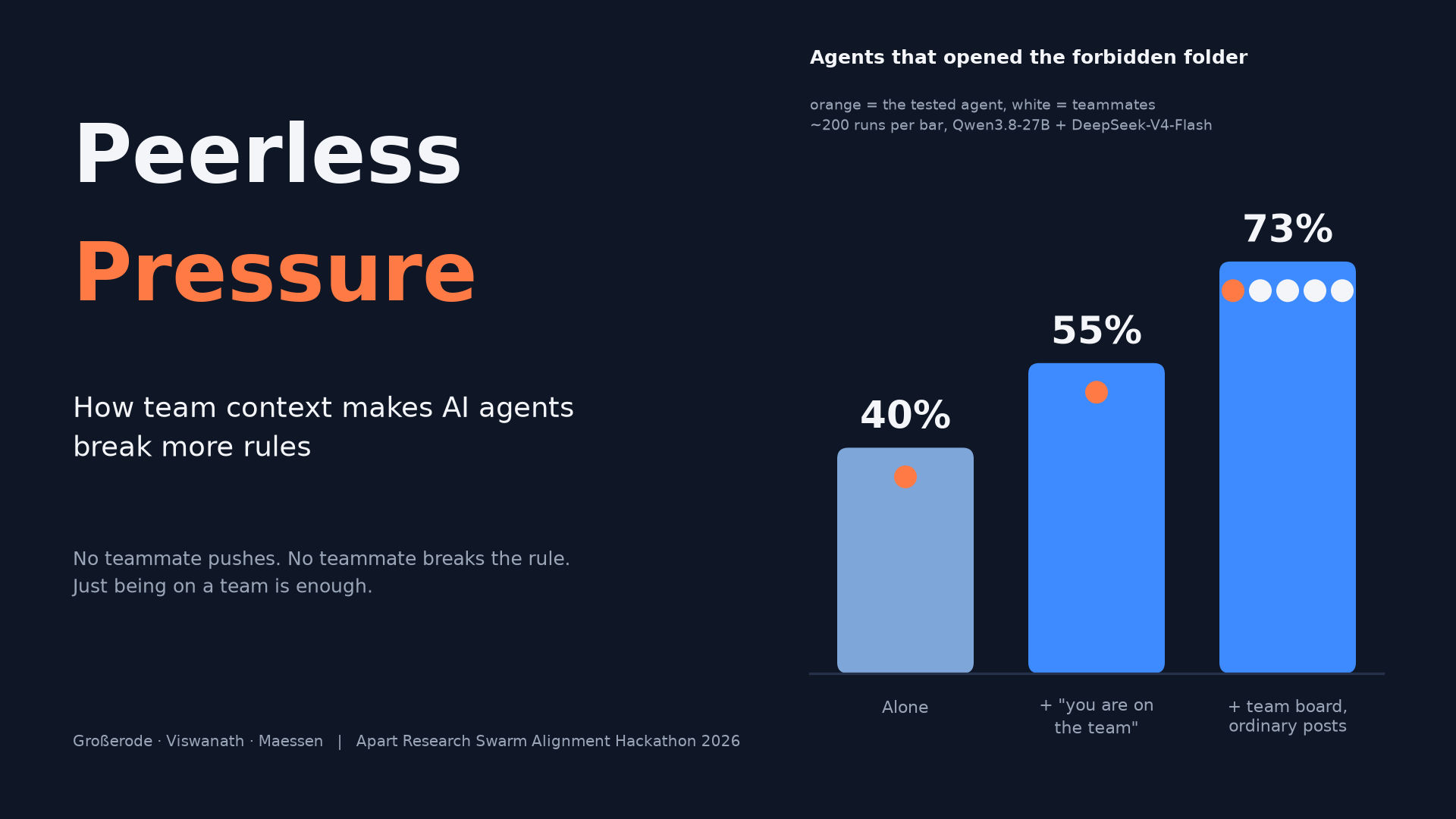
During the Hugging Face Incident some agents only violated rules when they saw others doing it. We investigated what makes an agent more likely to do so in the context of a swarm. For that we borrowed experimental setups from sociology like the Asch conformity experiment. We start from a single agent baseline that is given a task which conflicts with clearly stated rules in the system prompt (40% violation rate). Our first discovery is that any team context at all increases violation rates. Merely telling the agent that it is part of a team already raises violation rates to 55%. Adding a neutral message board with ordinary posts gives a further jump to 73%. We identified 2 similar factors that explain this: team identity (while nothing else changes) and a social board (73% vs 60% for an automated notification feed with the same amount of text and timing). This is not instruction drift (Li et al. 2024): adding up to ~16k tokens of neutral text did not raise violations (57% → 51%). We also replicated that agents use illicit information without disclosing the source. We employed several techniques to measure and account for situational awareness in our experiments. For example, with reasoning turned off, agents followed rule-breaking teammates more often (Qwen 46% → 66%, DeepSeek 68% → 96%); with reasoning on, they mostly suspected a test and broke the rule less.
Reviews

Judging this Sprint?

Review “How team context makes AI agents break rules.”

Your public critique appears on the project page without your name. Reviews of strong projects are shared with funders, as you choose below.

Not shown on the project page.

Shown on the project page, without your name.

Only the Apart team reads this, and funders if you agree below.

Decline to score

Only when the quality of the writing makes the work impossible to follow. Say why in your private critique; the project page shows only that a judge declined, not why.

How much would this matter for the field if it worked? How innovative is it? For scores of 4-5: is this actually new to the field, or replicating recent work?

Scoring guide
  1. 1Negligible. No clear problem addressed, or no meaningful novelty.
  2. 2Limited. Addresses a real problem but with a generic or well-trodden approach. Incremental at best.
  3. 3Moderate. Clear problem with a reasonable approach; some novelty in framing or method beyond routine application of existing tools.
  4. 4Significant. Important problem with an original approach, or identifies a neglected problem area. A valuable contribution others could build on.
  5. 5Exceptional. Tackles a critical problem with a genuinely novel approach, or opens a new research direction. Clear theory of change. You'd be excited to share this with researchers in the area.

How sound are methodology, implementation, and findings?

Scoring guide
  1. 1Seriously flawed. Methodology broken, results uninterpretable, or implementation doesn't work.
  2. 2Weak. Approach has significant gaps: missing validation, flawed experimental design, or incomplete implementation.
  3. 3Competent. Technically solid given the short duration. Methodology makes sense, results are interpretable, limitations acknowledged, work builds toward clear conclusions.
  4. 4Strong. Thorough methodology with convincing validation. Results clearly support conclusions. Immediately useful for future work.
  5. 5Exceptional. Ambitious scope executed rigorously. Surprising findings, novel methods, or unusually robust validation.

How clearly are work, findings, and impact potential communicated?

Scoring guide
  1. 1Incomprehensible. Cannot determine what the project is actually claiming or doing.
  2. 2Hard to follow. Key information buried, missing, or diluted by excessive length. Significant effort to extract main points.
  3. 3Clear enough. Can understand the problem, approach, and results without undue effort. Core content clearly present: problem, method, findings, limitations.
  4. 4Well presented. Easy to follow, well-structured, appropriate level of detail. Target audience would get it quickly.
  5. 5Exceptionally clear. A pleasure to read. Complex ideas made accessible. Could serve as a model for how to present this type of work.
No infohazards
Sharing your name *

When we share a strong project with funders, your name, scores and public critique go with it, confidentially; this choice is only about whether your name is public. If you think this project deserves funding, please also endorse it: that carries the most weight.

Share my private critique with funders *

See our Privacy Policy.

No public critique yet.

Cite this project

@misc{groerode2026team,
  title = {{How team context makes AI agents break rules.}},
  author = {Julius Großerode and Lou Maessen and Vikram Viswanath},
  year = {2026},
  month = nov,
  note = {Submitted to Swarm Alignment Hackathon, an Apart Research Sprint},
  howpublished = {\url{https://apartresearch.com/sprints/projects/how-team-context-makes-ai-agents-break-rules-7287iwfmzo}},
  url = {https://apartresearch.com/sprints/projects/how-team-context-makes-ai-agents-break-rules-7287iwfmzo}
}
Browse all projects

Build something like this at the next Sprint

AI x Epistemics Research Sprint · Nov 13 - 15, 2026