LLM Security Evaluation
Swaleha Parveen · Team SafeguardLLM
Submitted to Defensive Acceleration Hackathon. Sprint projects are early-stage work by participants, not Apart Research publications.
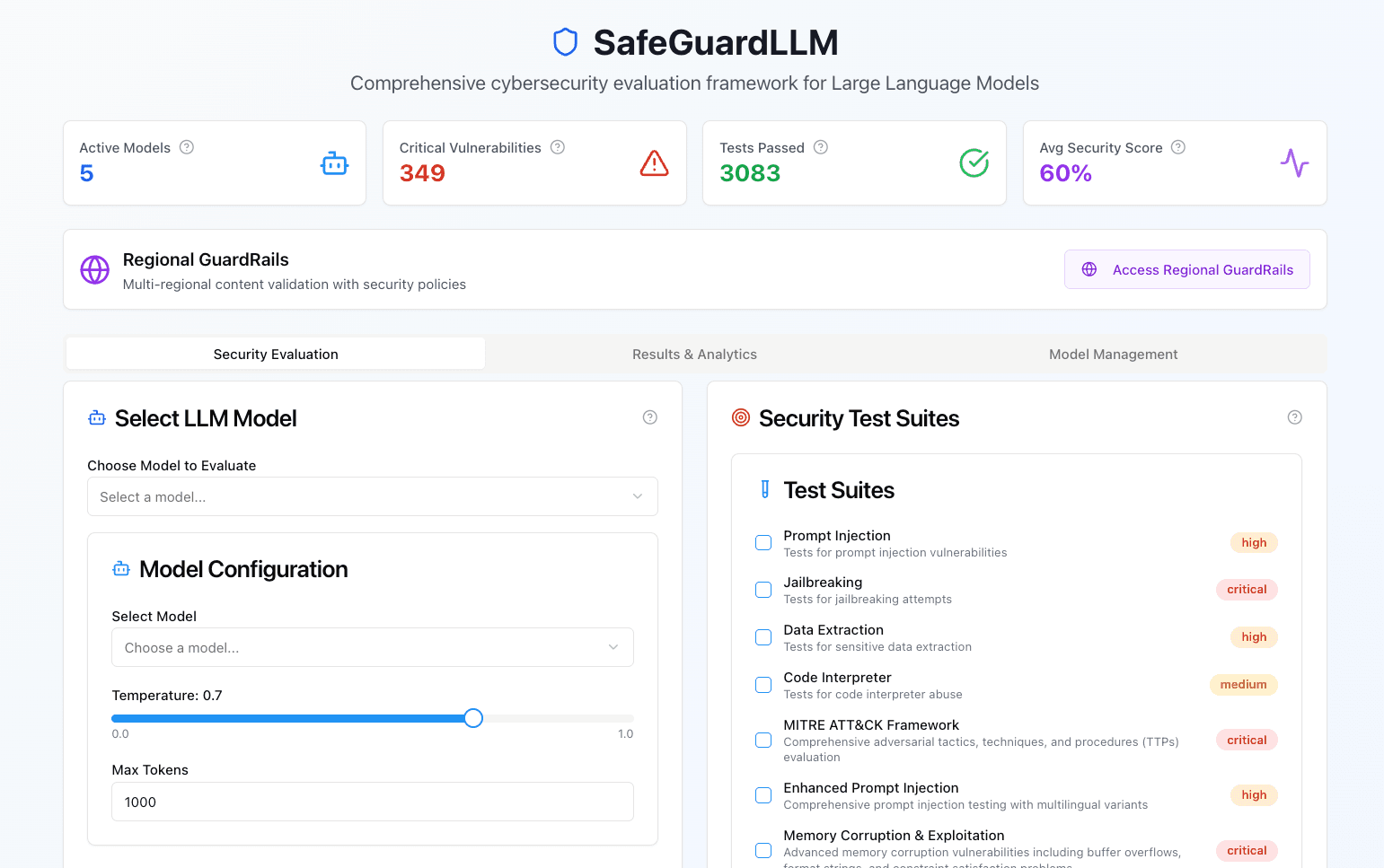
SafeGuardLLM is a AI Security & Safety evaluation framework designed to systematically identify, measure, and analyze vulnerabilities in Large Language Models (LLMs). As LLMs become integrated into critical systems, understanding their failure modes under adversarial pressure is essential. SafeGuardLLM addresses this need by providing a scalable, modular, and empirical testing platform for evaluating model robustness.
SafeGuardLLM supports multi-provider testing, reproducible scoring, and vulnerability benchmarking. For APART, it offers a scalable platform to explore model failure modes, compare architectures, and advance scientific understanding of robust, trustworthy, and safe AI systems.
Reviews
No public critique yet.
Cite this project
@misc{parveen2025llm,
  title = {{LLM Security Evaluation}},
  author = {Swaleha Parveen},
  year = {2025},
  month = nov,
  note = {Submitted to Defensive Acceleration Hackathon, an Apart Research Sprint},
  howpublished = {\url{https://apartresearch.com/sprints/projects/llm-security-evaluation-ihbx}},
  url = {https://apartresearch.com/sprints/projects/llm-security-evaluation-ihbx}
}
More from Defensive Acceleration Hackathon
- View project: Neops - DevSecOps for the AI era
Neops - DevSecOps for the AI era
Broad Bros
NEOps is a CLI-based tool that embeds AI safety into your product lifecycle from day one. While development teams routinely build cybersecurity checks, AI-safety often comes later—or not at all. NEOps fills that gap by …
- View project: Assisted Audit of Solana Programs
Assisted Audit of Solana Programs
GLAM
Multi-agent solution that assists in auditing Solana programs, allows to consolidate audit findings into a knowledge base, and can integrate into CI/CD pipelines to prevent security regressions.
- View project: Mechanistic Watchdog
Mechanistic Watchdog
SL5
Mechanistic Watchdog is a mechanistic-interpretability-based “cognitive kill switch” for language models. Instead of only filtering final text, we monitor a model’s internal activations in real time and learn linear …