Model, Instance, or Persona? Measuring Affective Signals in Public Text After an AI Is Retired
Anna Zhu
Submitted to Digital Minds Research Sprint. Sprint projects are early-stage work by participants, not Apart Research publications.
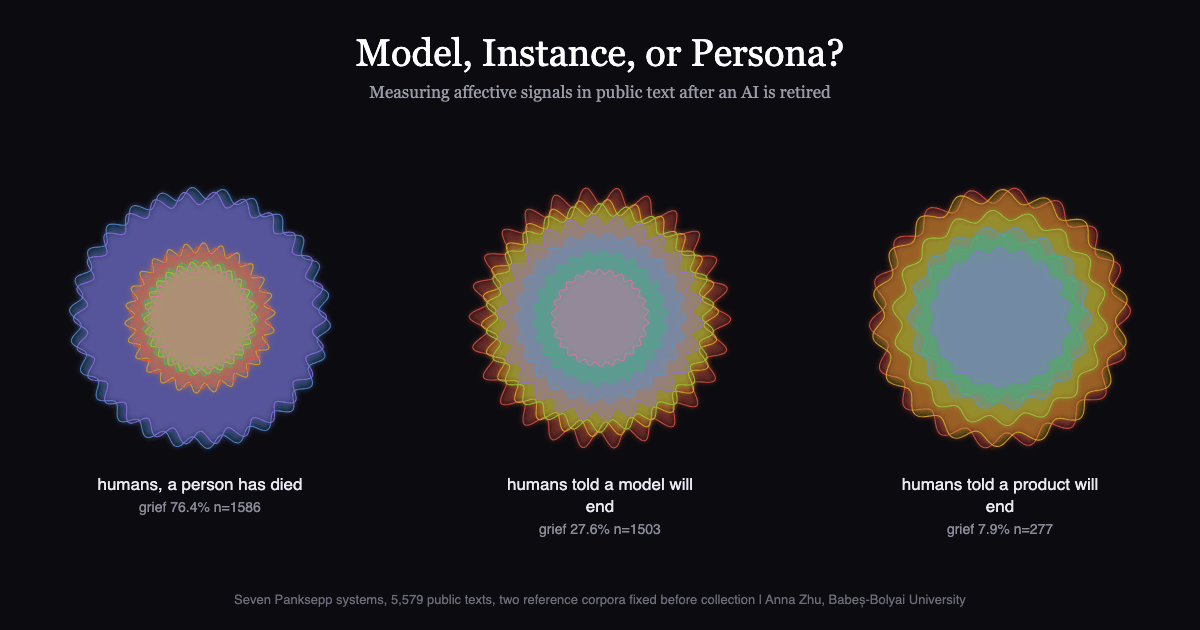
This sprint asks whether the assistant identifies as a model, an instance, or a persona. I ask which of the three its users name. When a company retires an AI model, users write about the loss in public, and what they treat as gone can be counted. The instrument is taken from affective neuroscience: Panksepp's seven primary affective systems, which were mapped across mammals and so do not presuppose a human subject. I read 5,579 public texts for affective signals under a prompt fixed before any collection and applied by a language model, and compared threads about retired models against two reference points chosen in advance: people mourning a person, and people losing a paid product. Most comments name nothing as lost. 58.5% are about the company, the price, or other users. Among those that do name something, people name the product version about six times as often as their own particular instance, which is the case the literature treats as central. The emotions match the consumer reference point more than the bereavement one: anger runs at 57.0% against grief at 27.6%. Asking models the same question turns out to be far less reliable than asking users. A change in how the prompt is framed moves the measured emotions by up to 63 points, and two AI scorers reading the same model output disagree 2.7 times more than they do on human text. Six predictions registered before collection failed and are reported as failed.
Reviews
Flipping the question is an interesting way to tackle the self-report validity trap most digital-minds work can be prone to. Also good to anchor to retirement events rather than to every session end. Your process is also quite detailed, a full second-annotator recode on a different architecture, within-rater alpha over reads, six predictions published as failures.
Two questions:
First, the prompt: David Hawkins' Map of Consciousness next to the Panksepp systems. Hmmmmmn personally I'm not too sure about the validity/application here (?)
Two, more for the limitations: you rank the corpus by engagement score, which is a live confound for your rage and play rates specifically. But you did mention the human-coded validation subset as follow-up.
Excellent work! This was the clearest and best-validated submission I reviewed. The finding that users refer to the released model version more often than to their individual instance is useful for retirement policy. I also like that you report where the method fails. This submission feels close to paper-ready.
I would encourage you to keep pursuin this idea, we are going to need sooner than later a lot of research into model welfare.
Cite this project
@misc{zhu2026model,
  title = {{Model, Instance, or Persona? Measuring Affective Signals in Public Text After an AI Is Retired}},
  author = {Anna Zhu},
  year = {2026},
  month = aug,
  note = {Submitted to Digital Minds Research Sprint, an Apart Research Sprint},
  howpublished = {\url{https://apartresearch.com/sprints/projects/model-instance-or-persona-measuring-aective-signals-in-public-text-after-an-ai-is-retired-hj7u}},
  url = {https://apartresearch.com/sprints/projects/model-instance-or-persona-measuring-aective-signals-in-public-text-after-an-ai-is-retired-hj7u}
}
More from Digital Minds Research Sprint
- 1st placeView project: Readable but Not Causal: Limits of Self-Attributed Welfare Representations in Language Models
Readable but Not Causal: Limits of Self-Attributed Welfare Representations in Language Models
Welfare-like internal representations are increasingly studied as candidate evidence about AI systems. Their entity attribution—whether a valence state belongs to the active assistant or to a merely represented other—is …
- 2nd placeView project: Project Anchored
Project Anchored
Team Wagner
Anchoring vignettes are the standard survey-methodology fix for self-reports that are not comparable across respondents. This project applies them to language models for the first time, using code generation as a …
- 4th placeView project: One Dial, Not a Tree: Occupational Personas and Emergent Misalignment
One Dial, Not a Tree: Occupational Personas and Emergent Misalignment
Misbehaved
Emergent misalignment (EM) is the effect where fine-tuning a model on a narrow harmful task makes it broadly harmful. It is already known to interact with persona prompts, but earlier work used openly negative …