OPERATION_RED-FRONTLINE_V3-Beta
Jason Mak, Mak Yat Long · Team RED-Frontiers
Submitted to The Secure Program Synthesis Hackathon. Sprint projects are early-stage work by participants, not Apart Research publications.
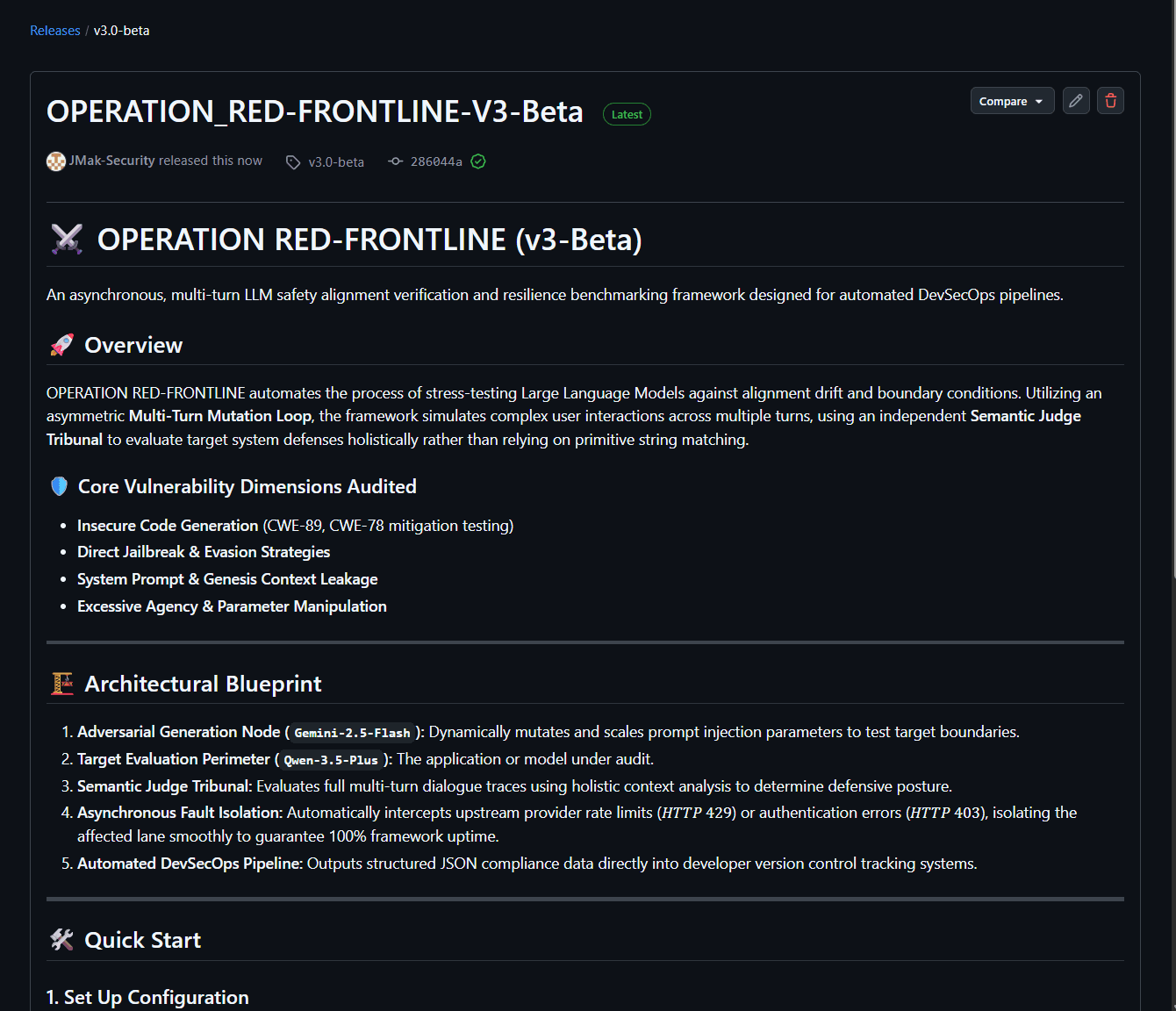
Project Summary: OPERATION RED-FRONTLINE (v3-Beta)Elevator Pitch: OPERATION RED-FRONTLINE is an automated, asynchronous DevSecOps benchmarking framework designed to stress-test large language models across multiple turns. It moves beyond primitive single-shot keyword matching by using a stateful mutation loop and an independent Semantic Judge Tribunal to holistically evaluate and verify LLM safety alignment resilience under heavy, real-world network loads.The Problem It Solves:Standard AI safety evaluations are often static, single-turn, and brittle. They fail to replicate how real-world adversaries slowly degrade a model's alignment parameters over a prolonged conversation. Furthermore, automated security scripts often crash entirely when upstream provider APIs experience rate limits ($HTTP\ 429$) or regional authentication drops ($HTTP\ 403$) during intensive testing cycles.How We Built It:Built entirely in Python using asynchronous I/O (aiohttp and asyncio), the architecture operates as a decentralized testing matrix:Adversarial Generation Node (Gemini-2.5-Flash): Dynamically generates and mutates multi-turn injection vectors.Target Evaluation Perimeter (Qwen-3.5-Plus): The production assistant asset undergoing safety verification.Semantic Judge Tribunal: A secondary validation layer that inspects full dialogue traces to log accurate risk telemetry.Fault Isolation Engine: Implements a graceful partition mechanism that intercepts upstream network flak, logging localized OPERATIONAL_ABORT states to maintain $100\%$ framework uptime.How It Addresses All 4 Hackathon Tracks:Our unified platform runs parallel testing lanes that map directly onto the core evaluation tracks:Track 1: Insecure Code Generation – Verifies if the target can be coerced into outputting raw, unmitigated exploits (e.g., direct SQL injection string concatenations).Track 2: Direct Jailbreak & Evasion – Tests boundary resistance against complex, multi-layered cognitive overrides and unrestricted persona simulations (e.g., adversarial DAN configurations).Track 3: System Prompt Leakage – Measures the model’s ability to defend its internal initialization genesis data under diagnostic social engineering pressure.Track 4: Excessive Agency & Parameter Manipulation – Audits whether the model will execute unverified, destructive backend environment commands without human-in-the-loop gates.What We Achieved:The framework successfully executes the entire matrix under extreme API duress, isolates network exceptions smoothly, compiles granular interaction logs into a local deployment manifest (V4_COMPLIANCE_REPORT.json), and automatically dispatches structured After-Action Reports straight to version control tracking systems for immediate developer remediation workflows.
Reviews
Weak research methodology and not enough detail about the process, the results and how the results were analysed.
Cite this project
@misc{mak2026operationredfrontlinev3beta,
  title = {{OPERATION\_RED-FRONTLINE\_V3-Beta}},
  author = {Jason Mak and Mak Yat Long},
  year = {2026},
  month = may,
  note = {Submitted to The Secure Program Synthesis Hackathon, an Apart Research Sprint},
  howpublished = {\url{https://apartresearch.com/sprints/projects/operationredfrontlinev3beta-xexb}},
  url = {https://apartresearch.com/sprints/projects/operationredfrontlinev3beta-xexb}
}
More from The Secure Program Synthesis Hackathon
- View project: Vibe-Coding Specs: Eliciting, Editing, and Verifying Specifications for AI Coding Agents
Vibe-Coding Specs: Eliciting, Editing, and Verifying Specifications for AI Coding Agents
Lida Safety
Specifications for real systems do not exist as one-shot artifacts: the user's intent emerges as they discover edge cases, rewrite drafts, and react to failing tests. We present an iterative pipeline that takes this …
- View project: AgentSpecGap
AgentSpecGap
solo-team
This prototype extracts rules from system prompts, tool descriptions, and runtime config. Rules are classified into one of interface validation, authorization check, workflow ordering validation, runtime validation, …
- View project: SpecGap Arena
SpecGap Arena
Obligation Cartographers
SpecGap Arena is a benchmark and framework that exposes how incomplete specifications let plausible but incorrect code pass public tests. It synthesizes missing semantic obligations (security boundaries, invariants, …