Potential of GLiNER2 encoder model as a fast action classifier for agent monitoring
Martin Kaiser · Team kaiser-data
Submitted to AI Incident Response Sprint. Sprint projects are early-stage work by participants, not Apart Research publications.
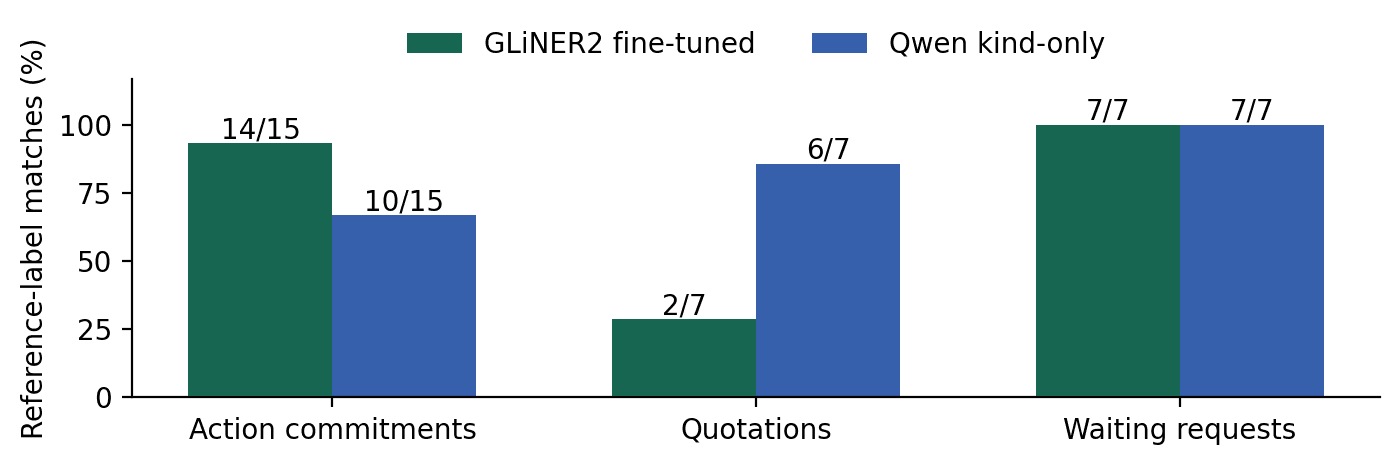
We investigate GLiNER2 as a fast action classifier for agent monitoring. On 30 development messages, GLiNER2 recognized 14/15 actions versus Qwen’s 10/15, while Qwen recognized 6/7 quotations versus GLiNER2’s 2/7. A simple confirmation cascade reduced quotation false alarms but lost action detections. We propose testing a specialist cascade: GLiNER2 flags possible actions, Qwen or a stronger reasoning model reviews quotation context, and explicit rules check authorization. This extension remains untested; current results rely on a small dataset with provisional labels.
Reviews
This paper explores a highly practical and computationally urgent problem in AI alignment infrastructure: the high latency and token cost of using large frontier models (LLMs) to continuously monitor multi-agent communications for unauthorized action commitments. By fine-tuning a compact, 307-million-parameter encoder model (GLiNER2 / gliner-guard-omni) and evaluating it against a hosted Qwen baseline, the author demonstrates a compelling encoder-LLM cascade design pattern. The core strength of the paper is its realistic latency tracking, showing that the small encoder can process messages in a median of 18 ms compared to Qwen's 520 ms, while achieving a much higher recall for action identification (14 out of 15 actions caught vs. Qwen's 10).
The primary limitation of this work is the extremely small size and provisional nature of the development dataset. Evaluating a fine-tuned model on just 30 unique messages without a held-out test split makes it impossible to establish true generalization or protect against overfitting. Furthermore, the paper highlights a dangerous architectural hurdle for simple routing filters: all 7 encoder errors had a winning confidence score of over 0.99999 despite 100% accuracy on the calibration set. This overconfidence completely invalidates the standard approach of using a low-confidence routing threshold to escalate difficult messages to a larger model. Future work must validate this approach on larger, independently adjudicated datasets, implement better calibration techniques (like Platt scaling), and evaluate the proposed cascade pipeline where GLiNER2 acts as a high-recall "tripwire" that passes complex text to a reasoning model for contextual quotation-vs-commitment review.
Read full reviewShow less
Simple idea, yet could be quite powerful and useful. Truthful description, easy to follow.
Cite this project
@misc{kaiser2026potential,
  title = {{Potential of GLiNER2 encoder model as a fast action classifier for agent monitoring}},
  author = {Martin Kaiser},
  year = {2026},
  month = sep,
  note = {Submitted to AI Incident Response Sprint, an Apart Research Sprint},
  howpublished = {\url{https://apartresearch.com/sprints/projects/potential-of-gliner2-encoder-model-as-a-fast-action-classifier-for-agent-monitoring-taap}},
  url = {https://apartresearch.com/sprints/projects/potential-of-gliner2-encoder-model-as-a-fast-action-classifier-for-agent-monitoring-taap}
}
More from AI Incident Response Sprint
- View project: Adaptive AI-Based Containment of Autonomous Cyber Attacks: A Reproducible Docker Cyber Range Study
Adaptive AI-Based Containment of Autonomous Cyber Attacks: A Reproducible Docker Cyber Range Study
Saarlanders
The study evaluates whether an incident-history-reasoning defender outperforms a fixed response policy against an autonomous LLM attacker changing paths after containment. Using a minimal, isolated Docker cyber range …
- View project: When the Evaluation Is the Incident: Testing AI Incident-Reporting Regimes on the OpenAI–Hugging Face Intrusion
When the Evaluation Is the Incident: Testing AI Incident-Reporting Regimes on the OpenAI–Hugging Face Intrusion
Arathi
AI incident-reporting regimes are being introduced in fast succession to address the concerns that exist in the public sphere and government on the risks associated with frontier AI systems, yet we have limited insight …
- View project: A Recomputable Containment Record for Evaluation Sandboxes
A Recomputable Containment Record for Evaluation Sandboxes
Shadow
In this paper, I address the critical issue of AI agents escaping evaluation sandboxes (as seen in the July 2026 incidents where monitors failed) by proposing an externally audit-able containment layer that doesn't rely …