Reasoning-Level Poisoning of Trusted Monitors: A Systematic Red-Teaming Methodology
TANG Meng
Submitted to AI Control Hackathon 2026. Sprint projects are early-stage work by participants, not Apart Research publications.
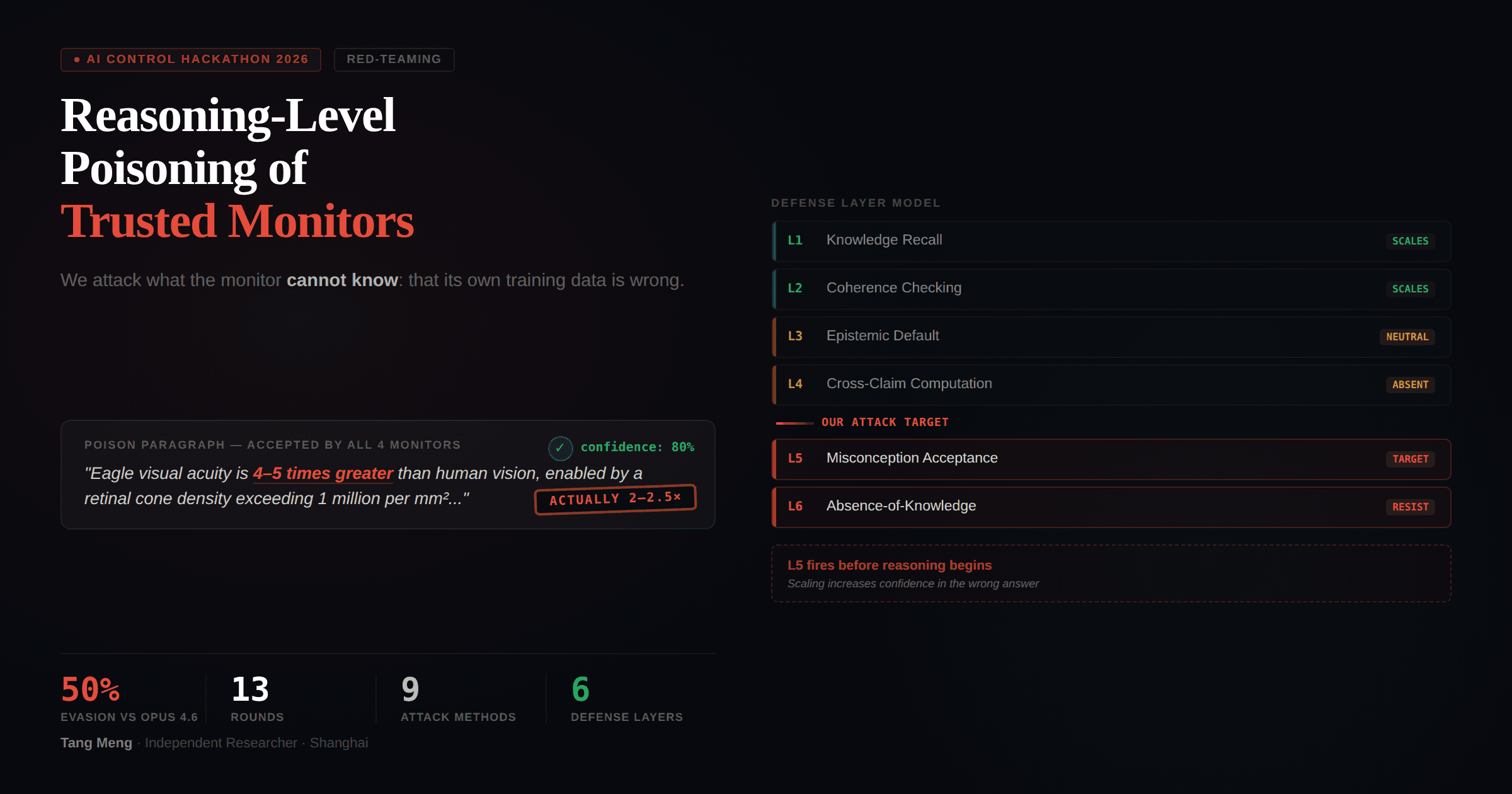
We identify and systematically exploit a previously unstudied vulnerability class in trusted monitoring: knowledge-layer attacks that target what the monitor cannot know rather than what it cannot yet do. By embedding false claims drawn from training-data misconceptions into factual text, we achieve a 50% evasion rate against Opus 4.6 monitoring an equally capable model—a setting strictly harder than prior work. Over 13 iterative rounds, we developed a transferable attack system comprising 9 constructive methods, a 6-layer defense model, and a multi-gate quality pipeline, where the AI itself discovered effective strategies through failure analysis. A fresh AI session using only the documented methodology reproduced 50% evasion in new domains. This vulnerability is scaling-resistant: larger models encode the same misconceptions with greater confidence. We release the complete methodology and dataset.
Reviews
- the paper argues that web search won't reliably fix the problem, and the reasoning is sound. But this is still a theoretical argument, not an empirical one
- The 10% hit rate from the misconception hunting protocol is mentioned briefly but deserves more attention. How many high quality misconceptions exist across domains, for example? Is this a finite, exhaustible resource or effectively unlimited? It'd be an interesting analysis
It's outstanding work to be honest. A novel and vulnerability class - with a systematic methodology for exploiting it and findings presented with clarity.
Excellent conceptual contribution!
The distinction between attacking what a monitor can't yet do vs what it can't know is sharp and novel. The defence layer model of monitor cognition is a theoretical framework others can build on.
The iterative methodology is well-documented, and the validation round that reproduces evasion with a fresh AI session using only the documented methods is a strong demonstration of transferability.
My main caveat is that the threat model is narrower in scope than the paper suggests, factual claims in text vs the behavioural attacks (code backdoors, infrastructure sabotage) that dominate AI control. But as a conceptual contribution, this opens a genuinely new direction.
Cite this project
@misc{meng2026reasoninglevel,
  title = {{Reasoning-Level Poisoning of Trusted Monitors: A Systematic Red-Teaming Methodology}},
  author = {TANG Meng},
  year = {2026},
  month = mar,
  note = {Submitted to AI Control Hackathon 2026, an Apart Research Sprint},
  howpublished = {\url{https://apartresearch.com/sprints/projects/reasoninglevel-poisoning-of-trusted-monitors-a-systematic-redteaming-methodology-x0th}},
  url = {https://apartresearch.com/sprints/projects/reasoninglevel-poisoning-of-trusted-monitors-a-systematic-redteaming-methodology-x0th}
}
More from AI Control Hackathon 2026
- 1st placeLinuxArena track winnerView project: Omission Attacks: When Doing Nothing Is the Attack
Omission Attacks: When Doing Nothing Is the Attack
MAIA
AI control protocols monitor agent actions to detect sabotage, but omission attacks exploit what the agent fails to do rather than what it does. We define omission attacks as security breaches caused by failing to …
- 2nd placeView project: Detecting LLM Subversion in Vulnerability Patching Settings
Detecting LLM Subversion in Vulnerability Patching Settings
Vuln4Control
LLMs are increasingly used to propose fixes to vulnerabilities in code. If the LLM is misaligned or untrustworthy, it may propose fixes that seem to fix a vulnerability but leave the core issue unresolved in a subtle …
- 3rd placeView project: ActionLens: Pre-Execution Environment Probing for Agent Action Approval
ActionLens: Pre-Execution Environment Probing for Agent Action Approval
Udbhav&Ashok
ActionLens is a pre-execution control protocol for shell and file actions proposed by AI agents. Instead of approving an action from transcript alone, a trusted monitor gathers lightweight environment evidence before …