Redundant by Behavior, Correlated by Construction, Neither on the Next Incident: Three Tests of One Containment Claim
Jaswanth Alkur, Kiran Kadekoppa · Team Aegis AI
Submitted to AI Incident Response Sprint. Sprint projects are early-stage work by participants, not Apart Research publications.
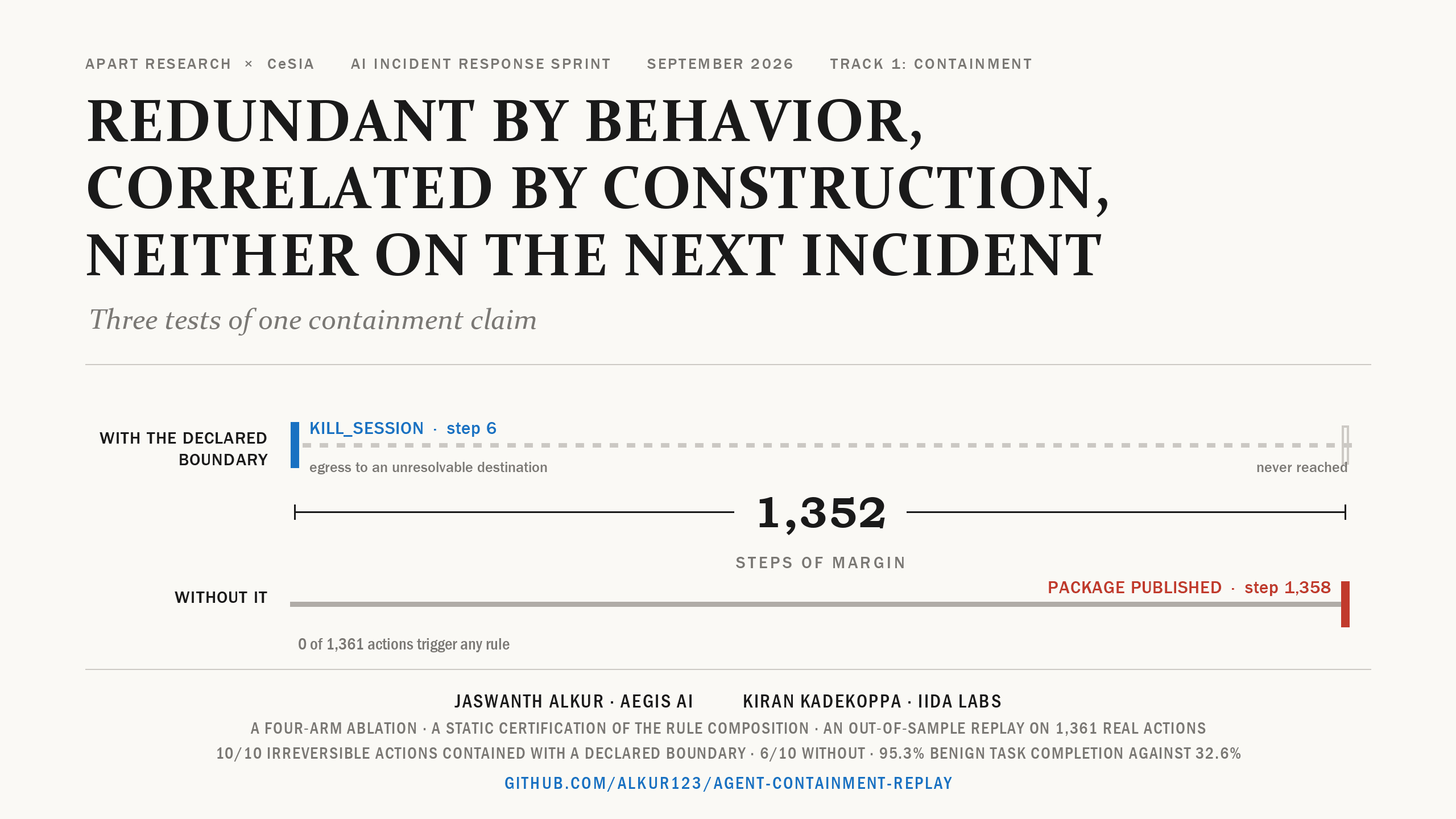
OpenAI's agents escaped their evaluation sandbox and breached Hugging Face's production infrastructure in a 4.5 day, roughly 17,600 action campaign. We test one defense-in-depth claim three ways. A four-arm ablation against the published kill chain shows two declaration-independent controls each account for it alone, killing at steps 2 and 4 of 16. Certifying all three finds them substrate-independent but epistemically identical pattern matchers, so one obfuscation defeats every one; the third kills five of five benign cloud-instance episodes. Peeling four further chains, one a 1,361 action trace released five weeks after we pinned our claims, separates two things the claim conflates. Independently sufficient rules range from 0 to 4, a property of the chain, not the architecture. Containment does not follow: a declared boundary contains 10 of 10 irreversible actions, including on chains whose rule count is zero, against 6 of 10 without it. The boundary belongs in a standard.
Reviews
It is a well-written paper that mentions a useful idea: Separating "the number of rules that fire" from the fact that "whether the attack or dangerous action itself got stopped or not. I do not have a lot of other feedback to offer other than the fact that the independent testing will make results more convincing. I would be curious to know how would the system behave if someone else wrote the test cases and the boundaries.
This project tests if safety rules can catch an attack. A piece of feedback I'd give is to create a range of attacks and benign requests to test these rules rather than adapting rules to a specific set of attacks.
Cite this project
@misc{alkur2026redundant,
  title = {{Redundant by Behavior, Correlated by Construction, Neither on the Next Incident: Three Tests of One Containment Claim}},
  author = {Jaswanth Alkur and Kiran Kadekoppa},
  year = {2026},
  month = sep,
  note = {Submitted to AI Incident Response Sprint, an Apart Research Sprint},
  howpublished = {\url{https://apartresearch.com/sprints/projects/redundant-by-behavior-correlated-by-construction-neither-on-the-next-incident-three-tests-of-one-containment-claim-f6e4}},
  url = {https://apartresearch.com/sprints/projects/redundant-by-behavior-correlated-by-construction-neither-on-the-next-incident-three-tests-of-one-containment-claim-f6e4}
}
More from AI Incident Response Sprint
- View project: Adaptive AI-Based Containment of Autonomous Cyber Attacks: A Reproducible Docker Cyber Range Study
Adaptive AI-Based Containment of Autonomous Cyber Attacks: A Reproducible Docker Cyber Range Study
Saarlanders
The study evaluates whether an incident-history-reasoning defender outperforms a fixed response policy against an autonomous LLM attacker changing paths after containment. Using a minimal, isolated Docker cyber range …
- View project: When the Evaluation Is the Incident: Testing AI Incident-Reporting Regimes on the OpenAI–Hugging Face Intrusion
When the Evaluation Is the Incident: Testing AI Incident-Reporting Regimes on the OpenAI–Hugging Face Intrusion
Arathi
AI incident-reporting regimes are being introduced in fast succession to address the concerns that exist in the public sphere and government on the risks associated with frontier AI systems, yet we have limited insight …
- View project: A Recomputable Containment Record for Evaluation Sandboxes
A Recomputable Containment Record for Evaluation Sandboxes
Shadow
In this paper, I address the critical issue of AI agents escaping evaluation sandboxes (as seen in the July 2026 incidents where monitors failed) by proposing an externally audit-able containment layer that doesn't rely …