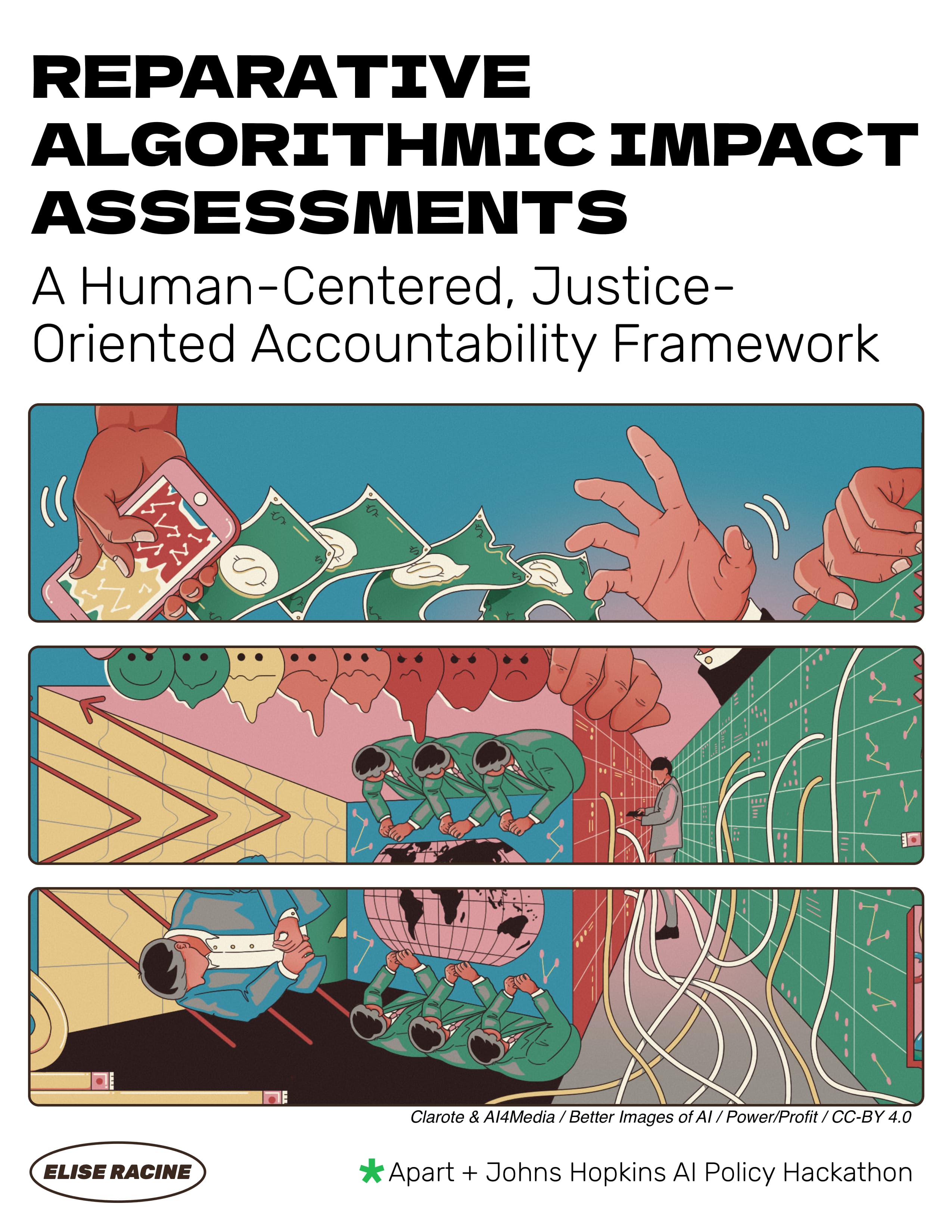
Reparative Algorithmic Impact Assessments A Human-Centered, Justice-Oriented Accountability Framework
Elise Racine · Team Reparative AI
Submitted to AI Policy Hackathon at Johns Hopkins University. Sprint projects are early-stage work by participants, not Apart Research publications.
While artificial intelligence (AI) promises transformative societal benefits, it also presents critical challenges in ensuring equitable access and gains for the Global Majority. These challenges stem in part from a systemic lack of Global Majority involvement throughout the AI lifecycle, resulting in AI-powered systems that often fail to account for diverse cultural norms, values, and social structures. Such misalignment can lead to inappropriate or even harmful applications when these systems are deployed in non-Western contexts. As AI increasingly shapes human experiences, we urgently need accountability frameworks that prioritize human well-being—particularly as defined by marginalized and minoritized populations.
Building on emerging research on algorithmic reparations, algorithmic impact assessments, and participatory AI governance, this policy paper introduces Reparative Algorithmic Impact Assessments (R-AIAs) as a solution. This novel framework combines robust accountability mechanisms with a reparative praxis to form a more culturally sensitive, justice-oriented, and human-centered methodology. By further incorporating decolonial, Intersectional principles, R-AIAs move beyond merely centering diverse perspectives and avoiding harm to actively redressing historical, structural, and systemic inequities. This includes colonial legacies and their algorithmic manifestations. Using the example of an AI-powered mental health chatbot in rural India, we explore concrete implementation strategies through which R-AIAs can achieve these objectives. This case study illustrates how thoughtful governance can, ultimately, empower affected communities and lead to human flourishing.
Reviews
No public critique yet.
Cite this project
@misc{racine2024reparative,
  title = {{Reparative Algorithmic Impact Assessments A Human-Centered, Justice-Oriented Accountability Framework}},
  author = {Elise Racine},
  year = {2024},
  month = oct,
  note = {Submitted to AI Policy Hackathon at Johns Hopkins University, an Apart Research Sprint},
  howpublished = {\url{https://apartresearch.com/sprints/projects/reparative-algorithmic-impact-assessments-a-human-centered-justice-oriented-accountability-framework}},
  url = {https://apartresearch.com/sprints/projects/reparative-algorithmic-impact-assessments-a-human-centered-justice-oriented-accountability-framework}
}
More from AI Policy Hackathon at Johns Hopkins University
- 1st place by peer reviewView project: Robust Machine Unlearning for Dangerous Capabilities
Robust Machine Unlearning for Dangerous Capabilities
Robust Machine Unlearning for Dangerous Capabilities
We test different unlearning methods to make models more robust against exploitation by malicious actors for the creation of bioweapons.
- View project: Infectious Disease Outbreak Prediction and Dashboard
Infectious Disease Outbreak Prediction and Dashboard
Infectious Diseace Dashboards
Our project developed an interactive dashboard to monitor, visualize, and analyze infectious disease outbreaks worldwide. It consolidates historical data from sources like WHO, OWID, and CDC for diseases including …
- View project: Modernizing DC’s Emergency Communications
Modernizing DC’s Emergency Communications
AI-CAD
The District of Columbia proposes implementing an AI-enabled Computer-Aided Dispatch (CAD) system to address critical deficiencies in our current emergency alert infrastructure. This policy establishes a framework for …