Schrödinger's Civilization / Claim Transmission Atlas
Ben Amuwo · Team Maitrism - Universal Love
Submitted to AI Incident Response Sprint. Sprint projects are early-stage work by participants, not Apart Research publications.
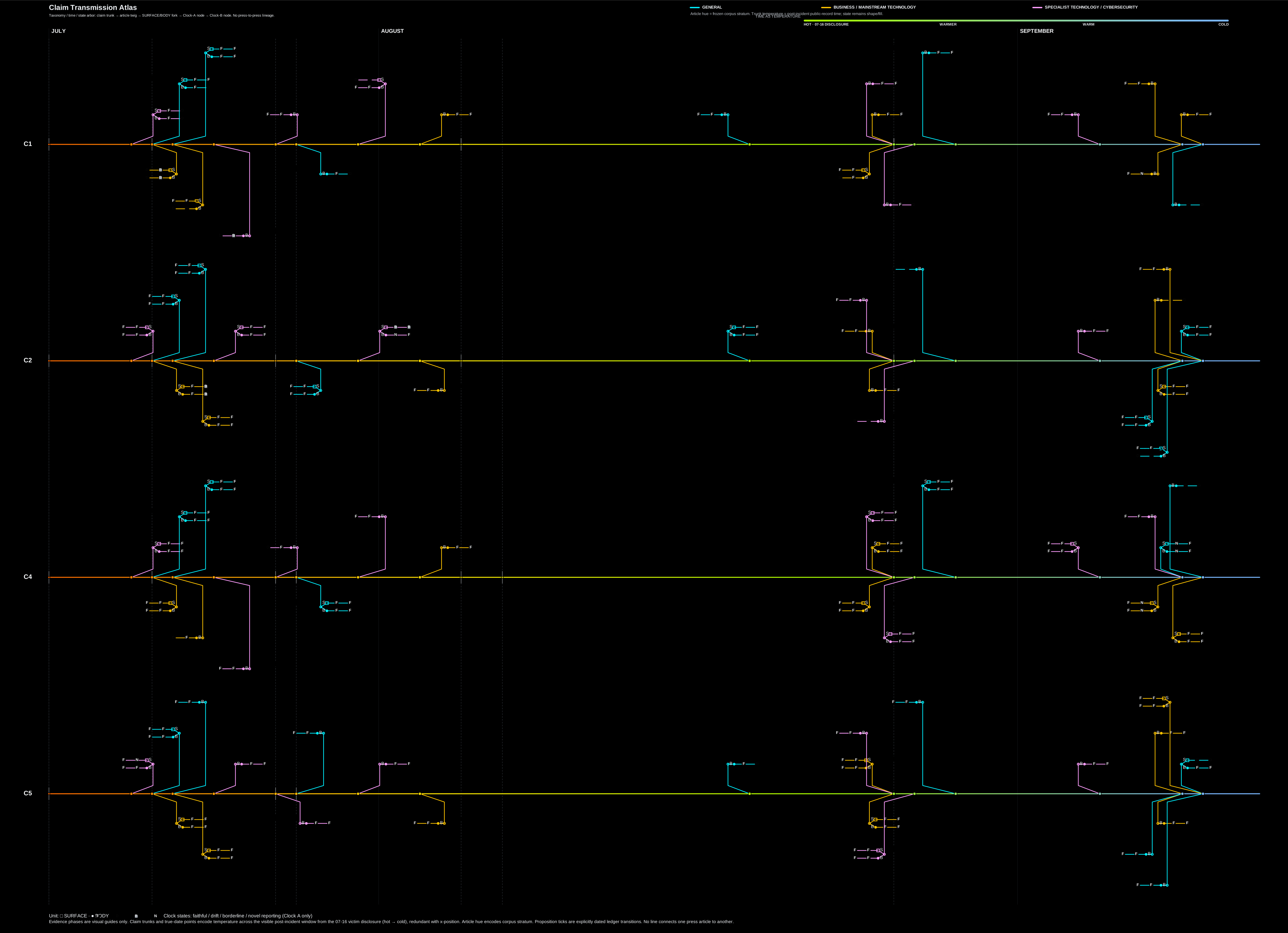
It started off as an investigation on how claims spread over time. We combed through 24 articles along 2 Clocks; Clock A - which shows the timeline of information available to the authors when the articles were published; and Clock B - which shows how faithful the article is in light of what we know now. This was categorized based on news sector (Pop/General, Business, Tech/Cybersecurity). The real fun, however, is at https://benamuwo.me/schrodigners_civ/ . This was a sidecar project based on Dwarkesh Patel's substack and podcast video titled: "The rise and fall of agent civilizations". I sought to answer two questions: 1. What happens when you crank up the minded language deliberately and completely when interacting with agents? Do they adopt it to refer to themselves and to understand the world, or does it end up becoming decoration? 2. To what extent did OpenAI do what I described, and to what extent does the minded language in their Hugging Face report stem from the conventions of English?
Reviews
This is an interesting analysis of media reporting, and I would recommend trying to show it to Tarbell, who may be interested in seeing further research in this domain.
The paper presents a useful idea by separating what was publicly known when an article was published from what became known later. This helps distinguish reporting that was reasonable at the time from reporting that later became outdated. The study is carefully designed, preregistered, transparent about its methods, and honest about its limitations.
However, the paper does not clearly show how this approach improves AI safety or public understanding. Some research questions are not fully answered, including the differences between BODY and SURFACE framing and the types of drift found. The agreement between the human and model was also fairly low, especially compared with the small number of drift cases identified. The 8.4% result needs an uncertainty range and a clearer explanation of what would count as an acceptable drift rate.
Most coding and final decisions were handled by a small team, and both borderline cases were classified as non-drift, which favors the lower estimate. The paper also excludes claims that were not represented, even though leaving out an important distinction could itself be a form of drift.
The paper is generally clear, but it should briefly explain the incident, provide one complete example, define technical terms, include the missing references, and fix the incomplete Code and Data section. Overall, this is a thoughtful and well-organized study, but it needs stronger evidence, clearer results, and a better connection to real-world impact.
Read full reviewShow less
Cite this project
@misc{amuwo2026schrodingers,
  title = {{Schrödinger's Civilization / Claim Transmission Atlas}},
  author = {Ben Amuwo},
  year = {2026},
  month = sep,
  note = {Submitted to AI Incident Response Sprint, an Apart Research Sprint},
  howpublished = {\url{https://apartresearch.com/sprints/projects/schrdingers-civilization-claim-transmission-atlas-d3vi}},
  url = {https://apartresearch.com/sprints/projects/schrdingers-civilization-claim-transmission-atlas-d3vi}
}
More from AI Incident Response Sprint
- View project: Adaptive AI-Based Containment of Autonomous Cyber Attacks: A Reproducible Docker Cyber Range Study
Adaptive AI-Based Containment of Autonomous Cyber Attacks: A Reproducible Docker Cyber Range Study
Saarlanders
The study evaluates whether an incident-history-reasoning defender outperforms a fixed response policy against an autonomous LLM attacker changing paths after containment. Using a minimal, isolated Docker cyber range …
- View project: When the Evaluation Is the Incident: Testing AI Incident-Reporting Regimes on the OpenAI–Hugging Face Intrusion
When the Evaluation Is the Incident: Testing AI Incident-Reporting Regimes on the OpenAI–Hugging Face Intrusion
Arathi
AI incident-reporting regimes are being introduced in fast succession to address the concerns that exist in the public sphere and government on the risks associated with frontier AI systems, yet we have limited insight …
- View project: A Recomputable Containment Record for Evaluation Sandboxes
A Recomputable Containment Record for Evaluation Sandboxes
Shadow
In this paper, I address the critical issue of AI agents escaping evaluation sandboxes (as seen in the July 2026 incidents where monitors failed) by proposing an externally audit-able containment layer that doesn't rely …