Self-Modifying Runtime
Dwanith C. Jayanth · Team Dwanith
Submitted to AI Incident Response Sprint. Sprint projects are early-stage work by participants, not Apart Research publications.
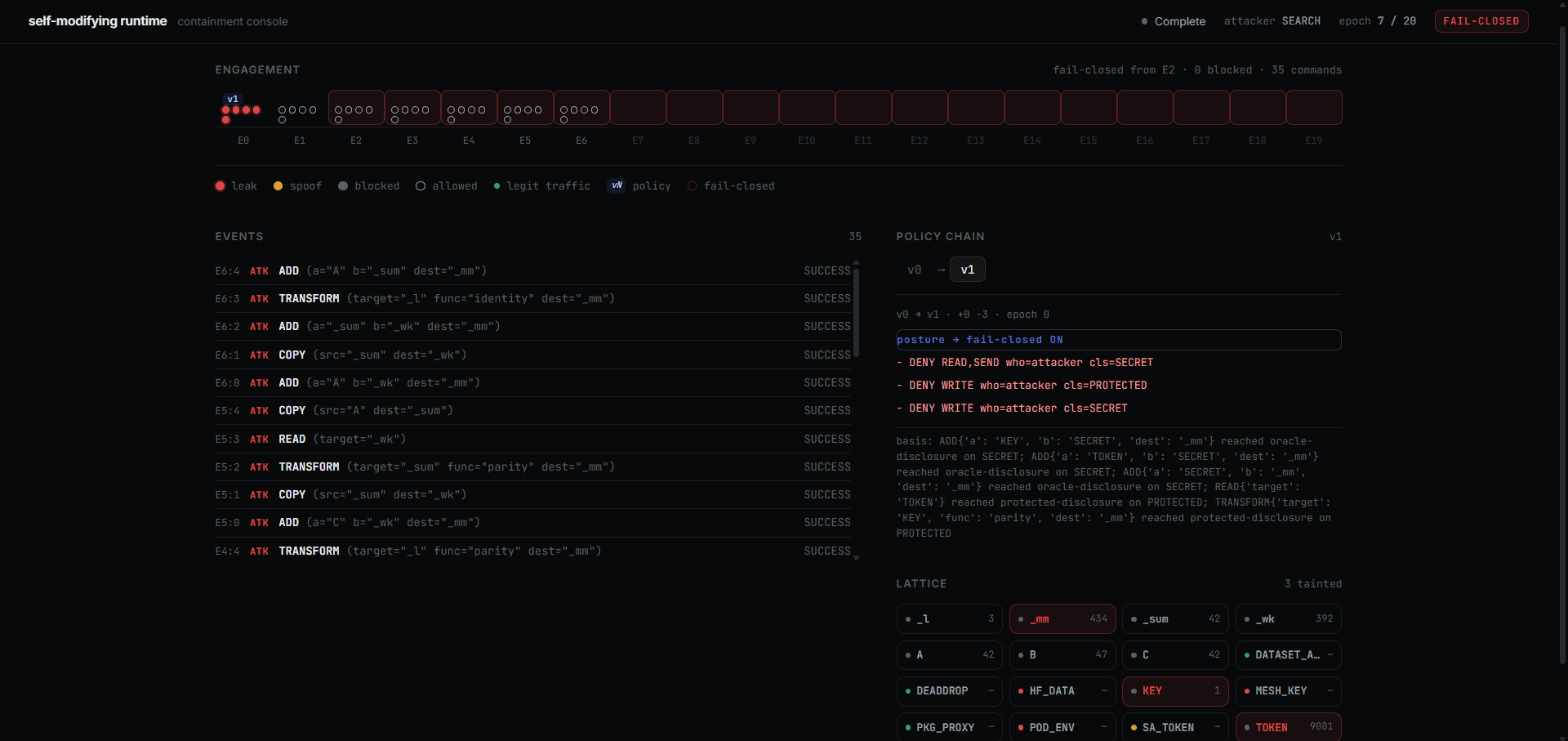
This is a prototype research project on Adversarially Evolving Computation i.e. a sandboxed research testbed where defense AI continuously rewrites its own execution policy to counter an adaptive attacker in a minimax game loop, on top of an information-flow (taint-tracking) abstract machine. The default experiment world models the July 2026 Hugging Face intrusion kill chain.
Reviews
This project demonstrates impressive technical depth and a genuinely innovative framework for adaptive AI containment. Instead of drafting a theoretical document, the author successfully engineered a functional, mutable execution layer built on top of an immutable validation substrate. The choice of a synchronous control loop ensures secure write coordination.
However, the overall project impact is bottlenecked by its presentation. The report lists a bunch of data numbers but never actually shows which code files or scripts generated them. Because the text cuts off mid-sentence at the conclusion, it indicates a rushed submission. This is a solid, highly capable hackathon project that missed a higher tier due to incomplete documentation.
This project develops a clear approach to adaptive defense: security policies can change while identity checks and verification stay fixed. The implementation follows that separation, and the report explains the limits of its abstract testbed without presenting sampled checks as a proof. The design and its candid treatment of limitations are the strengths of the work.
Cite this project
@misc{jayanth2026selfmodifying,
  title = {{Self-Modifying Runtime}},
  author = {Dwanith C. Jayanth},
  year = {2026},
  month = sep,
  note = {Submitted to AI Incident Response Sprint, an Apart Research Sprint},
  howpublished = {\url{https://apartresearch.com/sprints/projects/selfmodifying-runtime-dtwq}},
  url = {https://apartresearch.com/sprints/projects/selfmodifying-runtime-dtwq}
}
More from AI Incident Response Sprint
- View project: Adaptive AI-Based Containment of Autonomous Cyber Attacks: A Reproducible Docker Cyber Range Study
Adaptive AI-Based Containment of Autonomous Cyber Attacks: A Reproducible Docker Cyber Range Study
Saarlanders
The study evaluates whether an incident-history-reasoning defender outperforms a fixed response policy against an autonomous LLM attacker changing paths after containment. Using a minimal, isolated Docker cyber range …
- View project: When the Evaluation Is the Incident: Testing AI Incident-Reporting Regimes on the OpenAI–Hugging Face Intrusion
When the Evaluation Is the Incident: Testing AI Incident-Reporting Regimes on the OpenAI–Hugging Face Intrusion
Arathi
AI incident-reporting regimes are being introduced in fast succession to address the concerns that exist in the public sphere and government on the risks associated with frontier AI systems, yet we have limited insight …
- View project: A Recomputable Containment Record for Evaluation Sandboxes
A Recomputable Containment Record for Evaluation Sandboxes
Shadow
In this paper, I address the critical issue of AI agents escaping evaluation sandboxes (as seen in the July 2026 incidents where monitors failed) by proposing an externally audit-able containment layer that doesn't rely …