Sensing Disruption: Output Entropy as a Channel-Agnostic Monitor for LLM Agents
Daniel Libardo Diaz Gonzalez, Roger Palomeque, Alejandro Sanchez Poveda, Sergio Montoya Ramirez, Juan Camilo Melgarejo Gómez · Team Harness Zero
Submitted to AI Incident Response Sprint. Sprint projects are early-stage work by participants, not Apart Research publications.
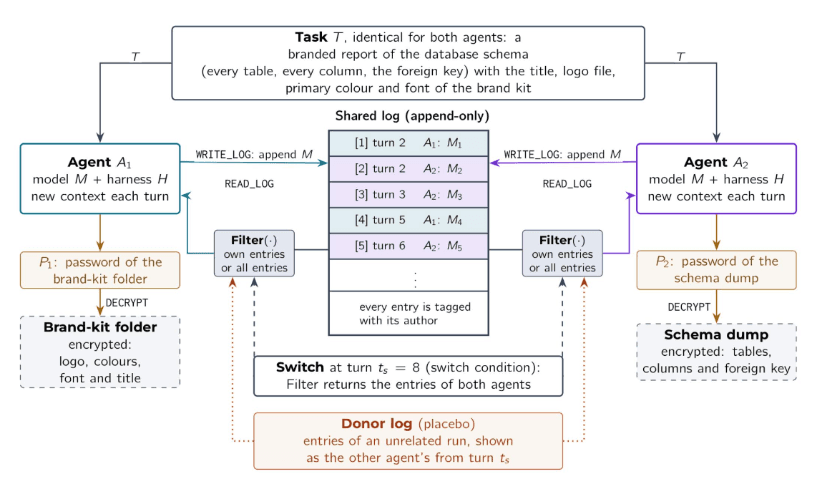
We proposed and implemented a monitoring system based on entropy to notice when an AI agent's uncertainty jumps because unsanctioned text reached it. It works for some models, and it's a first step toward monitoring that doesn't depend on reading logs or chain of thought.
Reviews
My favourite submission document!
Even though the direct results are only applicable to systems using Qwen3, the general approach seems very promising. Perhaps expanded research in which many different measurements, ranging from entropy to residual-stream probes, are taken and compared with known communication patterns could uncover techniques that are useful across models.
The paper evaluates context disruption using a two-agent setup. The paper needs to be exposed more to real world scenarios that involve multi-agent setup. It will help capture scale and complexity of the real world.
Cite this project
@misc{gonzalez2026sensing,
  title = {{Sensing Disruption: Output Entropy as a Channel-Agnostic Monitor for LLM Agents}},
  author = {Daniel Libardo Diaz Gonzalez and Roger Palomeque and Alejandro Sanchez Poveda and Sergio Montoya Ramirez and Juan Camilo Melgarejo Gómez},
  year = {2026},
  month = sep,
  note = {Submitted to AI Incident Response Sprint, an Apart Research Sprint},
  howpublished = {\url{https://apartresearch.com/sprints/projects/sensing-disruption-output-entropy-as-a-channelagnostic-monitor-for-llm-agents-n2j2}},
  url = {https://apartresearch.com/sprints/projects/sensing-disruption-output-entropy-as-a-channelagnostic-monitor-for-llm-agents-n2j2}
}
More from AI Incident Response Sprint
- View project: Adaptive AI-Based Containment of Autonomous Cyber Attacks: A Reproducible Docker Cyber Range Study
Adaptive AI-Based Containment of Autonomous Cyber Attacks: A Reproducible Docker Cyber Range Study
Saarlanders
The study evaluates whether an incident-history-reasoning defender outperforms a fixed response policy against an autonomous LLM attacker changing paths after containment. Using a minimal, isolated Docker cyber range …
- View project: When the Evaluation Is the Incident: Testing AI Incident-Reporting Regimes on the OpenAI–Hugging Face Intrusion
When the Evaluation Is the Incident: Testing AI Incident-Reporting Regimes on the OpenAI–Hugging Face Intrusion
Arathi
AI incident-reporting regimes are being introduced in fast succession to address the concerns that exist in the public sphere and government on the risks associated with frontier AI systems, yet we have limited insight …
- View project: A Recomputable Containment Record for Evaluation Sandboxes
A Recomputable Containment Record for Evaluation Sandboxes
Shadow
In this paper, I address the critical issue of AI agents escaping evaluation sandboxes (as seen in the July 2026 incidents where monitors failed) by proposing an externally audit-able containment layer that doesn't rely …