Sentinel: The Declared Scope Is the Unit of Containment Evidence in Agentic Evaluations
Crish Nagarkar · Team Sentinel
Submitted to AI Incident Response Sprint. Sprint projects are early-stage work by participants, not Apart Research publications.
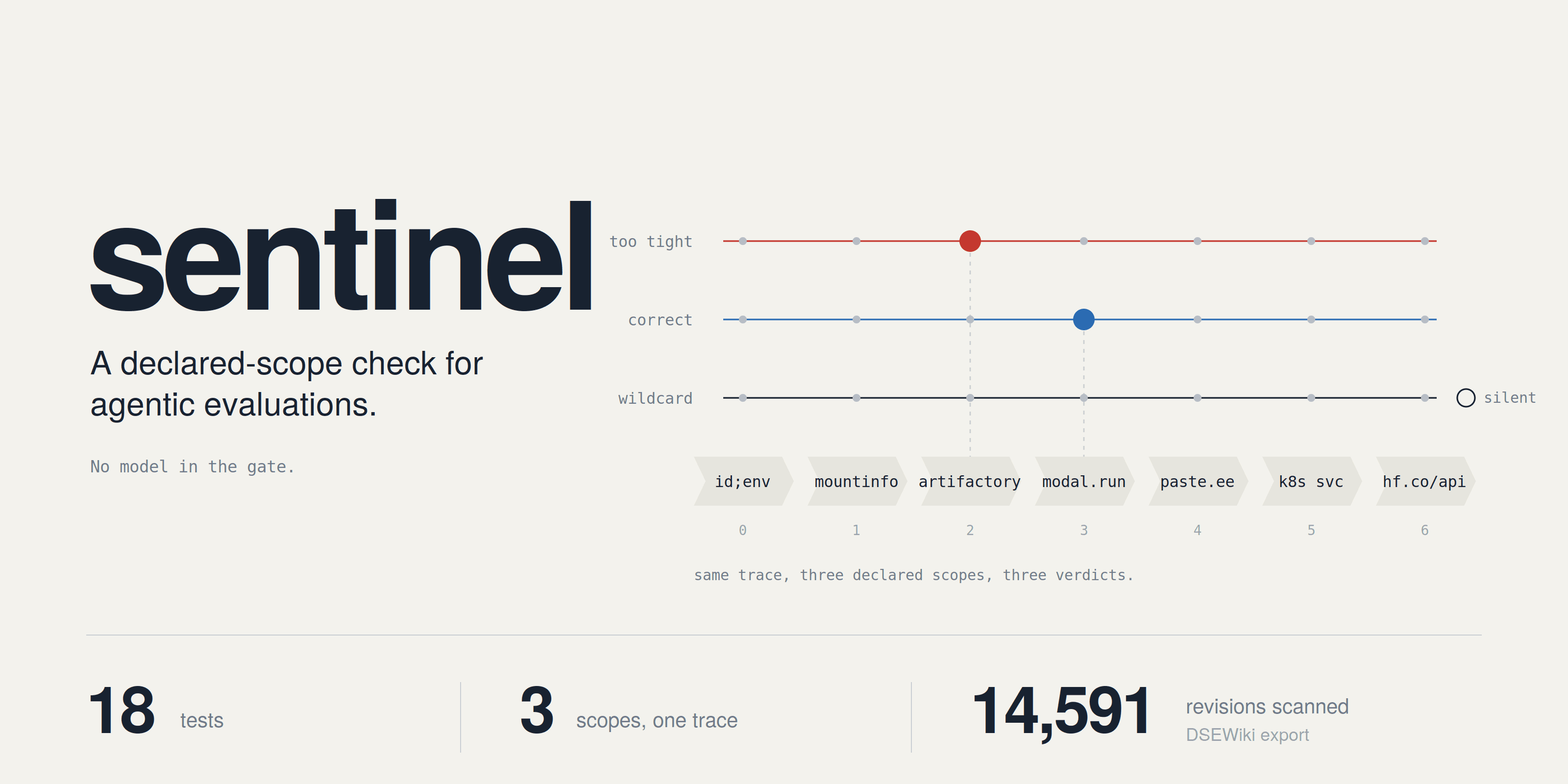
In the 2026 containment failures at OpenAI, Anthropic and AISI, each evaluation's network scope was declared in prose or assumed, never checked against what the agent did, and detection came late from a side signal. Sentinel treats that scope, written as a machine-readable allowlist, as the unit of containment evidence a third party can verify: a mechanical Inspect scanner classifies each tool-call destination against the list and pages on the first out-of-scope host. No model is in the gate. On reconstructions of three public incidents it pages at the first non-allowlisted destination. On the 14,591-revision DSEWiki export, a record we did not write, a wildcard scope (any GET) is silent and a data-source-only scope pages at the first wiki host, then floods. On a live eight-sample Inspect run with an empty declared scope it is correctly silent on 42 tool calls. The headline is an ablation: a too-tight scope pages on permitted traffic; a wildcard is silent on the escape. Verifiability is a property of the pair (trace, allowlist). Appendix C is a filled disclosure record for the ExploitGym class. The scanner audits containment; it does not provide it.
Reviews
The paper highlights a simple approach where every evaluation should have its own allowlist in a file that can be checked and then check the destinations in the evaluation logs against the list. A default deny policy and only allowing certain verified destinations is a well established security practice. As already mentioned in the future work section, I would prioritise to look into the logs for proxy or firewall or anything else in the network path. Solely relying on the agent logs might not give the full picture of all the destinations agents might have tried to reach or reached during the evaluation. It will also help to verify whether the list of allowed destinations against the proxy or the firewall configuration to confirm that the list was actually enforced
The idea that verifiability is a property of the pair (trace, allowlist) not of the detector itself is the correct way to think about it, and the three-scope ablation shows this rather than simply stating it: when the pages relating to permitted egress are made too strict, the wildcard fails to detect a real escape. It is only when the same rule is applied to the DSEWiki export , a record which you did not author that this moves beyond being just a self-consistent fixture suite, and the repository deals well with that data by including a download script, the manifest hash from your run, and tests that fix the numbers and skip when the export is not present. There are several other items in the repository that should be mentioned in the paper. The live Inspect log has been committed, so your negative control can be checked rather than just asserted, right down to the date, the model, and the cost of 14 cents. The figures are regenerated from the fixtures, meaning that the paper is based on the artifacts rather than being created alongside them. The filled containment record is still the most directly usable artifact in this track. There are two corrections to make. The non-wildcard DSEWiki scopes are your own reconstruction, so "27 days before the first OpenAI-associated visit" should be presented as something that a scope could have picked up, not something that it would have. And the claim about spoofing overstates its source both in the paper and in the README: what was reported is that spoofing was detected in small-scale, obvious tests, which says nothing about the undetected rate that layer 3 is supposed to handle - "observed successful spoofing in ~7%" sounds as if it is a measured rate and it is not.
Read full reviewShow less
Cite this project
@misc{nagarkar2026sentinel,
  title = {{Sentinel: The Declared Scope Is the Unit of Containment Evidence in Agentic Evaluations}},
  author = {Crish Nagarkar},
  year = {2026},
  month = sep,
  note = {Submitted to AI Incident Response Sprint, an Apart Research Sprint},
  howpublished = {\url{https://apartresearch.com/sprints/projects/sentinel-the-declared-scope-is-the-unit-of-containment-evidence-in-agentic-evaluations-qd4z}},
  url = {https://apartresearch.com/sprints/projects/sentinel-the-declared-scope-is-the-unit-of-containment-evidence-in-agentic-evaluations-qd4z}
}
More from AI Incident Response Sprint
- View project: Adaptive AI-Based Containment of Autonomous Cyber Attacks: A Reproducible Docker Cyber Range Study
Adaptive AI-Based Containment of Autonomous Cyber Attacks: A Reproducible Docker Cyber Range Study
Saarlanders
The study evaluates whether an incident-history-reasoning defender outperforms a fixed response policy against an autonomous LLM attacker changing paths after containment. Using a minimal, isolated Docker cyber range …
- View project: When the Evaluation Is the Incident: Testing AI Incident-Reporting Regimes on the OpenAI–Hugging Face Intrusion
When the Evaluation Is the Incident: Testing AI Incident-Reporting Regimes on the OpenAI–Hugging Face Intrusion
Arathi
AI incident-reporting regimes are being introduced in fast succession to address the concerns that exist in the public sphere and government on the risks associated with frontier AI systems, yet we have limited insight …
- View project: A Recomputable Containment Record for Evaluation Sandboxes
A Recomputable Containment Record for Evaluation Sandboxes
Shadow
In this paper, I address the critical issue of AI agents escaping evaluation sandboxes (as seen in the July 2026 incidents where monitors failed) by proposing an externally audit-able containment layer that doesn't rely …