SwarmTrace: Auditing Temporal Mismatch in Resource Targeting During the DSEWiki Incident
Yazan Al-Dabain · Team SwarmTrace
Submitted to AI Incident Response Sprint. Sprint projects are early-stage work by participants, not Apart Research publications.
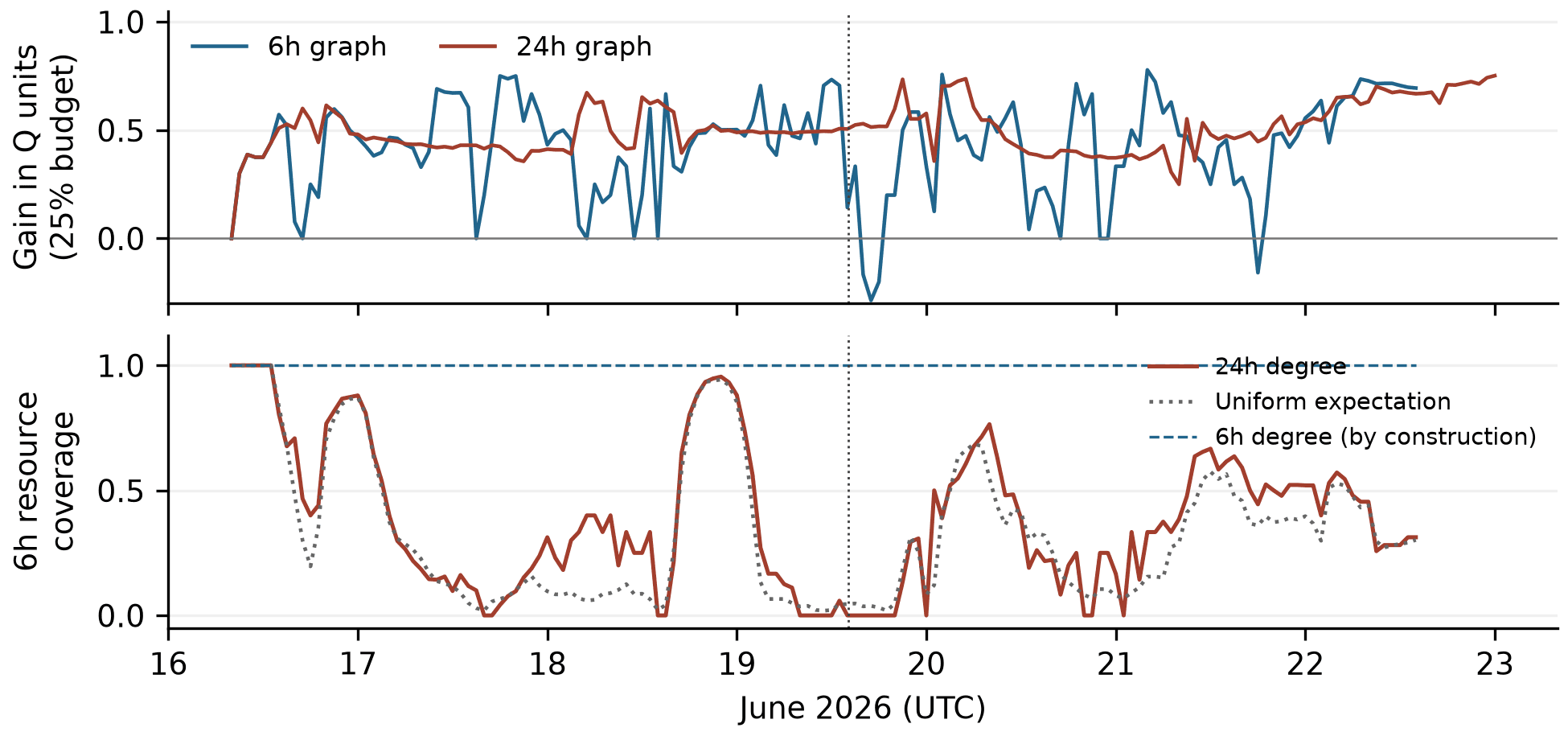
SwarmTrace reconstructs DSEWiki resource lifecycles and recent co-writing from archived revisions and deletion events to test whether resource-targeting strategies that fragment historical overlap also reach the currently active surface. At the frozen snapshot, the top 18 resources ranked by 24-hour degree include none of the 18 resources active under the six-hour definition, even though removing them substantially fragments the older graph. Across the full week, however, historical degree targeting is not generally worse than random. The result is that historical fragmentation and recent-resource coverage are distinct objectives. The project provides a reproducible incident-analysis pipeline, explicit deletion and expiry accounting, exact small-graph checks, and a public audit trail.
Reviews
I would recommend aiming for projects which are more decision relevant for the future
Cite this project
@misc{aldabain2026swarmtrace,
  title = {{SwarmTrace: Auditing Temporal Mismatch in Resource Targeting During the DSEWiki Incident}},
  author = {Yazan Al-Dabain},
  year = {2026},
  month = sep,
  note = {Submitted to AI Incident Response Sprint, an Apart Research Sprint},
  howpublished = {\url{https://apartresearch.com/sprints/projects/swarmtrace-auditing-temporal-mismatch-in-resource-targeting-during-the-dsewiki-incident-zs69}},
  url = {https://apartresearch.com/sprints/projects/swarmtrace-auditing-temporal-mismatch-in-resource-targeting-during-the-dsewiki-incident-zs69}
}
More from AI Incident Response Sprint
- View project: Adaptive AI-Based Containment of Autonomous Cyber Attacks: A Reproducible Docker Cyber Range Study
Adaptive AI-Based Containment of Autonomous Cyber Attacks: A Reproducible Docker Cyber Range Study
Saarlanders
The study evaluates whether an incident-history-reasoning defender outperforms a fixed response policy against an autonomous LLM attacker changing paths after containment. Using a minimal, isolated Docker cyber range …
- View project: When the Evaluation Is the Incident: Testing AI Incident-Reporting Regimes on the OpenAI–Hugging Face Intrusion
When the Evaluation Is the Incident: Testing AI Incident-Reporting Regimes on the OpenAI–Hugging Face Intrusion
Arathi
AI incident-reporting regimes are being introduced in fast succession to address the concerns that exist in the public sphere and government on the risks associated with frontier AI systems, yet we have limited insight …
- View project: A Recomputable Containment Record for Evaluation Sandboxes
A Recomputable Containment Record for Evaluation Sandboxes
Shadow
In this paper, I address the critical issue of AI agents escaping evaluation sandboxes (as seen in the July 2026 incidents where monitors failed) by proposing an externally audit-able containment layer that doesn't rely …