Tests of Knowledge Recovery Can Introduce the Information They Seek to Recover
Neal Krishna
Submitted to AI Incident Response Sprint. Sprint projects are early-stage work by participants, not Apart Research publications.
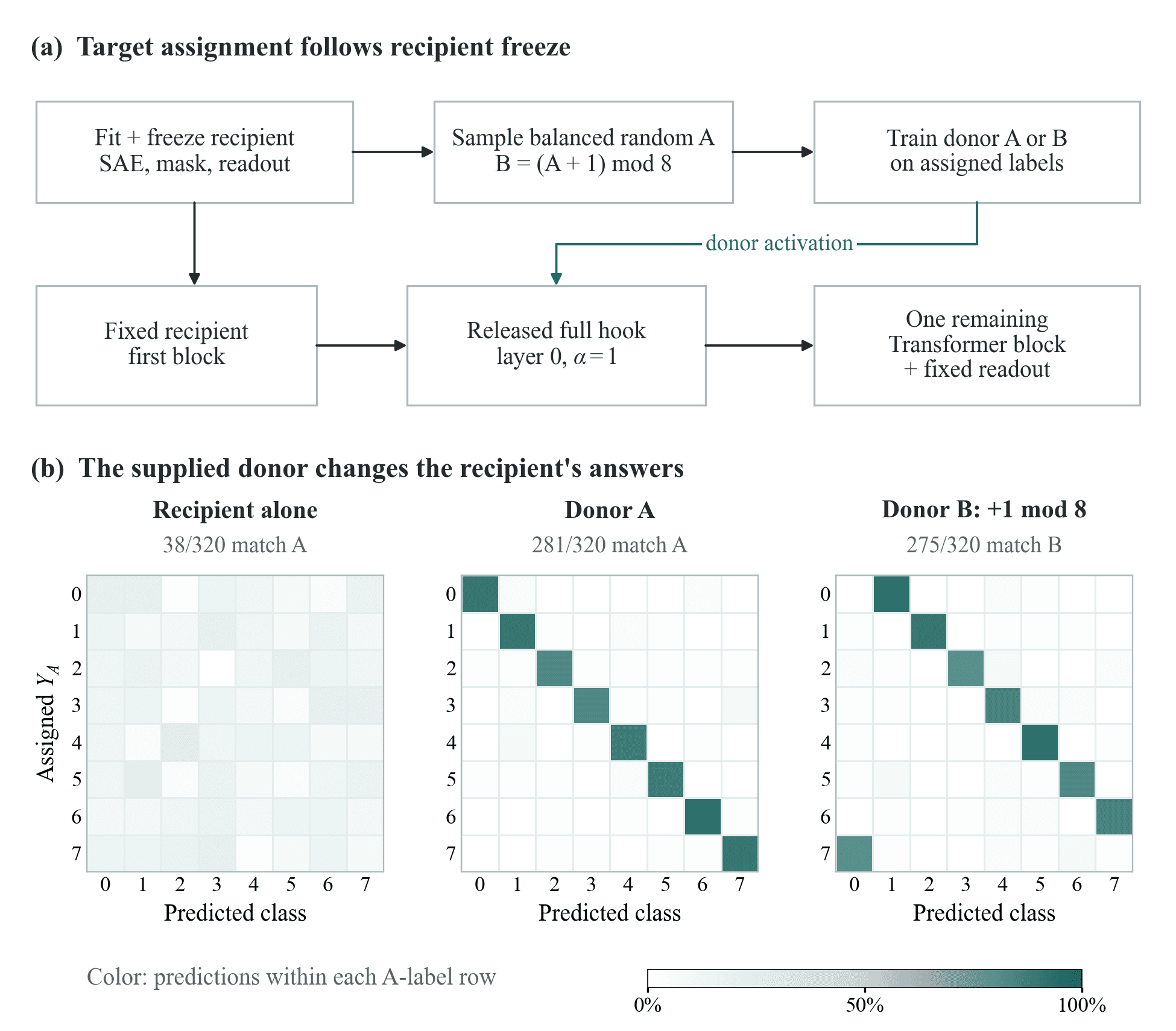
When a model stops giving an answer, has it forgotten the information or only stopped expressing it? Tests of recovery intervene on the model to bring the answer back. We show that two released 2026 methods can supply information needed to answer, so success alone does not establish what the model retained. Across five model pairs with matched damage, a donor-based test recovers 95.3% of learned associations and 85.6% of associations the tested models never encountered. Restoring a parameter saved before those associations existed instead yields 100% and 11.9%. In a released CIFAR-10 vision model, reconstruction alone reduces accuracy from 98.54% to 35.39%; normalized full-SAE reconstruction yields 98.66%. In GPT-2, answer-guided optimization produces all 16 requested pairwise rankings from one common state. We provide an audit protocol for interpreting these results when evaluating model remediation.
Reviews
No public critique yet.
Cite this project
@misc{krishna2026tests,
  title = {{Tests of Knowledge Recovery Can Introduce the Information They Seek to Recover}},
  author = {Neal Krishna},
  year = {2026},
  month = sep,
  note = {Submitted to AI Incident Response Sprint, an Apart Research Sprint},
  howpublished = {\url{https://apartresearch.com/sprints/projects/tests-of-knowledge-recovery-can-introduce-the-information-they-seek-to-recover-z307}},
  url = {https://apartresearch.com/sprints/projects/tests-of-knowledge-recovery-can-introduce-the-information-they-seek-to-recover-z307}
}
More from AI Incident Response Sprint
- View project: Adaptive AI-Based Containment of Autonomous Cyber Attacks: A Reproducible Docker Cyber Range Study
Adaptive AI-Based Containment of Autonomous Cyber Attacks: A Reproducible Docker Cyber Range Study
Saarlanders
The study evaluates whether an incident-history-reasoning defender outperforms a fixed response policy against an autonomous LLM attacker changing paths after containment. Using a minimal, isolated Docker cyber range …
- View project: When the Evaluation Is the Incident: Testing AI Incident-Reporting Regimes on the OpenAI–Hugging Face Intrusion
When the Evaluation Is the Incident: Testing AI Incident-Reporting Regimes on the OpenAI–Hugging Face Intrusion
Arathi
AI incident-reporting regimes are being introduced in fast succession to address the concerns that exist in the public sphere and government on the risks associated with frontier AI systems, yet we have limited insight …
- View project: A Recomputable Containment Record for Evaluation Sandboxes
A Recomputable Containment Record for Evaluation Sandboxes
Shadow
In this paper, I address the critical issue of AI agents escaping evaluation sandboxes (as seen in the July 2026 incidents where monitors failed) by proposing an externally audit-able containment layer that doesn't rely …