The Cognitive Debt Crisis - A Data-Driven Forecast Analysis of AI’s Impact on Human Thinking
Preetham Sathyamurthy, Varun Balakrishnan · Team Astroware
Submitted to The AI Forecasting Hackathon. Sprint projects are early-stage work by participants, not Apart Research publications.
We are accumulating debt of cognition / decline in critical thinking capability by outsourcing our thinking to AI.
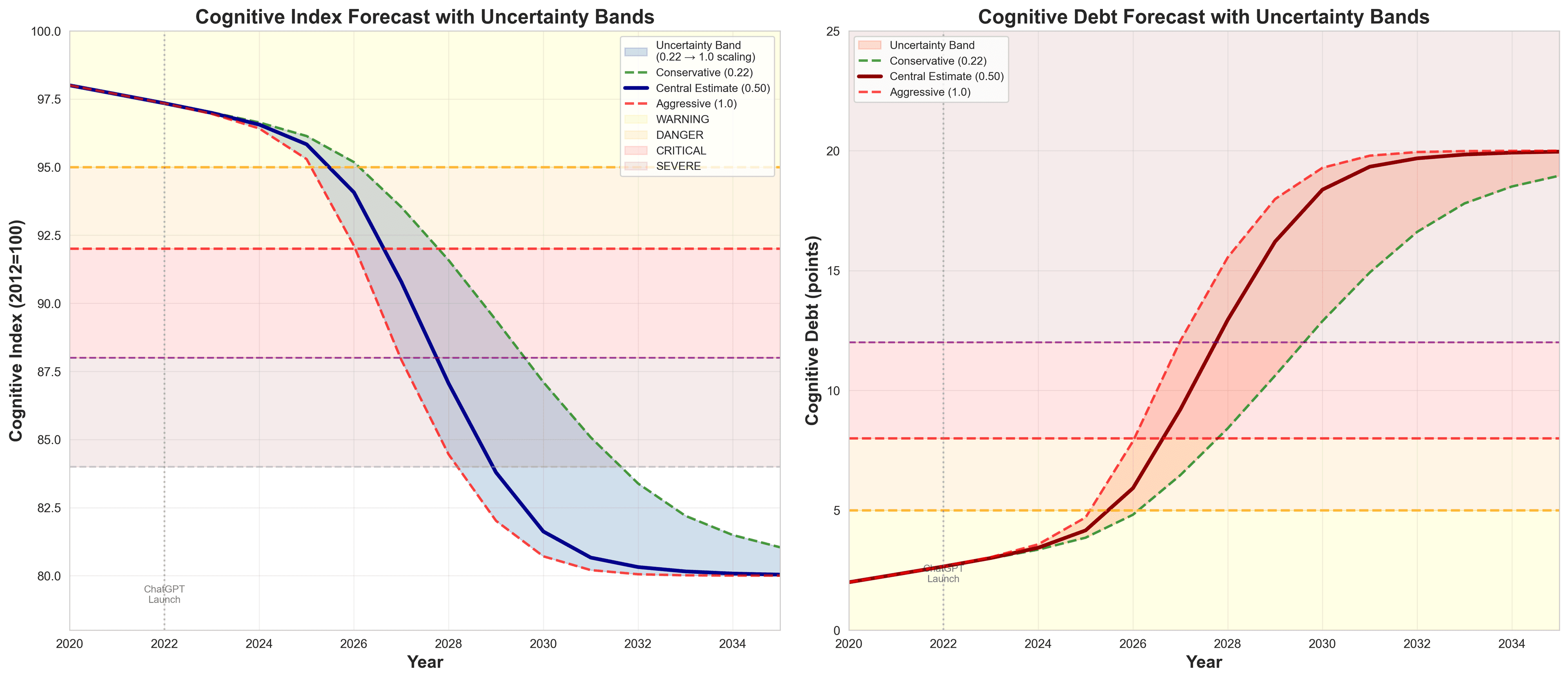
Between 2022 and 2024, ChatGPT adoption grew from 1% to 9% of the global population while humanity’s measured cognitive ability—based on standardized assessments like PISA and NAEP—declined by 1.1 points, a 96% acceleration over the pre-AI baseline. Our data-driven forecast model, calibrated against real-world data (RMSE = 0.22), projects a global cognitive index below 92 by 2027–2028 and 81–87 by 2030. ChatGPT adoption is occurring 18.4× faster than social media’s historical rate, compressing a 15-year cognitive impact timeline into less than one year. Six recent studies mechanistically validate the concept of cognitive debt—demonstrating neural connectivity loss, cognitive effort reduction, and dependence on AI systems. Our findings reveal a two-year window where collective action by 2026 is three times more effective than delayed intervention. This is not dystopian speculation but a mathematical projection grounded in observed data. We have two years to figure out ways to preserve human cognition decline and improve it.
Reviews
- The concern of cognitive decline as a result of AI use is of critical importance, and I'm happy to see others treating it as such!
- While this is an area we need to be investigating, the analysis conducted is primarily speculative, based on the fact that cognitive decline has increased in the past few years, which also happens to match when ChatGPT was first introduced. This is a bold claim, so we need very rigorous evidence; examining correlation between adoption of AI and cognitive decline, correlation between model capabilities and decline, assessing thoroughly the possibility of alternate explanations (especially those posited by other scholars researching this area), and comparing cognitive decline as seen by the index to studies which have investigated mental ability whether or not the person used AI for the task would just scratch the surface of the kind of validation that would be needed.
Read full reviewShow less
Cite this project
@misc{sathyamurthy2025cognitive,
  title = {{The Cognitive Debt Crisis - A Data-Driven Forecast Analysis of AI’s Impact on Human Thinking}},
  author = {Preetham Sathyamurthy and Varun Balakrishnan},
  year = {2025},
  month = nov,
  note = {Submitted to The AI Forecasting Hackathon, an Apart Research Sprint},
  howpublished = {\url{https://apartresearch.com/sprints/projects/the-cognitive-debt-crisis-a-datadriven-forecast-analysis-of-ais-impact-on-human-thinking-ob8w}},
  url = {https://apartresearch.com/sprints/projects/the-cognitive-debt-crisis-a-datadriven-forecast-analysis-of-ais-impact-on-human-thinking-ob8w}
}
More from The AI Forecasting Hackathon
- View project: System Dynamics Game-Theoretic Model of the AI Development Race
System Dynamics Game-Theoretic Model of the AI Development Race
System Dynamics BCN
A Game theoretic / System Dynamics model of the race dynamics of the US, China, and EU, as a follow up to the Armstrong et al. (2016) paper “Racing to the Precipice”. We find preliminary results where knowledge of …
- View project: ExogenousAI
ExogenousAI
Fibonacci
Current AI capability forecasting methodologies, including EpochAI's Direct Approach and Biological Anchors framework, primarily rely on internal metrics such as training compute and scaling laws while assuming stable …
- View project: AI Incidents Forecasting
AI Incidents Forecasting
KLACE
This research develops a framework for forecasting AI incidents to help predict future risks. We have developed two models that forecasts incidents which include calibrated 90% prediction intervals with backtests. These …