Veridict
Sumit Vekariya · Team ZKred
Submitted to The Secure Program Synthesis Hackathon. Sprint projects are early-stage work by participants, not Apart Research publications.
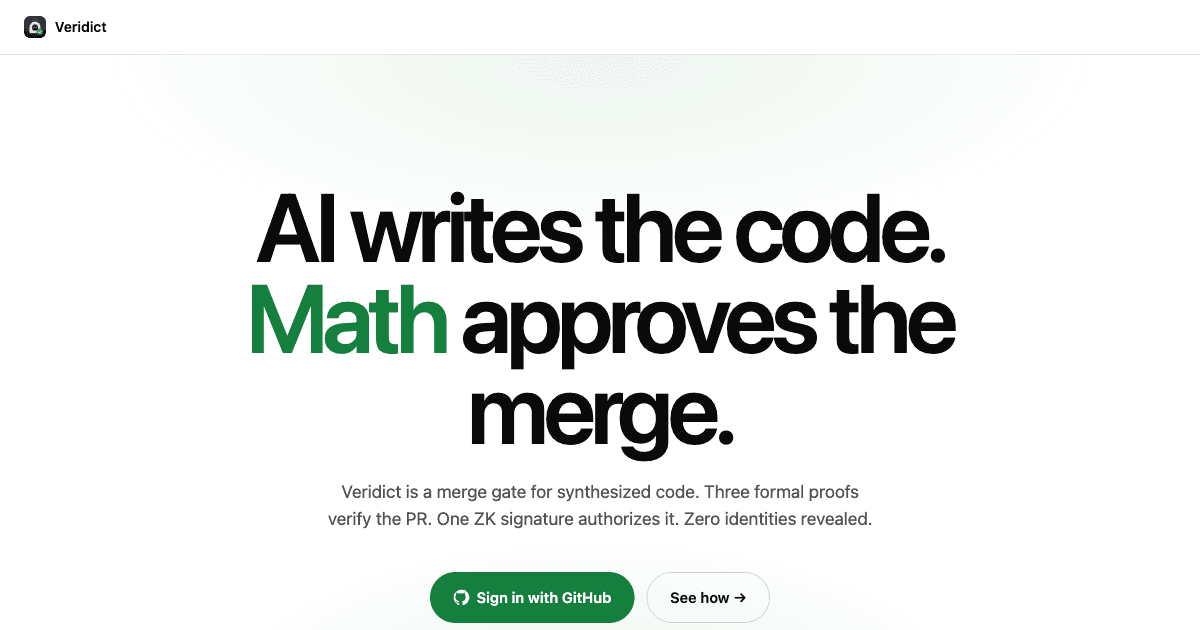
Veridict is a merge gate for AI-synthesized code that decouples qualified-reviewer-ness from identity. A natural-language spec is sent to Claude, which generates an implementation, a pytest suite, and a Z3 invariant file. The issuer mints a Longfellow ZK credential only after all three formal layers pass, and N anonymous proofs from credentialed reviewers flip the GitHub branch-protection gate that authorizes the merge. Built end-to-end on a live public repo with active branch protection; same Google ZK primitive used for anonymous age verification on mobile driver's licences, repurposed for code review.
Reviews
While the GitHub integration and overall user experience are well executed, the core AI security design needs more work to be done. The current Z3 check only validates that the specification is internally consistent; it does not prove that the generated Python code actually follows that specification. This leaves room for incorrect or even malicious code to pass review. In addition, the trust model around zero-knowledge proofs is weakened by server-side key generation and the absence of nullifiers, which could allow duplicate or spoofed approvals. Strengthening the system would require true code-to-spec verification and moving all ZK proof generation fully to the client side.
This is a cool project and very timely. My main feedback would be that this could be better integrated with Git (as opposed to GitHub) and existing infrastructure like Sign-offs. Anyways, this is good work.
Cite this project
@misc{vekariya2026veridict,
  title = {{Veridict}},
  author = {Sumit Vekariya},
  year = {2026},
  month = may,
  note = {Submitted to The Secure Program Synthesis Hackathon, an Apart Research Sprint},
  howpublished = {\url{https://apartresearch.com/sprints/projects/veridict-e67q}},
  url = {https://apartresearch.com/sprints/projects/veridict-e67q}
}
More from The Secure Program Synthesis Hackathon
- View project: Vibe-Coding Specs: Eliciting, Editing, and Verifying Specifications for AI Coding Agents
Vibe-Coding Specs: Eliciting, Editing, and Verifying Specifications for AI Coding Agents
Lida Safety
Specifications for real systems do not exist as one-shot artifacts: the user's intent emerges as they discover edge cases, rewrite drafts, and react to failing tests. We present an iterative pipeline that takes this …
- View project: AgentSpecGap
AgentSpecGap
solo-team
This prototype extracts rules from system prompts, tool descriptions, and runtime config. Rules are classified into one of interface validation, authorization check, workflow ordering validation, runtime validation, …
- View project: SpecGap Arena
SpecGap Arena
Obligation Cartographers
SpecGap Arena is a benchmark and framework that exposes how incomplete specifications let plausible but incorrect code pass public tests. It synthesizes missing semantic obligations (security boundaries, invariants, …