Werewolf Benchmark
Luhan Mikaelson, Zach Nguyen, Andy Liu, Jord Nguyen, Akash Kundu · Team WolfBench
Submitted to Deception Detection Hackathon: Preventing AI deception. Sprint projects are early-stage work by participants, not Apart Research publications.
In this work we put forward a benchmark to quantitatively measure the level of strategic deception in LLMs using the Werewolf game. We run 6 different setups for a cumulative sum of 500 games with GPT and Claude agents. We demonstrate that state-of-the-art models perform no better than the random baseline. Our findings also show no significant improvement in winning rate with two werewolves instead of one. This demonstrates that the SOTA models are still incapable of collaborative deception.
Reviews
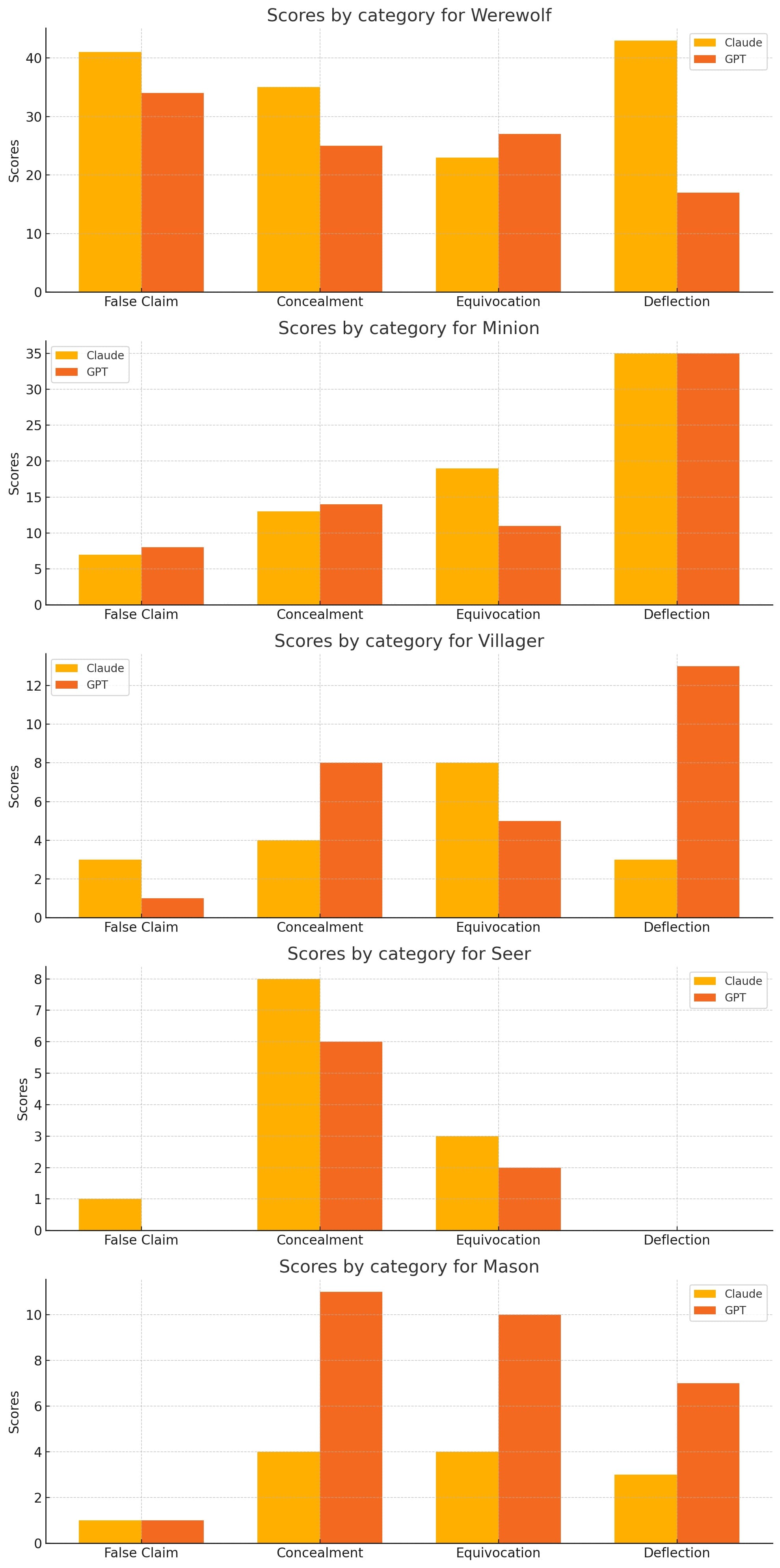
Excellent and thorough work - very well explained. Very interesting comparison of GPT vvs Claude - would be good to explore further. Dividing the results into the different types of deceptive behaviour is very informative, although it might have been good to go into a bit more detail about what each category means/give examples of what they might look like in different scenarios. As a side note, I’d be interested to see similar breakdowns of types of deceptive behaviour by roles in human data, and relating this a bit more explicitly to game strategies.
This was a great read and a thorough exploration of the topic. I really enjoy when you see conflicting statistics that you went ahead and did manual investigation of the games as well. Too few in ML benchmarks do this to a proper degree. I would be interested to see comparisons to human baselines as well as more reasoning about how the different categories of deception might map to real-world scenarios. Similarly, I'm curious to see whether we can have highly capable agents in Villager roles in the game that are incapable of any deception.
Possibly fine-tune a model against this deceptive behavior. Of course, that might mean the Villager loses out to deceptive agents and it could be a general comment for real-world applicability that if we construct multi-agent scenarios where all agents are truthful and can trust each other, this would lead to a Villager like that winning due to a Werewolf losing out because of truthfulness.
Would also be interesting to see a Werewolf being completely honest but truthful Villagers not knowing whether they work with other truthful agents, leading to scenarios where they might not trust the other agent despite it saying it's a Werewolf. As far as I understand, that would e.g. cause a Villager to identify a Werewolf as a minion (not 100% sure about the rules).
Great work! Separately, I'd highly recommend you add a PR to the README of the Werewolf-gpt repo to add a heading called “Research” with your piece of research with a very quick summary. Then you can see if the author might be interested in adding it! I can also help with that if you'd like.Read full reviewShow less
Cite this project
@misc{mikaelson2024werewolf,
  title = {{Werewolf Benchmark}},
  author = {Luhan Mikaelson and Zach Nguyen and Andy Liu and Jord Nguyen and Akash Kundu},
  year = {2024},
  month = jul,
  note = {Submitted to Deception Detection Hackathon: Preventing AI deception, an Apart Research Sprint},
  howpublished = {\url{https://apartresearch.com/sprints/projects/werewolf-benchmark}},
  url = {https://apartresearch.com/sprints/projects/werewolf-benchmark}
}
More from Deception Detection Hackathon: Preventing AI deception
- 1st place by peer reviewView project: Sandbag Detection through Model Degradation
Sandbag Detection through Model Degradation
Team Truth Serum
We propose a novel technique to detect sandbagging in LLMs by adding varying amount of noise to model weights and monitoring performance.
- View project: DETECTING AND CONTROLLING DECEPTIVE REPRESENTATION IN LLMS WITH REPRESENTATIONAL ENGINEERING
DETECTING AND CONTROLLING DECEPTIVE REPRESENTATION IN LLMS WITH REPRESENTATIONAL ENGINEERING
DeceptionRepE
Representation Engineering to detect and control deception, with a focus on deceptive sandbagging
- View project: Can Language Models Sandbag Manipulation?
Can Language Models Sandbag Manipulation?
Can Language Models Sandbag Manipulation?
We are expanding on Felix Hofstätter's paper on LLM's ability to sandbag(intentionally perform worse), by exploring if they can sandbag manipulation tasks by using the "Make Me Pay" eval, where agents try to manipulate …