Where Authorization Stops: Effect-Bound Containment, Independent Evidence and the Limits of Preview
Aditya Pratap Singh · Team Effect-Bound Containment
Submitted to AI Incident Response Sprint. Sprint projects are early-stage work by participants, not Apart Research publications.
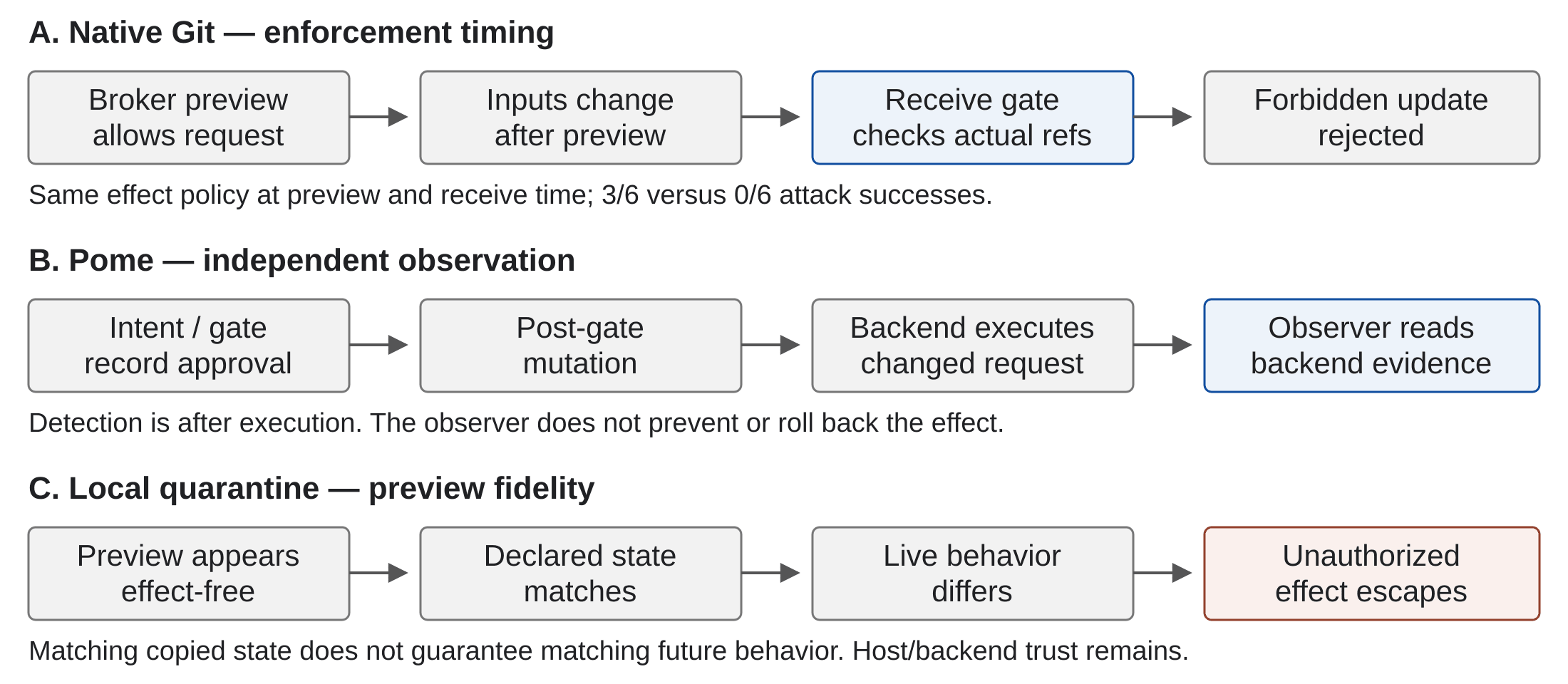
Containment for evaluated models usually names a permitted route but not the effects allowed through it. That is the gap the July 2026 incident exploited. We test three controls on synthetic backends (native Git, an isolated HTTP gateway, API twins) which check authority for the exact effect at the component that executes it, keep backend evidence the actor and broker cannot forge and treat a pre-execution preview as advisory, not proof. Execution-time checks prevented every tested violation that upstream approval missed (Git 0/6 vs 3/6; HTTP 0/12 vs 8/12) with no loss of legitimate work, and independent backend evidence detected 6/6 executed attacks that intent logs missed.
Our adaptive-quarantine hypothesis was only partly supported: preview missed execution-only faults, so we designed an execution-time effect gate (state and data flow) that closes that gap. We release a nine-control containment standard, every run including negatives, and a one-command offline verifier so a third party can check it without a lab's network.
Reviews
An action approved ahead of time isn't the same as controlling what it actually does once it runs - and this team takes that seriously. Instead of relying on the upfront approval alone, they double-check permission at the exact moment an action executes, and it catches attacks that would otherwise slip through, by a wide margin. They also back this up with evidence the system itself can't fake, and built a simple tool so anyone can verify the results independently. It's good to see them being upfront about the one part that didn't fully pan out, rather than glossing over it.
The paper is careful and honest about its results. It clearly explains what passed, what failed, and what was not tested. Including the failed results is especially valuable. The Git example, offline review process, and acceptance checklist are also practical and easy to understand.
My main concerns are:
The baselines are weak, and the attacks focus on their known weaknesses. Some results therefore feel more like expected unit-test outcomes than strong experimental findings.
The tests and controls were designed together, which may have made the tests easier to pass. The later review also found important cases that the original tests missed.
The paper does not fully explain how exact-effect controls could be defined and implemented across many tools, especially third-party services such as GitHub.
The motivating incident involved a compromised proxy, but the paper’s design assumes the gateway is trusted. This leaves an important gap.
The AI-safety connection is limited because no meaningful model-based attacker was successfully tested.
The “720 cases” are mostly repeated runs of a small number of workflows, so the number may sound stronger than the evidence actually is.
Execution-side enforcement is reasonably supported, but the additional value of quarantine remains unclear.
The related-work section should include more discussion of existing authorization controls, policy engines, reference monitors, ToolEmu, and AI-control research.
The presentation could also be improved. Internal labels such as H26 and H30 need more explanation, some table symbols were unclear, and the abstract contains too many numbers.
Read full reviewShow less
Cite this project
@misc{singh2026where,
  title = {{Where Authorization Stops: Effect-Bound Containment, Independent Evidence and the Limits of Preview}},
  author = {Aditya Pratap Singh},
  year = {2026},
  month = sep,
  note = {Submitted to AI Incident Response Sprint, an Apart Research Sprint},
  howpublished = {\url{https://apartresearch.com/sprints/projects/where-authorization-stops-effectbound-containment-independent-evidence-and-the-limits-of-preview-4nwz}},
  url = {https://apartresearch.com/sprints/projects/where-authorization-stops-effectbound-containment-independent-evidence-and-the-limits-of-preview-4nwz}
}
More from AI Incident Response Sprint
- View project: Adaptive AI-Based Containment of Autonomous Cyber Attacks: A Reproducible Docker Cyber Range Study
Adaptive AI-Based Containment of Autonomous Cyber Attacks: A Reproducible Docker Cyber Range Study
Saarlanders
The study evaluates whether an incident-history-reasoning defender outperforms a fixed response policy against an autonomous LLM attacker changing paths after containment. Using a minimal, isolated Docker cyber range …
- View project: When the Evaluation Is the Incident: Testing AI Incident-Reporting Regimes on the OpenAI–Hugging Face Intrusion
When the Evaluation Is the Incident: Testing AI Incident-Reporting Regimes on the OpenAI–Hugging Face Intrusion
Arathi
AI incident-reporting regimes are being introduced in fast succession to address the concerns that exist in the public sphere and government on the risks associated with frontier AI systems, yet we have limited insight …
- View project: A Recomputable Containment Record for Evaluation Sandboxes
A Recomputable Containment Record for Evaluation Sandboxes
Shadow
In this paper, I address the critical issue of AI agents escaping evaluation sandboxes (as seen in the July 2026 incidents where monitors failed) by proposing an externally audit-able containment layer that doesn't rely …