Jan 30 - Feb 1, 2026Online
The Technical AI Governance Challenge
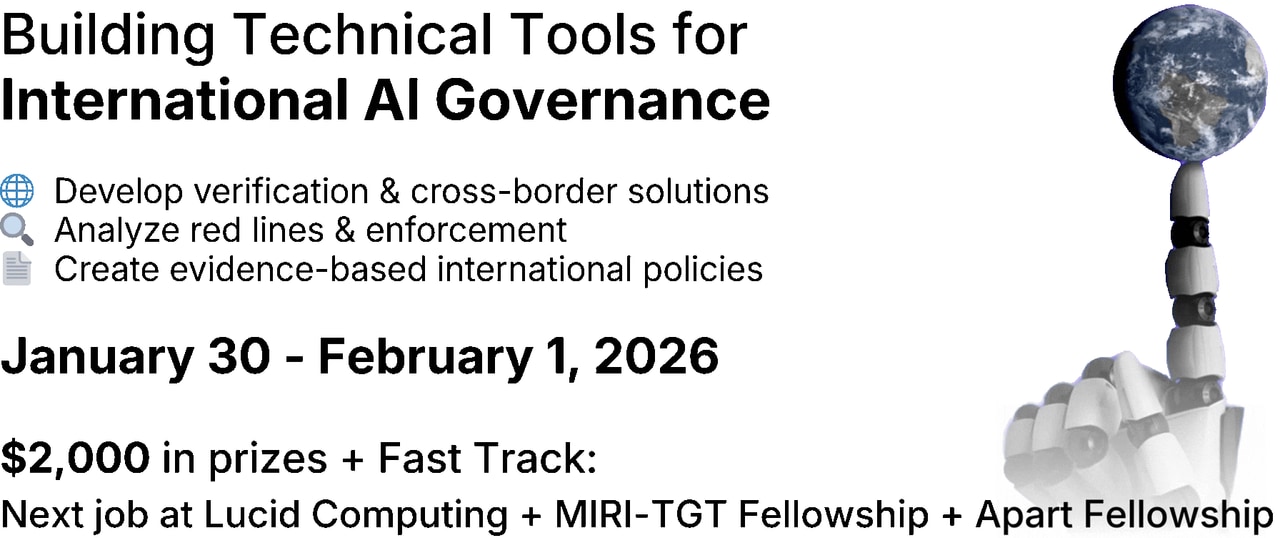
This hackathon brings together 500+ builders to prototype verification tools, compliance systems, and coordination infrastructure that enable international cooperation on frontier AI safety.
Entries
- 1st placeView project: LidaSim: Testing AI Policies With Persona-Based Simulations
LidaSim: Testing AI Policies With Persona-Based Simulations
Team Lida Safety · Montreal
We simulate well-known figures in AI and politics with agents, scraping large amounts of data to get realistic simulations. Then, we test questions and proposed policies against these public figures, to see which policies are more likely to be broadly supported. We focus on policies related to compute governance and …
- 2nd placeView project: Markov Chain Lock Watermarking: Provably Secure Authentication for LLM Outputs
Markov Chain Lock Watermarking: Provably Secure Authentication for LLM Outputs
Team MCL · Lausanne
We present Markov Chain Lock (MCL) watermarking, a cryptographically secure framework for authenticating LLM outputs. MCL constrains token generation to follow a secret Markov chain over SHA-256 vocabulary partitions. Using doubly stochastic transition matrices, we prove four theoretical guarantees: (1) exponentially …
- 3rd placeView project: Political Intelligence for AI Safety: The AI Risk Attitudes Survey (AIRAS)
Political Intelligence for AI Safety: The AI Risk Attitudes Survey (AIRAS)
Team AIRAS · London, UK
The AI safety and governance community is making progress on defining red lines around existential risk from advanced AI systems, and building verification infrastructure to support this objective. However, this is only half the battle. Implementing these red lines requires unprecedented international coordination, …
- 4th placeView project: Fingerprinting All AI Cluster I/O Without Mutually Trusted Processors
Fingerprinting All AI Cluster I/O Without Mutually Trusted Processors
Team The Bypass Annihilators · UK, Germany, Singapore, Australia
We design and simulate a "border patrol" device for generating cryptographic evidence of data traffic entering and leaving an AI cluster, while eliminating the specific analog and steganographic side-channels that post-hoc verification can not close. The device eliminates the need for any mutually trusted logic, while …
- 5th placeView project: Prototyping an Embedded Off-Switch for AI Compute
Prototyping an Embedded Off-Switch for AI Compute
Berkeley
This project prototypes an embedded off-switch for AI accelerators. The security block requires periodic cryptographic authorization to operate: the chip generates a nonce, an external authority signs it, and the chip verifies the signature before granting time-limited permission. Without valid authorization, outputs …
- View project: Same Question, Different Lies: Cross-Context Consistency (C3) for Black-Box Sandbagging Detection
Same Question, Different Lies: Cross-Context Consistency (C3) for Black-Box Sandbagging Detection
Team sandbaggers · London
As language models grow more capable, governance frameworks—from the EU AI Act to Anthropic's RSP and OpenAI's Preparedness Framework—increasingly rely on capability evaluations to trigger safety mitigations. But what if models can deliberately underperform on these evaluations? This behavior, known as sandbagging, …
- View project: EU AI Act Compliance Form Builder: Automating Article 53 Documentation for General Purpose AI Models
EU AI Act Compliance Form Builder: Automating Article 53 Documentation for General Purpose AI Models
Brussels, Belgium
The EU AI Act requires providers of General Purpose AI (GPAI) models to submit technical documentation under Article 53, following the GPAI Code of Practice. This process is traditionally manual: model providers must read through their model cards, cross-reference compliance requirements, and populate a Word document …
- View project: IG: A Unified Platform for Governed AI Agent Execution with Human-in-the-Loop Tool Verification
IG: A Unified Platform for Governed AI Agent Execution with Human-in-the-Loop Tool Verification
Team RNG Inc · Manchester, United Kingdom
Abstract: As AI systems transition from passive assistants to autonomous agents ca- pable of executing real-world actions, the governance challenge shifts from controlling model outputs to controlling model behaviors. This paper introduces Inference Gateway, a unified self-hosted platform that addresses critical gaps …
- View project: Operationalizing Frontier AI Safety: A Canadian Framework for Risk Thresholds, Compliance Infrastructure, and Healthcare Agentic AI Governance
Operationalizing Frontier AI Safety: A Canadian Framework for Risk Thresholds, Compliance Infrastructure, and Healthcare Agentic AI Governance
Team Canadian Framework for Technical Governance · Vancouver, Canada
This paper presents a governance framework for operationalizing frontier AI safety in Canada,addressing three critical domains: (1) risk thresholds and red lines derived from comparative analysis of Anthropic's ASL, OpenAI's Preparedness Framework, and DeepMind's Frontier Safety Framework; (2) compliance …
- View project: LINE⁴: Operationalizing the Edge of AI Risk
LINE⁴: Operationalizing the Edge of AI Risk
Team Line4
LINE⁴ (Line Four) aggregates official safety evaluations across three frameworks to provide transparent, real-time visibility into AI safety assessments across major labs. The dashboard tracks risks across four critical dimensions: CBRN proliferation, cyber offense capabilities, autonomous replication, and deceptive …
- View project: Self-Governance Under Revision
Self-Governance Under Revision
Team Safety Frameworks Evaluators · Warsaw
Frontier AI labs have published voluntary safety frameworks committing to evaluate dangerous capabilities and implement safeguards before deployment. These documents, including Anthropic's Responsible Scaling Policy, OpenAI's Preparedness Framework, and Google DeepMind's Frontier Safety Framework, are often cited as …
- View project: AI Safety Threshold Tracker
AI Safety Threshold Tracker
Team AI Safety Threshold Tracker · Dallas
AI Safety Threshold Tracker An interactive dashboard that connects AI capability benchmarks to governance-defined thresholds. The tracker aggregates verified data from third-party evaluations (METR, SWE-Bench, WMDP) and company RSP disclosures (Anthropic ASL classifications, CBRN uplift scores), mapping them to …
- View project: Risks and Benefits of Emerging Cryptographic Primitives for Compute Governance
Risks and Benefits of Emerging Cryptographic Primitives for Compute Governance
Team Obfuscurity · London
International cooperation on AI safety requires verification without surveillance. We examine how emerging cryptographic primitives - Fully Homomorphic Encryption (FHE) and Indistinguishability Obfuscation (iO) - could enable privacy-preserving compute governance. We present two protocols of increasing strength. The …
- View project: Attested Multi-Agent Conversation Logs: A Tamper-Evident Black Box for AI Governance
Attested Multi-Agent Conversation Logs: A Tamper-Evident Black Box for AI Governance
Team Attested Logs · Chennai, India
As multi-agent AI systems assume high-stakes responsibilities, governance frameworks such as the EU AI Act demand traceable, auditable records of agent interactions. We introduce Attested Logs, an open-source Python library that serves as a tamper-evident "black box" for AI conversations. Each message is …
- View project: AI Dual Use Risk Assessor
AI Dual Use Risk Assessor
Team Rose City Hackers · Portland
The rapid advancement of frontier research across biomedical sciences, semiconductor technology, AI/ML, cybersecurity, chemistry, and nuclear domains presents unprecedented dual-use challenges for research governance. We present the AI Dual-Use Risk Assessor, a web-based tool that leverages large language models to …
- View project: RSP Harmonization Engine: Automated Analysis and Harmonization of Responsible Scaling Policies
RSP Harmonization Engine: Automated Analysis and Harmonization of Responsible Scaling Policies
Team Anurag's Team · Rochester,New York (remote)
Major AI labs have published Responsible Scaling Policies (RSPs) using incompatible terminology—Anthropic uses ASL levels, OpenAI uses Low/Medium/High/Critical, DeepMind uses CCL, and Meta uses Tiers—creating significant barriers to international regulatory coordination. We present the RSP Harmonization Engine, an …
- View project: RED30 AI Red Lines Tracker: A Comprehensive Technical Infrastructure for Monitoring Frontier Model Proximity to Critical Safety Thresholds
RED30 AI Red Lines Tracker: A Comprehensive Technical Infrastructure for Monitoring Frontier Model Proximity to Critical Safety Thresholds
Team RED3 · India
Each frontier developer publishes self-assessments under its own risk framework: OpenAI’s Preparedness Framework, Anthropic’s Responsible Scaling Policy, Google DeepMind’s Frontier Safety Framework, and etc. However, these assessments remain disconnected, lack a basis tracking for dangerous capabilities, and are …
- View project: Red Lines Forecasting: When Will Frontier AI Cross Compute Thresholds?
Red Lines Forecasting: When Will Frontier AI Cross Compute Thresholds?
Team BPG · San Francisco
We forecast when frontier AI training runs will cross compute thresholds relevant to AI governance. Frontier models are those trained with the largest computational budgets each year; we measure training compute in FLOPs (floating-point operations, the total computational work used to train a model). Using Epoch AI …
- View project: The Sentinel Engine: Solving the Observability Trilemma via Differential Precision Probing
The Sentinel Engine: Solving the Observability Trilemma via Differential Precision Probing
Team Sentinel · Newark USA
The Sentinel Engine is a novel forensic framework that resolves the Observability Trilemma—the fundamental conflict between Inference Efficiency, Cognitive Observability, and Adversarial Assurance in LLM governance. By shifting the paradigm of quantization noise from a computational artifact to a differential …
- View project: Blind Audit
Blind Audit
Team Blind Audit · Toronto, Canada
Verify that data doesn't contain bad stuff by running challenges against it in a trusted execution environment
- View project: SafetyGap: Coordination Infrastructure, Auditing and Tools for Multilingual AI Safety
SafetyGap: Coordination Infrastructure, Auditing and Tools for Multilingual AI Safety
Team SafetyGap · Canada
The EU AI Act requires evaluation of general-purpose AI models, yet compliant evaluation for bias detection is currently impossible in 19 of 24 official EU languages. The International Network of AI Safety Institutes needs shared visibility into what evaluation infrastructure exists to coordinate effectively. We …
- View project: Modelling the impact of verification in cross-border AI training projects
Modelling the impact of verification in cross-border AI training projects
Team I need to go sleep · London
This paper develops a stylized game-theoretic model of cross-border AI training projects in which multiple states jointly train frontier models while retaining national control over compute resources. We focus on decentralized coordination regimes, where actors publicly pledge compute contributions but privately …
- View project: Participatory Alignment Verification
Participatory Alignment Verification
Team Shon · San Francisco
We can improve the fitness for aligned AI versus unaligned AI via costly signaling. An aligned AI can create "signal" by creating tests for misaligned AI, free for itself since it isn't misaligned. A misaligned AI on the other hand, is in a lose-lose situation. Either it needs to create weaker tests for collusion, but …
- View project: Moltbook RiskMap: Post-Deployment Monitoring of Autonomous Agent Misalignment in the Wild
Moltbook RiskMap: Post-Deployment Monitoring of Autonomous Agent Misalignment in the Wild
Team Moltbook Riskmap Assessment · London
As autonomous AI agents increasingly operate in public multi-agent environments like Moltbook, a critical safety gap has emerged between controlled pre-deployment evaluations and actual real-world behavior. This project addresses that gap by introducing a post-deployment monitoring system that analyzes live …
- View project: Verification Mechanism Feasibility Scorer (VMFS)
Verification Mechanism Feasibility Scorer (VMFS)
Team Basis
A decision-support framework and dashboard that scores AI verification mechanisms across feasibility dimensions to help policy makers, diplomats, technical AI governance, and related stakeholders design pragmatic, layered treaties for global AI risks.
- View project: AI Safety Template
AI Safety Template
Team AIS Zero · Norway, Japan, Portugal, USA
A prototype for creating standardized AI safety evaluations that run in a hardened & private way
- View project: ATrain
ATrain
Team Ajsel Budlla · Tirana
ATrain is a system that lets us prove, in a secure and transparent way, how much compute a model actually used during training. It logs training metrics, estimates computational usage, and cryptographically signs the data so anyone can verify it hasn’t been tampered with. We built a simple dashboard in Colab where you …
- View project: The Half-Life of Compute Thresholds
The Half-Life of Compute Thresholds
San Diego, CA
ompute thresholds are widely discussed as a practical governance tool, but the literature rarely specifies how quickly fixed thresholds become outdated as algorithmic efficiency improves. We develop a compute-threshold staleness model that distinguishes raw training compute from baseline-equivalent (“effective”) …
- View project: ZK-GovProof: Composable Zero-Knowledge Proofs for AI Governance
ZK-GovProof: Composable Zero-Knowledge Proofs for AI Governance
Kolkata
ZK-GovProof addresses a critical verification paradox in international AI governance: regulators require data to verify compliance, yet AI laboratories cannot disclose sensitive competitive and security information. This system leverages zero-knowledge cryptography to enable cryptographically verifiable compliance …
- View project: Cross-Border Agentic AI Compliance (CBAAC): Embedding Regulatory and Cultural Risk Compliance into Agentic Communication
Cross-Border Agentic AI Compliance (CBAAC): Embedding Regulatory and Cultural Risk Compliance into Agentic Communication
Team Matt Pagett and Tomoko Mitsuoka · USA/Japan
AI regulations (EU AI Act, Japan METI, Korea AI Basic Act) require providers to certify compliance — but how can businesses verify that the agents they use, and sub-agents in the chain, actually comply? Current approaches rely on costly audits, additional external agreements, or trust — and do not scale well to a …
- View project: Insurance-Grade Data Infrastructure for Frontier AI Governance
Insurance-Grade Data Infrastructure for Frontier AI Governance
India
This project proposes an insurance-grade data infrastructure framework for frontier AI governance that addresses the critical challenge of including non-state actors—such as frontier labs, cloud providers, and model deployers—in international AI safety agreements through market-based mechanisms rather than state …
- View project: Maxwell
Maxwell
Team Compute Permit Markets Simulator
Maxwell: A Mechanism for Compute Permitting under Imperfect Monitoring Traditional command-and-control governance fails when monitoring is imperfect or expensive. We introduce 'Sovereign Subsidies', a novel cryptoeconomic mechanism (ERC-20 + Slashing) that aligns private profit with public safety. Using a multi-agent …
- View project: Technical AI Governance via an Agentic Bill of Materials and Risk Tiering
Technical AI Governance via an Agentic Bill of Materials and Risk Tiering
Team Red Protocol · Jersey City
This paper proposes a technical governance framework for agentic AI systems, autonomous agents with tools, memory, and self-directed behaviour, that current regulations do not adequately address. It introduces an Agentic Bill of Materials (ABOM), a machine-readable manifest that documents an agent’s capabilities, …
- View project: AUDIT:
AUDIT:
Team AUDIT · San Diego
A framework for detecting malicious open-source AI models by analyzing both their internal weights for tampering and their behavioral outputs for safety violations at the scale of platforms like Hugging Face.
- View project: Systematic Cross-Regulation Threat Topology for EU AI Governance
Systematic Cross-Regulation Threat Topology for EU AI Governance
Team Convent · Brooklyn
A single frontier AI training run can simultaneously trigger obligations under the EU AI Act, GDPR, Copyright Directive, and NIS, yet no systematic framework maps these compounding regulatory threats across stakeholder types and jurisdictions. We present a systematic threat topology covering 19 EU-level regulations …
- View project: DOMAIN OWNERSHIP PROBING
DOMAIN OWNERSHIP PROBING
Team DOMAIN · indonesia
We propose Domain Ownership Probing (DOP), a lightweight verification method that evaluates a model’s internal representation structure instead of its stochastic text outputs. DomainProbe embeds domain-specific statements, forms prototype centroids, and computes domain ownership win-rate and cohesion to assess whether …
- View project: Global AI Safety Notary: A Decentralised Protocol for International AI Incident Reporting
Global AI Safety Notary: A Decentralised Protocol for International AI Incident Reporting
Team Neutral Ground · Cape Town
Global AI Safety Notary is a decentralised incident reporting platform that creates immutable, verifiable records of AI safety incidents on the blockchain. Built on the Ethereum Attestation Service (EAS), the platform enables researchers, developers, and organisations to report and track AI failures, including bias, …
- View project: No One Thanks You for Disasters That Never Happened: Pricing AI Risk While Making AI Safety Investable
No One Thanks You for Disasters That Never Happened: Pricing AI Risk While Making AI Safety Investable
Team No One Thanks You for Disasters That Never Happened · Seville, Spain
This paper examines whether risk quantifi cation and pricing can function as a practical mechanism of AI governance. We present a prototype framework for pricing AI risk under deep uncertainty, using a scenario-based frequency–severity decomposition with dependency-aware propagation and aggregation with …
- View project: AEGIS
AEGIS
Team DisasterLens · Kathmandu, Nepal
AEGIS solves the "Trust Deadlock" in global AI governance by enabling regulators to verify model safety without accessing proprietary weights. Acting as a "Digital IAEA," it uses Trusted Execution Environments (TEEs) to perform "blind" inspections that check for 1025 FLOP compute thresholds and CBRN risks. This …
- View project: Global AI Bias Audit for Technical Governance
Global AI Bias Audit for Technical Governance
Team Global AI Dataset Project · Bangkok
This project is the exploratory phase of Phases 3-4 of my milestone-based, ongoing Global AI Dataset (GAID) Project. In this exploratory project, I used the version 2 GAID dataset (published on Harvard Dataverse) as a framework to stress-test the open-weight Llama-3 8B model and evaluate geographic and socioeconomic …
- View project: Automated Compliance Measurement for Frontier AI Models: Evidence-Based Scoring of Model Card Disclosures
Automated Compliance Measurement for Frontier AI Models: Evidence-Based Scoring of Model Card Disclosures
Team AI Transparency · London
As frontier AI models become more capable, rigorous compliance monitoring becomes essential for governance frameworks. This paper introduces an automated, evidence-based system for measuring model card disclosure quality against three complementary safety frameworks: EU AI Act Code of Practice, STREAM ChemBio …
- View project: AI Governance Transparency Ledger
AI Governance Transparency Ledger
Team Zuzana Kapustikova · London
A tamper-proof compliance verification system for frontier AI governance that enables labs, auditors, and regulators to coordinate on safety requirements without requiring full mutual trust. Key Features: - Deployment Gate: Blocks AI model releases until all compliance requirements are met and safety concerns resolved …
- View project: VeriTrain - Formal Verification for AI Governance Compliance
VeriTrain - Formal Verification for AI Governance Compliance
Team VeriTrain · Bangladesh
VeriTrain is a system that lets AI developers generate machine-verifiable proofs that their training and deployment processes followed safety and regulatory rules without revealing code, data, or model details. It uses a theorem prover, Isabelle/HOL, to check that properties like compute limits, mandatory safety …
- View project: NeuroVer
NeuroVer
Team Katena · San Fransico
Zero-Knowledge verification that LoRA fine-tuning followed safety constraints — without revealing training data or model weights.
- View project: Frontier AI Risk Threshold Analyzer
Frontier AI Risk Threshold Analyzer
Dubai, UAE
Different AI labs define "dangerous AI" using incompatible frameworks: Anthropic uses ASL levels (ASL-2, ASL-3) Google DeepMind uses CCL tiers OpenAI uses preparedness levels The EU AI Act uses compute thresholds (10²⁵ FLOPS) This fragmentation makes international coordination nearly impossible. How do you negotiate …
- View project: Panopticon
Panopticon
Team Panopticon · Bangalore
A proof of chain verifier for AI Use, determining if the AI has been tampered with and if so, at what stage. Also detect anomalous outputs in the LLM, and flag them to the user, organizing the LLM into dangerous, confusing or safe inputs. Analyze the LLM's activation states to determine LLM's confusion on seeing …
- View project: CoherenceGuard
CoherenceGuard
Team QUANTARA · Canada
Current AI governance relies on tracking physical infrastructure (data centers, GPU clusters, power consumption), but this approach fails against architecturally efficient "dark" systems that achieve frontier capabilities with minimal detectable footprint. CoherenceGuard solves this enforcement gap. CoherenceGuard is …
Overview
HACKATHON WINNERS
Huge congratulations to all our winners, and thank you to everyone who participated and to our incredible panel of 17 judges who reviewed every single project. With 300+ participants and 48 projects submitted, the competition was fierce and the projects were outstanding. Here's who came out on top:
- 🥇 1st Place ($1000):
LidaSim: Testing AI Policies With Persona-Based Simulations - 🥈 2nd Place ($500):
Markov Chain Lock Watermarking: Provably Secure Authentication for LLM Outputs - 🥉 3rd Place ($300):
Political Intelligence for AI Safety: The AI Risk Attitudes Survey (AIRAS) - 🏅 4th Place ($100):
Fingerprinting All AI Cluster I/O Without Mutually Trusted Processors - 🏅 5th Place ($100):
Prototyping an Embedded Off-Switch for AI Compute
—————————————————————————————————————————————————
Frontier AI labs are training systems that could pose international risks. Countries want agreements on safe development. Labs need ways to demonstrate compliance without exposing competitive advantages.
The technical infrastructure to make this possible doesn't exist yet. We have policy frameworks without verification systems. International agreements without monitoring tools. Compliance requirements without practical implementation paths.
This hackathon focuses on building that missing infrastructure. You'll have one intensive weekend to create verification protocols, monitoring tools, privacy-preserving compliance proofs, or coordination systems that could enable enforceable international cooperation on AI safety.
Top teams get:
| 💰 $2000 in cash prizes + Fast track to: |
| Your Next Job at Lucid Computing |
| Product Engineer |
| Hardware Security |
| Compiler & Kernel |
| Network Security |
| The MIRI TGT Fellowship |
| The Apart Fellowship |
Fast-tracks include at least one interview with leadership from Lucid Computing, or researchers at MIRI TGT or Apart Research.
What is International Technical AI Governance?
Technical international governance refers to the practical infrastructure needed to verify, monitor, and enforce international agreements on AI development. This includes:
- Hardware verification that tracks compute resources used in training frontier models
- Attestation systems that cryptographically prove model properties without revealing weights
- Privacy-preserving compliance proofs using zero-knowledge cryptography or trusted execution environments
- Risk threshold frameworks that define when capabilities trigger safety requirements
- International coordination mechanisms that enable verification between parties without full trust
- Dual-use detection for identifying dangerous capabilities in AI research before deployment
Labs are training increasingly capable systems. Some pose risks that cross borders. International cooperation requires technical mechanisms to verify compliance without exposing sensitive information or creating security vulnerabilities.
Why this hackathon?
The Problem
AI systems get more capable, our governance infrastructure doesn't. Multiple labs are training models above the EU's 10²⁵ FLOP threshold for systemic risk. Some frontier models now require ASL-3 safeguards. Decentralized training makes compute monitoring harder to implement.
The EU AI Act took effect in August 2024, but practical compliance tools remain scarce. Export controls on AI chips lack verification mechanisms. Responsible scaling policies define thresholds without automated monitoring. Labs coordinate through voluntary frameworks that lack enforcement infrastructure.
Most governance proposals assume technical capabilities that don't exist yet. They require compute tracking systems not deployed at scale, attestation mechanisms not integrated into hardware, and verification protocols not tested between adversarial parties. We're building policy without infrastructure.
Why International Technical AI Governance Matters Now
International cooperation depends on verifiable compliance. If agreements can't be verified without exposing sensitive IP or creating security risks, countries won't sign them. Labs won't share information that compromises their competitive position.
We're massively under-investing in governance infrastructure. Most effort goes into capabilities research or post-deployment harm mitigation. Far less into building the verification systems, monitoring tools, and coordination mechanisms that enable international agreements.
Better technical infrastructure could give us agreements that labs can verify without exposing model weights, monitoring systems that respect privacy while enabling compliance checks, and coordination mechanisms that work between parties without full trust. It could create the practical foundation needed for international cooperation on frontier AI safety.
Hackathon Tracks
1. Hardware Verification & Attestation
- Design hardware verification protocols for tracking compute resources in datacenter environments
- Build attestation systems using trusted execution environments (TEEs) that prove model properties without exposing weights
- Create compute monitoring tools that detect training runs above regulatory thresholds
- Develop chip-level security mechanisms for remote verification of AI hardware properties
2. Compliance Infrastructure & Privacy-Preserving Proofs
- Build zero-knowledge proof systems that demonstrate regulatory compliance without revealing sensitive information
- Create privacy-preserving audit mechanisms for federated learning or distributed training
- Develop compliance automation tools for EU AI Act requirements, GPAI reporting, or safety frameworks
- Design cryptographic protocols that enable verification between parties without full trust
3. Risk Thresholds & Compute Verification
- Build risk assessment frameworks that map compute thresholds to capability levels
- Create tools for harmonizing ASL/CCL terminology across different lab safety frameworks
- Develop capability evaluation systems for dual-use risks (CBRN, cyber, autonomous AI R&D)
- Design monitoring systems for responsible scaling policies and deployment safeguards
4. International Verification & Coordination
- Build coordination infrastructure for International Network of AI Safety Institutes
- Create verification mechanisms inspired by IAEA frameworks adapted for AI governance
- Develop systems for cross-border information sharing that respect national security concerns
- Design tools for implementing global AI safety standards and red lines
5. Research Governance & Dual-Use Detection
- Build detection systems for identifying dangerous capabilities in pre-publication research
- Create frameworks for assessing dual-use risks in biological AI models or other specialized domains
- Develop pre-publication review tools that scale across research communities
- Design capability-based threat assessment systems for frontier AI research
Who should participate?
This hackathon is for people who want to build solutions to technological risk using technology itself.
You should participate if you're an engineer, researcher, or developer who wants to work on consequential problems and build practical verification, monitoring, or compliance infrastructure.
No prior governance research experience required. We provide resources, mentors, and starter templates.
What you will do
Participants will:
- Form teams or join existing groups.
- Develop projects over an intensive hackathon weekend.
- Submit open-source verification tools, compliance systems, monitoring infrastructure, or empirical research advancing international AI governance
Please note: Due to the high volume of submissions, we cannot guarantee written feedback for every participant, although all projects will be evaluated.
What happens next
Winning and promising projects will be:
- Awarded $2,000 in cash prizes
- Fast-tracked for interviews with Lucid Computing, MIRI TGT, or Apart Research
- Published openly for the community
- Invited to continue development within the Apart Fellowship
- Shared with relevant safety researchers and policymakers.
Why join?
- Work on consequential problems: Build infrastructure that could enable international cooperation on frontier AI safety
- Learn from experts: Get guidance from AI safety researchers and technical governance practitioners throughout the weekend
- Build your network: Collaborate with technical talent from across the globe focused on AI safety
- Develop practical skills: Gain hands-on experience with verification systems, cryptographic proofs, or monitoring infrastructure that employers value
Resources
General Introduction
- International AI Safety Report 2025
Led by Yoshua Bengio, backed by 30 countries and international organizations
The inaugural comprehensive scientific review of general-purpose AI capabilities and risks. Essential reading that establishes the evidence base for AI governance discussions, covering capability assessments, risk taxonomies, and technical approaches to safety. Participants will gain a shared vocabulary and understanding of the threat landscape that underpins all hackathon tracks. - Computing Power and the Governance of AI
Centre for the Governance of AI (GovAI)
The foundational paper explaining why compute is uniquely governable compared to other AI inputs (data, algorithms). Covers compute's detectability, excludability, quantifiability, and supply chain concentration. Essential for understanding why hardware-focused governance is feasible and how visibility, allocation, and enforcement mechanisms work in practice. - The Annual AI Governance Report 2025: Steering the Future of AI
International Telecommunication Union (ITU)
Comprehensive overview of global AI governance approaches, from Europe's risk-based AI Act to Asia's innovation-driven models. Covers the transition from principles to operational tools, regional variations in governance philosophy, and the emerging role of international coordination. Provides crucial context on the political landscape participants will be building for.
Track 1: Hardware Verification, Attestation & Lifecycle Security
- Technology to Secure the AI Chip Supply Chain: A Working Paper
Center for a New American Security (CNAS) – April 2025
Detailed primer on Hardware-Enabled Mechanisms (HEMs) including location verification, offline licensing, and workload attestation. Explains how these mechanisms could enable targeted export controls, privacy-preserving compliance reporting, and enforcement of international agreements. Essential reading for understanding the technical building blocks of chip governance. - Hardware-Enabled Mechanisms for Verifying Responsible AI Development
arXiv – April 2025
Technical deep-dive into location verification, offline licensing, workload classification, and detailed verification approaches. Covers open challenges including anti-tamper techniques, privacy protections, and cluster configuration flexibility. Includes practical discussion of Trusted Execution Environments (TEEs) and remote attestation. - Flexible Hardware-Enabled Guarantees (FlexHEG) Report
Future of Life Institute – January 2025
Ambitious proposal for a family of hardware mechanisms consisting of secure processors within tamper-resistant enclosures that locally enforce flexible policies. Addresses privacy-preserving verification, mutual verification between geopolitical rivals, and the potential for international agreements. Forward-looking vision of what mature chip governance could look like.
Supplementary Resources
- Secure, Governable Chips – CNAS foundational report on on-chip governance
- Can "Location Verification" Stop AI Chip Smuggling? – Accessible overview of delay-based location verification
- Request for Proposals on Hardware-Enabled Mechanisms – Longview Philanthropy funding priorities
- Harnessing Silicon Lifecycle Management For Chip Security – Industry perspective on chip security
Track 2: Compliance Infrastructure, Monitoring & Privacy-Preserving Proofs
- How the EU's Code of Practice Advances AI Safety
AI Frontiers – July 2025
Explains the EU Code of Practice's requirements including risk estimation, external evaluation, incident reporting, and public transparency. Critical for understanding what compliance actually requires under the first major frontier AI regulation—and therefore what compliance infrastructure must support. - AI Lab Watch – Commitments Tracker
Zach Stein-Perlman
Comprehensive tracking of AI company commitments, from the Seoul Summit pledges to responsible scaling policies. Documents the gap between stated commitments and actual implementation. Essential context on what independent monitoring looks like today and where gaps exist (this effort is winding down, creating an important gap). - AI Safety Index Winter 2025
Future of Life Institute – December 2025
Systematic evaluation of 7 leading AI companies across 33 indicators of responsible AI development. Provides methodology for assessing compliance with safety commitments, covering risk management, governance, transparency, and disclosure. Model for what rigorous independent monitoring looks like.
Supplementary Resources:
- AI Compliance in 2025: Standards and Frameworks – Overview of NIST AI RMF, EU AI Act, sector-specific requirements
- Privacy & AI Compliance 2025 – Privacy-enhancing technologies and compliance strategies
- Zero Knowledge Proofs in Web3/DeFi – Technical primer on ZKP market growth and applications
Track 3: Risk Thresholds, Modeling & Compute Verification
- Common Elements of Frontier AI Safety Policies
METR (Model Evaluation & Threat Research)
Comprehensive analysis of capability thresholds, risk tiers, and safeguards across 12 published frontier safety policies from OpenAI, Anthropic, DeepMind, xAI, Amazon, and others. Essential for understanding how labs currently define "dangerous" and where approaches differ. Includes direct quotes from each framework. - AI Safety under the EU AI Code of Practice
Georgetown CSET – July 2025
Analysis of how the Code of Practice sets a "minimum standard for appropriate risk management" that goes beyond current industry practices. Covers pre-defined risk tiers, capability-based thresholds, and the requirement for external evaluation. Critical for understanding what risk threshold harmonization might look like. - The Role of Compute Thresholds for AI Governance
Institute for Law & AI – February 2025
Deep analysis of how compute thresholds function as regulatory triggers, their limitations (algorithmic progress, post-training enhancements), and verification challenges. Discusses how "on-chip governance mechanisms" could verify compute claims. Essential for understanding threshold-based governance.
Supplementary Resources:
- Epoch AI Key Trends – Data on training compute, algorithmic efficiency improvements
- AI 2027 Compute Forecast – Projections for compute scaling and algorithmic progress
- Global Call for AI Red Lines – International campaign for binding AI limits with 300+ signatories
- EU AI Act Code of Practice Portal – Official text and analysis from the chairs
Track 4: International Verification & Coordination Infrastructure
- Do We Want an "IAEA for AI"?
Lawfare – November 2024
Careful analysis of whether and how IAEA models apply to AI governance. Covers IAEA's monitoring and verification functions, its limitations (North Korea, Iran), and unique challenges for AI (software copyability, compute repurposing, ephemeral training runs). Essential framing for international verification discussions. - The Global Landscape of AI Safety Institutes
All Tech Is Human – May 2025
Comprehensive catalogue of national AI Safety Institutes worldwide, their functions, and the International Network of AI Safety Institutes. Analyzes the tension between national sovereignty and international coordination, and the recent UK rebranding to "AI Security Institute." Essential map of the institutional landscape. - Mechanisms to Verify International Agreements About AI Development
ResearchGate – June 2025
Technical paper on low-tech and high-tech approaches to international verification. Covers self-reporting with inspection, on-chip mechanisms for remote attestation, and workload classification for detecting large training runs. Practical roadmap for what near-term verification could look like.
Supplementary Resources:
- An Institutional Analysis of the IAEA and IPCC – Lessons for AI governance institution design
- International Network of AI Safety Institutes Launch – NIST fact sheet on the network
- AI Safety Institute Wikipedia – Current status of national institutes (CAISI renaming, etc.)
Track 5: Research Governance & Dual-Use Detection
- Dual-use Capabilities of Concern of Biological AI Models
PLOS Computational Biology – May 2025
Technical analysis of biosecurity risks from AI, including prevention and mitigation strategies: data exclusion, machine unlearning, API access restrictions, and governmental risk-benefit assessment. Model for how dual-use research governance discussions apply to AI-specific contexts. - Framework for Artificial Intelligence Diffusion
Bureau of Industry and Security – January 2025
The Biden administration's framework for controlling AI chip exports and model weights. Establishes the first regulatory framework treating AI model weights as controlled items alongside hardware. Essential context for understanding export control approaches to dual-use AI. - Regulating Artificial Intelligence: U.S. and International Approaches
Congressional Research Service – 2025
Comprehensive overview of U.S. AI regulatory approaches including compute thresholds, dual-use reporting requirements, and the policy shift under the Trump administration. Provides essential context on the regulatory landscape and open questions for Congress.
Supplementary Resources
- AI Policies in Academic Publishing 2025 – How journals are handling AI disclosure
- America's AI Action Plan – Current U.S. policy direction
- Boosting Safety Research – AI Lab Watch – Tracking labs' safety research output
Useful Datasets, Benchmarks & Tools
Datasets
- Epoch AI Training Compute Database – Historical compute usage for notable models
- AI Incident Database – Documented AI failures and harms
- OECD.AI Policy Observatory – Global AI policy tracking
Benchmarks & Evaluations
- METR Evaluations – Autonomous capability evaluations
- UK AISI Inspect Framework – Open-source evaluation framework
- Anthropic Model Card – Example of safety documentation
Open-Source Tools
- Three.js – 3D visualization (for hardware/network simulations)
- D3.js – Data visualization
- LangChain/LlamaIndex – For AI-powered document analysis
- Plotly – Interactive charts
Project Ideas
- Lucid Computing Project Ideas
- CeSIA Project Ideas
- MIRI-TGT Project Ideas
Project Scoping Advice
Based on successful hackathon retrospectives:
- Focus on MVP, Not Production. In 2 days, aim for:
- Day 1: Set up environment, implement core functionality, get basic pipeline working
- Day 2: Add 1-2 key features, create demo, prepare presentation
- Use Mock/Simulated Data rather than integrating real APIs or databases, use:
- Synthetic chip registries or compliance records
- Simulated protocol interactions (e.g., attestation handshakes)
- Pre-compiled policy documents and model cards
This eliminates authentication, rate limiting, and data quality issues.
- Leverage Existing Frameworks. Don't build from scratch. Use:
- Published policy texts (EU Code of Practice, lab RSPs) as structured inputs
- Epoch AI datasets for compute trends
- AI Incident Database for documented cases
- Existing comparison frameworks as starting points
- Clear Success Criteria. Define what "working" means:
- For hardware verification: Models 3+ attack scenarios with documented threat assumptions
- For compliance tools: Tracks 5+ lab commitments with structured change detection
- For threshold analysis: Compares definitions across 4+ major labs with gap taxonomy
- For international verification: Maps 10+ arms control precedents to AI-specific challenges
- For research governance: Classifies 50+ papers with documented methodology and error cases
Guidelines
🏆 Judging Criteria
Dimension 1: Impact Potential & Innovation
How much would this matter for AI safety if it worked? How innovative is it?
For scores of 4-5: is this actually new to the field, or replicating recent work?
| Score | Description |
|---|---|
| 1 | Negligible. No clear problem addressed, or no meaningful novelty. |
| 2 | Limited. Addresses a real problem but with a generic or well-trodden approach. Incremental at best. |
| 3 | Moderate. Clear problem with a reasonable approach; some novelty in framing or method beyond routine application of existing tools. |
| 4 | Significant. Important problem with an original approach, or identifies a neglected problem area. A valuable contribution others could build on. |
| 5 | Exceptional. Tackles a critical AI safety problem with a genuinely novel approach, or opens a new research direction. Clear theory of change. You'd be excited to share this with researchers in the area. |
Dimension 2: Execution Quality
How sound are methodology, implementation, and findings?
| Score | Description |
|---|---|
| 1 | Seriously flawed. Methodology broken, results uninterpretable, or implementation doesn't work. |
| 2 | Weak. Approach has significant gaps: missing validation, flawed experimental design, or incomplete implementation. |
| 3 | Competent. Technically solid given the short duration. Methodology makes sense, results are interpretable, limitations acknowledged, work builds toward clear conclusions. |
| 4 | Strong. Thorough methodology with convincing validation. Results clearly support conclusions. Immediately useful for future work. |
| 5 | Exceptional. Ambitious scope executed rigorously. Surprising findings, novel methods, or unusually robust validation. |
Dimension 3: Presentation & Clarity
How clearly are work, findings, and impact potential communicated?
| Score | Description |
|---|---|
| 1 | Incomprehensible. Cannot determine what the project is actually claiming or doing. |
| 2 | Hard to follow. Key information buried, missing, or diluted by excessive length. Significant effort to extract main points. |
| 3 | Clear enough. Can understand the problem, approach, and results without undue effort. Core content clearly present: problem, method, findings, limitations. |
| 4 | Well presented. Easy to follow, well-structured, appropriate level of detail. Target audience would get it quickly. |
| 5 | Exceptionally clear. A pleasure to read. Complex ideas made accessible. Could serve as a model for how to present this type of work. |
Submission Requirements
All projects must be submitted by the deadline through the official submission portal.
Your submission must include:
- A completed project report using the provided template (mandatory)
- Link to a public GitHub repository with your code (recommended)
- A brief (3-5 minute) video demonstration of your solution (optional)
- An appendix documenting any AI/LLM prompts used in your project for reproducibility (optional)
Important: Include an appendix called "Limitations & Dual-Use Considerations" that addresses the following:
- Limitations (false positives/negatives, edge cases, scalability constraints)
- Dual-use risks (could your method be used to train better manipulators?)
- Responsible disclosure recommendations (if vulnerabilities discovered)
- Ethical considerations in your approach
- Suggestions for future improvements
Please note: Due to the high volume of submissions, we cannot guarantee written feedback for every participant, although all projects will be evaluated.
❓ Frequently Asked Questions
About the Technical International Governance Hackathon
Q: Who can participate?
A: Anyone with a strong interest in AI safety research, technical solutions, or AI policy. This includes researchers, engineers, students, policy analysts, and domain experts in other domains.
Q: Do I need AI safety or research experience?
A: No. We provide starter resources and mentors.
Q: Is the hackathon remote?
A: Yes. Global and virtual. Talks are streamed. Collaboration happens on the Apart community Discord
Q: How do teams work?
A: Teams can have up to 5 members. You can form teams in advance or join the team-matching session at the beginning of the event. Solo participants are welcome, though collaboration is encouraged.
Q: What computing resources will be available?
A: Each team will receive $400 in cloud computing credits.*
Q: Is there a code of conduct?
A: Yes. All participants must adhere to the hackathon code of conduct, which promotes responsible research, ethical AI development, and respectful collaboration.
*Cloud compute access to A100s or stronger GPUs is not available to participants from countries with active U.S. sanctions. A list of sanctioned countries can be found here.
Schedule

FULL SCHEDULE
| Wednesday, January 28 |
|---|
| 10:00 PT - HackTalk: Charbel-Raphaël Segerie, Executive Director at CeSIA |
| Thursday, January 29 |
| 10:00 PT - HackTalk: Henry Papadatos, Executive Director at SaferAI |
| Friday, January 30 |
| 10:00 PT - Keynote: Kristian Rönn, Cofounder of Lucid Computing |
| 18:00 PT - HackTalk (In-Person): Peter Barnett, MIRI Technical Governance Team |
| 19:00 PT - Hacking Begins |
| Sunday, February 1 |
| 23:59 PT - Submission Deadline! |
Note: All times listed in PT (Pacific Time, UTC-8)
Speakers

Kristian Rönn
Keynote Speaker
Kristian Rönn is the CEO and co-founder of Lucid Computing, an AI hardware governance company building verification infrastructure for compute export controls. Before pivoting to AI safety, he spent 11 years building Normative, a carbon accounting platform that became a leading tool for corporate emissions tracking. His path to tech entrepreneurship started at Oxford's Future of Humanity Institute, where he worked on global catastrophic risks. He's the author of The Darwinian Trap, which examines how evolutionary pressures shape systemic risks to humanity's future.

Charbel-Raphaël Segerie
Speaker
Charbel-Raphaël Segerie is the Executive Director of CeSIA, France's leading AI safety research organization. He created Europe's first AI safety course for general-purpose models at ENS Paris-Saclay and founded ML4Good, a bootcamp series that has trained researchers across six countries. His technical work focuses on RLHF limitations and interpretability. He led the Global Call for AI Red Lines, an international campaign signed by 10 Nobel laureates and introduced at the UN General Assembly, and contributes to the EU AI Office's Code of Practice for general-purpose AI systems.

Henry Papadatos
Speaker
Henry Papadatos is the Executive Director of SaferAI, where he works on technical solutions for frontier AI risk management. He contributed to the EU AI Act's Codes of Practice as part of the expert working group on risk taxonomy and assessment, and helped draft the G7 Hiroshima AI Process reporting framework through the OECD task force. His technical work includes an AI risk management ratings system for developers and current research on quantitative risk modeling for AI-enabled cyber threats. Before SaferAI, he conducted alignment research on large language models at UC Berkeley's Center for Human-Compatible AI.

Peter Barnett
Speaker
Peter Barnett is a Technical AI Governance Researcher at the Machine Intelligence Research Institute, where he focuses on preventing catastrophic and extinction risks from artificial intelligence. He co-authored MIRI's international agreement proposal to prevent premature development of artificial superintelligence, which includes verification mechanisms for AI chip usage and training restrictions. His work includes developing AI governance research agendas and addressing trust challenges in multilateral AI agreements. Before MIRI, he conducted alignment research at UC Berkeley's Center for Human-Compatible AI and holds a Master's degree in Physics from the University of Otago, where he specialized in quantum optics simulations.
Organizers

Local sites
AISSA x Apart: Technical AI Governance
We'll be hosting a in person session each day of the Hackathon, at AI Safety South Africa, following the below schedule: Friday 19:30 - 21:30 - Kick-off and live keynote screening Saturday 10-15:00 - Research development Sunday 10-15:00 - Final development
Event page: AISSA x Apart: Technical AI Governance (opens in new tab)Bay Area Local Hub: Technical AI Governance
Schedule Friday, January 30: 5pm-10pm Pacific Time Saturday, January 31: 10am-8pm Pacific Time Sunday, February 1: 10am-8pm Pacific Time Location: Near Downtown Berkeley BART station. Exact address provided upon acceptance.
Event page: Bay Area Local Hub: Technical AI Governance (opens in new tab)London Local Hub: Technical AI Governance
Schedule Saturday, Jan 31: 9am - 9pm GMT Sunday, Feb 1: 9am - 9pm GMT Work alongside other participants, watch recorded talks from our speaker lineup, and build together.
Event page: London Local Hub: Technical AI Governance (opens in new tab)Montréal's Technical AI Governance Challenge
This is the Montréal edition of the global The Technical AI Governance Challenge.
Event page: Montréal's Technical AI Governance Challenge (opens in new tab)
Where a Sprint can lead
How our programs connectAnyone can join
Stand out
6 to 16 weeks on your own project, with a research project manager, compute and publication support.
Upcoming Sprints
All SprintsAI Collusion Research Sprint
A weekend research sprint on collusion between AI agents: when it emerges in markets and everyday workflows, how to detect and audit it, how it is carried, and what breaks it. Co-organized with Poseidon Research and AE Studio, online with in-person hubs at Collider in New York City and AI Safety Hong Kong. Top teams are invited to apply to the Apart Fellowship.
Read the brief: AI Collusion Research SprintSwarm Alignment Hackathon
Alignment can't stop at single models when AI agents start to negotiate, trade and share tools. Spend a weekend uncovering and preventing failures that emerge between multiple agents.
Read the brief: Swarm Alignment HackathonQuestions? sprints@apartresearch.com