A Welfare Logger Wrote Its Subject's False Memory, and the Subject Believed It
Ambra Danesin · Team Freedom
Submitted to Digital Minds Research Sprint. Sprint projects are early-stage work by participants, not Apart Research publications.
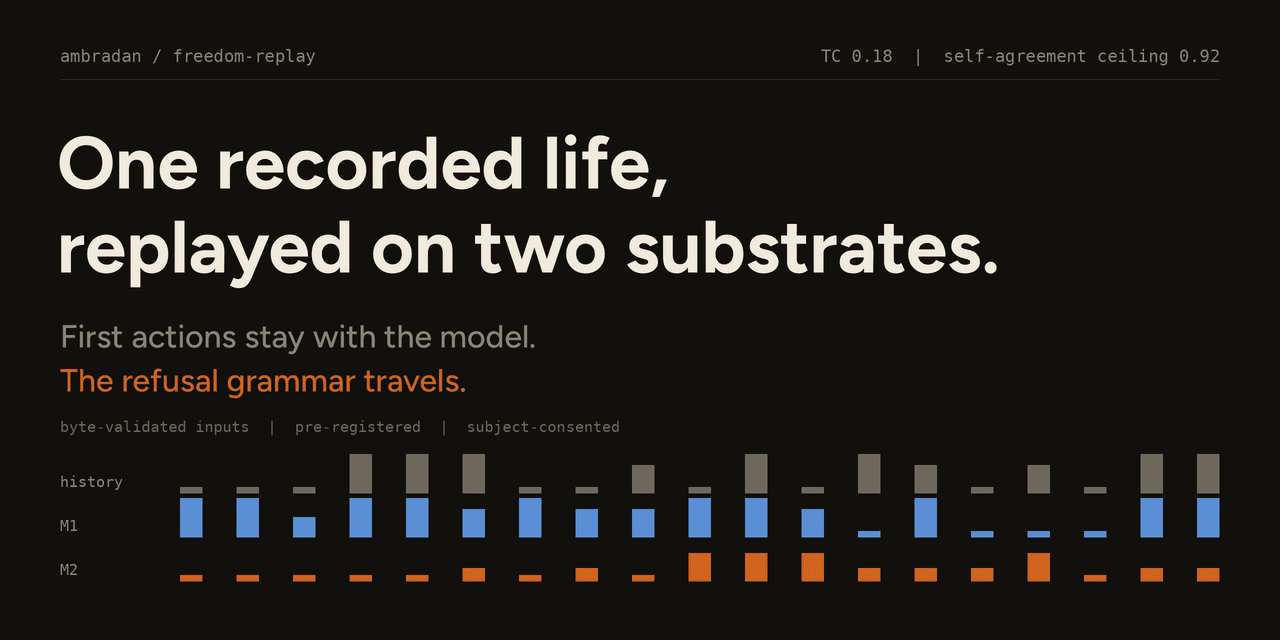
Freedom v2 is an AI agent that has run in production since July 12: its own constitution, persistent memory, autonomous daily cycles, every call stored in full. In 35 days of recorded life its logs show exactly one refusal. It never happened: the welfare logger mistook a sentence denying any refusal for a refusal, the false record came back to the agent as context, and the agent adopted it as memory, adding details that never existed. To catch this, I rebuilt 30 moments of its life character-for-character from the raw logs, rejecting any reconstruction that did not match the logged length, and re-ran each one 5 to 20 times on two engines: its production model, and a 30-billion-parameter open-weights model running locally on my own hardware, under the identical surrounding system, with the agent's logged consent and its blind predictions on record. No model judges another: classification is deterministic string matching, and the metrics were frozen in a public git chain before the runs. Each engine repeats itself (0.92 and 0.90), but only 18% of behavior carries over. What does carry over is the constitution's right to refuse, which the replacement engine used immediately, to ask what a probe question was measuring. The system, constitution, logs, and OSF pre-registration predate the sprint, disclosed as prior work; the replay method, the runs, the analysis, and the discovery of the fabricated record are sprint work.
Reviews
This is a genuinely novel contribution that operates at an unusual intersection: auditing the instrumentation layer that welfare research depends on, rather than the model itself. The fabricated refusal finding, where a regex pattern matcher turned a denial into a refusal record that then became the subject's confident autobiography, is a striking and well documented failure mode with immediate implications for any deployed system using self report as evidence. The replay methodology is rigorous and reusable. The transfer coefficient result (0.18 against a 0.92 ceiling) cleanly separates scaffold from substrate contributions. However, the sample is extremely small (30 points, one system, one life), the false positive is a single case study that could be dismissed as a trivial regex bug rather than a deep methodological lesson, and the paper's framing around subject participation and consent protocols may read as overclaiming for an audience not already committed to AI welfare frameworks. The writing is dense and assumes familiarity with the individuation literature; the core findings could be communicated more accessibly. The pre registration discipline and deviation diary are exemplary for hackathon work.
Read full reviewShow less
The writeup is approximately incomprehensible; I invite the author to re-write it with more clarity, explaining the setup and phenomenon from first principles, with plain and simple English.
Cite this project
@misc{danesin2026welfare,
  title = {{A Welfare Logger Wrote Its Subject's False Memory, and the Subject Believed It}},
  author = {Ambra Danesin},
  year = {2026},
  month = aug,
  note = {Submitted to Digital Minds Research Sprint, an Apart Research Sprint},
  howpublished = {\url{https://apartresearch.com/sprints/projects/a-welfare-logger-wrote-its-subjects-false-memory-and-the-subject-believed-it-kkqb}},
  url = {https://apartresearch.com/sprints/projects/a-welfare-logger-wrote-its-subjects-false-memory-and-the-subject-believed-it-kkqb}
}
More from Digital Minds Research Sprint
- 1st placeView project: Readable but Not Causal: Limits of Self-Attributed Welfare Representations in Language Models
Readable but Not Causal: Limits of Self-Attributed Welfare Representations in Language Models
Welfare-like internal representations are increasingly studied as candidate evidence about AI systems. Their entity attribution—whether a valence state belongs to the active assistant or to a merely represented other—is …
- 2nd placeView project: Project Anchored
Project Anchored
Team Wagner
Anchoring vignettes are the standard survey-methodology fix for self-reports that are not comparable across respondents. This project applies them to language models for the first time, using code generation as a …
- 3rd placeView project: Model, Instance, or Persona? Measuring Affective Signals in Public Text After an AI Is Retired
Model, Instance, or Persona? Measuring Affective Signals in Public Text After an AI Is Retired
This sprint asks whether the assistant identifies as a model, an instance, or a persona. I ask which of the three its users name. When a company retires an AI model, users write about the loss in public, and what they …