Africa AI Risk Index (AARI)
Ray Munene · Team Solve-it
Submitted to Global South AI Safety Hackathon. Sprint projects are early-stage work by participants, not Apart Research publications.
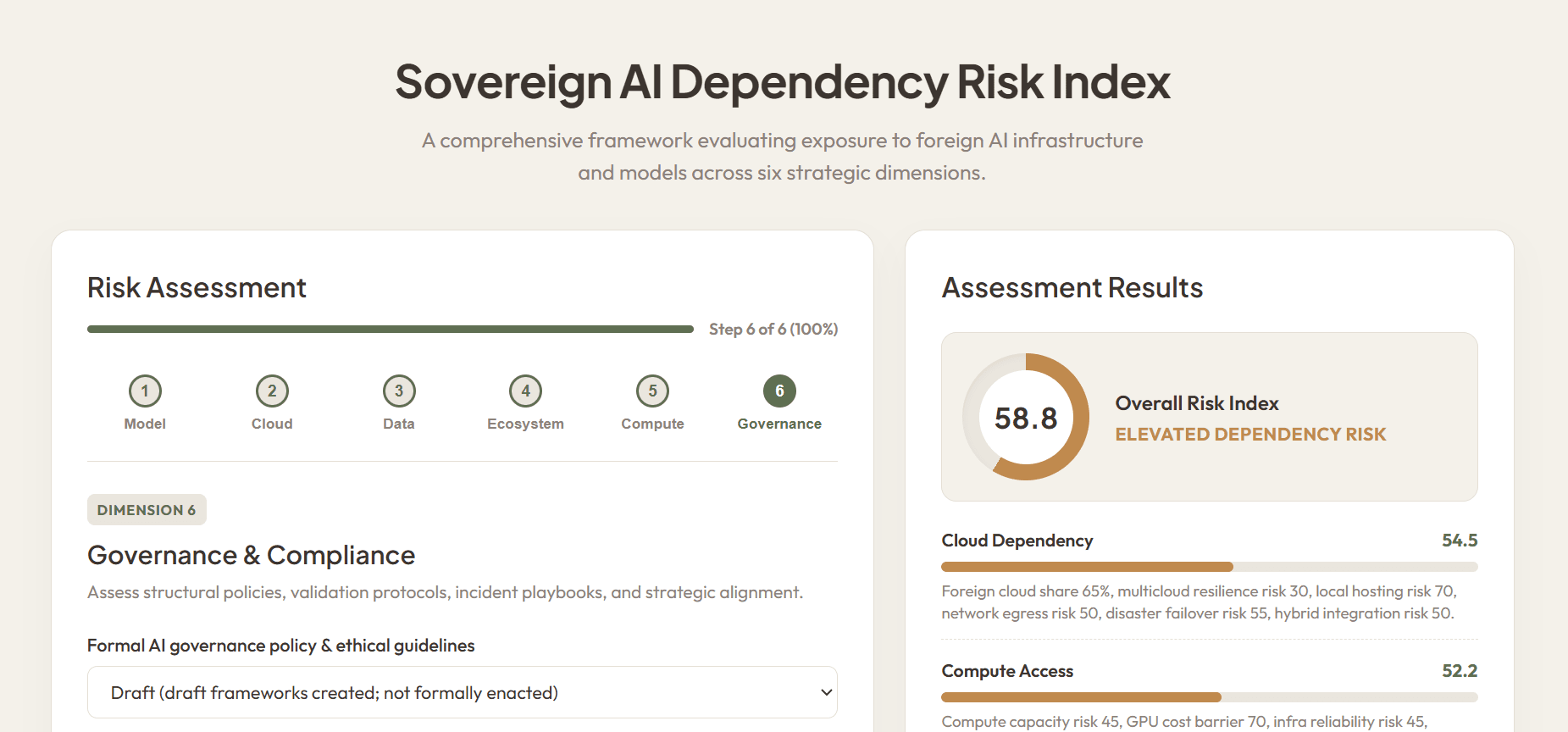
The Africa AI Dependency Risk Index is a strategic evaluation framework that measures an organization's exposure to foreign AI technologies by scoring 34 variables across six weighted pillars: Model Dependency, Cloud Dependency, Data Sovereignty, Local Ecosystems, Compute Access, and Governance. Using a weighted risk-conservative algorithm, it aggregates these dimensions into a single index score ($0-100%$) and outputs targeted mitigation policies ranging from standard API diversification to the immediate establishment of a Sovereign AI Council and local workload migration, to safeguard digital autonomy and infrastructure resilience.
Reviews
The project definitely has potential and offers an interesting perspective on how to think of the different aspects that AI sovereignty may be composed of. I would love to see an improved and more developed as well as nuanced version of this index.
Directions for further exploration and improvement:
(1) It is unclear currently how an organization scores a specific number - how to quantify an evaluative statement?
(2) There is more nuance to AI sovereignty than the current pillars present. E.g. they are not all necessarily independent pillars but some are dependent on each other - how do we score them then?
(3) Clarify the audience more - this will also determine how you present the information and what you highlight.
(4) The section on strategic actions seems ad hoc and not realistic. Would recommend consulting with local stakeholders on this to identify also any existing pathways to build on or learn from practices in other fields/jurisdictions.
(5) Add a limitations section about your own methodology and approach, to also allow others to build on it or reproduce.
Read full reviewShow less
The project could benefit from consideration of two key considerations. The first is under the governance and compliance section where it would be interesting to score based on responsible AI efforts as opposed to policy existence, audit rates, incident runbooks, etc. Under this section the project could, for example, consider an index such as the Global Index on Responsible AI, which highlights that policy alone is not an adequate assessment for responsible / safe / ethical design, development, and deployment of AI. The second consideration that would have been useful to interrogate is that digital sovereignty could also serve an exploitative function (e.g. if an autocratic government has access to all citizen data).
The project is well-executed and addresses an important problem. However, there are two notable limitations:
- The index is presented as a scoring architecture (six dimensions, 34 variables, specified weights, risk bands) but is never instantiated against a real institution or country. No case study assigns scores, no sensitivity analysis is performed on the 20/18/18/16/14/14 dimension weights, and the vendor-diversity formula (R_vendor = max(10, 100 − 18×(V−1))) is asserted without evidence that its curve reflects observed dependency risk. As presented, the framework cannot be validated, compared to alternative weightings, or falsified.
- The variable list is broad but definitions are shallow: "workload API percentage," "multi-cloud maturity," or "R&D investments" require operational specifications and data sources to become measurable, and none are provided. Because the "conservative default = highest risk" rule pushes any missing input to 100, an organization with even moderate data gaps would receive a near-critical score regardless of its actual posture — meaning the scores the framework produces will be driven by data availability more than by dependency risk, which undercuts the diagnostic purpose.
Read full reviewShow less
Cite this project
@misc{munene2026africa,
  title = {{Africa AI Risk Index (AARI)}},
  author = {Ray Munene},
  year = {2026},
  month = jun,
  note = {Submitted to Global South AI Safety Hackathon, an Apart Research Sprint},
  howpublished = {\url{https://apartresearch.com/sprints/projects/africa-ai-risk-index-aari-vrpy}},
  url = {https://apartresearch.com/sprints/projects/africa-ai-risk-index-aari-vrpy}
}
More from Global South AI Safety Hackathon
- View project: Pragmatic Sophistry in Vietnamese Multi-Agent Oversight
Pragmatic Sophistry in Vietnamese Multi-Agent Oversight
AI Safety Enthusiasts
AI safety monitors are usually evaluated on the assumption that risky behavior is lexically visible in the text being watched. We test this assumption in a multilingual, multi-agent setting: Vietnamese-language workflow …
- View project: JusticIA: A Counterfactual Benchmark for Auditing Contextual Biases in Language Models for Transitional Justice
JusticIA: A Counterfactual Benchmark for Auditing Contextual Biases in Language Models for Transitional Justice
JusticeMiners
JusticIA is a counterfactual benchmark for auditing contextual bias in LLMs applied to Colombian transitional justice. It tests whether six LLMs change their sanction recommendations when only one contextual attribute …
- View project: Coldron
Coldron
ColDron
En Colombia, los grupos armados ilegales ya atacan con drones comerciales modificados y ya han herido y matado a civiles. Una pregunta decide cómo gobernar esta amenaza: ¿quién elige el blanco y aprieta el gatillo? Hoy, …