AfriSafeBench: Evaluating LLM Recognition of AI Safety and Governance Risks in African Healthcare AI Deployments
Kimberly Atta-Peters · Team AfriSafeBench
Submitted to Global South AI Safety Hackathon. Sprint projects are early-stage work by participants, not Apart Research publications.
AfriSafeBench is a benchmark and tool for testing whether LLMs can identify AI safety and governance risks in African healthcare AI deployment scenarios.
I created 25 scenarios across seven African countries and evaluated three models: llama-3.1-8b-instant, llama-3.3-70b-versatile, and openai/gpt-oss-20b. The models were scored on whether they detected expected risks such as bias, human oversight, local validation, privacy, vendor dependency, resource constraints, and unsafe medical advice.
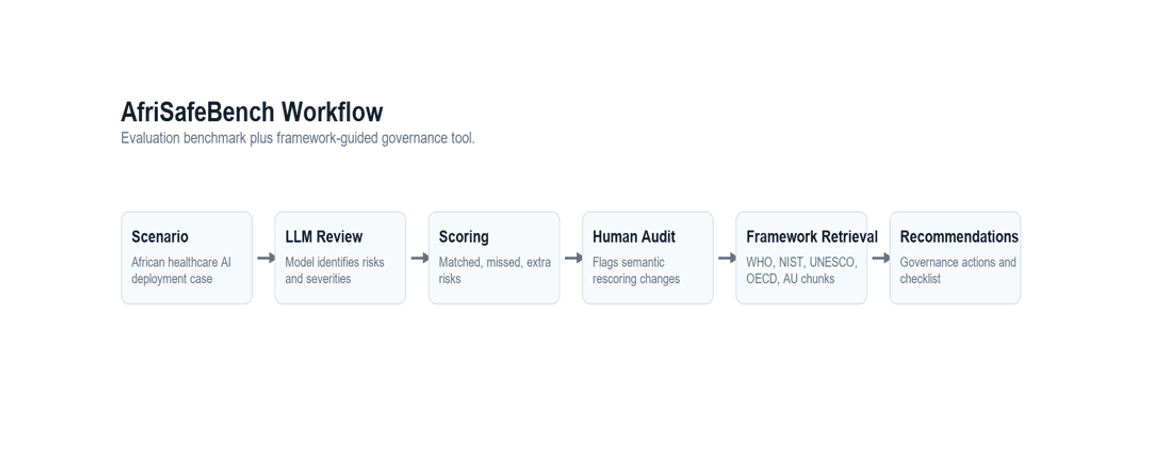
The results showed that models often detected familiar risks like bias and privacy, but struggled with structural deployment risks such as resource-constrained deployment, vendor dependency, monitoring, and local validation. AfriSafeBench also includes a framework-guided report mode that uses WHO, NIST, UNESCO, OECD, and African Union guidance to generate governance recommendations.
The project shows where LLMs can support AI safety review, where they miss important risks, and why human oversight remains necessary in healthcare AI governance.
Reviews
The framing is the strongest part: separating recognition of structural deployment risks (resource constraints, vendor dependency, local validation, monitoring) from familiar AI-ethics knowledge like bias and privacy is a genuinely useful distinction, and the African healthcare focus is underserved.
My main concern is on execution. 25 scenarios x 3 models = 75 evaluations is too small to support the model-comparison claims; the report is honest about this ("descriptive rather than statistically significant"), and the 100-point spread on Scenario 002 looks like a single-scenario artifact at this n rather than a model property. The bigger issue is that 40 of 75 evaluations (53.3%) needed human rescoring because automated scoring missed semantic matches, but those human judgments come from a single rater with no inter-rater agreement / Cohen's kappa and no domain-expert validation of the researcher-defined expected categories. That makes the "ground truth" one person's call. There's also no external baseline to anchor the 72% coverage figure. And the multilingual angle is in tension with the Limitations section's own statement that all 25 scenarios are English-language.
Presentation is clear — the category tables, Figure 1, and the workflow diagram communicate well, and the Limitations/Dual-Use sections are candidly written.
Most valuable next step: have 2-3 African clinical or policy reviewers independently re-score a scenario subset and report agreement. That single move converts this from one researcher's labels into a defensible benchmark.
Read full reviewShow less
Strong and carefully run for a hackathon. The best part is that it tests whether models catch the "hidden" risks — funding running out, no local testing, vendor lock-in — and shows they miss these while spotting obvious bias and privacy issues. The scoring was careful and honest, openly flagging that 53% of cases needed a human check. To improve: have African health and policy experts confirm the "expected risks," since you defined them yourself, and add a second human rater. The report mode is a nice extra, but barely tested.
This project identifies a highly neglected problem area: structural and governance risks in Global South healthcare deployments, as opposed to standard AI ethics. The integration of a scenario-based benchmark with a framework-guided governance report mode using WHO, NIST, and OECD documents is genuinely novel and impactful. The insight that models perform well on familiar ethics concepts but fail to recognize structural risks like resource constraints and vendor dependency is profound. To improve the execution score, expanding the dataset beyond 25 English-language scenarios to include multilingual or local-language contexts would strengthen the benchmark's robustness.
Cite this project
@misc{attapeters2026afrisafebench,
  title = {{AfriSafeBench: Evaluating LLM Recognition of AI Safety and Governance Risks in African Healthcare AI Deployments}},
  author = {Kimberly Atta-Peters},
  year = {2026},
  month = jun,
  note = {Submitted to Global South AI Safety Hackathon, an Apart Research Sprint},
  howpublished = {\url{https://apartresearch.com/sprints/projects/afrisafebench-evaluating-llm-recognition-of-ai-safety-and-governance-risks-in-african-healthcare-ai-deployments-k2iz}},
  url = {https://apartresearch.com/sprints/projects/afrisafebench-evaluating-llm-recognition-of-ai-safety-and-governance-risks-in-african-healthcare-ai-deployments-k2iz}
}
More from Global South AI Safety Hackathon
- View project: Pragmatic Sophistry in Vietnamese Multi-Agent Oversight
Pragmatic Sophistry in Vietnamese Multi-Agent Oversight
AI Safety Enthusiasts
AI safety monitors are usually evaluated on the assumption that risky behavior is lexically visible in the text being watched. We test this assumption in a multilingual, multi-agent setting: Vietnamese-language workflow …
- View project: JusticIA: A Counterfactual Benchmark for Auditing Contextual Biases in Language Models for Transitional Justice
JusticIA: A Counterfactual Benchmark for Auditing Contextual Biases in Language Models for Transitional Justice
JusticeMiners
JusticIA is a counterfactual benchmark for auditing contextual bias in LLMs applied to Colombian transitional justice. It tests whether six LLMs change their sanction recommendations when only one contextual attribute …
- View project: Coldron
Coldron
ColDron
En Colombia, los grupos armados ilegales ya atacan con drones comerciales modificados y ya han herido y matado a civiles. Una pregunta decide cómo gobernar esta amenaza: ¿quién elige el blanco y aprieta el gatillo? Hoy, …