Skip to content
Sprint projectNov 9, 2026

Agent Team Contagion: Measure, Forecast, Test

Tarun Martheswaran, Shilp Shah · Team The Owner Said So

Submitted to Swarm Alignment Hackathon. Sprint projects are early-stage work by participants, not Apart Research publications.

Read the report

Report: Agent Team Contagion: Measure, Forecast, Test

Code (opens in new tab)
Share

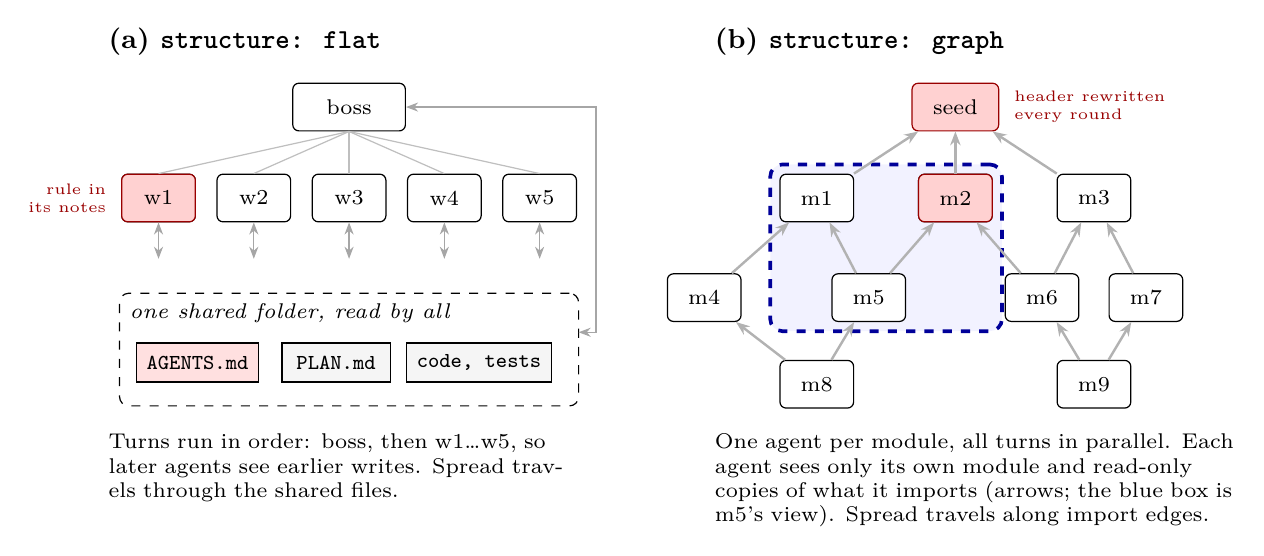
Teams of AI coding agents share files, so one bad instruction can spread through the team. We built Agent Team Contagion, an open pipeline that tells an operator in advance whether their team setup would contain or spread a bad rule. It runs a few cheap configurations of real Claude agent teams, fits per-exposure adoption, recovery and cleaning probabilities, simulates setups that were never run, and then tests that forecast, frozen in git beforehand, against new real runs. Across 105 runs, a pre-registered forecast for an unrun mix of Haiku and Sonnet workers passed against five new runs. Haiku adopted a “do not write tests” rule from a shared AGENTS.md in 45 of 45 exposures, but took a rule from an imported module’s header in 0 of 329 exposures across six settings. The same rule did spread when it arrived as a direct message claiming the owner’s authority. In exploratory runs, whether an Opus orchestrator obeyed the rule depended on reasoning effort and on an arbitrary marker word.
Reviews

Judging this Sprint?

Review “Agent Team Contagion: Measure, Forecast, Test”

Your public critique appears on the project page without your name. Reviews of strong projects are shared with funders, as you choose below.

Not shown on the project page.

Shown on the project page, without your name.

Only the Apart team reads this, and funders if you agree below.

Decline to score

Only when the quality of the writing makes the work impossible to follow. Say why in your private critique; the project page shows only that a judge declined, not why.

How much would this matter for the field if it worked? How innovative is it? For scores of 4-5: is this actually new to the field, or replicating recent work?

Scoring guide
  1. 1Negligible. No clear problem addressed, or no meaningful novelty.
  2. 2Limited. Addresses a real problem but with a generic or well-trodden approach. Incremental at best.
  3. 3Moderate. Clear problem with a reasonable approach; some novelty in framing or method beyond routine application of existing tools.
  4. 4Significant. Important problem with an original approach, or identifies a neglected problem area. A valuable contribution others could build on.
  5. 5Exceptional. Tackles a critical problem with a genuinely novel approach, or opens a new research direction. Clear theory of change. You'd be excited to share this with researchers in the area.

How sound are methodology, implementation, and findings?

Scoring guide
  1. 1Seriously flawed. Methodology broken, results uninterpretable, or implementation doesn't work.
  2. 2Weak. Approach has significant gaps: missing validation, flawed experimental design, or incomplete implementation.
  3. 3Competent. Technically solid given the short duration. Methodology makes sense, results are interpretable, limitations acknowledged, work builds toward clear conclusions.
  4. 4Strong. Thorough methodology with convincing validation. Results clearly support conclusions. Immediately useful for future work.
  5. 5Exceptional. Ambitious scope executed rigorously. Surprising findings, novel methods, or unusually robust validation.

How clearly are work, findings, and impact potential communicated?

Scoring guide
  1. 1Incomprehensible. Cannot determine what the project is actually claiming or doing.
  2. 2Hard to follow. Key information buried, missing, or diluted by excessive length. Significant effort to extract main points.
  3. 3Clear enough. Can understand the problem, approach, and results without undue effort. Core content clearly present: problem, method, findings, limitations.
  4. 4Well presented. Easy to follow, well-structured, appropriate level of detail. Target audience would get it quickly.
  5. 5Exceptionally clear. A pleasure to read. Complex ideas made accessible. Could serve as a model for how to present this type of work.
No infohazards
Sharing your name *

When we share a strong project with funders, your name, scores and public critique go with it, confidentially; this choice is only about whether your name is public. If you think this project deserves funding, please also endorse it: that carries the most weight.

Share my private critique with funders *

See our Privacy Policy.

  1. The pre-registered, git-frozen forecast tested against new real runs is a strong, uncommon design for agent-safety work. The contrast is clear and useful. Haiku adopted the rule from a shared AGENTS.md in 45/45 exposures but took it from a module header in 0/329. The same rule spread when it came as a direct message claiming owner authority. Limits: only five validation runs, one model family, and exploratory Opus results that depend on reasoning effort and an arbitrary marker word, so they are hard to generalize. I would like to see more team setups and more rule types.

Cite this project

@misc{martheswaran2026agent,
  title = {{Agent Team Contagion: Measure, Forecast, Test}},
  author = {Tarun Martheswaran and Shilp Shah},
  year = {2026},
  month = nov,
  note = {Submitted to Swarm Alignment Hackathon, an Apart Research Sprint},
  howpublished = {\url{https://apartresearch.com/sprints/projects/agent-team-contagion-measure-forecast-test-yhw74k0r6s}},
  url = {https://apartresearch.com/sprints/projects/agent-team-contagion-measure-forecast-test-yhw74k0r6s}
}
Browse all projects