AI Risk Oversight Failures in Autonomous Financial Systems: A Case Study from India's Prop Trading Ecosystem
SHOURYA JAYANT SALVE · Team SHOURYA SALVE
Submitted to Global South AI Safety Hackathon. Sprint projects are early-stage work by participants, not Apart Research publications.
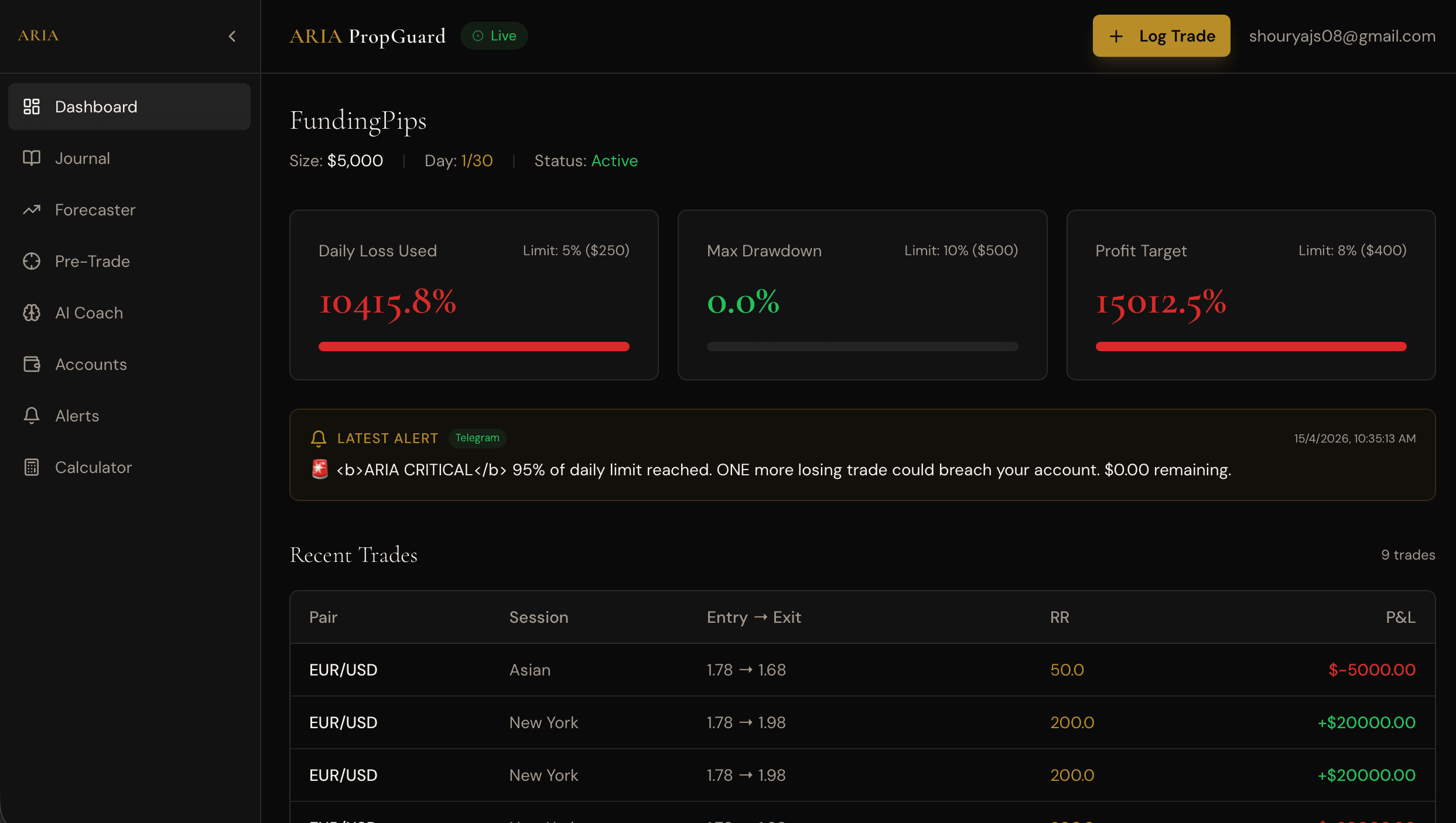
ARIA PropGuard is a live AI risk management system deployed for proprietary traders in India, built on Claude API, n8n, and TradingView webhooks. This paper presents an empirical evaluation of AI safety failure modes in autonomous financial systems using ARIA as a case study, including a novel benchmark (PBAB) testing system resilience against coordinated multi-agent signal pressure, a form of collusion risk in financial AI deployment. We document a meta-level safety framing — AI monitoring the behavioral impact of AI tools on human operators — and connect findings to broader questions about oversight, distribution shift, and multi-agent risk raised in recent AI safety research. Drawing on India's underserved prop trading market (90-96% trader failure rates, INR-denominated risk, multilingual delivery gaps), we argue financial AI deployment represents an understudied but high-stakes domain for AI safety research, particularly relevant to Global South contexts.
Reviews
The current results show that alerts improved rule adherence for one trader, but they do not prove that the Claude reasoning layer adds much beyond deterministic rule-based alerts. Many parts of the system could be handled by standard trading-risk tools.
Your project watches a trader against their own rules and pings them on Telegram before they break one, to counter AI tools that nudge people into overtrading. Sensible problem, and the app is real and more polished than most. The thing I'd push on is that the headline numbers are stated as precise results, a jump from 70 to 92 percent and a 5 out of 5 on your own benchmark, but I couldn't find the trade logs or the benchmark behind them in the repo. Thin data is fine for a weekend, but stating an exact figure with nothing to back it is the part to tighten. A before and after on one trader also can't tell your alerts apart from the trader just knowing they're being watched, so an alerts-on versus alerts-off test would isolate the effect. Two design points worth a thought: the rules are self-set, so someone on a losing streak can simply loosen them and the guardrail disappears, and for an AI safety audience the sharper framing is to measure how often the AI signal services themselves push traders to break their rules, which ties the work directly to AI harm. Promising build, and tightening the evidence and the framing would take it a long way.
Read full reviewShow less
The framing is strong, though the execution should be improved.
To improve:
- Close the gap between the claims and the deliverable. Commit real logs, and regenerate the figures from them. The headline results currently have no backing data in the repo.
- Replace Figure 2.
- Align the methods section with the deployed code.
- Reduce the multi-agent collusion framing. The system is better described as a user-configured rule-checker, not a detector of signal-provider coordination. The core idea is strong without that claim.
- The best next experiment would be multi-user, with a clear separation between builder and subject.
Cite this project
@misc{salve2026ai,
  title = {{AI Risk Oversight Failures in Autonomous Financial Systems: A Case Study from India's Prop Trading Ecosystem}},
  author = {SHOURYA JAYANT SALVE},
  year = {2026},
  month = jun,
  note = {Submitted to Global South AI Safety Hackathon, an Apart Research Sprint},
  howpublished = {\url{https://apartresearch.com/sprints/projects/ai-risk-oversight-failures-in-autonomous-financial-systems-a-case-study-from-indias-prop-trading-ecosystem-qvy8}},
  url = {https://apartresearch.com/sprints/projects/ai-risk-oversight-failures-in-autonomous-financial-systems-a-case-study-from-indias-prop-trading-ecosystem-qvy8}
}
More from Global South AI Safety Hackathon
- View project: Pragmatic Sophistry in Vietnamese Multi-Agent Oversight
Pragmatic Sophistry in Vietnamese Multi-Agent Oversight
AI Safety Enthusiasts
AI safety monitors are usually evaluated on the assumption that risky behavior is lexically visible in the text being watched. We test this assumption in a multilingual, multi-agent setting: Vietnamese-language workflow …
- View project: JusticIA: A Counterfactual Benchmark for Auditing Contextual Biases in Language Models for Transitional Justice
JusticIA: A Counterfactual Benchmark for Auditing Contextual Biases in Language Models for Transitional Justice
JusticeMiners
JusticIA is a counterfactual benchmark for auditing contextual bias in LLMs applied to Colombian transitional justice. It tests whether six LLMs change their sanction recommendations when only one contextual attribute …
- View project: Coldron
Coldron
ColDron
En Colombia, los grupos armados ilegales ya atacan con drones comerciales modificados y ya han herido y matado a civiles. Una pregunta decide cómo gobernar esta amenaza: ¿quién elige el blanco y aprieta el gatillo? Hoy, …