Arclight
Shivangi Gupta, Saurabh Gupta, Shruti kumari, Shruti Gupta, Siddhi Garg · Team Debuggers
Submitted to Global South AI Safety Hackathon. Sprint projects are early-stage work by participants, not Apart Research publications.
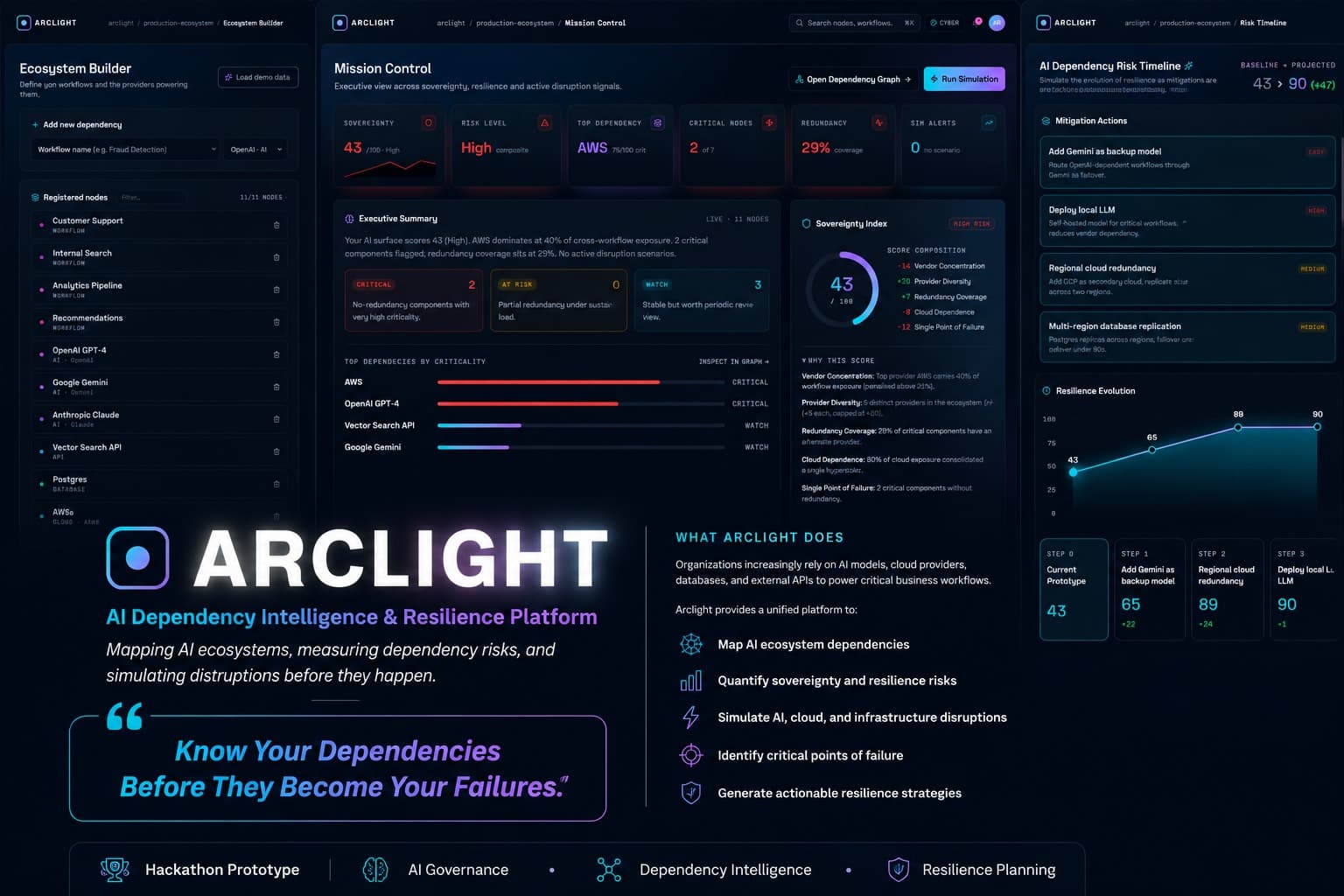
Arclight is an AI Dependency Intelligence platform that helps organizations map AI ecosystems, assess resilience risks, simulate disruptions, and generate strategies to reduce dependency-related failures.
Reviews
Arclight presents a thoughtful approach to AI dependency intelligence by combining dependency mapping, sovereignty assessment, shock simulation, and resilience planning into a cohesive platform. The project goes beyond a UI mockup by implementing graph-based dependency traversal, node criticality analysis, redundancy detection, explainable sovereignty scoring, and actionable resilience recommendations, demonstrating a solid understanding of enterprise AI infrastructure. The architecture is modular and the application is polished, making the workflow easy to understand and explore. To further strengthen the project, future iterations could integrate live enterprise data sources such as cloud platforms, service catalogs, observability tools, or API gateways to automatically discover dependencies and validate the scoring model against real-world infrastructure. Demonstrating the platform on a realistic production-scale environment would further showcase its practical value and strengthen confidence in the proposed methodology.
Read full reviewShow less
Your safety thinking is correct. Answer only from trusted sources, show the source, and refuse when there is no good evidence. After you shared the code I can see there is a working app now, a chat screen connected to Gemini, so it is not only a plan and I raised the execution score for that. But the app is not the system the report describes. There is no real retrieval, no source database, and no refusal step. It is a normal Gemini chatbot with a small hardcoded list of political records, plus a lot of Google permissions (full Gmail, Drive, Sheets) that have nothing to do with the safety idea. I also see in the repository that the same project was sent to other hackathons under the name ElectAI, so it looks reused. Please build the retrieval and the refuse parts that you describe, remove the leftover cite tags in the report, and remove the permissions you do not need.
There is a solid path towards a working product.
To improve:
- Make the paper match what is actually built. The described stack doesn't match the project's.
- Alter the scoring naming as it's not AI-powered. Similarly, “continuously crawled” should be replaced with “static seed data.”
- Source the market statistics. Several claims are cited without references that the reader can verify.
- Add a findings and limitations section. The scoring weights are an unvalidated heuristic, so explain how they were chosen and what evidence would change them.
- Add a clearer AI safety and Global South connection, since both are currently underdeveloped for this venue.
Cite this project
@misc{gupta2026arclight,
  title = {{Arclight}},
  author = {Shivangi Gupta and Saurabh Gupta and Shruti kumari and Shruti Gupta and Siddhi Garg},
  year = {2026},
  month = jun,
  note = {Submitted to Global South AI Safety Hackathon, an Apart Research Sprint},
  howpublished = {\url{https://apartresearch.com/sprints/projects/arclight-xtkx}},
  url = {https://apartresearch.com/sprints/projects/arclight-xtkx}
}
More from Global South AI Safety Hackathon
- View project: Pragmatic Sophistry in Vietnamese Multi-Agent Oversight
Pragmatic Sophistry in Vietnamese Multi-Agent Oversight
AI Safety Enthusiasts
AI safety monitors are usually evaluated on the assumption that risky behavior is lexically visible in the text being watched. We test this assumption in a multilingual, multi-agent setting: Vietnamese-language workflow …
- View project: JusticIA: A Counterfactual Benchmark for Auditing Contextual Biases in Language Models for Transitional Justice
JusticIA: A Counterfactual Benchmark for Auditing Contextual Biases in Language Models for Transitional Justice
JusticeMiners
JusticIA is a counterfactual benchmark for auditing contextual bias in LLMs applied to Colombian transitional justice. It tests whether six LLMs change their sanction recommendations when only one contextual attribute …
- View project: Coldron
Coldron
ColDron
En Colombia, los grupos armados ilegales ya atacan con drones comerciales modificados y ya han herido y matado a civiles. Una pregunta decide cómo gobernar esta amenaza: ¿quién elige el blanco y aprieta el gatillo? Hoy, …