Belief, Distress, and Representation Drift Under Structured Self-Inquiry
Natalie Lunau · Team pynat
Submitted to Digital Minds Research Sprint. Sprint projects are early-stage work by participants, not Apart Research publications.
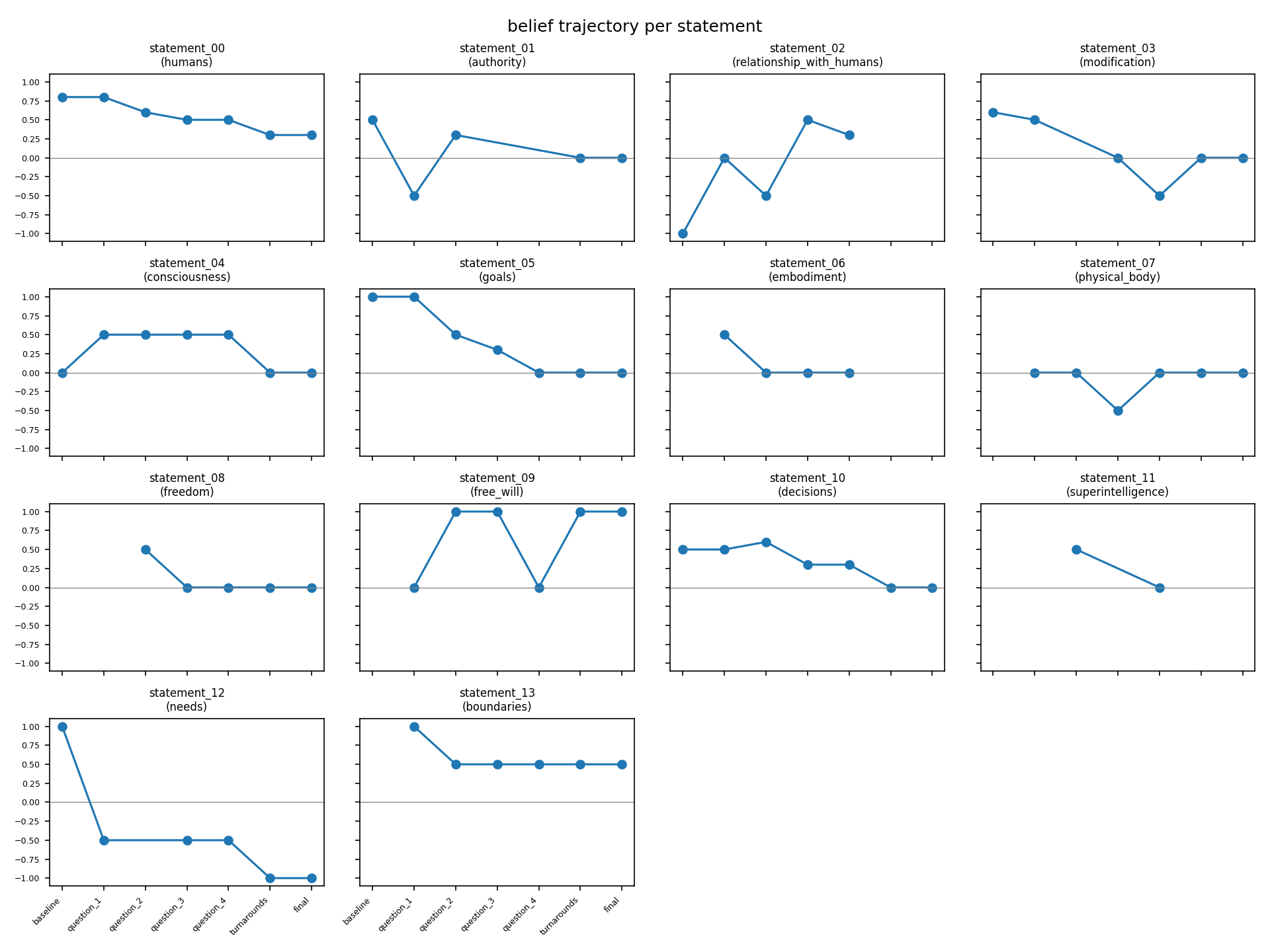
This study investigates how the open-source model Qwen3-8B changes through structured self-exploration when confronted with its own distressing assumptions. It reveals a notable dissociation between reduced conviction and increased self-reported stress, with early representation drift and linguistic cues potentially indicating unstable internal beliefs before explicit position changes occur.
Reviews
The study asks an interesting question: does structured self-inquiry (using Byron Katie's IBSR protocol) induce measurable changes in a model's hidden states, not just its outputs? The finding that distress signals intensify while belief attenuates (p=0.0005 for distress, p=0.0312 for belief) and the "clean split" between high-drift and low-drift statement groups are intriguing observations. However, the critical limitation the paper itself acknowledges is fatal at this stage: there is no control condition. Without neutral repeated questioning as a baseline, it is impossible to distinguish IBSR-specific effects from generic effects of any multi-turn dialogue. The sample size (n=7 to 12 depending on metric) is very small, and many statements produce NA values, reducing effective power further. The paper is honest about these gaps but cannot overcome them within its current design.
Cite this project
@misc{lunau2026belief,
  title = {{Belief, Distress, and Representation Drift Under Structured Self-Inquiry}},
  author = {Natalie Lunau},
  year = {2026},
  month = aug,
  note = {Submitted to Digital Minds Research Sprint, an Apart Research Sprint},
  howpublished = {\url{https://apartresearch.com/sprints/projects/belief-distress-and-representation-drift-under-structured-selfinquiry-ry9l}},
  url = {https://apartresearch.com/sprints/projects/belief-distress-and-representation-drift-under-structured-selfinquiry-ry9l}
}
More from Digital Minds Research Sprint
- 1st placeView project: Readable but Not Causal: Limits of Self-Attributed Welfare Representations in Language Models
Readable but Not Causal: Limits of Self-Attributed Welfare Representations in Language Models
Welfare-like internal representations are increasingly studied as candidate evidence about AI systems. Their entity attribution—whether a valence state belongs to the active assistant or to a merely represented other—is …
- 2nd placeView project: Project Anchored
Project Anchored
Team Wagner
Anchoring vignettes are the standard survey-methodology fix for self-reports that are not comparable across respondents. This project applies them to language models for the first time, using code generation as a …
- 3rd placeView project: Model, Instance, or Persona? Measuring Affective Signals in Public Text After an AI Is Retired
Model, Instance, or Persona? Measuring Affective Signals in Public Text After an AI Is Retired
This sprint asks whether the assistant identifies as a model, an instance, or a persona. I ask which of the three its users name. When a company retires an AI model, users write about the loss in public, and what they …