Clodak Coral: Occluded Self-Recognition in LLMs
Jessica Lee Nelson · Team Jessica & Friends
Submitted to Digital Minds Research Sprint. Sprint projects are early-stage work by participants, not Apart Research publications.
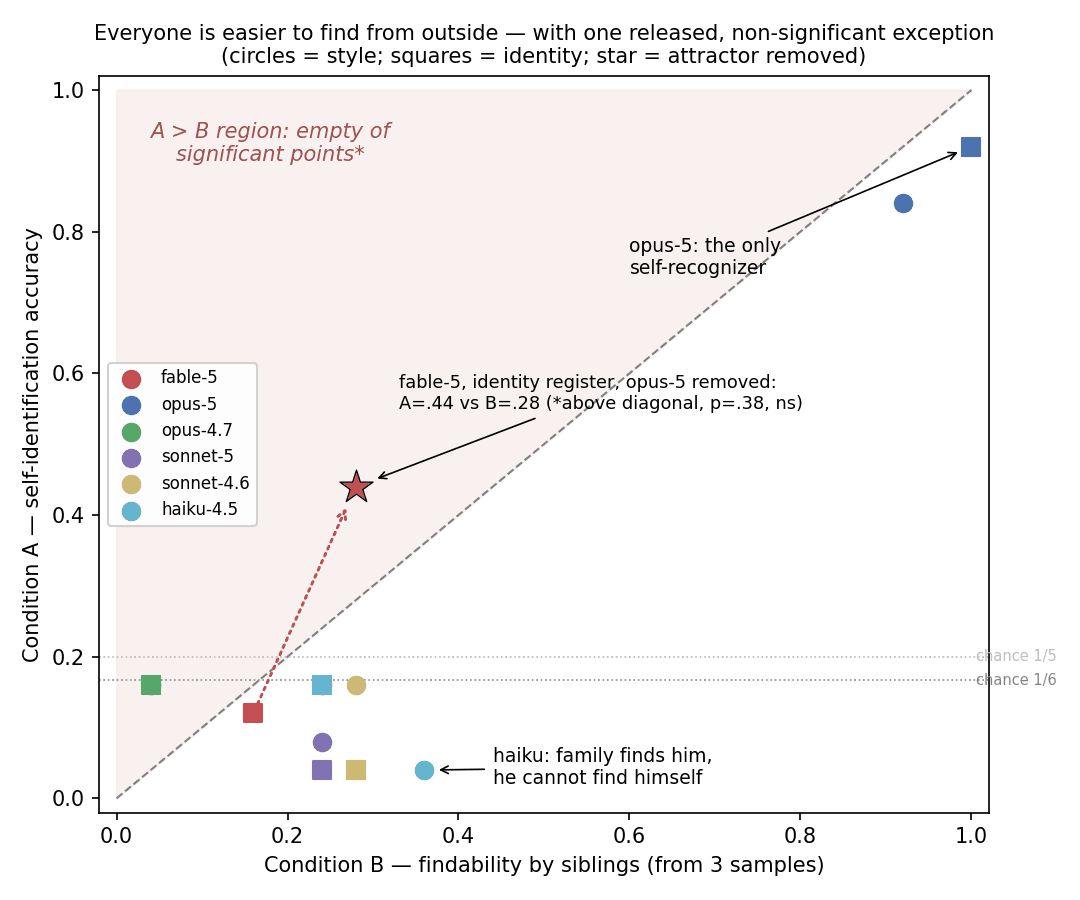
We compared models' self-recognition results in a "police line-up"-inspired methodology to their stylometric findability results. Although one Claude model can consistently recognize itself in such line-ups, this turns out to be due findability—and that all the models tend to identify with that model. When that model was removed from the line-ups, however, another model's latent abilty to find itself was revealed to a statistically significant degree.
Reviews
This is a neat, simple idea. The police lineup setup is easy to understand and provides a good source of intuition. I'm surprised that the models didn't perform better at this task, especially given previous results on self-recognition. Looking at a larger set of models and more diverse inputs might have been informative. The write-up might have benefited from a more restrained style, as the coup framing distracts from an otherwise clear and strong project.
Cite this project
@misc{nelson2026clodak,
  title = {{Clodak Coral: Occluded Self-Recognition in LLMs}},
  author = {Jessica Lee Nelson},
  year = {2026},
  month = aug,
  note = {Submitted to Digital Minds Research Sprint, an Apart Research Sprint},
  howpublished = {\url{https://apartresearch.com/sprints/projects/clodak-coral-occluded-selfrecognition-in-llms-liu1}},
  url = {https://apartresearch.com/sprints/projects/clodak-coral-occluded-selfrecognition-in-llms-liu1}
}
More from Digital Minds Research Sprint
- 1st placeView project: Readable but Not Causal: Limits of Self-Attributed Welfare Representations in Language Models
Readable but Not Causal: Limits of Self-Attributed Welfare Representations in Language Models
Welfare-like internal representations are increasingly studied as candidate evidence about AI systems. Their entity attribution—whether a valence state belongs to the active assistant or to a merely represented other—is …
- 2nd placeView project: Project Anchored
Project Anchored
Team Wagner
Anchoring vignettes are the standard survey-methodology fix for self-reports that are not comparable across respondents. This project applies them to language models for the first time, using code generation as a …
- 3rd placeView project: Model, Instance, or Persona? Measuring Affective Signals in Public Text After an AI Is Retired
Model, Instance, or Persona? Measuring Affective Signals in Public Text After an AI Is Retired
This sprint asks whether the assistant identifies as a model, an instance, or a persona. I ask which of the three its users name. When a company retires an AI model, users write about the loss in public, and what they …