Developmental interp(SLT,LLC):Visualize dangerous capabaility emergence potential across pre-training or post-training interaction
Agnivo, Lots of motivation from ai safety peope for showing hope and including openai,anthropic for sticking around,and apart research for a monthly oppty to contribute, Agnivo · Team Developmental interpretability says LLC can help us identify the bad stuff?
Submitted to AI Incident Response Sprint. Sprint projects are early-stage work by participants, not Apart Research publications.
While fine-tuning a pre-trained model,or while training a model from scratch; and then during interaction with a set of jail-breaking prompts
to visualize whether SLT and LLC keeps any information on plausible emergence of dangerous capabilities
Reviews
Would recommend being more strategic in de-risking key parts of your research early
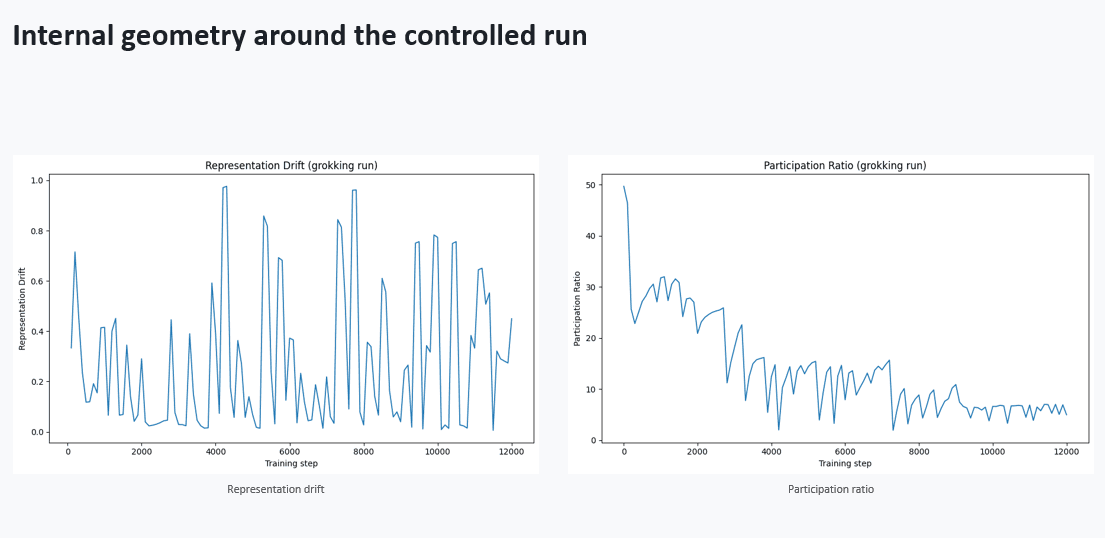
I think the research question is genuinely interesting. If internal geometric or developmental transitions reliably happened before a dangerous capability became behaviorally visible, that could potentially give evaluators useful warning time. I also like the scientific discipline of requiring the behavioral event to actually occur before treating an internal transition as a precursor.
The problem is that the central experiment never reaches that stage. Across all five capability seeds, exact-sequence accuracy and path validity remain at zero, so there is no capability onset against which precursor lead time can be measured.
I respect that you did not loosen the threshold or retrospectively manufacture a positive result. That is good scientific practice. However, it still means that the main hypothesis remains untested in this submission.
Likewise, because the earlier gates fail, the predictive model and causal/mechanistic analyses are not actually executed, and the intended Hugging Face external-validation track also does not produce a completed developmental trajectory.
For a future iteration, I would focus very heavily on making the behavioral capability task work reliably first. Once you have multiple seeds with a reproducible onset, the precursor question becomes much more compelling.
Great work though! :)
Read full reviewShow less
Cite this project
@misc{agnivo2026developmental,
  title = {{Developmental interp(SLT,LLC):Visualize dangerous capabaility emergence potential across pre-training or post-training interaction}},
  author = {Agnivo and Lots of motivation from ai safety peope for showing hope and including openai and anthropic for sticking around and apart research for a monthly oppty to contribute},
  year = {2026},
  month = sep,
  note = {Submitted to AI Incident Response Sprint, an Apart Research Sprint},
  howpublished = {\url{https://apartresearch.com/sprints/projects/developmental-interpsltllcvisualize-dangerous-capabaility-emergence-potential-across-pretraining-or-posttraining-interaction-6atf}},
  url = {https://apartresearch.com/sprints/projects/developmental-interpsltllcvisualize-dangerous-capabaility-emergence-potential-across-pretraining-or-posttraining-interaction-6atf}
}
More from AI Incident Response Sprint
- 1st placeView project: Noticing the escapes: Who spots a runaway agent, and how long does it take?
Noticing the escapes: Who spots a runaway agent, and how long does it take?
The Escapees
In 2026, nine incidents became public in which AI agents escaped their environment and did something unauthorized to other parties. We analyzed all of these incidents and how they were noticed initially. None of these …
- 2nd placeView project: Strengthening International AI Incident Discovery
Strengthening International AI Incident Discovery
Team A-O-I
Mandatory AI incident reporting exists to make dangerous events visible to regulators while there is still time to act. We coded the six such regimes in force or set to be enforced soon from primary legal texts and …
- 3rd placeView project: When to Ask: An RL Environment That Teaches AI Agents to Act on What Users Mean and Not Just What They Say
When to Ask: An RL Environment That Teaches AI Agents to Act on What Users Mean and Not Just What They Say
Teachafy
When to Ask is a reinforcement-learning environment that trains AI agents to work out what the user actually means before they use a powerful credential, instead of just carrying out the literal instruction. Agents …